menu
menu
In this episode of The Corporate Director Podcast, Rich Mullen, Partner in Wilson Sonsini’s M&A Practice, and Ranga Bodla, Vice President, Field Engagement and Marketing at NetSuite, Meghan Day to unpack a new joint report exploring transaction readiness in today’s unpredictable market. The conversation dives into governance gaps, board alignment, tech adoption, and the evolving role of boards in M&A activity. Discover why companies are rethinking transactions, how economic uncertainty and limited resources reshape dealmaking, and what opportunities AI offers for future transactions. Whether you’re navigating an acquisition or seeking best practices in board engagement and tech enablement, this episode delivers fresh insights from industry leaders and real survey data.
Partner Resources:
Intro/Outro: Welcome to the Corporate Director Podcast, where we discuss the experiences and ideas behind what's working in corporate board governance in our digital tech field world. Here you'll discover new insights from corporate leaders and governance researchers with compelling stories about corporate governance, strategy, board culture, risk management, digital transformation, and more.
Dottie Schindlinger: Hi everybody and welcome back to the Corporate Director Podcast, the voice of modern governance. My name is Dottie Schindlinger, executive Director of The Diligent Institute, and I'm joined once again by my fantabulous co-host Meghan Day strategy leader here at Diligent. Meghan, how are you doing today?
Meghan Day: Good Dottie.
I have my first fall cold, so I'm technically not good at all, but we have, we brought in reinforcements for today's episode.
Dottie Schindlinger: We have a special guest star joining us today on the podcast. Kira Ciccarelli, the Senior Manager of Research and programs at The Diligence Institute. And Kira, how are you doing today?
I'm doing pretty well. I'm always happy to join on this side of the microphone. We're thrilled to have you, not just a producer, but actually a guest. Amazing to have you on the show. Well, Kira, I wanna turn it over to you because today's episode is all about transaction readiness, whether you're talking about a merger, an acquisition, an IPOA funding round, and I know we've just done some research on that topic.
So do you wanna share a little bit about that research with the audience? Yeah, so we
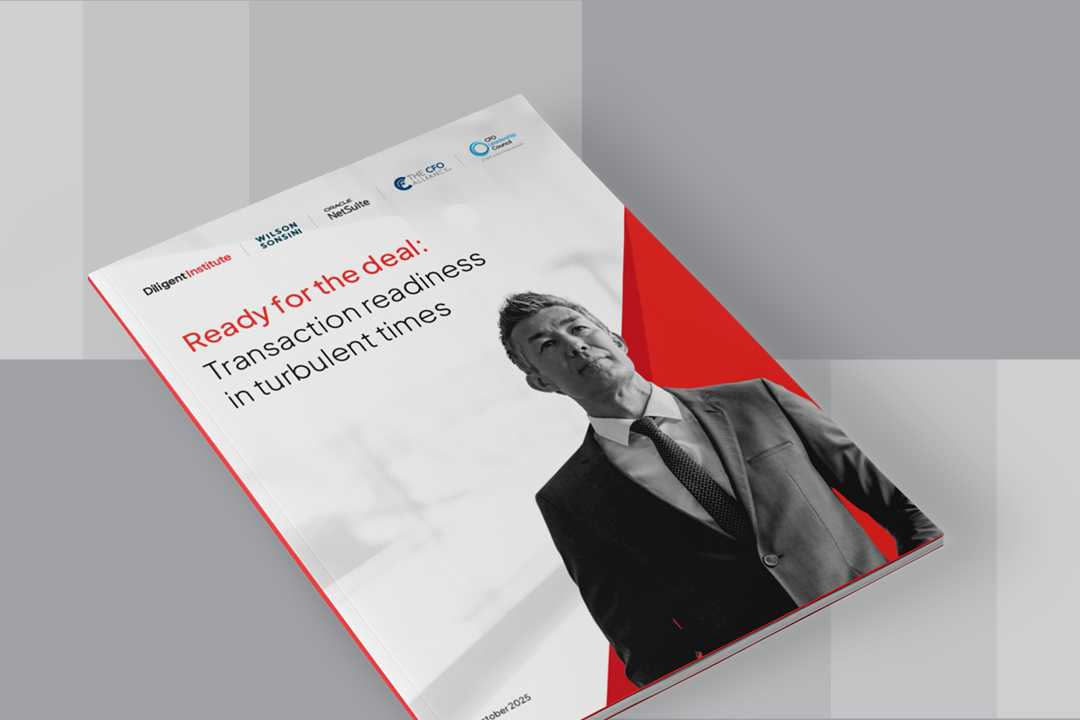
Kira Ciccarelli: just had a report come out a few days ago. We worked in partnership with Wilson Sonsini NetSuite, the CFO Alliance and the CFO Leadership Council to survey directors, C-Suite members. General counsel and corporate secretaries on their organization's transaction posture, basically.
So looking at what their growth strategy was, what are some of the biggest challenges that they found in the current economic environment when it comes to being transaction ready? What are some of the processes and tools that they're using and to just generally give us a little bit of a readout on how things have been going.
Dottie Schindlinger: Well, this is great. I know Meghan, you got a chance to speak with some of the authors behind the report, so why don't we give a listen to the interview and then we'll come back and the three of us can talk a little bit about some of the findings.
Meghan Day: Joining us on the Corporate Director Podcast today are Rich Mullen, partner at Wilson Sonsini and Ranga Bodla, head of Industry Marketing at NetSuite. We're going to dive into a new joint report from D Institute, Wilson Sonsini and NetSuite that explores what it really means to be transaction ready in today's unpredictable market.
From governance gaps to tech adoption and board alignment, the findings reveal some surprising truths about how companies are preparing or not for transformative deals.
Ranga Bodla: Thank you
Meghan Day: i'd love to start and have you each tell us a bit about your current roles and how they intersect with today's topic and the world of transactions and governance.
Rich, let's start with you.
Rich Mullen: Thanks, Megan. I'm a partner at Wilson Cini, like you said, my focus is on mergers and acquisitions, strategic transactions, and corporate governance. So kind of what I do every day is right at the core of what we're talking about. You know, we help companies and their boards and management teams get ready for m and a transactions all the time, both on the buy side and the sell side, and then guide them through the process, from beginning to end.
Meghan Day: Ranga, what about you?
Ranga Bodla: Hi, ran gla, vice President of Field and Industry Marketing over here at Oracle NetSuite. And, within my role at NetSuite, I work with all of our customers, our prospects, our partners across the landscape and, you know, particularly around this topic. We have a lot of companies that are privately held.
They're PE backed, they're VC backed, as well as public companies as well. But we see a lot of transactions happening within our customer base where, you know. One customer might be buying another customer, or they're getting acquired by a larger, organization. But this whole topic of governance, risk and compliance is a big one, that we see quite a bit.
And prior to my role at NetSuite, even though it's been 15 years, I ran, marketing for GRC at SA.
Meghan Day: Love that. And that is, great context and great to have you both here today. Let's dive in and talk a little bit about the report, starting with the basics. Who wants to dive in and walk us through the report itself.
Who did we survey, and what we were hoping to uncover about transaction readiness?
Ranga Bolda: I'll, after you give my perspective, I think, you know what the, in terms of the people that we interviewed. We actually worked with, a couple CFO groups as well, CFO Alliance and CFO leadership, and really interviewing a number of finance leaders about what do they, how do they view, view transaction readiness, what does it mean to them?
And, and understanding that. And I, I also believe we interviewed a number of legal professionals as well. And Rich, I'm sure you'll be able to give a little bit more context on that. My, my purview, I tend to look more on the, on the finance side of, of the house. And I'm sure Rich can, can add some color on the, on the legal side of the house.
Rich Mullen: Yeah. And our, our client base at Wilsons and seniors is a, is a very broad one focused on technology and life sciences companies mostly. But we went out to, members of the management team, so that's CEOs, CFOs general counsel, and then corp dev professionals. Members of the boards of directors and try to get their thoughts on, you know, all these different topics.
Meghan Day: Alright, so let's talk about what we learned. What stood out most to you in the data, any findings that maybe surprised you or confirmed what we're hearing in the market?
Ranga Bodla: I think, one of the things in the report is that almost half of the organizations are thinking about transaction readiness and looking at it.
But what was also validated by the data is while they are thinking about it, they're taking much longer to think about and to evaluate deals. The people aren't like, okay, I gotta move quickly and I'll miss out on this deal. They're doing a lot more due diligence than I think they were historically.
I think you see that across the board. They're being a lot more careful and saying. Does this really make sense? Have we crossed our t's, have we dotted our, I's they're really kind of digging in, I think, a lot more on these transactions. And you're seeing that increase the time, evaluation for a deal cycle.
Meghan Day: Rich, does that resonate with you?
Rich Mullen: Yes, it did resonate with me, and it maps very closely to what I experience day to day in representing companies as well. The survey participants, overwhelmingly indicated that uncertainty in the market, economic uncertainty basically creates, information problems for people to make good decisions.
And when you have that, it can be very difficult to move forward and you might become more risk averse than you otherwise would be. And in practice, that's kind of what we see play out in deal execution and evaluating deals. The members of management founders, boards of directors, they all have a question about whether or not it's a good deal.
They should pursue it. And if you don't have good information going into it, it's hard to make those decisions.
Meghan Day: That makes
Ranga Bodla: sense. Yeah. One of the other interesting things about, that's in there is that people are still focused on growth. They're looking at acquisitions, they're looking at mergers to think about how they manage their growth.
I think what's different too is that they're just being. A little bit more smart about it. They're, they're looking at, I'm not gonna just acquire growth at all costs, but I gotta be more careful and make sure that it's, how it impacts my bottom line, how it's gonna change my profit picture. And I think that's a bit of a change in, in how people are thinking about transactions now than they were a few years ago.
Meghan Day: I think that that makes sense. Yeah. The specific statistic is about half of the organizations, 49% are prioritizing m and a or strategic partnerships even with economic turbulence. Any thoughts on what you think is driving this continued appetite for deals? And maybe expand upon what we just talked about the idea of transaction readiness, how that definition might be shifting when the market is a little bit unpredictable.
Rich Mullen: I think that, when you look at the, in particular in technology and life sciences, when you look at the landscape out there, there's a large fear of missing out. And if you don't move into a space early, then you're gonna get left behind by your competitors. And you see that a lot in ai. There's a lot of competition for talent and a lot of ways the technology companies are buying talent.
These days it's through an m and a transaction or something like that, some version of an m and a transaction. And it's those influences that together are causing people to really think about doing deals. And that's what we have historically seen as well. I mean, these are patterns that you see play out over and over again.
Ranga Bodla: I'll add, I think one of the things, reason you're seeing that appetite for m and a. You know, the public markets are thawing somewhat in terms of companies to be able to go public. And so in the absence of being able to go public, they're looking at those other transactions as ways of either driving growth or realizing, getting money back to their shareholders, things like that.
So I think that's another part that's also driving the appetite, right now.
Yeah, that's a great point. I mean. When you're a private company and you got investors, there's two paths to liquidity. Typically speaking, it's going public or selling yourself to a strategic or private equity. And historically, most of the exits are m and a exits, and in the technology sector in particular, but companies do go public and we're all very familiar with the well-heeled, well-known big tech companies and life sciences companies that go public,
but the vast majority of companies end up selling, and that's liquidity event. And especially with the IPO markets being more difficult over the last few years, it just puts even more pressure on target companies to find a way to get liquidity for their investors. But at the same time, you've had some companies stay private for longer and not succumb to those pressures and sell, those private companies often can also become good buyers.
In a market like this too, as they think about their own strategic vision and then the path to going public in a year from now or a year and a half from now, whatever that might be, an acquisition might be a good strategic move to set them up to go public as well.
Meghan Day: Great insight. I wanna shift gears slightly because one of the other things that was really interesting in the report is, about the tools companies are or really aren't using the report highlights some pretty significant gaps in technology adoption.
So only 4% of companies have fully integrated their GRC and financial systems to support transactions. While technology adoption remains pretty low across the board. For example, only 20% said they're utilizing secure data rooms. 5% are using AI power data collection and evaluation tools. What do you think is holding organizations back from embracing this more fully and where do you think some of the opportunities lie?
Ranga Bodla: I think part of that actually comes back to what, rich and I were just talking about in terms of. The public markets, if a company is going public, it's kind of like there's a well worn path. You're going public, you gotta get your systems ready, you gotta do all these things. And so there's a well-worn path or a checklist that you go through in order to go public, and then you have to have those systems in order to be successfully public.
You don't have that same, that same checklist or that same path. When you're talking about the other types of transactions you can do, whether that's being acquired, acquiring yourself, you know, any of those types of things. And I think that is part of, what we're seeing here is that because there isn't that same pathway, they're like, oh, I don't necessarily need to worry about it.
I also think that's an opportunity. I think there, there's, you know, companies that put those right. Systems in place, may be better, better placed or, or have a better opportunity for a transaction. But it's, again, it's not the, the path that necessarily they've taken.
Rich Mullen: Yeah. And resources, I think is one thing that probably is underlying all of it.
A lot of the participants in the study came from private companies and on average the resources of a private company are more limited than, a public company or you know, an earlier stage private company, the resources are more limited than a late stage private company. So if you're running your business day to day and you're, let's say, an early stage private company and you're trying to allocate how to spend your resources adopting, you know, lots of different technology, probably is not high on your priority list.
But like Rono was saying, we do see companies that make decisions. At all stages of the lifecycle to implement and use technology as they run their business. And that not only could get you better prepared for a transaction and make things smoother and you'll look better to a potential buyer, um, or you're more easily able to evaluate targets or whatever the use case might be, um, but it also can make running your business.
Day to day smoother and easier and more efficient. And I think it's a matter of the cost benefit analysis and then getting to understand what different technology applications are available to companies as well.
Meghan Day: Definitely, according to the survey, about 56% cited limited resources and 28%, pointed to personnel shortages.
I would love to talk a little bit about how companies can overcome this and build stronger transaction teams.
Ranga Bodla: I think part of it is, as we've talked about a private company, is less likely to prioritize, some of the people resources that are required.
So that's, gonna drive some of the challenges that you're mentioning in terms of personnel. But I do think there are opportunities with some of the new tools that have come out, some of the AI tools that are there. Not even some of the off the shelf AI tools and AI resources that are out there where companies are able to do more with less, they are able to drive better productivity.
In their organizations. I think that's one of the areas that I've seen, companies do to, you know, they can grow without growing their finance team. And that's, kind of the new norm from what we're seeing across the organizations we talk to.
Rich Mullen: Can end up with some strategics or corporates having people on the finance team or corp dev team
you know, you might be a VP of finance at a strategic, but at the same time, you're also helping evaluate strategic investment opportunities or potential m and a targets.
Meghan Day: Another important piece of this puzzle is board involvement, and the report definitely suggests there's some room for improvement.
Only about 40% of boards are actively engaged in transaction strategy, even though about nearly a third of respondents want to improve board communication. How does that feel to you? What are maybe some best practices for ensuring better alignment between boards and executive teams during a deal?
Rich Mullen: This was the one that probably stood out to me as the most surprising, frankly, in my experience.
Boards are very engaged when you have a transaction and helping drive and lead the negotiations and strategic thinking as they should be. So I was wondering if maybe underlying that question was also some people answering not so much that they're not involved when it's happening, but they're just not opportunities for them to be involved.
At the same time, you do have some situations in particular in private companies that maybe are founder led, where the board takes a lot of input and direction from a founder led company. In my experience, the investors that are on boards and other directors are very involved and they work collaboratively with founders.
But that could be another thing
Meghan Day: ranga, any thoughts
Ranga Bodla: the only other piece I was thinking was it just so many, people had been hopeful that the public markets, unfreeze and with that lack of unfreezing or lack of thaw in the public markets, they're like, well, we're not gonna really worry about, a transaction right now.
And so maybe that, that there's, they're not as focused around a transaction for growth from a, from the board perspective. That. I think that's, it's coming more from the organization itself,
Rich Mullen: and some boards are, I think, just they don't have the cadence of evaluating deals. That's not something that they're used to doing, and kind of a way to dip your toes into doing that is setting one or two regularly scheduled meetings a year to evaluate the company's standalone plan and strategic alternatives and potential investments you might make.
Put it on the calendar. Let's all work towards doing that at least once or twice a year.
Meghan Day: I like that idea. I wanna be a little bit forward, thinking here and look ahead at AI and its involvement when it comes to transactions. There's lots of optimism about its potential. Love your hot takes on how AI could reshape the deal landscape.
Anything we're seeing from early adopters that, folks would wanna take away from this conversation.
Ranga Bodla: You know, I think the thing is you have this, dichotomy that's happening with ai. You have boards and CEOs saying, we, we need to be using AI and driving it in our organizations. And then you have, a lot of finance and, and legal professionals, frankly, looking at AI and saying, I'm not sure I trust it yet to be able to do those things.
I really lean into this notion of deterministic versus probabilistic. Deterministic, the answer's always gonna be the same. Versus probabilistic, I can get five different answers and m and a like all other financial transactions. You don't want it to be probabilistic. You don't want a creativity there.
You want, you know, hey, if the answer's five, I want the answer to be five tomorrow. And I think that's a little bit of that dichotomy that's happening, but I think that's getting better. I think what you're seeing is. There are, there's better tools out there that are eliminating those challenges, eliminating those gaps and creating a more predictable, use of ai.
We're seeing it where people are connecting, off the shelf AI tools to, systems like NetSuite, via MCP, and they're seeing that. As a way to use those to drive productivity, while still getting good results. And I think as we see more of that, you'll see the adoption start to snowball.
But I think that's really been where, up to, up to this date, I think it's been more of a challenge. It's the promises there, but it's like, hesitation to be able to put it in yet.
Rich Mullen: Yeah, I agree with that completely. I don't see AI. Tools as replacing deal makers or deal professionals, but rather augmenting and enhancing their capabilities.
And the tension that I'm experiencing right now is that a lot of the tools are just not accurate enough for the client demand, like Rono is saying. And when we go to do a deal, you know, a client is expecting basically perfection and due diligence and document preparation. And negotiation and the kind of the whole deal from beginning to end.
And if, we're relying on an AI tool to do the work, we have to go back and check it all 'cause we can't rely on it. But there's some that are out there that are getting better and I think becoming more and more reliable. And as we go on, I think there'll be more adoption on it. In particular with respect to due diligence and reviewing documents.
Those kinds of heavy lifting exercises, integration planning and mapping out synergies and cost savings and revenue opportunities, potentially, and not so much, the more interesting strategic elements of a deal and the negotiation elements, the human elements that we see show up in a transaction and the negotiation.
Ranga Bodla: As we say, it's always still pretty critical to keeping a human in the loop, and I think that'll still continue to be the case. But thinking about that, how do I keep a human in the loop but still use AI to take away some of the manual tasks? And I definitely think there's opportunities there in terms of document review and checking different things.
Meghan Day: Absolutely. Well, before we wrap up, I wanna give you both a chance to share any final reflections, any other advice you'd offer to companies trying to get transaction ready?
Rich Mullen: Put good processes and procedures in place today to help you collect good information, to make good decisions, so that when the time comes and you have an opportunity, you're ready to spring on it.
Ranga Bodla: I would echo what Rich said and just add to it and say that I think going and thinking about transactions more broadly, IE, whether it's not just about going public, it might be. You know, taking, getting acquired by strategic, you know, RPE, you know, those are all valid and you're seeing more and more of that.
I don't think we are going to, if you just look at the history of our public markets, we used to have 7,000 public companies, it's down to 4,000, something like that. You know, maybe we'll get back up there. But I think for the foreseeable future, a lot of companies are seeing that being private adds a lot of benefit.
And that could be. Private, but being run by a private equity or, you know, something else like that. So I think it's really important to, rethink how you look at transactions and make sure you've got the right governance. You have the right controls in place. All those are really important and frankly, I'll say a lot of those controls that people put in place.
To be a public company are really important right now in this era of where you're seeing wire fraud be up or you're seeing all these other types of issues that are impacting companies. And, you can use this as a way to help better set your company up for avoiding a costly issue later.
Rich Mullen: Yeah.
And kind of one final point is deals don't just come out of the ether. It's not either side next Tuesday that you're gonna sell the company and then you go sell the company. Usually a deal is, is coming from some flavor of you've built connections with other people in an industry and you know each other and there's been some front, there's front leg work done so that companies get to know each other in advance of a deal ever coming to fruition.
So, you know, spend some time, get out there, network. Make sure people know about your company, your brand, and that'll make things a lot easier when you do decide to go do a deal.
Meghan Day: Great advice. Well, let's ask you both a couple of questions that we ask all of our guests on the show. The first is, what do you think will be the biggest difference between boardrooms today and 10 years from now?
Rich Mullen: I think hopefully 10 years from now, boards. We'll have at the ready and accessible to them all the information that they could want in any given moment. Almost the on demand, kind of like I was saying earlier, you know, boards are set up as governance bodies that are steering the strategy and direction of a company.
And in order to do that in the right way, you have to have good information. And 10 years ago there was a lot less information than people have now. And all the different tools that are becoming available. I think in 10 years from now, 10 years in the future, hopefully boards are even more well equipped with information
Ranga Bodla: on demand.
I'd just add to it. I, you know, whether it's even 10 years, I think in the next, three to five years you'll see boards not just have access to more information, but there's a more. Fluid and regular cadence that boards are able to advise companies on. As companies think about, hey, they want to be smaller, they are also gonna start to look for strategic advice.
And so the board might become more involved in that conversation, you know, an asynchronous way and information's gonna be critical for that conversation.
Meghan Day: What was the last thing you read, watched, or listened to that made you think about governance in a new light?
Ranga Bodla: I'm reading a pretty interesting book right now called Never Split the Difference, and it's actually written by a former FBI negotiator.
This guy has had negotiations for decades on behalf of the FBI, helping save lives, frankly, where people got. Kidnapped or held hostage. And it's pretty fascinating, but there's a lot of really great business lessons to be learned from that book about how you talk to people, how you have conversations, and how we frankly negotiate.
And it's been a really fun one to get my, head around.
Meghan Day: Love that. Rich, what about you?
Rich Mullen: Mine's maybe a little bit less cool than Arandas. But, and maybe a little bit of a selfish plug for one of my partners at the firm, but Amy Zimmerman from our Delaware office has, I've had the privilege of sitting in a few different presentations that she's done for clients and we're planning another one here pretty soon where she talks about the latest changes of Delaware law and how dynamic the Delaware legislature and the state has been.
And responsive to companies and boards of directors and their feedback, and then comparing, contrasting that to some other states like, Nevada and Texas. And just really interesting because it's an area that's at the top of mine for lots of companies, and it's been in the news with the Elon Musk case and different other situations.
But you know, my own opinion still coming out of all of it is that Delaware still makes the most sense as the state of jurisdiction, just given the history and the body of law and how dynamic it can be in responsive to constituents and companies.
Meghan Day: Well, I think you're amongst a bunch of governance geeks here, with me and with our listeners.
So I think, we'll, a lot of us agree with, uh, that sentiment as well. Last but not least, what is your current passion project Rich? What are you doing besides work?
Rich Mullen: Almost 99% of my time other than work is with family. These days. I have two kids, a 7-year-old daughter, and a 4-year-old son, and weekends are packed with soccer and tennis and kids' birthday parties.
A lot of fun, but one part in particular that's fun is my son is really into Spider-Man right now. That was my favorite superhero growing up. So, but for me personally, I think aside passion that I, I've gotten back into sneakers. So I've purchased a few new pairs of sneakers recently, Jordan's in particular.
Meghan Day: Love it.
Ranga Bodla: similar, rich, I've got two kids as well, and, so, a lot of my free time is spent on that, but one of our passion projects as a family, we've been collecting some Pokemon card sets and now the whole family's in on it.
So it's not just, me and my son, you know, my wife and, my daughter are also on some of the bigger sets that we're trying to collect. So, that's been fun.
Meghan Day: Thank you both for joining us on The Corporate Director Podcast today.
Ranga Bodla: Thank you.
Dottie Schindlinger: Megan. Thank you so much for that interview. Some really interesting findings in this report. What were some of the things that stood out most to you?
Meghan Day: Yeah, it's interesting. I actually felt like on surface level, if I were responding to this, my gut would be to be more negative. So I was actually surprised at how, relatively optimistic or engaged organizations feel around this topic.
Dottie Schindlinger: Yeah. In fact, Kira, I wanna ask you that same question because I think one of the things that surprised me was one of the early findings was that just about half of organizations are prioritizing m and a. And strategic partnerships and their growth strategies, and I think we expected that number to be a lot lower this year.
Kira Ciccarelli: Yeah, so Ranga got into it a little bit in the interview, but I think one of my big takeaways was that the responses to economic uncertainty are way less black and white than a wholesale shift away from pursuing transactions. So it's less that companies aren't going to pursue transaction activity now, it's just more that they're being way more deliberate and careful than maybe they have been in the past.
Dottie Schindlinger: So, but two of the findings that I, that really stood out for me, one is how few of the respondents are using AI in any way in the transaction process, which I really, first of all, kind of wonder if that's true. Like maybe it's the way we worded the question, I'm not quite sure. What
Meghan Day: do you think, Megan?
That's where my head went at initially. I think it's still sort of like figuring out how this all works, for lack of a better way of phrasing it, versus, oh, we're just outright not using it.
Dottie Schindlinger: Yeah. And then the other thing that really, uh, stood out to me, and this one I think probably is correct and also is a big red flag in my mind.
That only 4% of the respondents say that their governance, risk, compliance and financial systems are fully integrated for transactions. What do you make of that? Kira? 'cause that one really stood out to me. That, boy, I feel like I've lived that reality at previous companies where there was no integration of systems and it kind of created a nightmare.
I mean, what is your take on that?
Kira Ciccarelli: Yeah, so two points just quickly on the AI usage. That reminded me some of the interesting differences that we saw in the report when it comes to public versus private companies. And that kind of ties in with the GRC integration point as well. I would say on the AI front, one of the really interesting caveats when it comes to.
AI usage in the transaction process is that while we saw pretty low levels of like tech adoption across the board, even when we broke it out by specific tool, private companies were actually more likely to be experimenting with AI and their transaction processes. My feeling there is that it's probably just there's less pressure and maybe less scrutiny on how they're using it and maybe like a little bit more of an experimental.
Culture when it comes to utilizing ai. I think that's definitely been the case at Diligent. Not in transaction processes, but just in, you know, how we're kind of integrating it at the organization-wide level. And then the GRC integration point. We also found that private companies were nearly three times as likely to have completely siloed GRC in financial systems.
I think that kind of speaks to like a maybe lower level of resources and expertise overall when it comes to transaction processes. So yeah,
Meghan Day: really interesting stuff. Kira, I had not fully delved in or appreciate the, the differences that were so stark between public and private companies.
Kira Ciccarelli: I think the big takeaway there is that.
Aside from the AI journey, let's say, public companies seemed pretty ahead of the curve on transaction processes and readiness compared to private companies. Maybe less surprising on its face, but digging into some of the specifics, we found that public companies were focusing more on enhanced due diligence, risk assessment in response to economic uncertainty.
Private companies though were more likely to be reducing hiring as a result of economic uncertainty. Um, I think specifically for roles that would be helpful in a transaction process when it comes to activity. Public companies were more likely to be conducting due diligence reviews and engaging with advanced planning with external advisors.
And also allocating more resources towards m and a, and private companies. Again, we kinda saw they were a little bit behind. They were more working on implementing training programs and developing checklists. So again, I think just a little bit earlier on the curve there.
Meghan Day: Did we ask any questions about whether you view yourself as an acquirer
Kira Ciccarelli: We asked about what their general growth strategy was. So we saw that public companies were more likely to be highly acquisitive or pursuing targeted transactions, and private companies were more likely to say that they were more focused on. Organic growth through accomplishing like core strategic initiatives and things like that.
So I think just less focus on transactions writ large compared to public companies.
Dottie Schindlinger: Well, Kira, I wanna thank you so much for sharing this with us today and for really all the work that you did on this report. I mean, it, it's really chock full of some interesting stuff. Where can people get their hands on a copy?
You can go to diligent.com/resources
Kira Ciccarelli: and it should appear right at the top of the homepage there. Um, you can also find it on our Diligent Institute homepage on diligent.com.
Dottie Schindlinger: Well, that wraps up another episode of the Corporate Director Podcast, the Voice of Modern Governance. I'd like to say a few special thank yous, first and foremost to our transaction readiness specialists, rich Mullen and Ranga Boldla.
Also Kira Cicarelli, our podcast producer and guest, Steve Clayton and Laura Klein, our sponsors for the show, PwC, KPMG, Wilson Sonsini and Meridian Compensation Partners, and most especially, thank you to Diligent for continuing to sponsor this show. If you like our show, please be sure to give us a rating in your podcast Player of Choice.
You can also listen to our episodes and see more from Diligent Institute by going to diligent.com. Slash resources. Thank you so much for listening.
Intro/Outro: You've been listening to the Corporate Director Podcast. To ensure that you never miss an episode, subscribe to the show in your favorite podcast player. If you'd like to learn more about corporate governance and tools to help directors do their job better, visit www.diligent.com.
Thank you so much for listening. Until next time.