
In this article

Stakeholder risk management determines whether projects succeed or fail. Organizations that overlook stakeholder dynamics see stakeholders emerging late in project cycles, forcing expensive rework and schedule extensions that erode ROI.
The challenge is twofold. Stakeholders can introduce risks to your project through opposition, competing priorities or last-minute demands. At the same time, your project creates risks for stakeholders whose workflows, resources or interests will be affected by the outcome. Failing to account for either dimension leaves projects vulnerable at critical moments.
According to Diligent Institute's Transaction Readiness Report, 56% of organizations cite limited resources as their top transaction readiness challenge — a problem compounded when stakeholder conflicts consume time and attention that should focus on execution. Effective stakeholder risk management transforms this dynamic, converting potential obstacles into project allies through systematic identification, assessment and engagement.
This guide covers practical strategies for managing stakeholder risk throughout your projects:
Stakeholder risk management is the systematic process of identifying, assessing and responding to risks that arise from individuals, groups or organizations with vested interests in project outcomes.
Unlike general risk management, which focuses broadly on threats to objectives, stakeholder risk management specifically addresses the human dynamics that can accelerate or derail initiatives.
Stakeholder risks fall into two distinct categories that require different identification and response strategies:
When organizations fail to acknowledge and address these impacts, affected stakeholders often mobilize opposition that threatens project completion.
Effective stakeholder risk management requires visibility into both dimensions. Project managers who focus exclusively on risks from stakeholders often miss the opposition that builds when affected parties feel their concerns are ignored.
When organizations neglect stakeholder risk management, the consequences extend beyond delayed timelines. Poor stakeholder risk management typically results in:
"There needs to be collaboration between risk and the business, vertically up and down but then also horizontally across the organization," says Michael Rasmussen, CEO of GRC Report. "The problem is there are silos.
To effectively manage the uncertainties around working with stakeholders, project managers should develop a framework for learning more about who stakeholders are, the kind of risk they represent and how they may be satisfied without harming your project.
Here are the three significant steps involved in developing a risk management strategy for stakeholders.
Unfortunately, many of us have experienced the exasperation of getting deep into a project development cycle only to be hit with new requirements from an unknown stakeholder. Even worse, these requirements may crop up at the moment of implementation or in the release phase, when it's too late to address them without expensive rework.
At that point, your team may discover the new stakeholder has the power and will to bring your venture to a halt. That's why stakeholder management should include a systematic approach to identifying potential stakeholders.
Start with team brainstorming that includes the project sponsor. Focus on those directly affected by any changes your project entails: who would end up benefiting from or losing something after you roll out the venture?
Give everyone paper to write down as many stakeholders as possible within 10 minutes. Then pull everyone's lists together, eliminating duplicates, and use that as the basis of a more traditional brainstorming session where everyone makes suggestions on who they would consider a stakeholder.
Once you've agreed on a stakeholder list, start creating profiles that outline their roles in the project. In addition, the profiles should include answers to questions that give you a better understanding of the risk a stakeholder poses to your venture. Examples of questions you might want to see answered with a specific stakeholder profile include the following:
The responses to your questions help the team achieve a 360-degree view of the project. That way, you increase the chance of identifying essential stakeholders at the start, which lowers the risk of an unknown yet vital stakeholder popping up near the end.
There's a lot of decision-making involved with every phase of a project. Who's in charge of making decisions for your project? Go over your current project plan, and make a list of all decisions and authorization points. Make a note of who would be responsible for the final call, and account for any stakeholder with veto authority you previously missed.
As you work on identifying your primary stakeholders, keep an eye out for groups who might typically get overlooked because they're not involved in the project execution. They would include the following groups:
If you don't account for secondary stakeholders from your project's outset, they could emerge as an adversarial force at the end just as easily as a primary stakeholder could.
Try to add a personal touch to the profiles you develop for stakeholders. Understanding who they are as people gives you more insight into their stake in a project and the stakeholder's potential influence. For example, “John Smith, Regional Operations” gives you something more specific to work with than simply “Operations.”
Once you know more about your stakeholders, the next step is figuring out effective ways of communicating back and forth with them. Start by organizing your stakeholders in order of importance and the potential risk they represent to your project.
As part of a risk management strategy, identify high-priority stakeholders by understanding what they care about, how their interests align or contrast with your project, whether they'll require significant monitoring and what it would take to keep them satisfied.
Then drill down to specifics: What title do they hold? What will they contribute? What level of authority do they have over the project? What outcome are they looking for? Do they represent a threat or an opportunity?
To mitigate project risk by getting stakeholder decisions to go your way, map the political landscape systematically:
This process reveals the power dynamics and relationship networks that determine whether your proposals succeed or fail, allowing you to develop targeted engagement strategies for each high-risk stakeholder.
How you communicate with stakeholders will differ depending on whether they are high-priority stakeholders, the amount of influence they carry, and how much information they require at different project stages. Develop a communication plan for delivering the correct information to the right people in the proper format as often as needed.
Use the information collected when identifying your main stakeholders to decide on communication strategies for different groups. By planning out your responses and communication strategies, you shift from a reactive mode to a proactive one for managing risk around stakeholders.
A solid communication strategy is essential in risk management. It gets everyone on the same page in identifying problems and the potential threats they represent to a project. In addition, you ensure that any solutions are developed to account for the concerns of every group affected.
The larger a project, the more confusion might arise on who has the final decision. This can lead to a lot of conflict between the project team and stakeholders and among different sets of stakeholders.
Your communication strategy can go a long way in getting stakeholders to move past any conflicting interests for the overall good of the project. Otherwise, you run the real risk of failure if you don't effectively communicate essential information to stakeholder groups.
Stakeholder risk communication tactics:
When stakeholders feel informed and heard, they're far less likely to become obstacles late in the project cycle. Consistent communication builds the trust that turns potential adversaries into allies and surfaces concerns while you still have time to address them.
See how AI-powered dashboards help organizations identify and monitor stakeholder risks before they derail projects.

Persuasive risk communication involves getting stakeholders to change their attitudes, opinions and behaviors around an objective that represents a risk to a project. Forms of persuasive risk communication include the following:
Rational persuasion: This relies on messages containing rational arguments subject to the premise that the stakeholder understands your logic and applies the same rules when making judgments about the source of your information. Both of you must also feel equally motivated to deal with the risk that an issue represents. However, you may run into trouble with this approach if the stakeholder operates from a different ruleset, relies on conflicting information sources or doesn't view the risk with the same sense of urgency.
Emotional persuasion: Stakeholders who may remain unmoved by rational persuasion may be more open to emotional persuasion, where you're appealing to their subconscious mind instead of their conscious mind. Many marketers and salespeople rely on emotional persuasion to appeal to consumers. Emotional persuasion can involve the arousal of feelings like fear or excitement to influence a stakeholder to adopt a more favorable position.
Managing stakeholder risks across complex projects requires visibility that spreadsheets and email chains cannot provide. AI-powered risk management platforms address the stakeholder identification, profiling and communication challenges documented throughout this guide.
For organizations building their first formal stakeholder risk management programs, Diligent's AI Risk Essentials provides a fast path to visibility. The platform uses AI-powered peer benchmarking against 180,000+ real-world risks from SEC 10-K filings to surface stakeholder-related risks that similar organizations face. Implementation takes days rather than months, giving project teams the risk intelligence they need without complex deployment.
"It's a solution that was properly priced, quick to deploy, and simple to learn — enhancing our enterprise risk management program and delivering immediate value to all stakeholders," says Melanie McGrath, General Counsel at CBCL Limited.
For organizations with established programs, Diligent ERM centralizes stakeholder risk data alongside strategic and operational risks. Interactive heat maps translate complex stakeholder dynamics into visual formats that leadership can quickly interpret, while automated workflows route stakeholder issues to appropriate personnel and track resolution progress.
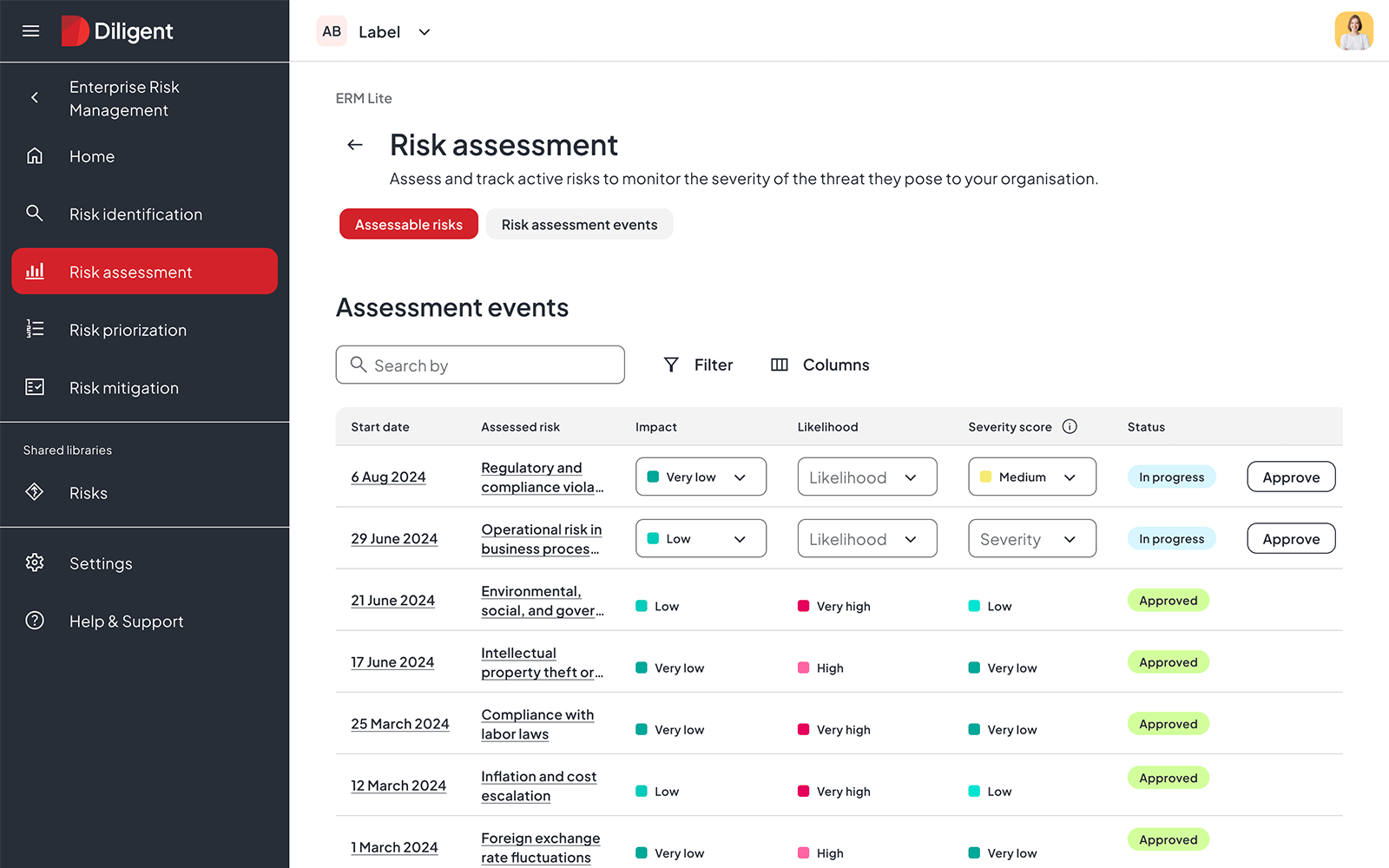
The City of Lethbridge achieved a four-year ERM maturity plan in under 12 months using Diligent's platform, with interactive dashboards fostering accountability and clearer communication across departments.
Overall, effective stakeholder risk management transforms potential obstacles into project allies through systematic identification, assessment and engagement. The right technology makes this transformation practical at any organizational scale.
Request a demo to see how Diligent can help your organization build stakeholder risk visibility that prevents project derailment.
Effective stakeholder risk management follows three core steps: identifying all stakeholders (including secondary stakeholders like regulators), profiling each stakeholder's interests and influence level to assess risk, and developing targeted response strategies for high-risk stakeholders. Ongoing communication and monitoring ensure risks don't escalate.
Stakeholder management is critical because stakeholders can accelerate or derail projects based on their support or opposition. Unknown stakeholders emerging late in project cycles cause delays, cost overruns and sometimes complete project failure.
Proactive stakeholder risk management identifies these dynamics early when response options remain flexible.
Poor stakeholder risk management typically results in project delays and budget overruns, regulatory penalties when compliance stakeholders are overlooked, reputational damage from public conflicts, and, in severe cases, complete project failure that wastes invested resources and damages organizational credibility.
Ready to transform your stakeholder risk visibility? Schedule a demo to see Diligent's ERM platform in action.