menu
menu

Enterprise risk management (ERM) vs operational risk management (ORM) isn't an either-or choice. Organizations that treat these disciplines as separate functions create dangerous visibility gaps between strategic oversight and day-to-day risk management.
The real question is how to connect both into a unified program that gives leadership the complete picture they need to make informed decisions.
This challenge has become more urgent as regulatory pressure intensifies. The EU's Digital Operational Resilience Act (DORA) and NIS2 directive now require organizations to demonstrate integrated risk oversight, while SEC cyber disclosure rules demand that boards show how they connect operational incidents to enterprise-level risk assessments.
Companies using disconnected spreadsheets and siloed tools struggle to meet these expectations.
According to the Q3 2025 Business Risk Index by Diligent Institute and Corporate Board Member, legal and compliance leaders rate business risk at 7.9 out of 10 — a 36% increase since Q1.
With geopolitical conflicts, regulatory unpredictability and macroeconomic pressures converging, organizations need risk management programs that translate operational incidents into strategic insights and strategic priorities into operational actions.
This article explains the relationship between enterprise and operational risk management by covering:
Enterprise risk management is a holistic approach that considers all risks across an entire organization — strategic, financial, compliance, operational and reputational — to support objectives and create value.
In contrast, operational risk management is a subset of ERM that specifically addresses risks from internal processes, people, systems and external events that affect daily operations.
The key difference is scope:
ERM answers "What risks could prevent us from achieving our goals?" while ORM answers "What could go wrong in how we operate today?"
Both disciplines are essential, and neither works effectively in isolation. When ORM operates separately from ERM, operational leaders lack context about strategic priorities. And when ERM doesn't incorporate operational data, boards receive incomplete pictures that miss emerging threats.
Organizations building their first formal risk programs often struggle with where to start. The distinction between ERM and ORM helps clarify the answer: You need both, but they serve different purposes and require different capabilities.
"There needs to be collaboration between risk and the business, vertically up and down but then also horizontally across the organization," says Michael Rasmussen, CEO of GRC Report. "Risk and audit are interconnected and interdependent. Collaboration helps provide audit's perspective, their insight across company policies and procedures that help improve risk's function."
For mid-market companies preparing for transactions or IPO readiness, this integration becomes critical. Investors and acquirers expect to see governance structures that demonstrate mature risk oversight.
Siloed approaches — where operational teams track incidents in spreadsheets while executives discuss strategic risks in separate meetings — create exactly the kind of gaps that surface during due diligence.
According to Diligent Institute's Transaction Readiness Report, technology adoption for transaction facilitation remains low across the board — only 20% of companies use secure data rooms, 16% use ERP software and just 5% use AI-powered evaluations or data collection.
"The data indicates that many organizations remain stuck in analog transaction processes, which means they are missing out on digital advantages," says Nithya Das, General Manager and Chief Legal Officer at Diligent.
This technology gap creates a fundamental divide between organizations prepared to demonstrate governance maturity and those still managing risk through fragmented processes.
The relationship between enterprise and operational risk management is bidirectional. Operational teams generate granular data about loss events, control effectiveness and process failures.
This information flows upward to inform enterprise risk assessments and board reporting. In return, ERM provides strategic context — risk appetite statements, priority rankings and resource allocation decisions — that guide operational programs.
Consider how this works in practice with cyber risk. Operational teams detect phishing attempts, track vulnerabilities and respond to incidents.
That data feeds into an enterprise cyber risk profile that the board reviews alongside other strategic risks. When the board sets cybersecurity risk appetite — perhaps determining that certain types of incidents require immediate escalation — that guidance flows back down to operational teams, who adjust monitoring thresholds accordingly.
"Cyber crime is absolutely the biggest risk companies are facing," notes Anastassia Lauterbach in Diligent's 2025 Risk and Opportunity Outlook. "Digital assets drive valuation, and most valuable businesses are data centric. This means the bread and butter of your business would then be impacted in a cyber incident."
The same integration applies to third-party risk, where operational due diligence on individual vendors must connect to enterprise assessments of supply chain exposure.
It applies to regulatory compliance, where control testing in specific processes must roll up to the enterprise compliance posture. And it applies to operational resilience, where process failures inform strategic investments and risk appetite decisions.
Demonstrate risk management maturity to investors without months of setup. AI Risk Essentials gets lean teams from zero to board-ready reporting in a week.

Most organizations don't build integrated risk programs overnight. The typical journey progresses through several stages, each requiring specific capabilities and governance structures.
Understanding where your organization sits helps identify the investments needed to reach the next level of maturity.
Operational teams manage risks through spreadsheets and departmental tools. Enterprise risk exists primarily as a periodic exercise — annual risk assessments, quarterly board reports compiled manually from information gathered across business units. The two functions operate independently with limited data sharing.
At this stage, risk management is reactive:
Organizations establish common risk categories and definitions across operational and enterprise levels. This shared language allows operational findings to aggregate into enterprise views without translation errors. Reporting aligns around consistent frameworks, though tools remain separate.
Data still moves between systems manually, creating delays and inconsistencies. For example, a control failure identified by operational teams might take weeks to appear in enterprise dashboards.
Additionally, risk owners spend significant time reconciling information rather than analyzing it. However, the foundation exists for tighter integration.
A single platform captures operational incidents, control assessments and strategic risks in one place. Automated workflows connect operational events to enterprise reporting without manual handoffs.
When an operational team logs an incident, it automatically updates relevant enterprise risk scores and triggers appropriate escalation paths.
Key risk indicators (KRIs) flow in real time from operations to dashboards that executives and boards review. Plus, risk committees can drill down from enterprise heat maps into the operational details behind any metric.
This visibility transforms board conversations from backward-looking reviews into forward-looking strategic discussions.
AI-powered analytics identify emerging risks by scanning internal data alongside external sources — regulatory changes, peer disclosures, market signals. Benchmarking against industry peers reveals blind spots that internal assessments miss. Scenario modeling helps leadership understand how different risk combinations could affect strategic objectives.
Continuous monitoring replaces periodic assessments. Rather than discovering control failures during quarterly reviews, automated systems flag anomalies as they occur.
Risk intelligence informs strategic planning in real time, enabling organizations to adjust course before small issues become material problems.
"Keep it practical," advises Maurice Crescenzi, Industry Practice Leader at Moody's. "Keep the ERM program practically designed and not overly complex, through the entire lifecycle of the ERM process. High, medium, low are good enough. Keep your presentations to the board simple. Demonstrate practicality throughout the entire process."
The City of Lethbridge demonstrated how quickly organizations can progress through these stages with the right infrastructure. Using Diligent's ERM platform, they achieved a four-year maturity plan in under 12 months — moving from manual spreadsheets to real-time risk visualization that now supports budget and strategic planning.
Their experience reflects a broader pattern: Organizations that invest in integrated platforms compress maturity timelines dramatically compared to those building capabilities incrementally with disconnected tools.
The key is starting where you are rather than waiting for perfect conditions. Organizations at Stage 1 don't need to leap directly to Stage 4.
Each stage builds capabilities that make the next transition easier, and each transition delivers measurable value in faster reporting, better visibility and reduced manual effort.
The convergence of ERM and ORM has accelerated as organizations recognize that fragmented tools cannot meet current regulatory and stakeholder expectations. AI-powered platforms now make integration practical even for organizations without large risk teams.
For mid-market companies building their first formal programs, Diligent’s AI Risk Essentials provides a fast path to maturity. The platform uses AI-powered peer benchmarking against 180,000+ real-world risks from SEC 10-K filings to identify industry-specific threats automatically.
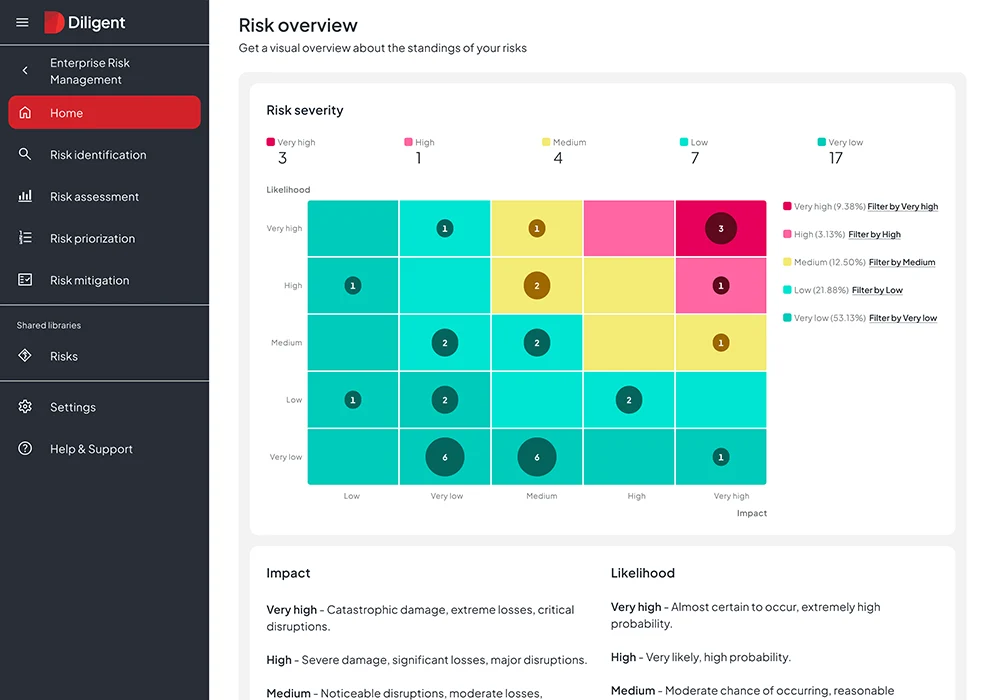
Implementation takes days rather than months, and the system provides the training tools and templates that lean teams need to launch effective programs without hiring consultants.
"It's a solution that was properly priced, quick to deploy, and simple to learn — enhancing our enterprise risk management program and delivering immediate value to all stakeholders," says Melanie McGrath, General Counsel at CBCL Limited, describing her organization's experience with AI Risk Essentials.
And for organizations with established programs, Diligent ERM provides the comprehensive capabilities needed to unify strategic and operational risk management.
The platform centralizes risk data, automates assessments and reporting, and delivers AI-driven intelligence that helps teams identify emerging risks before they escalate. Integration with Moody's benchmarking data adds external risk intelligence, while automated board reporting connects operational insights directly to governance oversight.
Grafton Group's experience illustrates the transformation possible with integrated platforms. Operating across 11 businesses in multiple countries, they moved from manual, siloed Excel-based processes to a centralized ERM system that now delivers real-time, board-ready risk insights while supporting regulatory compliance with the UK Corporate Governance Code.
Whether you're launching your first risk program or connecting existing capabilities across the enterprise, the goal remains the same: Building a risk management function that gives leadership the visibility they need to make confident decisions.
The technology exists to make that integration practical — what matters is taking the first step. Request a demo to see how Diligent can help your organization build a connected risk program.
Yes. Operational risk management is a component of enterprise risk management, not a separate discipline.
ERM encompasses all risk categories — strategic, financial, compliance and operational — while ORM focuses specifically on risks from processes, people, systems and external events affecting daily operations.
ERM ownership typically sits with the board, executive team and chief risk officer, who set risk appetite and ensure enterprise-wide oversight.
On the other hand, ORM ownership is distributed across business unit leaders, operational risk managers and process owners who manage day-to-day risk activities.
The key is shared accountability: Operational teams must feed data upward, and enterprise leaders must provide strategic direction downward. Organizations without clear ownership at both levels create gaps that undermine the entire program.
Key risk indicators (KRIs) provide the bridge between operational and enterprise risk management. Operational KRIs track specific process metrics like loss events, near misses, control test results and process availability.
These aggregate into enterprise KRIs that boards review: risk appetite utilization, trend analysis across categories and strategic risk exposure. Effective programs also track mitigation velocity (how quickly risks move from identified to resolved) and risk-adjusted performance metrics that connect risk management to business outcomes.
Integrated platforms eliminate the manual data transfers, inconsistent taxonomies and reporting delays that plague organizations using separate tools for operational and enterprise risk. Here’s how:
Ready to build a connected risk program? Schedule a demo to see how Diligent's AI-powered platform unifies operational and enterprise risk management.