
Organizations face an increasingly complex risk environment that demands sophisticated management approaches. The choice between enterprise risk management (ERM) and governance, risk and compliance (GRC) frameworks has become more critical as companies recognize the limitations of siloed systems.
According to Diligent Institute's Transaction Readiness Report, 60% of organizations report their GRC and finance systems remain completely or partially siloed, creating dangerous visibility gaps during critical business decisions.
While both frameworks aim to help companies mitigate risk and achieve similar objectives, they are based on entirely different approaches. GRC can be thought of as a framework to help organizations create strategies to address enterprise risk management, governance, and compliance activities. ERM can be thought of as a subset of GRC, focused on the “risk management” component of GRC.
Understanding the distinctions between ERM vs GRC frameworks is essential before implementing either approach or combining both within your organization's governance structure.
This guide explains everything you need to know about ERM and GRC frameworks, including:
ERM focuses specifically on identifying, assessing and managing organizational risks across all business functions, while GRC takes a broader approach, integrating risk management alongside governance processes and regulatory compliance activities into a unified framework.
Think of ERM as specialized risk intelligence, while GRC encompasses the full spectrum of organizational oversight, including:
While both frameworks help organizations manage risk and achieve strategic objectives, they approach governance from fundamentally different perspectives.
Understanding these distinctions becomes crucial when companies evaluate which framework — or combination of frameworks — best supports their governance maturity and business objectives.
Enterprise risk management (ERM) is a business discipline focused specifically on managing organizational risk across all functions and levels. The Committee of Sponsoring Organizations of the Treadway Commission (COSO) defines ERM as "a process, effected by an entity's board of directors, management and other personnel, applied in strategy-setting and across the enterprise, designed to identify potential events that may affect the entity, and manage risk to be within its risk appetite, to provide reasonable assurance regarding the achievement of entity objectives."
Rather than addressing individual risk categories in isolation — such as cybersecurity threats or operational disruptions — ERM creates a strategic layer that identifies and anticipates risks of all types: strategic, financial, operational, reputational and compliance-related. The framework typically includes:
ERM emphasizes identifying and assessing root-cause risks that impact multiple organizational areas simultaneously. This approach encourages companies to develop enterprise-wide risk cultures rather than managing risks in departmental silos.
By emphasizing risks that impact multiple areas, ERM helps organizations prioritize mitigation activities that deliver broader organizational benefits.
According to research from the Institute of Internal Auditors, organizations with mature ERM programs achieve 62% integration of risk information into strategic decision-making processes, compared to less than 30% for companies using fragmented approaches.
"There needs to be collaboration between risk and the business, vertically up and down but then also horizontally across the organization," says Michael Rasmussen, CEO of GRC Report. "It is absolutely essential — collaboration across risk departments. The problem is there are silos. Risk and audit are interconnected and interdependent. Collaboration helps provide audit's perspective, their insight across company policies and procedures that help improve risk's function."
The Open Compliance & Ethics Group (OCEG) defines governance, risk and compliance as "the integrated collection of capabilities that enable an organization to reliably achieve objectives, address uncertainty and act with integrity." GRC has been a fundamental component of organizational operations for decades, encompassing distinct but interconnected areas.
As the name suggests, GRC describes activities to help keep companies on track with their objectives in three main areas: governance, risk management and compliance.
These activities exist across various functions, including IT, HR, finance, legal, risk, compliance, the lines of business, the board, and the executive suite.
GRC activities operated in departmental silos. Each component — risk management, compliance and governance functions — operated independently with separate managers, subject-matter experts and practitioners.
This siloed approach created several challenges:
However, modern organizations have shifted toward integrated GRC approaches, also known as enterprise GRC (eGRC). According to recent data from Diligent Institute's Transaction Readiness Report, integration gaps persist across industries.
Only 4% of companies have achieved full integration of their GRC and finance systems into a single platform, while 60% report their systems remain completely or partially siloed.
"One of the clearest gaps I notice is between governance and finance systems," says Jack McCullough, Founder and President of the CFO Leadership Council. "
Organizations that close this gap gain speed, credibility and control in transactions — advantages that often determine whether a deal creates value or not."
Integrated GRC platforms address these silos by centralizing governance, risk and compliance activities while maintaining alignment with enterprise risk management. This integration helps organizations:
While integrated GRC incorporates risk management as a core component, it extends beyond risk alone to encompass the full spectrum of governance and compliance activities that drive organizational effectiveness.
Learn how transaction-ready organizations integrate GRC and finance systems to accelerate decision-making and improve deal outcomes.

Organizations implementing ERM or GRC frameworks face fundamentally different risk environments than those that shaped traditional approaches.
According to Diligent Institute's What Directors Think 2025 research — an annual survey of more than 200 U.S. public company directors conducted in partnership with Corporate Board Member and FTI Consulting — board priorities have shifted dramatically.
While 76% of directors now prioritize growth opportunities, they simultaneously manage complex risk landscapes that require sophisticated oversight.
Contemporary frameworks must address risks that barely existed when traditional GRC approaches were established:
"In my opinion, geopolitical risk is one of the biggest areas companies will have to tackle in 2025," says Ana Dutra, an experienced public and private company director. "There are about 50 country-wide elections going on around the world in the next few years. Considering the degree to which social, economic issues and climate issues are being politicized, the outcomes to these elections can have a huge impact on corporate strategy and enterprise risk management."
Organizations select between ERM, GRC or integrated approaches based on several factors:
"Keep it practical," advises Maurice L. Crescenzi, Jr., Industry Practice Leader at Moody's. "Keep the ERM program practically designed and not overly complex through the entire lifecycle of the ERM process. High, medium, low are good enough. Keep your presentations to the board simple. Demonstrate practicality throughout the entire process."
Organizations implementing ERM or GRC frameworks face a critical decision: whether to manage these activities through manual processes, multiple point solutions or unified platforms that integrate governance, risk and compliance into a single system.
Today’s organizations increasingly recognize that unified platforms deliver advantages that manual approaches cannot match.
For organizations ready to move beyond siloed systems, The Diligent One Platform provides the unified solution designed to centralize all governance, risk and compliance activities.
Rather than managing separate tools for board management, risk assessment, audit and compliance, organizations gain a consolidated view of risk across the enterprise while maintaining the flexibility to address specific functional needs.
The platform's 100+ third-party integrations connect with existing systems — including Salesforce, SAP, Microsoft and Oracle — creating a single source of truth that addresses integration challenges.
Diligent ERM centralizes risk management with Moody's benchmarking data and AI-driven risk intelligence. AI-powered risk identification benchmarks against 180,000+ real-world risks from SEC 10-K reports, enabling organizations to identify relevant threats without extensive consultant engagement.
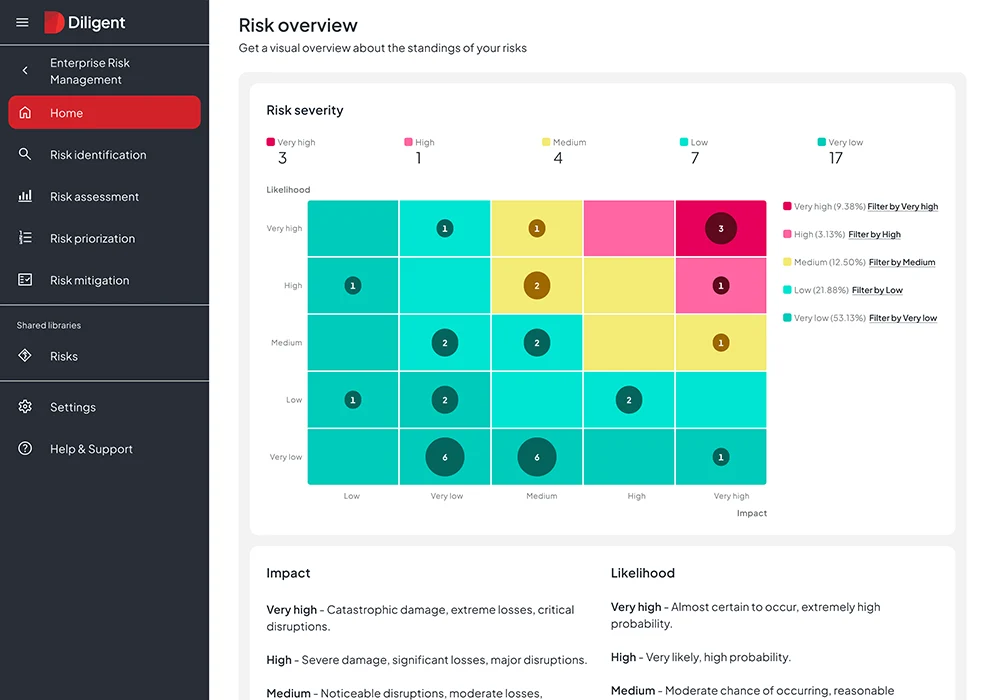
Real-time reporting through interactive dashboards, heat maps and trend lines gives boards immediate visibility into changing risk profiles.
Diligent’s AI Risk Essentials enables smaller organizations to establish foundational ERM infrastructure in under seven days. AI-powered peer benchmarking identifies relevant risks from public company disclosures, providing industry-specific risk intelligence without consultant fees.
"It's a solution that was properly priced, quick to deploy and simple to learn — enhancing our enterprise risk management program and delivering immediate value to all stakeholders," says Melanie McGrath, General Counsel at CBCL Limited.
Whether you're establishing your first formal risk program or optimizing sophisticated governance infrastructure, the right platform should scale with your organizational complexity while providing the real-time visibility and strategic intelligence contemporary risk environments demand.
Ready to transform your governance, risk and compliance capabilities? Request a demo to discover how Diligent's unified platform delivers the integrated oversight and AI-powered intelligence your organization needs.
ERM focuses specifically on enterprise-wide risk management with emphasis on root-cause risks that affect multiple departments. Integrated GRC takes a broader approach, combining governance, risk management, compliance and audit activities into a unified framework.
Organizations may implement ERM as a standalone discipline or as the risk management component within a comprehensive GRC program.
Organizations should evaluate several factors: regulatory requirements that may mandate specific frameworks, organizational maturity and resource availability, strategic priorities around risk intelligence versus comprehensive governance, and whether existing systems already address certain components.
Many organizations implement integrated approaches that incorporate elements of both frameworks.
AI capabilities transform ERM and GRC by:
However, AI enhances rather than replaces human judgment in risk assessment and strategic decision-making.
Yes, many organizations start with focused ERM implementations and expand to integrated GRC as maturity and resources grow. This phased approach allows companies to build foundational risk management capabilities while preparing for broader governance integration.
Ready to build integrated risk management capabilities that scale with your organization's growth? Schedule a demo to explore framework options aligned with your strategic objectives.