
The consequences of noncompliance with regulations extend far beyond the headlines of billion-dollar fines. For every organization — whether a growing company building investor-ready governance or an enterprise managing multi-jurisdictional requirements — regulatory violations trigger effects that threaten finances, reputation, operations and even personal freedom.
The stakes have never been higher. According to the Q4 2025 GC Risk Index by Diligent Institute and Corporate Board Member, legal and compliance leaders rate the current business risk environment at 7.9 out of 10. Technology concerns dominate, with 60% of respondents citing technology as a top risk — well ahead of economic factors (33%) and tariffs (23%). This elevated risk environment makes noncompliance consequences increasingly severe and far-reaching.
Meanwhile, enforcement continues to intensify. According to DLA Piper's 2025 GDPR Fines and Data Breach Survey, total GDPR fines since 2018 have reached approximately €5.88 billion, with the largest single fine standing at €1.2 billion against Meta in 2023.
Regulators are also expanding personal accountability, investigating whether individual directors can be held liable for their organization's compliance failures.
This comprehensive guide covers:
Noncompliance occurs when an organization fails to meet the requirements set by laws, regulations, industry standards or internal policies. These requirements vary by industry, jurisdiction and business activity — but the consequences of ignoring them follow similar patterns across all sectors.
Corporate compliance refers to following your organization's own rules, policies and ethical standards. Regulatory compliance, by contrast, involves meeting externally mandated requirements from government agencies and regulatory bodies.
Both types matter. A company can achieve regulatory compliance while still failing corporate compliance standards — or vice versa. However, regulatory compliance typically carries more severe consequences because violations attract enforcement action from authorities with the power to impose fines, revoke licenses or pursue criminal charges.
The regulatory landscape has expanded dramatically in recent years. Organizations now navigate overlapping requirements across multiple domains:
"The convergence of these factors keeps risk levels high and requires businesses to invest more in proactive compliance, risk management, scenario planning and governance frameworks," says Taras Lytovchenko, Chief Legal and Compliance Officer at Trinitex.
This complexity creates a challenging environment where even well-intentioned organizations can inadvertently violate requirements they didn't know applied to them. Understanding effective strategies for corporate risk management helps organizations navigate this landscape proactively.
Noncompliance consequences fall into four interconnected categories. Understanding each helps organizations prioritize compliance investments and prepare appropriate risk responses.
Financial penalties represent the most visible consequence of noncompliance. Regulators worldwide have demonstrated willingness to impose substantial fines that materially impact even the largest organizations.
GDPR remains the benchmark for significant data protection penalties:
The GDPR framework allows penalties up to €20 million or 4% of global annual turnover for severe violations — whichever is higher. Even lower-tier violations can result in fines up to €10 million or 2% of turnover.
Sarbanes-Oxley (SOX) violations carry both corporate and personal penalties. Executives who knowingly certify financial reports that don't comply with SOX requirements face fines up to $1 million and up to 10 years imprisonment. For willful violations, penalties increase to $5 million and 20 years.
HIPAA violations follow a tiered penalty structure that can reach approximately $1.5 million per violation category per year. Aggregate penalties in significant cases regularly reach several million dollars. The Office for Civil Rights has imposed settlements exceeding $10 million for egregious violations involving large-scale data breaches.
Violating U.S. anti-money laundering regulations can mean penalties up to $500,000 per violation, plus potential forfeiture of assets. Financial institutions have faced billion-dollar settlements for systematic AML failures.
Noncompliance can trigger criminal prosecution, particularly for willful violations or fraudulent conduct. The trend toward individual accountability means executives and directors increasingly face personal liability.
Common criminal exposure areas include following:
Regulators are increasingly pursuing individual executives rather than just corporate entities. The Dutch Data Protection Authority announced it is investigating whether it can hold directors of Clearview AI personally liable for GDPR violations, following a €30.5 million fine against the company. This novel approach signals that personal liability for compliance failures may expand significantly.
"Board members frequently receive surface-level data, such as the number of whistleblowing reports, with little context," says Pav Gill, CEO of Confide. "Always dig deeper. For instance, three reports in a quarter may sound like a low figure, but if all those reports involve the same individual, that's a red flag worth investigating."
Reputational harm often exceeds direct financial penalties in long-term business impact. The effects compound across multiple dimensions:
Regulatory violations signal to customers, partners and investors that an organization may not operate with integrity. This perception affects purchasing decisions, partnership opportunities and investment attractiveness. Trust, once lost, requires years to rebuild — if recovery is possible at all.
Additionally, institutional investors increasingly evaluate governance and compliance posture before committing capital. Organizations with compliance failures face:
Compliance scandals also affect an organization's ability to attract and retain top talent. Professionals evaluate prospective employers' ethical reputation, and public compliance failures can trigger departures of key personnel who don't want association with problematic organizations.
Finally, environmental, social and governance (ESG) factors are now embedded in regulatory regimes, investor stewardship expectations and exchange listing requirements. Perceived shortcomings regarding ethics, integrity or governance practices can trigger investor pressure, consumer boycotts and divestment campaigns — even when specific regulatory violations haven't occurred.
Noncompliance can halt business operations entirely, creating immediate revenue impact and long-term competitive damage.
Serious breaches can lead regulators to suspend licenses, restrict certain operations or require temporary shutdowns of affected sites until issues are remediated. Financial services firms may lose authorization to operate in specific markets. Healthcare providers may face exclusion from government reimbursement programs.
Beyond penalties, regulators often mandate corrective actions that consume significant resources:
Compliance failures can also disqualify organizations from doing business with major customers or partners who require supplier compliance certifications. Government contractors, for example, must meet specific compliance standards — violations can result in debarment from future contracts.
Beyond headline penalties, noncompliance generates substantial indirect costs that often exceed direct fines.
Regulatory investigations trigger significant professional fees:
These costs accumulate throughout multi-year investigation and resolution processes, often reaching millions of dollars regardless of final penalty amounts.
Compliance failures affect insurance coverage and costs:
Failed due diligence creates immediate revenue impact. Customers and partners increasingly require compliance certifications and audit reports before entering relationships. Organizations that can't demonstrate compliance maturity lose deals to competitors who can.
According to Diligent Institute's Transaction Readiness Report, only 4% of governance professionals say their GRC and financial systems are fully integrated — a gap that becomes apparent during investor due diligence and can delay or derail transactions entirely.
Compliance failures consume leadership attention at the expense of strategic priorities. Executive time spent on investigations, remediation and regulatory relationships directly reduces capacity for growth initiatives, competitive response and innovation.
Learn how top organizations adapt to constant regulatory change with agile frameworks, smart tools and future-ready strategies.

For organizations tracking dozens of regulations across multiple jurisdictions, manual compliance processes create inherent risk. Spreadsheet-based tracking, email approvals and document-based policies leave gaps that become violations — often discovered only during audits or enforcement actions.
Purpose-built compliance platforms eliminate this fragmentation, transforming reactive compliance firefighting into proactive risk prevention.
The Diligent One Platform unifies governance, risk and compliance functions into a single connected infrastructure — reducing the silos that allow compliance gaps to go undetected. Within the platform, Regulatory Compliance Management directly addresses the challenges that lead to noncompliance consequences:
Diligent IT Compliance helps organizations achieve and maintain certifications across 75+ frameworks including SOC 2, ISO 27001, HIPAA and FedRAMP. The Common Controls Framework enables control reuse across multiple certifications, reducing duplicate testing while automated evidence collection replaces manual screenshot gathering and spreadsheet tracking.
For organizations facing compliance requirements across multiple frameworks, this consolidation significantly reduces both the cost of compliance and the risk of gaps between overlapping requirements.
Diligent ERM connects compliance activities to broader enterprise risk management, providing the context boards and executives need to prioritize effectively. Moody's benchmarking helps organizations understand how their risk profile compares to peers, while board-ready reporting translates technical compliance data into strategic metrics.
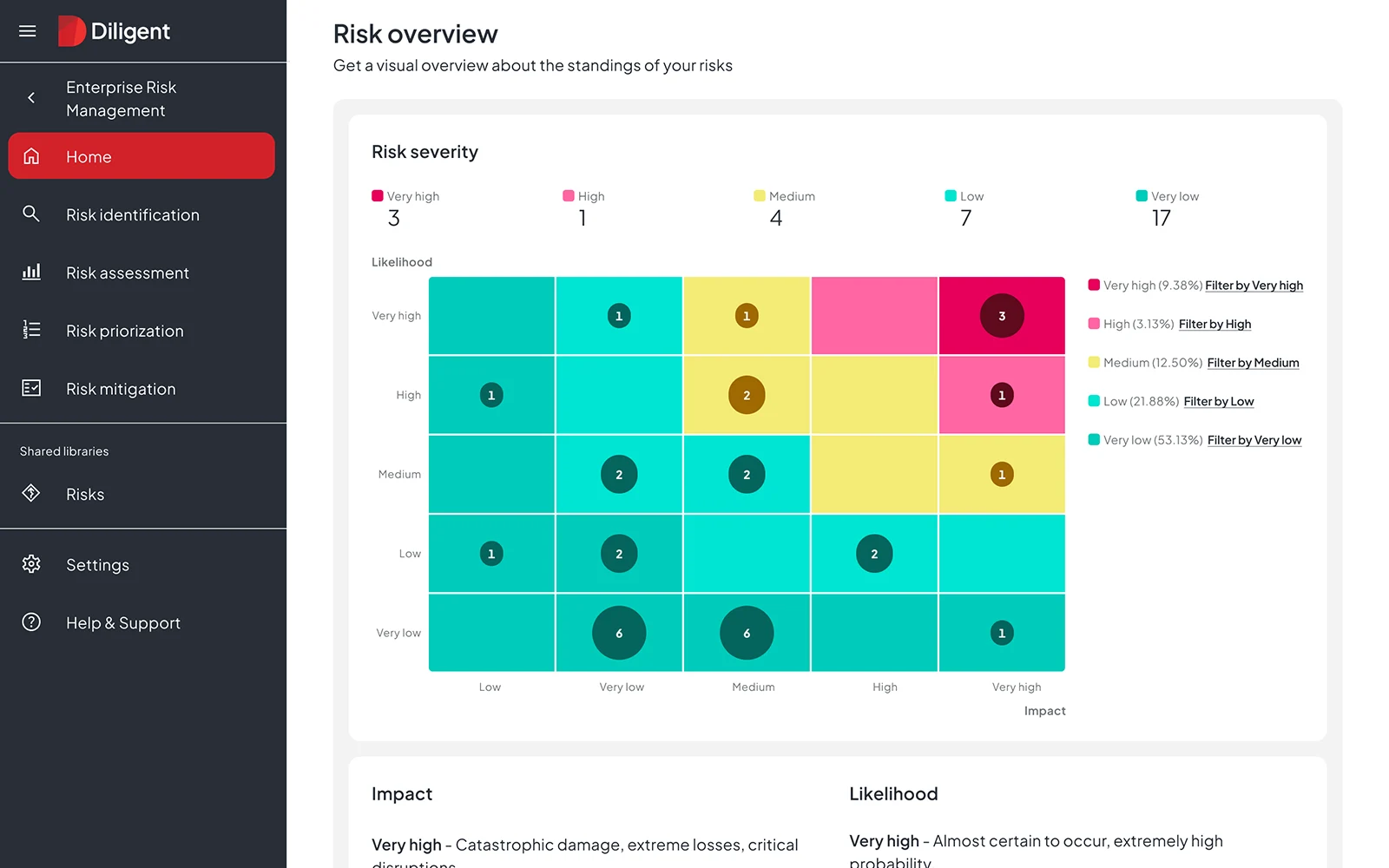
This integration ensures compliance issues surface alongside operational, financial and strategic risks — preventing the siloed thinking that allows violations to escalate undetected.
Whether you're managing SOX controls, tracking GDPR obligations or building compliance infrastructure for an upcoming transaction, the consequences of noncompliance make reactive approaches increasingly untenable. Integrated compliance technology provides the visibility and automation needed to prevent violations before they occur.
Request a demo to see how Diligent helps organizations build compliance programs that prevent costly violations.
The most common consequences include financial penalties, reputational damage affecting customer and investor relationships, operational disruptions including potential license suspensions, and in serious cases, criminal liability for responsible individuals.
Financial services, healthcare, energy and data-intensive technology companies face particularly elevated compliance exposure due to extensive regulatory frameworks governing their activities.
However, all organizations face compliance obligations related to employment, data privacy, workplace safety and other universal requirements. Industry-specific risk profiles depend on the organization's activities, geographic footprint and data handling practices.
Effective risk reduction requires a comprehensive compliance program including regular risk assessments, clear policies and procedures, ongoing employee training, continuous monitoring and auditing, accessible reporting mechanisms and a culture that supports compliance.
Technology platforms that centralize compliance activities, automate monitoring and provide real-time visibility significantly enhance program effectiveness.
Organizations should conduct formal compliance program reviews at least annually, with additional reviews triggered by significant regulatory changes, business expansion into new markets, major incidents or near-misses, and material changes to operations or risk profile.
Continuous monitoring supplements periodic reviews by providing real-time visibility into compliance status.
Ready to strengthen your compliance program? Schedule a demo to see how Diligent helps organizations avoid the consequences of noncompliance.