
In this article

Strong board performance depends on clear structure, rigorous self-evaluation and the right governance tools. This checklist covers the key steps, from running focused meetings to conducting multi-tiered board evaluations, that governance leaders use to strengthen performance and maintain accountability.
Board directors have limited time inside and outside the boardroom. They cannot afford to spend it on issues where they are making no progress or having no impact. This board effectiveness checklist gives governance leaders a working list of practices, organized by meeting effectiveness, evaluation, composition and tools, that they can put in place directly rather than a general discussion of governance theory.
This guide covers:
"We show up, we attend meetings, we read the materials before the meetings, and we come prepared to ask questions and think of things through a strategic standpoint. Being a board member means showing up and being engaged and listening to what's going on. And thinking through things from a strategic standpoint and not getting lost in the details," says Jim Myers, Deputy General Counsel for Corporate Governance at Fannie Mae
A board effectiveness checklist only earns its place if it holds up across the full cycle of how a board operates: not just the meetings themselves, but also how the board evaluates its own performance, who sits around the table, and what infrastructure supports it all. The four areas below cover that full cycle. Work through them in order, or use them as a standing reference to audit one area at a time.
Use the checklist below to review your board against four areas: meeting effectiveness, evaluation, composition and tools. Each item is written as something a board can put in place directly, with the context needed to act on it.
Well-run meetings are the foundation on which the rest of this checklist builds. A board that cannot execute a focused meeting will struggle with every item that follows.
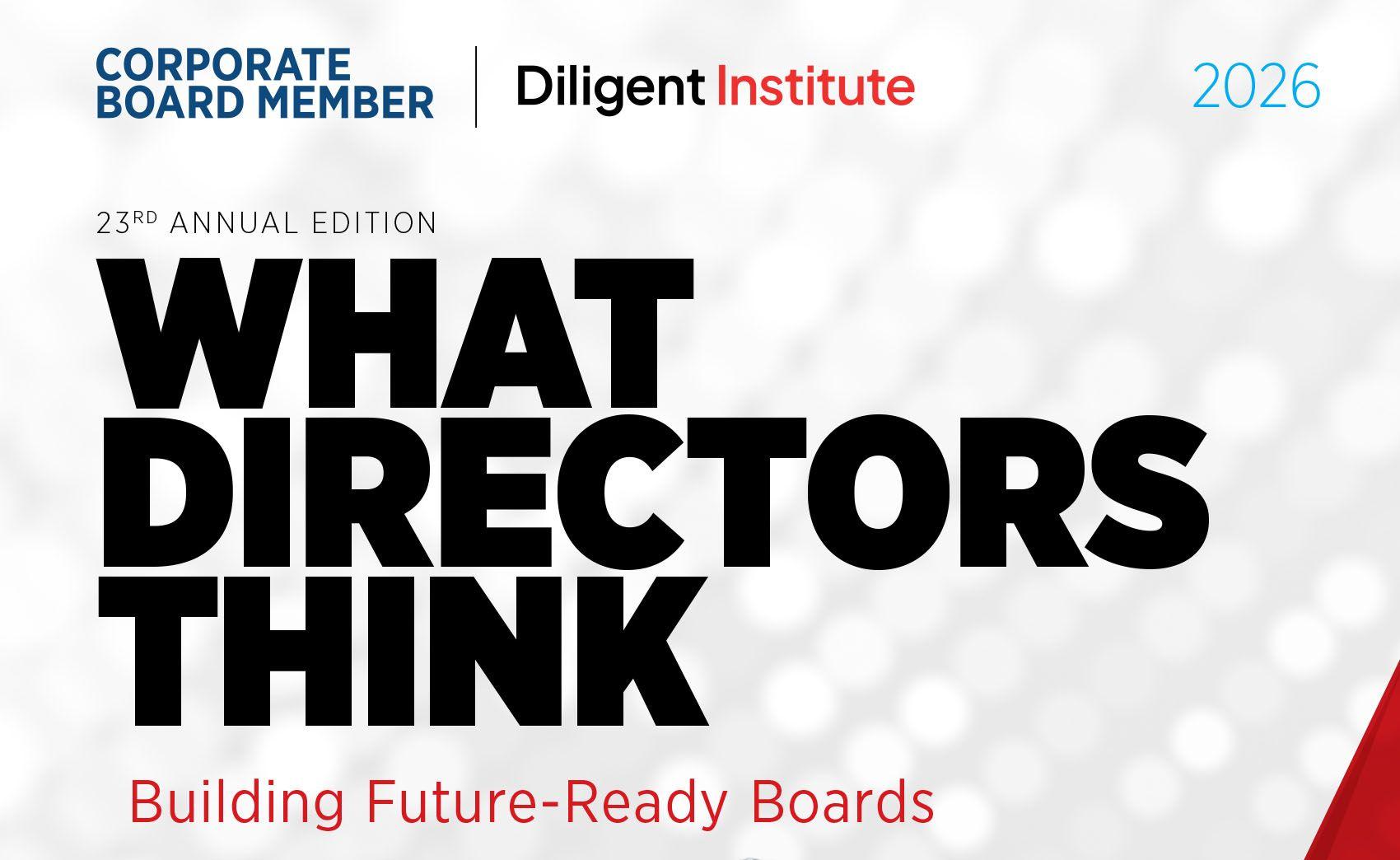
According to Diligent Institute's What Directors Think 2026, 58% of directors want more time for strategic planning, and 42% want fewer presentations and more discussion. Meetings only run as well as the material feeding into them, though, which is where evaluation comes in: a disciplined assessment cycle is what tells a board whether its meetings, and everything else on this checklist, are actually working.
Evaluation practices are now close to universal: 99% of S&P 500 boards conduct some form of annual evaluation, up from 90% in 2008, and 27% added an independent third-party facilitator in 2025, down slightly from 28% the year before, according to the 2025 U.S. Spencer Stuart Board Index.
Individual director assessment has caught up, too: about 48% of S&P 500 companies used it in 2024, up from 38% a decade earlier, per a Skadden analysis, which is part of why the three-tiered structure above increasingly reaches every director rather than just the board as a whole. Follow-through is where most boards fall short: more than 51% of directors think at least one colleague should be replaced, according to the PwC 2025 Annual Corporate Directors Survey, and only 49% feel their board is sufficiently invested in the assessment process, which is exactly what named owners and review dates are meant to fix.
Evaluation quality and follow-through distinguish the strongest boards. The items below cover cadence, method, scope and what happens after the results come in.
That kind of follow-through starts with how the evaluation itself is run.
"As part of the annual evaluation process, it's important to do individual interviews once every two years to reinforce the norms you want the board to align to … Make it clear this is a confidential process. Use an outside moderator or consultant to do this process," says Myers.
The method you choose for that process matters, too:
| Method | Best for | Trade-off |
|---|---|---|
| Self-assessment | Annual baseline; low cost, easy to run every cycle | Less candor on sensitive dynamics issues |
| Peer review | Direct accountability between directors; fast becoming a market-standard supplement to self-assessment | Requires trust and a facilitator to manage sensitivity |
| External facilitation | Objectivity and benchmarking; recommended at least every two to three years | Higher cost and lead time; not needed every cycle |
Turn assessment findings into a documented plan with clear owners and review dates.

A board's skills, size and independence rarely stay right for long. What the company needed at formation is not what it needs during a fundraise, an IPO or a market shift, which is why composition has to be reviewed on a cycle rather than left until a seat opens up.
Disclosure is catching up with practice on the skills side: the share of boards including a skills matrix in their proxies has more than doubled over the past five years, according to Spencer Stuart research. Independence and refreshment are harder to reduce to a single number, but they follow the same logic: a board that never turns over or never has to justify its makeup drifts out of step with what the company actually needs. None of this shows up in a boardroom without the right infrastructure, which is where tools come in.
The right tools don't replace the practices above; they make them easier to execute consistently as governance requirements and committee workloads expand.
That gap between meetings is where boards most often lose the thread: 53% of directors say they don't often receive real-time data between meetings, according to the previously cited What Directors Think 2026 study. Closing it is less about any single practice on this checklist than about the platform beneath them all, which is where the right technology comes in.
See how stronger meeting preparation, secure collaboration and evaluation workflows can help your board act on this checklist.

The checklist above works whether or not a board uses Diligent, but a platform built for it removes most of the manual work behind each item.
Manual meeting preparation, conflicting document versions, fragmented evaluation workflows and delayed information between meetings can weaken otherwise sound board practices. These problems become more difficult as governance requirements expand and committees handle more sensitive material. Board management software addresses these execution gaps as a category: it centralizes meeting preparation and document distribution, enables secure real-time collaboration, supports voting and governance records and facilitates evaluation workflows.
Diligent Boards delivers these capabilities on a single platform. It records votes and governance decisions to provide a defensible audit trail and supports evaluation workflows via digital board assessment software. Nominations governance functionality also helps committees compare candidates against a current skills matrix rather than relying only on personal networks.
Smart Builder speeds up board book creation and document synthesis, while Smart Minutes reduces manual work in meeting follow-up. Market intelligence between meetings helps directors monitor companies, topics and industries so material developments can reach the board before the next formal agenda.
Diligent's platform reach is extensive: more than 700,000 directors worldwide, including 75% of the Fortune 500, rely on Diligent. For governance teams, the practical outcome is less administrative work, stronger version control, more consistent follow-through on evaluations and more time for substantive board discussion.
See how Diligent Boards can strengthen meeting preparation, secure collaboration and evaluation follow-through. Schedule a demo.