
The stakes for governance, risk and compliance (GRC) data management have never been higher. As regulatory frameworks evolve globally and risk landscapes shift with unprecedented speed, boards demand real-time visibility into organizational risk exposure rather than quarterly snapshots.
The challenge extends beyond compliance requirements: effective GRC data management has become essential infrastructure for strategic decision-making, operational resilience and stakeholder confidence.
Organizations face mounting pressure from multiple directions. According to the Q3 GC Risk Index from Diligent Institute and Corporate Board Member, legal and compliance leaders rate business risk at 7.9 out of 10 — a 36% increase from the start of 2025.
Meanwhile, directors report that geopolitical conflicts, regulatory unpredictability and tariff volatility create heightened uncertainty requiring more sophisticated risk intelligence. Traditional approaches to GRC data — quarterly reports compiled from departmental spreadsheets — cannot keep pace with the velocity of change boards now navigate.
This comprehensive guide explains how organizations transform GRC data from periodic compliance exercises into continuous business intelligence by covering:
GRC data encompasses the information organizations collect, analyze and report to demonstrate how effectively they govern operations, manage risks and maintain compliance.
This data flows from multiple sources across the enterprise:
When properly integrated and analyzed, GRC data provides the evidence base that supports informed decision-making at every organizational level.
The value of GRC data extends beyond regulatory compliance. Organizations increasingly recognize that comprehensive GRC data drives strategic advantages: faster response to emerging threats, more accurate resource allocation, improved stakeholder confidence and competitive differentiation through demonstrated operational excellence.
Historically, governance, risk and compliance functions operated independently, each maintaining separate datasets and reporting structures.
Audit teams tracked control test results in spreadsheets, risk managers maintained risk registers in departmental systems, compliance officers monitored regulatory requirements through email alerts, and boards received disconnected updates that lacked cohesive strategic context.
This fragmentation created multiple problems. Duplicate data collection consumed resources without adding value, inconsistent definitions prevented meaningful analysis across functions, and the inability to connect tactical findings to strategic risks left boards frustrated by data volume without actionable insights.
Data-driven GRC consolidates these information streams into unified intelligence. This integrated approach to risk consolidates functional and technological methodologies and, as a result, enhances organizations' ability to tackle the risks they face.
Organizations gain a single source of truth that eliminates conflicting narratives, establishes clear accountability for data quality, enables comprehensive analysis across the entire risk landscape, and provides boards with strategic context rather than departmental updates.
Boards cannot delegate their fundamental accountability for governance, risk management and compliance oversight. While they appropriately delegate operational execution to management, directors maintain ultimate responsibility, which requires them to understand GRC performance and hold leadership accountable for results.
Data-driven GRC capabilities transform how boards execute this mandate by providing real-time visibility and strategic context rather than periodic compliance reports.
The Institute of Internal Auditors' Three Lines of Defense model remains the standard framework for risk management in complex organizations. The first line (management owning and managing operational risks), second line (risk, compliance and oversight functions) and third line (independent internal audit) each generate critical data that informs board oversight.
However, the model's effectiveness depends entirely on the quality and integration of GRC data flowing through these lines.
Traditional quarterly risk reporting creates a dangerous lag time between risk emergence and board awareness. Organizations face threats that materialize and evolve within days or weeks — cyber incidents, supply chain disruptions, regulatory actions, reputational crises — yet boards often receive updates months after management first identified the issue.
According to the Director Confidence Index by Diligent Institute and Corporate Board Member, 2025, directors rate current business conditions at 4.9 out of 10, with 37% predicting deterioration in the near term due to regulatory complexity, geopolitical uncertainty and market volatility.
These rapidly evolving conditions demand a governance infrastructure that provides continuous rather than periodic intelligence.
Data-driven GRC platforms enable real-time board visibility into organizational risk posture. Automated dashboards surface emerging threats as they develop, highlight risk appetite alignment across business units, track remediation progress on identified issues, and flag outliers requiring immediate attention.
Sample-based auditing and periodic compliance testing leave significant blind spots in organizational oversight. Traditional approaches examine 5-10% of transactions, conduct quarterly control tests and perform annual risk assessments.
These methods miss patterns, fail to detect emerging issues between assessment cycles and provide limited assurance to boards regarding comprehensive risk management.
Comprehensive data analytics transform oversight capabilities by analyzing 100% of transactional data rather than statistical samples, conducting continuous monitoring instead of point-in-time testing, identifying anomalies and control failures in real-time and providing detailed evidence that supports board-level assurance.
One of the most persistent challenges in GRC reporting involves translating tactical data into strategic intelligence.
Boards receive detailed audit findings, lengthy risk registers and extensive compliance status reports but struggle to understand how these operational details connect to strategic objectives, competitive positioning and stakeholder expectations.
Data-driven GRC methodologies solve this problem by establishing clear linkages between tactical controls and strategic risks.
Visual dashboards connect exception investigations to enterprise risk appetite, automated analysis highlights trends affecting strategic initiatives, and intelligent reporting surfaces the specific findings requiring board attention while providing appropriate context.
The Three Lines of Defense model provides the organizational structure for comprehensive risk management. Data-driven approaches enhance each line's effectiveness while enabling the integration essential for complete risk visibility.
Business unit leaders and process owners — the first line of defense — generate the operational data underpinning all GRC intelligence. Their engagement determines data quality, response timeliness and the organization's ability to remediate identified issues effectively.
Data-driven GRC platforms empower first-line owners by providing:
Risk management, compliance and oversight functions — the second line — coordinate the frameworks and monitoring that validate first-line control effectiveness.
These functions historically maintained separate systems and reporting structures that prevented comprehensive risk visibility.
Data-driven approaches integrate second-line monitoring into unified platforms:
Integration eliminates the common problem where boards receive separate reports from risk, compliance and finance that present inconsistent risk narratives. Unified GRC data ensures all oversight functions work from a shared understanding of organizational risk posture.
Internal audit, the third line, provides independent assurance over governance, risk and compliance effectiveness. Recent evolution has transformed audit from cyclical testing to a continuous business partnership, but this transformation requires advanced data capabilities.
Data-driven internal audit leverages comprehensive analytics to examine 100% of transactions rather than samples, conduct continuous monitoring that identifies issues immediately, focus skilled auditors on investigation and advisory work rather than manual testing and provide real-time assurance to boards regarding control effectiveness.
Organizations pursuing data-driven GRC capabilities encounter predictable obstacles. Understanding these challenges enables proactive mitigation and realistic expectations about transformation timelines.
The most fundamental challenge involves establishing consistent, accurate data across multiple systems and business units.
Different functions use varying definitions for key terms, legacy systems lack integration capabilities, manual data entry introduces errors, and business units prioritize operational activities over GRC data updates.
Data governance standards address these issues through clear ownership for each data element, documented processes for collection and validation, regular quality audits identifying systematic problems, and technology platforms that automate validation and eliminate manual entry where possible.
Discover how leading organizations deliver real-time risk intelligence to boards through unified governance.

Risk, audit and compliance functions evolved independently with separate leadership, budgets, systems and reporting lines. These structural silos create resistance to integrated approaches even when leadership recognizes the strategic value.
Breaking down silos requires more than technology implementation. Organizations need:
Many organizations operate GRC activities through spreadsheets, email and legacy departmental applications. These tools cannot provide the real-time visibility, comprehensive analytics and integrated reporting that data-driven GRC requires.
Technology modernization challenges include limited budgets for GRC platform investments, concerns about implementation complexity and timelines, resistance from teams comfortable with existing tools, and integration requirements with enterprise systems such as ERP and HRMS.
Organizations can address these challenges through:
GRC teams face persistent pressure to accomplish more with existing resources. Budget constraints limit hiring, talent shortages affect specialized skills like data analytics, and competing priorities force difficult tradeoffs about coverage versus depth.
Data-driven approaches paradoxically address resource constraints while requiring upfront investment.
Automation handles routine data collection and validation that previously consumed staff time, comprehensive analytics provide better coverage than manual sampling and real-time monitoring reduces time spent on periodic reporting cycles.
Boards increasingly expect real-time risk visibility and comprehensive coverage, but operational teams struggle to deliver against these expectations using manual processes and disconnected systems. This expectation gap creates frustration on both sides and undermines confidence.
Organizations bridge this gap through:
Manual GRC data management cannot scale to meet contemporary requirements. The volume of data, complexity of regulations and speed of business change exceed human capacity for comprehensive oversight without technological support.
Organizations need unified platforms integrating governance, risk, compliance and audit management rather than disconnected point solutions.
The Diligent One Platform centralizes board collaboration, risk management, compliance tracking and audit coordination into a unified solution scaling from mid-market to enterprise complexity.
The platform integrates with 100+ third-party systems, including SAP, Oracle, Salesforce and Microsoft, while exclusive Diligent Market Intelligence data feeds provide board-ready insights on executive compensation, shareholder activism and ESG scoring.
Diligent’s Smart Builder transforms governance material preparation by synthesizing information from multiple sources, identifying relevant updates automatically and generating executive-ready risk summaries with supporting documentation. This reduces board preparation time from weeks to days while improving material quality and consistency.
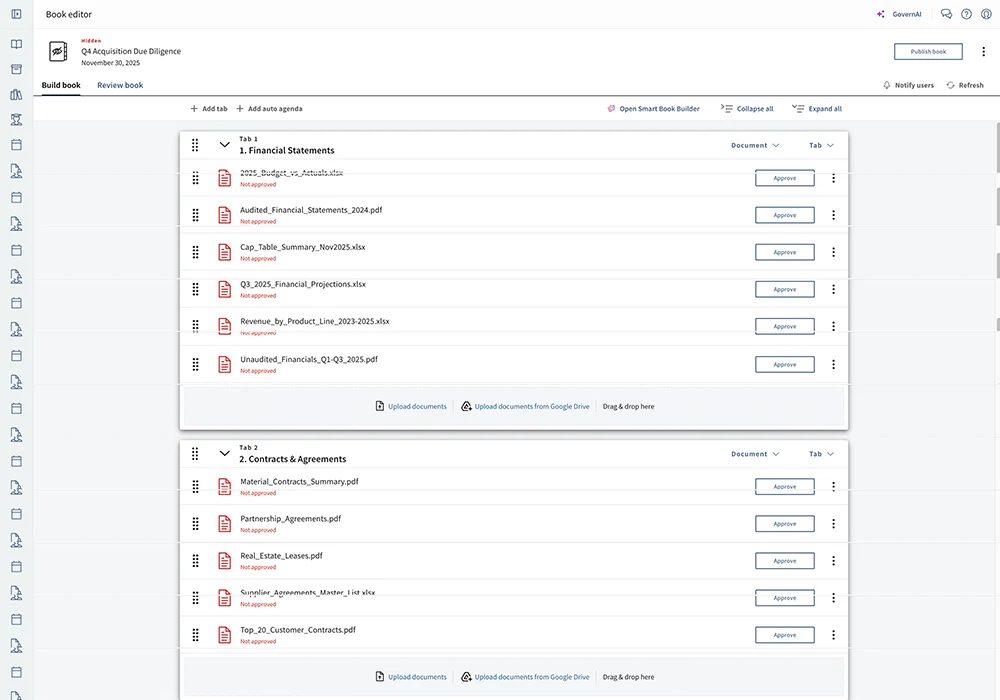
Additionally, Smart Risk Scanner continuously analyzes documents, communications and business processes to identify potential legal issues, compliance gaps and sensitive content before distribution.
Diligent’s ACL Analytics processes 100% of transactional data rather than traditional sampling approaches. The natural language interface allows non-technical users to run complex audits with simple prompts — no coding required.
Automated monitoring robots conduct continuous assurance, while 100+ data connectors integrate with enterprise systems.
Organizations using ACL Analytics identify risks weeks earlier than traditional approaches while freeing skilled auditors from manual testing to focus on strategic advisory work.
Diligent’s Enterprise Risk Management (ERM) provides comprehensive risk oversight with AI-powered risk identification benchmarking against 180,000+ real-world risks from SEC 10-K reports and Moody's risk intelligence, providing external benchmarking data.
Real-time dashboards, heat maps and trend lines surface emerging threats as they develop. For organizations launching risk management programs, AI Risk Essentials — a solution within Diligent's broader ERM offering — provides AI-powered peer benchmarking with 7-day implementation timelines, making sophisticated risk management accessible to lean teams.
These integrated capabilities address the core challenges organizations face with GRC data. By automating routine data collection and surfacing real-time insights, AI-powered platforms transform GRC from periodic compliance exercises into continuous strategic intelligence.
Ready to transform your GRC capabilities with unified AI-powered intelligence? Request a Diligent demo to discover how integrated governance, risk and compliance oversight delivers the real-time visibility your board needs.
Data-driven GRC leverages continuous monitoring, automated risk assessment and real-time analytics to provide boards with strategic risk intelligence that supports decision-making. Traditional approaches, on the other hand, rely on periodic assessments and manual reporting that cannot keep pace with modern business requirements.
Effective board oversight requires clear committee structures with defined responsibilities, regular coordination between audit and risk committees and integrated risk reporting that shows coordination across all three lines.
Boards should also establish joint committee sessions for critical topics and ensure cross-committee membership where appropriate.
Effective GRC data provides clear, actionable insights enabling boards and executives to make informed strategic decisions. It also:
Book a demo to discover how Diligent's integrated GRC platform enables boards to achieve real-time risk intelligence and strategic oversight.