Board strategic planning is where directors set the company's long-term board strategy and test management's assumptions. The board must also hold management accountable for execution. It cannot delegate that responsibility, even though management runs the business day to day.
The board's role in strategic planning is to set the company's long-term direction and test management's assumptions. It must also hold management accountable for execution. The board cannot delegate that responsibility, even though management runs the business day to day.
A long-term board strategy plan defines where the owners and CEO want to take the company. Boards are essential to developing that plan, yet this responsibility often receives little attention.
This guide covers:
- Why the board of directors has a role in strategic planning
- What that role entails and the advantages boards bring to it
- The five steps of a typical board planning process
- How directors challenge management's ideas without taking over execution
- 6 tips for managing the board and the plan over the long term
Why should the board of directors have a role in strategic planning?
Management creates and executes the process. The board provides long-term oversight so the company can test assumptions and stay focused on its direction.
The most important role of a CEO and the C-suite leadership team is to create and successfully execute the long-term plan. The board's role is equally vital in overseeing and developing that plan. Boards vary in how closely they participate in its development. To gauge whether responsibilities are properly divided, ask, "If the board is developing the plan, what is the CEO, who knows the company's day-to-day operations best, doing?" If the board plays no helpful role, it may be time to find new board members.
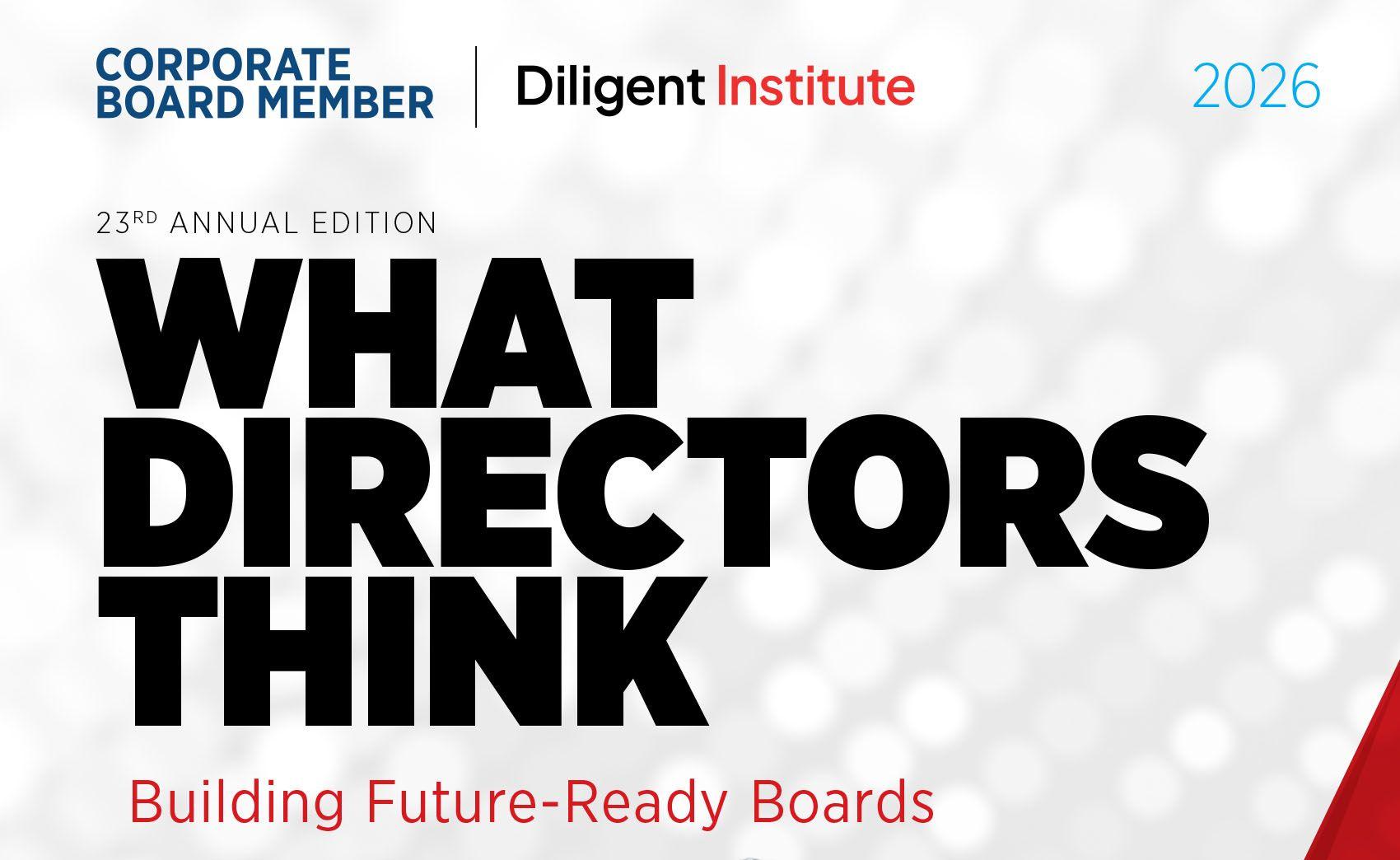
Boards should be highly involved in corporate planning. Directors themselves recognize the need. In What Directors Think 2026, from Diligent Institute and Corporate Board Member, 58% of directors want more meeting time devoted to strategic planning, and strategic planning was the top-cited listed priority for the next meeting at 47%. Boards should protect dedicated agenda time for forward-looking discussion rather than allowing presentations and routine reporting to consume the meeting.
Shareholders and management are increasingly relying upon boards to take a more hands-on approach in setting company direction as today's leaders face new challenges:
- Long-term planning is becoming more important to a company's well-being. A downward trend in global investment and productivity, combined with technologically driven change, makes it clear that extending historically effective approaches won't suffice.
- Trade disputes and rising shareholder activism trends require more board oversight. Social expectations, including those related to diversity, also influence company planning.
- Immediate and frequently competing board duties can crowd out longer-term planning. Legal priorities force more focus on governance issues, including the audit committee's role and the CEO compensation package. Heightened regulatory challenges, including Sarbanes-Oxley compliance, require constant attention. New risks continue to appear, such as cybersecurity and data privacy. These pressures are particularly demanding for pre-IPO companies establishing audit committee readiness and preparing for public-company oversight.
- The accelerating pace of change requires companies to review and reevaluate their underlying assumptions continually. Globalization and the adoption of digital technology have substantially changed the business environment. Pulled between long-term planning and day-to-day tasks, management may struggle to keep up with changes. Boards are better positioned to stay informed.
Role of board of directors in strategic planning
The board's planning role rests on four advantages management lacks: long-term focus, external connections, expanded knowledge and the standing to push back. These planning duties sit within the board's broader roles and responsibilities.
The nature of a board's relationship with its company and the corporate environment dictate the factors that define its role in strategic planning:
- Long-term focus. A CEO focuses on daily operations, and shareholder pressure often ties the next big goal to the end of a quarter. Boards exist apart from the company's daily challenges. They can look to the future and mitigate some of the negative impacts of short-term thinking. That distance helps boards consider long-term direction.
- Board (and broad) connections. Companies frequently highlight external noncompetitive economic and political forces in annual reports. Board members typically have connections and contacts in other political, business and industry settings, including through interlocking directorates, which can provide important insights. Boards can use this connectedness to recognize and respond to emerging threats or opportunities.
- Expanded knowledge. Companies have growing opportunities to expand or cross industry boundaries quickly. Amazon, Apple and Google illustrate how new business models and technologies allow companies to explore new sectors and rapidly expand their customer bases. Detailed, sector-specific knowledge only carries a company so far. Board members can apply knowledge about new technologies and competitive opportunities to company plans and fill management's skills or knowledge gaps.
- Regular and specific pushback. Oversight of the plan is part of the board's natural governance role. Boards are uniquely situated to test management's effectiveness by regularly challenging key assumptions and monitoring execution. Boards should make risks and opportunities standing agenda topics. They should also periodically assess their vulnerabilities from an outside-in activist viewpoint and prepare proactive response plans before an activist approaches.
"The winners will be the companies that recognize that risk and opportunities need to be standing discussion topics on the board agenda," says Ana Dutra, Experienced public and private company director.
For public companies, this pushback also requires coordination among independent directors, attention to stakeholder scrutiny and oversight across complex committee structures.
Board strategy planning process
A board works through five recurring items on the board's planning agenda: dedicating time, analyzing external conditions, thinking beyond strengths and weaknesses, developing new approaches and reviewing the plan continuously.
Creating and following through on an effective plan takes careful thought, questioning and the courage to challenge the status quo, including:
- Continually dedicating time to long-term planning: Boards must allow enough time for thorough planning. Planning is a process; it wasn't designed to be completed in one meeting. Most boards need several board or committee meetings to complete the process with confidence.
- Analyzing external conditions: Boards should consider a situation analysis and a SWOT analysis. They need to identify short- and long-term goals and outline steps to achieve them. A situation analysis considers the economic, competitive, technical, regulatory and societal environment in which the company expects to achieve its objectives. Because boards and managers have little or no control over these areas, considering them before identifying action steps helps the company adapt to external changes.
- Thinking beyond strengths and weaknesses: Boards should identify strengths, weaknesses, opportunities and threats, then record ways to build on current strengths and minimize weaknesses. They should consider how to take advantage of opportunities and come prepared to discuss how to defend against threats.
- Developing new approaches: After considering the SWOT and situation analyses, boards should develop new approaches to meet their objectives.
- Reviewing and improving the board strategy plan: Don't complete the plan and throw it in a drawer. Strategic planning requires ongoing review. Boards and managers should keep the plan handy and share their views on it continuously. As they review it, they should ask whether conditions have changed and whether the right approaches are still in place.
Bring AI insight to board strategy
See how AI can give directors more time for judgment and less for document review.
Boards protect the plan by testing management's ideas on their merits, including the risks attached to each one, whatever the CEO's tenure or reputation.
During planning, board directors must challenge the CEO's and senior managers' ideas. This isn't easy, especially when the CEO is a strong leader with a powerful reputation and long tenure. Consider every idea based on its own merits, regardless of the CEO's reputation. Reject ideas with a low chance of success, even if senior managers favor them.
Think about the risks that may accompany specific plans. Discuss whether those risks are worth taking, whether they can be mitigated and whether the plans and risks fit the company's direction. In the GC Risk Index 2026 from Diligent Institute, only 21% of senior legal leaders said they were very confident their board receives the right mix of risk information. Boards should close that information gap as part of their strategic risk oversight before the next planning discussion.
Aligning management and the board of directors in long-term planning
Alignment comes from shared process and constant communication: The board challenges assumptions through structured discussion, while management retains ownership of execution.
How can a board improve its effectiveness as a partner with management? Key practices include:
- Educate management about the planning process. A board can help management understand and select the proper process for developing a long-term plan. A SWOT analysis is a useful starting point for understanding the company's strengths, weaknesses, opportunities and threats.
- Assure that any plan addresses all the resources necessary to implement it effectively. For example, identify where additional investment will be required for personnel and training.
- Create options for the board to discuss with management initially. Introducing options compels board participation and uses individual directors' skills and expertise. The resulting discussions build understanding and long-term agreement.
- Establish channels for regular communication between the CEO and the board to keep the board current on plan development and execution.
- Identify at the outset and continually watch for red flags and warning signs that indicate the plan is not returning anticipated results and may need revision.
6 tips for effectively managing the board of directors and long-term planning
The plan should be a living document that takes the company from where it is now to where it wants to be over the short and long term. Managing the plan and the board requires careful, ongoing oversight, especially if the board habitually lets management run the show.
Effective oversight requires:
- Expressing differing opinions: Acknowledge unresolved objections. If you don't believe something will work, don't just go along with the crowd. Others may share the concern. Directors should offer independent opinions rather than agree with everyone else. "Being on a board is about realism and not perfection. Many directors are afraid to say when they don't know something," says Anastassia Lauterbach, PhD, Technology expert and board member.
- Challenging the status quo: Make sure approaches are in place for every objective and will meet the desired end. Don't support the same approach the board has used in the past if it has never worked. Determine whether there's a better approach and whether the goal is reasonable.
- Avoiding weak approaches: Abandon a losing approach. Refocus planning on approaches that can work and factor in competitors' potential responses. Be ready to revise the plan if a competitor's actions hurt the company's progress.
- Building a strong management team: Assess whether current managers can carry out the plan and whether the team has the required experience. Remove people who cannot carry out the plan in the future.
- Providing guidance: Remember that the board's role is advisory. Directors should ask questions that stimulate thought and provide guidance. Assess the risks that may accompany the plan. Ask openly, "What issues aren't on management's radar?" It takes courage to raise some issues, and it's the board's job to demonstrate that courage.
- Adopting a board management system: Board management technology keeps communication and materials in one secure system. The right system should help directors prepare and follow through without transferring ownership of execution from management to the board.
How Diligent supports board strategic planning
Board management technology gives directors one secure place to prepare, question and follow through on board strategy planning.
To engage effectively in planning, the board needs diverse expertise and experience, along with knowledge of the underlying industry and the external economic, technological and other factors that will affect the company. Directors also need time to examine management's assumptions, along with consistent materials and secure collaboration.
Diligent Boards centralizes the materials directors use for planning discussions. Its capabilities address different governance needs without changing the board's oversight role:
- For pre-IPO companies, SmartPrep 360 generates pointed discussion questions with source citations. These questions help audit committees improve preparation and discussion quality during the public-company transition.
- For enterprise and public companies, Smart Builder supports institutional-quality board books for independent directors managing stakeholder scrutiny and complex committee oversight.
Assore Holdings saved up to 60% of the time spent preparing for board meetings using Diligent Boards with GovernAI capabilities. This freed directors and governance teams to focus more attention on planning discussions.
By bringing board and executive collaboration into a secure environment, Diligent Boards supports continuous preparation and informed follow-through on short- and long-term priorities. It also applies governance technology without changing the division between board oversight and management execution.
Board strategic planning FAQ
What is the board's role in strategic planning?
The board's role is to set the company's long-term strategy and test management's assumptions. It must also hold management accountable for execution. The sharpest questions for a board of directors test whether the plan's underlying assumptions still hold.
How often should a board revisit its strategic plan?
A board should revisit its plan continuously rather than only once a year. Keep it at hand, review it when conditions change and ask whether the right approaches remain in place.
How does a board challenge management's strategy without undermining trust?
By judging every idea on its merits and raising objections through established channels. Regular communication and jointly discussed options let directors challenge assumptions while management retains ownership of execution.
What's the difference between the board's role and management's role in strategy?
The board oversees the plan; management creates and executes it. Directors test the plan's assumptions and hold management accountable without taking over day-to-day operations.
How can technology support board-level strategic planning?
Technology centralizes board materials so directors can spend more time discussing the plan. Board management platforms support preparation and judgment while keeping sensitive board information in one place.
See how Diligent Boards can sharpen your board's role in strategic planning. Schedule a demo.