

For early-stage companies racing to capture market share and close funding rounds, compliance for startups often feels like an obstacle rather than an enabler.
According to Diligent Institute's Transaction Readiness Report, companies rate their transaction readiness confidence at just 5.7 out of 10 — and investor due diligence has become increasingly rigorous, with compliance gaps routinely delaying funding rounds and reducing valuations.
Inadequate compliance infrastructure represents a major contributor to this low confidence, creating vulnerabilities that emerge precisely when capital is most critical.
The challenge isn't that founders don't care about compliance. It's that most early-stage teams lack dedicated compliance personnel, face competing priorities between growth and governance, and struggle to identify which regulatory obligations actually apply to their business model.
Building the right compliance infrastructure doesn't require enterprise budgets or full-time compliance officers. It requires understanding what matters at your stage and implementing processes that scale with growth.
This guide explains how to build a foundational compliance infrastructure that protects your business and enables growth, covering:
Startup compliance means establishing systems, policies and documentation that satisfy regulatory requirements, customer expectations and investor due diligence standards. It includes everything from data privacy practices and employment law adherence to industry-specific regulations like HIPAA or financial services frameworks.
For early-stage companies, compliance serves as an operational infrastructure that enables growth rather than bureaucratic overhead.
Traditional compliance narratives focus on avoiding penalties. That framing misses what actually matters for growth-stage companies. Professional compliance infrastructure serves three business-critical functions that directly impact your ability to raise capital and close enterprise contracts:
The financial impact of inadequate compliance extends well beyond regulatory penalties. Companies discover compliance gaps during three critical moments:
Each scenario creates different but equally problematic consequences.
During funding rounds, investors typically identify compliance gaps that require remediation before closing. This discovery extends transaction timelines by weeks or months while legal teams implement required processes and documentation. More problematic, these gaps give investors leverage to negotiate lower valuations or more favorable terms.
For enterprise sales, missing required certifications or compliance frameworks simply disqualifies you from procurement processes. Enterprise procurement teams won't even evaluate products from vendors lacking SOC 2 certification or relevant security frameworks. This limitation directly caps revenue growth for companies targeting enterprise markets.
Regulatory examinations create the most severe financial exposure. Penalties for violations like data breaches or privacy law violations routinely reach millions of dollars. These examinations can also trigger class action lawsuits that cost even more to defend than the underlying regulatory penalties.
The good news: Building compliance infrastructure doesn't require enterprise complexity or budgets. The following eight-step checklist provides a practical roadmap for establishing foundational compliance that scales with your business and satisfies investor expectations.
Generic compliance checklists fail because regulatory obligations vary dramatically by industry, business model and geographic markets. A SaaS company selling to healthcare providers faces entirely different requirements than a fintech startup or a direct-to-consumer e-commerce platform. Your first step involves identifying which frameworks actually apply to your specific situation.
Start by analyzing three factors:
Industry-specific regulations like HIPAA for healthcare, Sarbanes-Oxley for financial services or FedRAMP for government contractors create foundational compliance obligations that you cannot ignore, regardless of company size.
Customer segments determine additional requirements beyond industry regulations. For example:
Geographic operations create overlapping compliance requirements that compound complexity. Operating in California adds CCPA obligations, and a European presence requires GDPR compliance. Multi-state operations trigger varying state-level regulations around data privacy, employment law and tax obligations.
Compliance without documentation equals no compliance at all. Auditors, investors and regulators care less about what you claim to do than what you can prove you've done. Professional documentation systems create the audit trail that demonstrates compliance when it matters most.
Begin with centralized storage for all compliance-related documentation. Shared drives and email attachments fail during audits because they cannot demonstrate version control, access logs or systematic retention. You need purpose-built systems that track who accessed documents, when changes occurred and how long materials have been retained.
Key documentation categories include:
Version control matters as much as storage. Auditors need to see how policies evolved over time and verify that employees acknowledged current versions rather than outdated procedures. Systems without version control create compliance gaps even when underlying processes work correctly.
Data privacy and security controls form the foundation of startup compliance infrastructure. These controls protect customer information, prevent breaches that trigger notification obligations and satisfy baseline requirements for enterprise sales and investor due diligence.
Start with data mapping that documents what information you collect, where it lives, who can access it and how long you retain it. This mapping exercise serves multiple compliance frameworks simultaneously while identifying security risks you may not have considered.
Access controls determine who can view or modify different types of data. Implement role-based access that grants the minimum necessary permissions for each employee's job function. Document how you provision and deprovision access when employees join or leave. Review access quarterly to remove permissions that are no longer necessary.
Data retention policies specify how long you keep different types of information and when you delete it. These policies satisfy both privacy regulations that limit retention and litigation holds that require preservation. Clear retention schedules prevent liability from storing unnecessary data while ensuring required documentation remains available.
Compliance infrastructure only works when employees understand their obligations and follow established procedures. Training programs and accountability mechanisms transform policies from documents into operational reality.
Employee onboarding should include compliance training tailored to role-specific obligations. For instance:
"There should be a direct, consistent line of communication from the Chief Compliance Officer (CCO) or General Counsel (GC) to the board," says Pav Gill, CEO of Confide. While early-stage startups may lack these formal roles, the principle holds: compliance accountability should flow from leadership through clear reporting lines.
Annual refresher training keeps compliance top of mind and addresses new frameworks or updated procedures. Track completion rates and require acknowledgment of policy updates. This documentation proves training occurred when auditors or regulators ask.
Startups cannot maintain in-house legal teams or compliance officers at early stages. External advisors provide necessary expertise while keeping fixed costs manageable. The key involves structuring these relationships to provide ongoing guidance rather than an expensive crisis response.
Select advisors with specific expertise in your industry and regulatory environment. General corporate attorneys might not be able to provide the specialized guidance you need for HIPAA compliance or financial services regulations. Find advisors who regularly work with companies at your stage, facing similar challenges.
Retainer relationships cost less than hourly engagements while providing predictable access to expertise. Monthly retainers typically include routine compliance questions, policy reviews and limited document preparation. This structure encourages you to ask questions early rather than waiting until problems become expensive.
Build a network that includes:
No security infrastructure prevents every incident. What separates prepared companies from those facing regulatory penalties is having documented response procedures before incidents occur. Incident response plans specify exactly who does what when you discover a security breach, data leak or compliance violation.
Your incident response plan should define:
Many regulations specify strict timeframes for breach notifications. GDPR requires notification within 72 hours. State privacy laws have similar requirements. Without documented procedures, teams waste critical hours figuring out basic response steps instead of executing containment strategies.
Test your incident response plan annually through tabletop exercises that simulate different scenarios. These exercises reveal gaps in procedures, identify unclear responsibilities and train teams before actual incidents create pressure. Documentation of these tests also demonstrates compliance program maturity to auditors and investors.
Regulatory environments evolve constantly. New privacy laws, updated security frameworks and industry-specific guidance create compliance obligations that didn't exist when you established initial procedures. Monitoring mechanisms ensure you identify changes before they create liability.
Subscribe to regulatory updates from industry associations, legal advisors and framework organizations. Many organizations provide free newsletters or alerts about regulatory changes affecting their sectors. These subscriptions cost nothing but provide early warning of upcoming obligations.
Schedule quarterly compliance reviews that assess current procedures against regulatory requirements and identify gaps requiring attention. These reviews should examine recent regulatory changes, new business activities that trigger additional obligations and control effectiveness for existing procedures.
See how AI Risk Essentials helps startups demonstrate risk management maturity to investors without hiring consultants or building frameworks from scratch.

Investor due diligence and customer audits will examine your compliance infrastructure multiple times as you scale. Preparation determines whether these examinations reveal a professional operation or ad hoc processes that reduce valuations and kill deals.
Maintain a due diligence data room with current compliance documentation. This centralized repository should contain:
Regular internal assessments identify gaps before external auditors find them. Quarterly self-audits using the same frameworks that external auditors apply reveal control weaknesses while you still have time to fix them. Document these assessments and track remediation activities to demonstrate continuous improvement.
For startups managing compliance with limited resources, AI-powered tools transform what's possible without expanding headcount. Modern compliance platforms like Diligent address the specific challenges that prevent early-stage companies from building professional infrastructure.
Diligent IT Compliance accelerates the certifications that unlock enterprise revenue. Most startup teams pursuing SOC 2, ISO 27001 or other buyer-required certifications face months of manual framework implementation.
IT Compliance supports 75+ frameworks with prebuilt toolkits that eliminate the need to start from scratch. AI control suggestions help teams without compliance expertise implement requirements quickly, while the Common Controls Framework enables reuse across multiple certifications — so achieving SOC 2 today accelerates ISO 27001 tomorrow.
Continuous controls monitoring proactively catches issues like access review gaps or segregation of duties violations, improving audit readiness while reducing breach likelihood. As startups scale, the platform grows with them — including FedRAMP and DoD IL-5 authorized options for teams expanding into public sector markets without switching platforms.
Building on this foundation, Diligent Regulatory Compliance Management provides AI-powered compliance assistance that analyzes regulatory updates, identifies key changes and suggests mitigating controls automatically — addressing the regulatory monitoring burden that startups face without dedicated compliance staff.
The platform's Regology partnership ensures regulation libraries stay current as requirements change, while centralized regulatory controls create the single source of truth that auditors and investors expect during due diligence.
For startups establishing formal risk management, Diligent’s AI Risk Essentials helps teams launch risk programs in under seven days.
The platform's AI-powered peer benchmarking identifies relevant risks by analyzing 180,000+ real-world risks from SEC 10-K reports, eliminating the need to hire consultants or build frameworks from scratch.
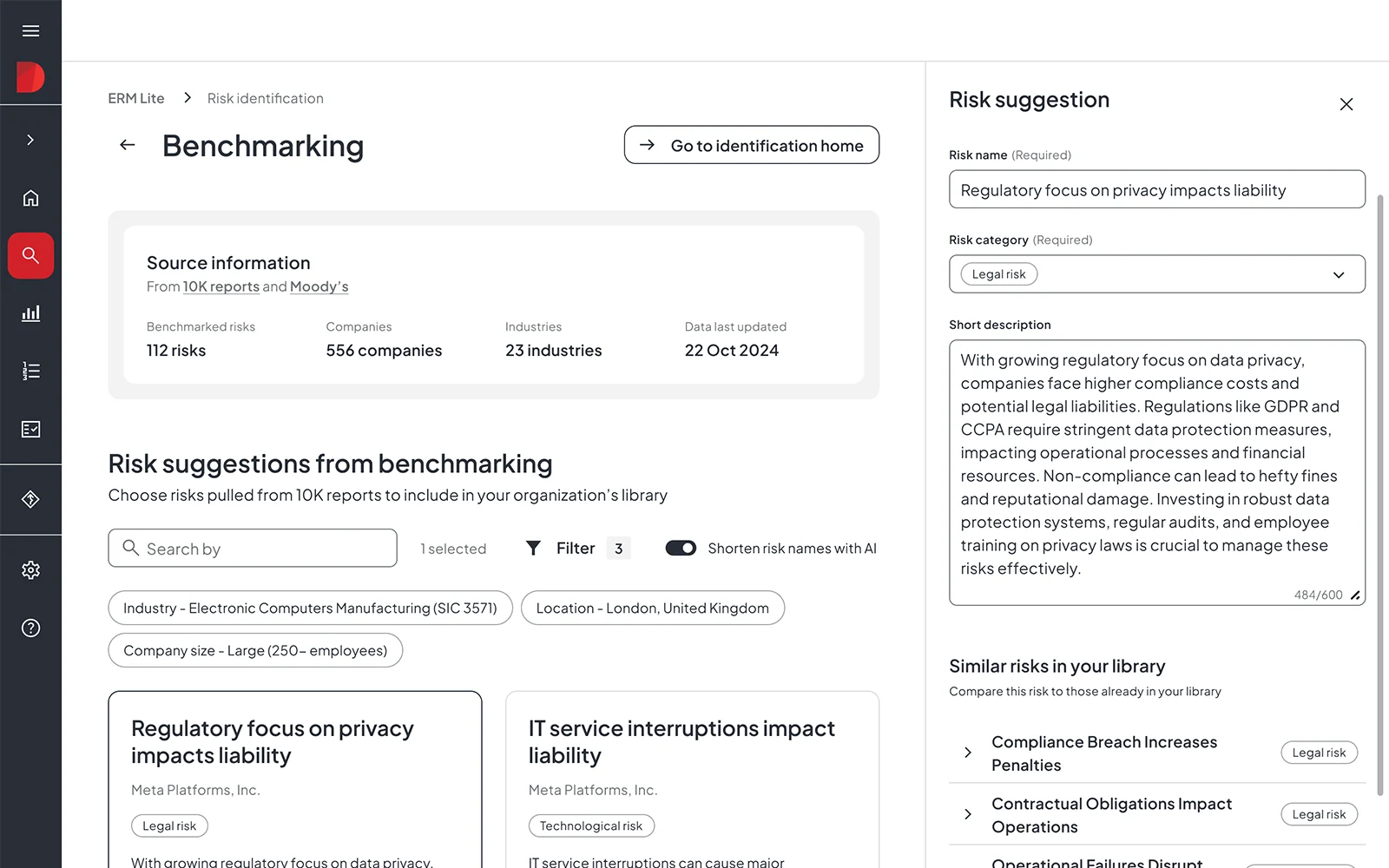
This capability proves particularly valuable during funding rounds, when demonstrating risk management maturity to investors becomes critical for valuations.
Together, these tools help startups build scalable compliance infrastructure that grows from funding rounds through enterprise sales without the complexity or cost of traditional compliance programs.
Ready to build investor-ready compliance infrastructure? Schedule a demo to see how Diligent helps startups establish professional compliance programs.
Minimum requirements depend on your industry, business model and target customers rather than company size. All startups need basic data privacy practices, employment law compliance and financial record-keeping. Beyond that baseline, industry-specific regulations like HIPAA or financial services requirements create additional obligations.
Customer contracts often impose certification requirements like SOC 2 regardless of legal mandates. Begin by identifying applicable frameworks, then implement controls that satisfy multiple requirements simultaneously.
Professional compliance doesn't require enterprise budgets. Start with foundational controls that apply across frameworks: access management, data encryption, documented policies and employee training.
Many compliance tools offer startup-friendly pricing or free tiers for early-stage companies. External advisors on monthly retainers cost less than full-time hires while providing specialized expertise. Focus initial investments on requirements that block revenue or create regulatory exposure rather than trying to implement everything simultaneously.
Multi-jurisdictional compliance requires understanding which laws apply based on where you operate, where customers live and where you store data. Start by identifying all relevant jurisdictions, then map specific obligations in each. Look for frameworks that satisfy requirements across multiple jurisdictions simultaneously.
For example, implementing GDPR compliance often satisfies many U.S. state privacy laws. Work with legal advisors who understand international regulations rather than trying to interpret requirements yourself.
Transparency and clear remediation plans matter more than perfect compliance. Document gaps honestly, explain root causes and present realistic timelines for correction. Investors and customers appreciate candor about compliance status more than discovering hidden issues later.
Many deals accommodate compliance remediation as a pre-closing or post-closing condition. The key involves demonstrating that you take compliance seriously and have plans to address gaps rather than minimizing their significance.
Discover how Diligent helps startups build professional compliance programs that satisfy investor expectations. Request a demo today.





