

In this article

According to the Spencer Stuart Director Pulse Survey, board directors spend an average of 200 hours per year on board work. How do they keep all the discussions, meetings and action items straight? Board meeting minutes — the official record of every meeting.
Knowing how to take minutes at a board meeting is both an art and a science. It’s understanding what good governance means to your organization, applying your own touch to include the right amount of information and following a board-approved process to keep all directors in the loop.
While board meeting minutes and their takers aren’t always the boardroom stars, they serve a critical function, without which meetings are less effective and even non-compliant.
This article will explain the key to great minute-taking, including:
Board meeting minutes are the official written record of discussions, decisions and actions taken during a board meeting. They serve as a legal document that outlines key motions, votes and resolutions, ensuring transparency and accountability within the organization.
Unlike informal meeting notes, minutes become part of the corporate record once approved. Courts and regulators can request them during audits, litigation or compliance reviews. This makes accurate minute-taking essential for demonstrating that boards upheld their fiduciary duties and engaged in proper deliberation.
Board meeting notes and meeting minutes are closely related but serve different purposes with varying formality levels. Understanding this distinction is essential for proper governance documentation.
Notes are informal records that anyone can take during a meeting. The corporate secretary might use them as raw material when drafting official minutes. Notes remain either for the note-taker's personal reference or for drafting purposes—they don't enter the corporate record.
Minutes, by contrast, are formal legal documents. They follow a standardized format, require board approval and become part of the organization's permanent record. Unlike notes, minutes are legally binding and can be subpoenaed in legal proceedings.
Despite these differences, both serve essential roles in the governance process. AI-powered board portal software can now translate notes into official meeting minutes, making good note-taking the foundation for effective minute documentation.
Meeting minutes are critical accountability and compliance tools. They record the conversations, reports and decisions the board engages in during each meeting — serving those who miss a meeting while also fulfilling legal requirements.
Most states have laws that dictate corporate board minutes should remain on file, with just five states leaving minute-taking practices to corporations themselves. Public-facing boards face additional requirements under state open meeting laws, which often mandate not only recording minutes but also publishing them for public access.
Meeting minutes help prove compliance with these laws and make the board's actions more defensible. They can also help the board prove they engaged in sufficient deliberation if a decision leads to an unfavorable outcome that ends in litigation.
"Looking ahead, high performing boards will treat governance as a continuous discipline, built on real-time data flows rather than periodic reports," says Dottie Schindlinger, Executive Director of Diligent Institute. The quality of meeting minutes plays a direct role in this shift: they are the foundation on which boards build institutional memory and demonstrate governance rigor.
Effective meeting minutes catalyze organizational management. They streamline action before, during and after meetings while keeping boards and stakeholders on track. The transition to digital governance platforms has amplified their importance — directors can now access minutes anytime, anywhere.
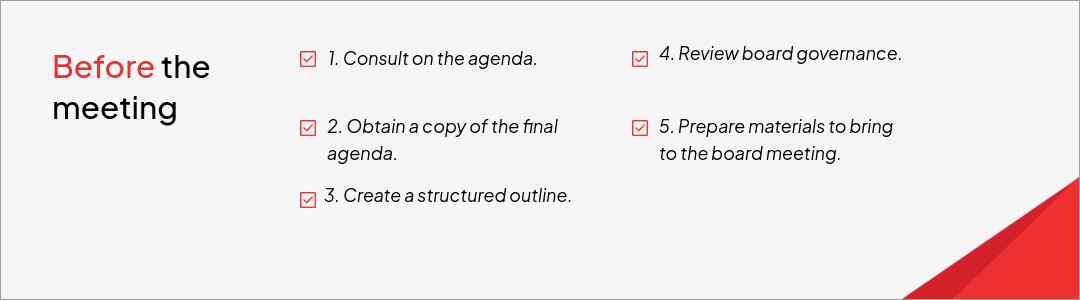
Before the meeting:
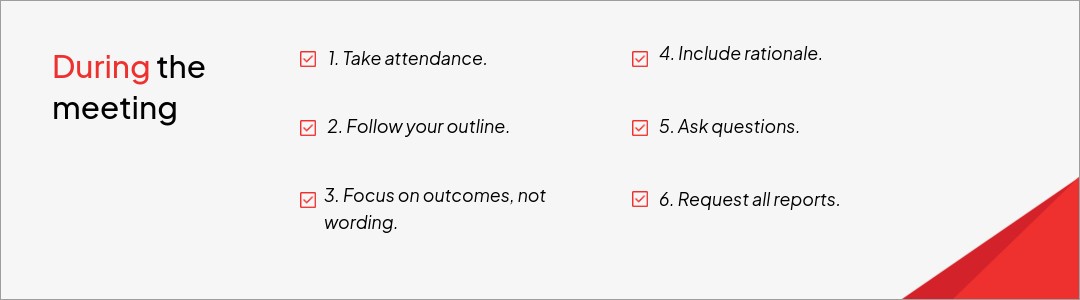
During the meeting:
After the meeting:
For global organizations, minutes also bridge geographic distances. Ridgeback Resources, a private petroleum producer headquartered in Alberta, Canada, uses digital tools to keep board directors informed worldwide.
"With Diligent, now it takes me less than an hour to prepare and distribute meeting materials. Everything's integrated," says Catherine Cipriano, executive assistant at Ridgeback Resources.
Prepare and send meeting minutes in just a few clicks, fueling better board decision-making.

There are two types of minutes based on the session: open or closed. How to take minutes at a board meeting depends on the session.
Board meeting minutes contain a plethora of information. Part of knowing how to take minutes at a board meeting is understanding which details to include and how to represent them in writing effectively.
Minutes may vary slightly depending on the state and the organization, but they typically include:
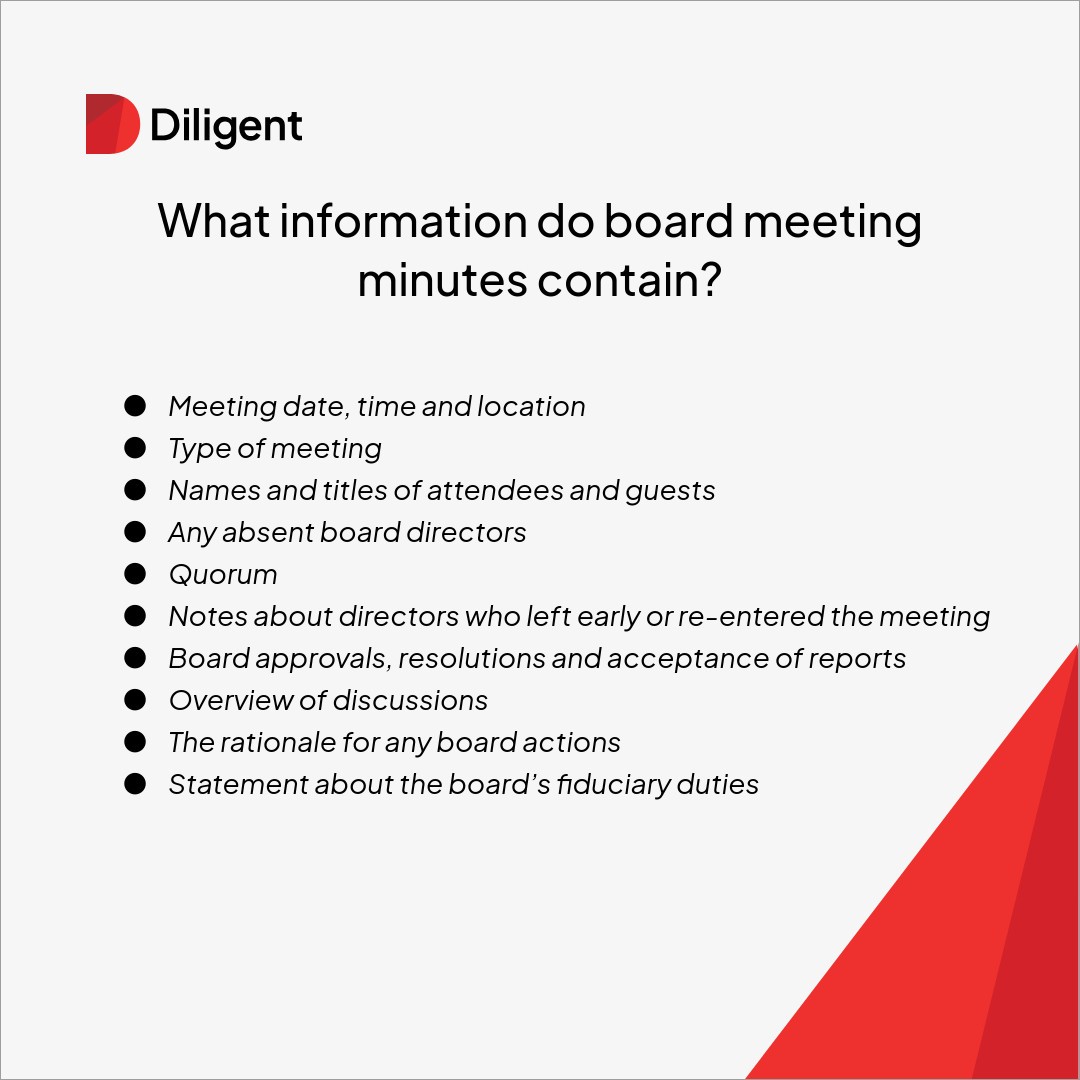
The balancing act of board meeting minutes is that, while they should be comprehensive, they shouldn’t be a play-by-play of the meeting. A board member may get heated, or a debate may run long, but those details shouldn’t make it into the minutes.
Keep minutes factual, concise and legally sound, leaving out information like:
Future speculation or unconfirmed actions: Only include voted-on or finalized motions. This streamlines the minutes and avoids confusion about which decisions were made and which will arise in future meetings. Instead of “We will likely approve funding next quarter,” say, “The board will revisit funding next quarter.”
Avoid common meeting minutes mistakes. Discover 15 do’s and don’ts in our blog to ensure your meeting minutes are accurate and effective.

Once you understand what to include and exclude in your meeting minutes, the next best step is to see what best-in-class meetings look like. Here are example board meeting minutes from a hypothetical board meeting:
Board of Directors meeting minutes
The XYZ Company
Date: March 12, 2025
Time: 3:00 p.m. to 4:30 p.m. EST
Location: Virtual
1. Call to order
Board Chair Angela Smith called the meeting to order at 3:02 p.m.
2. Roll call
Present:
Absent:
Staff Present:
3. Approval of minutes
The minutes from the February 12, 2025, board meeting were reviewed.
Motion: To approve the minutes as submitted.
Moved by: Priya Desai | Seconded by: Tom White
Outcome: Motion carried unanimously
4. Financial report
David Lopez presented the February financial statements.
Motion: To accept the financial report as presented.
Moved by: Monica Chang | Seconded by: Priya Desai
Outcome: Motion carried unanimously
5. New business
Marketing strategy update
Sarah Tran shared updates on Q2 marketing efforts.
6. Old business
Bylaws review: The governance committee is still reviewing revisions. Final recommendations will be presented at the April meeting.
7. Adjournment
The meeting was adjourned at 4:28 p.m.
Motion: To adjourn the meeting.
Moved by: Monica Chang | Seconded by: Tom White
Outcome: Motion carried unanimously.
Minutes submitted by:
Priya Desai, Board Secretary
Date: March 14, 2025
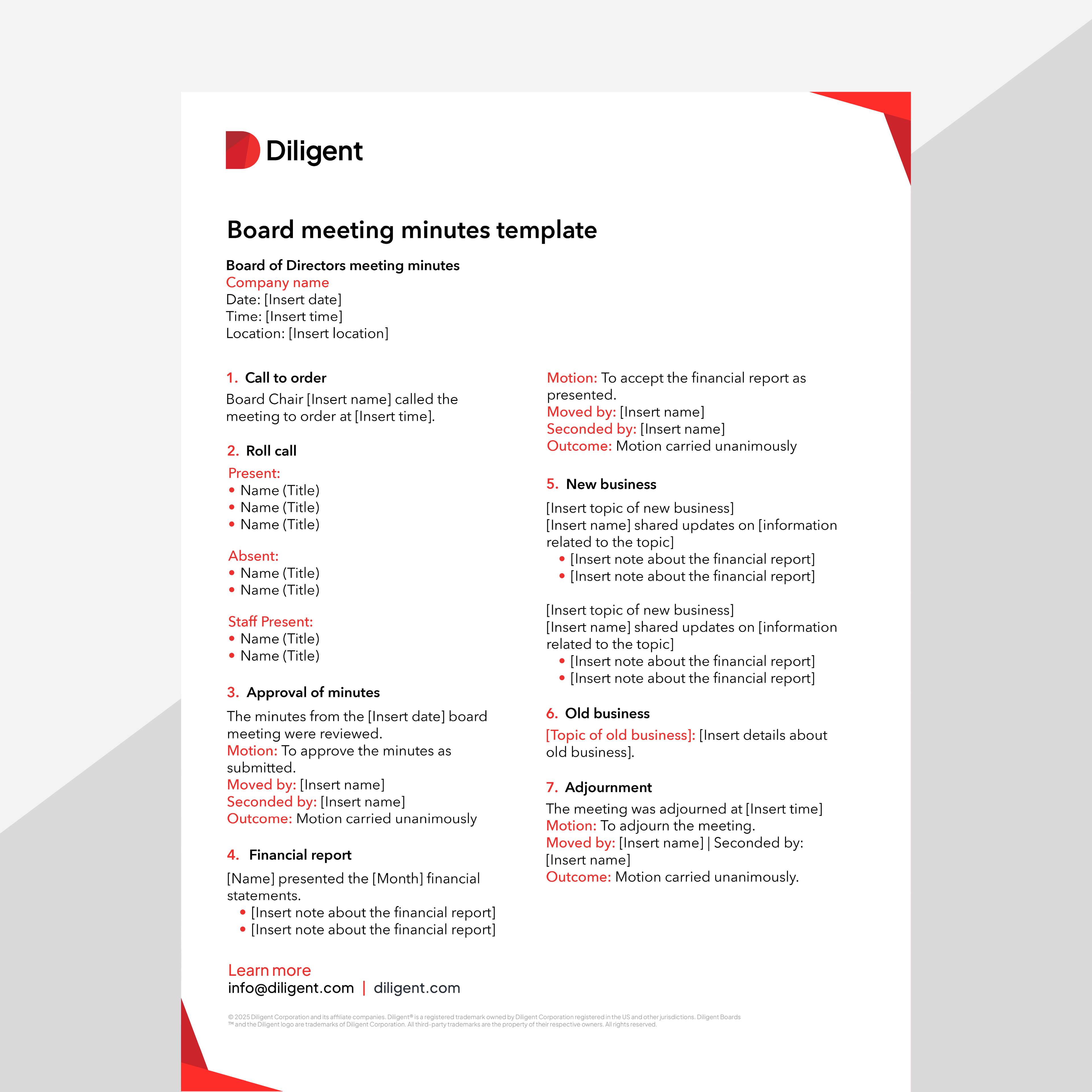
With the help of a template and a transparent, step-by-step process, you can end the stress of minute-taking. Based on the example above, use this template to guide the minutes for your next meeting:
Though you take the minutes at the board meeting, this phrasing is a misnomer. Minute-takers play a vital role in preparing for and reflecting on the meeting.
Knowing how to take minutes at a board meeting means understanding the role of minute-takers before, during and after the board meeting.

Download our board meeting minutes template, built for corporate secretaries and governance professionals who need consistency and compliance at every meeting.

Meeting minutes are more than notes, so adopting best practices can help you learn how to take minutes at a board meeting that amplifies board effectiveness.
These include:
Accurate and compliant board meetings are key legal tools. Following legal requirements for board meeting minutes helps demonstrate that the board has upheld its fiduciary duty, held itself accountable and engaged in good governance practices.
Below are essential legal considerations every board should understand when preparing for and recording meeting minutes.
While the above legal requirements are a solid starting point, the specific rules and regulations governing how you take and store minutes can vary significantly. Below is a summary of how board minute regulations differ across the U.S., UK, Canada, Australia and New Zealand.
In the U.S., legal requirements for board minutes are generally governed by state law and the organization’s bylaws. There’s no federal mandate on content or format, but courts often treat approved minutes as legal evidence. Many states require both nonprofits and corporations to keep written records of all board actions and to retain them permanently. Requirements for quorum, notice and remote participation vary widely by state.
All states have passed laws that pertain to nonprofit corporations, for-profit corporations and other types of organizations. Most states have laws on the books that require corporations to keep meeting minutes with other corporate documents and records. A handful of states leave the responsibility for recording and retaining minutes up to the corporations. Those states are:
The UK’s Companies Act 2006 requires companies to keep all board and general meeting minutes for at least 10 years. Minutes must record the proceedings and any resolutions passed. Although the format is flexible, directors can be held liable if proper records are not maintained. The Charity Commission also expects accurate minute-keeping for accountability and regulatory compliance for charities.
The federal Canada Not-for-profit Corporations Act (CNCA) and Canada Business Corporations Act (CBCA) mandate that corporations and nonprofits maintain detailed records of board meetings, including resolutions and votes. Provincial laws may also apply. Minutes must be stored at the registered office and made available to directors and, in some cases, members. Retention periods can range from six to 10 years, depending on jurisdiction.
Under the Corporations Act 2001, Australian companies must keep minutes of board meetings within one month of the meeting date. Minutes should document attendees, discussions, resolutions and declarations of interest. These must be retained for at least seven years. Failure to maintain proper records can result in penalties for directors. For nonprofits, additional rules may apply depending on whether they are incorporated associations or companies limited by guarantee.
In New Zealand, the Companies Act 1993 requires directors to ensure minutes of board meetings are kept and retained for at least seven years. Minutes must include decisions and resolutions and be available for directors to inspect. Charitable organizations registered with Charities Services are also expected to keep proper records for accountability and transparency.
Meeting minutes do summarize what the board discussed during a meeting, but they are also a legal record of an organization’s decisions and governance. Adhering to board meeting minute legal requirements protects the board, the organization and its stakeholders. Here’s why compliance is essential:
For every minute a meeting lasts, corporate secretaries can spend hours gathering documents and refining the meeting minutes. Part of learning how to take minutes during a meeting is learning how to streamline time-intensive processes like artificial intelligence.
According to What Directors Think 2026 by Diligent Institute and Corporate Board Member, 66% of directors now use AI for board work, with 40% saying they want access to AI-powered technology for board oversight. Yet only 22% have formal AI governance processes in place for board-level AI usage, highlighting the gap between adoption interest and structured implementation.
“In our research, we’re seeing a sense of cautious optimism from corporate secretaries and general counsel for using GenAI in their work,” says Dottie Schindlinger, Executive Director of Diligent Institute. “They see the benefits of having more efficient processes, but are concerned about the potential for inaccurate results because of GenAI 'hallucinations' and about the potential for data privacy risk. The good news is that there are purpose-built GenAI tools for governance professionals that help to greatly reduce both of these risks.”
Diligent Boards, part of the Diligent One Platform, addresses these challenges through integrated AI capabilities specifically designed for governance professionals:
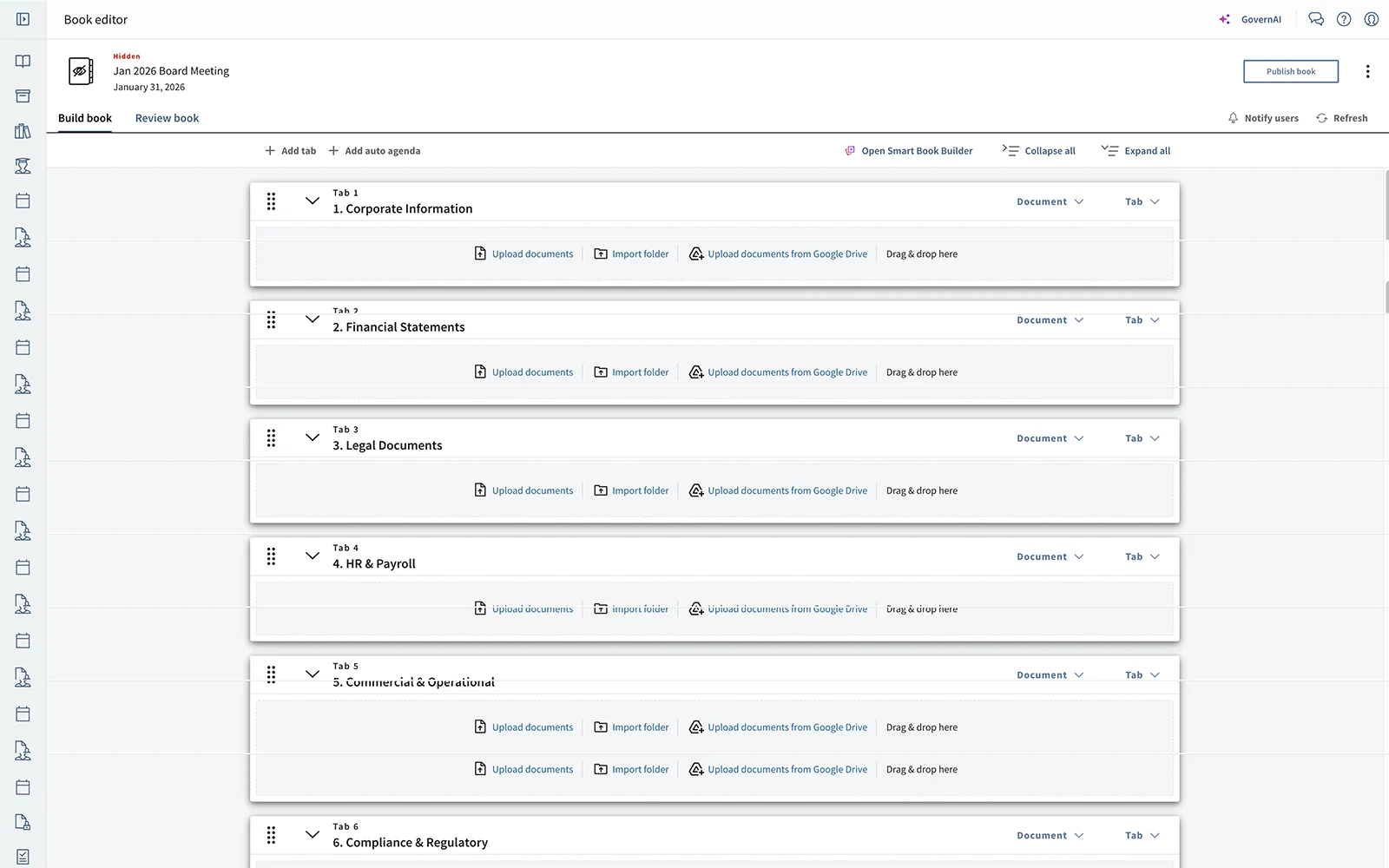
The platform's secure architecture addresses data privacy concerns that governance professionals often cite when evaluating AI tools.
All processing occurs within an enterprise-grade security infrastructure with SOC2 Type II certification and support for data residency requirements across jurisdictions.
Part of learning how to take minutes during a meeting is learning how to streamline time-intensive processes. Here's how to convert notes to polished minutes using Diligent Boards:
For organizations managing multiple boards or subsidiaries across regions, these capabilities scale without proportional headcount increases. The result: corporate secretaries can evolve from administrative support into strategic governance partners.
Imagine joining a company with a seasoned workforce that is loyal to the company but entrenched in legacy governance processes. This was the scenario Eric Myers inherited when he began his tenure as General Counsel and Corporate Secretary at ELCO Mutual Life and Annuity, a trusted insurance and financial services provider.
“We were using one file-sharing product, which just didn’t work well. I would get calls and emails from directors saying they couldn’t access or open their files,” Myers says.
This inefficiency burdened Myers and the IT department, distracting them from more critical tasks. Streamlining ELCO’s approach to governance — board meeting minutes included — was about unleashing the board and the company’s full potential. Myers started by adopting Diligent Boards.
“I could set up books for all the meetings, publish them and share drafts with certain people for feedback before finalizing,” he says.
Diligent’s new AI-generated meetings feature further transformed the value of board materials.

However, the time savings only scratch the surface of AI-powered minutes’ many benefits.
“Having something that tells the board, ‘Hey, this is where you need to go, this is what you should focus on,’ is very helpful,” Myers says.
This helps the board prepare effectively and empowers them to engage with targeted insights meaningfully, leading to a more productive board.
Once you learn how to take minutes at a board meeting, the minutes become more than a record — they’re a tool that keeps the board effective, on track and in compliance. While corporate and board secretaries are easily underestimated, the reality is that an effective secretary who takes equally effective meeting minutes can make the difference between a successful board and an inefficient one.
Board portal software can also give boards the boost they need. It offers a secure place to take, distribute and store minutes so secretaries and board members alike can make the most of every meeting — and the many critical tasks in between.
Learn more about Board Management from Diligent, part of the Diligent One Platform, or request a demo to see Diligent in action.
The board secretary is typically responsible for recording minutes, but sometimes, an appointed staff member or third-party service may take on the role. AI tools are also pushing the boundaries on how boards take minutes.
In either case, the person taking minutes should clearly understand board procedures and ensure accuracy in documenting key discussions, motions and decisions without excessive detail.
Yes, electronic or digital board meeting minutes are legally valid in most jurisdictions, provided they meet certain standards. The minutes must be accurate, tamper-proof and stored in a secure, accessible format.
Many state and national laws — including those in the U.S., UK, Canada, Australia, and New Zealand — recognize digital records as legally acceptable if they are properly maintained and approved by the board.
It's important to ensure your organization’s bylaws allow for electronic documentation and that digital minutes follow the same procedures for review and approval as paper records. Always confirm specific requirements with legal counsel or regulatory authorities in your jurisdiction.
Meeting minutes and a meeting summary are different in formality, detail and purpose. Meeting minutes are a formal, legal record of a meeting and follow a specific format. They must also be approved by the board at the next meeting and can be called upon in legal proceedings.
A meeting summary is a more casual, high-level overview. It’s flexible, focuses on the big picture and does not become part of the official corporate record.
The accessibility of board meeting minutes depends on the organization’s structure and regulations. Certain minutes may be required to be disclosed for publicly traded companies and government and education entities.
However, private corporations and nonprofits typically keep minutes confidential, sharing them only with board members and authorized stakeholders. Always check state laws and organizational bylaws to determine disclosure requirements.
The board secretary or administrator finalizes and stores the minutes. It’s part of their official duties to ensure minutes are accurate, formatted properly and meeting legal and organizational standards.
They will oversee the formal approval process and store the final version in the corporate records, usually using a secure board portal.
To extract key items from your notes, skim through the notes, looking specifically for assignments, deadlines, decisions requiring follow-up or anything like a “next step” or “to do.” You can also turn vague notes like “discussed website redesign” into concise action items like “Bill to send website design RFP to vendors by October 4.”
This process can be tedious, but AI-powered meeting minutes software can often do this step for you. Input your board meeting notes, and AI can translate them into actionable meeting minutes in just one click.
Several digital tools can help streamline the creation, storage and management of board meeting minutes. Diligent Boards Minutes automatically captures key information to produce consistent minutes quickly, reducing formatting time, facilitating faster reviews and ensuring boards have thorough records on which to base their decisions.
Corporate meeting minutes should be detailed enough to capture key discussions, decisions and action items while remaining concise and objective. They should include:
Overly detailed or word-for-word transcriptions can create unnecessary legal exposure. Stick to factual, neutral language that accurately reflects the meeting’s outcomes.
To write a board meeting note, think about quickly recording what’s happening in the boardroom. Consider it a first draft before meeting minutes or a practical document for yourself or the team. Jot down attendees, agenda items and action items, along with who will be responsible for them.
Note also when a consensus is reached, whether an official vote took place or note. After the meeting, you can clean up your notes so they’re either more usable for the broader board or ready to translate into meeting minutes.
Sensitive information, such as legal discussions, personnel matters or proprietary business strategies, should be documented carefully to balance transparency with confidentiality. Some best practices include:
Consult legal counsel to determine the best approach for handling confidential details when in doubt.
Informal board meeting notes can be shared shortly after the meeting, usually within a few days. The secretary or a fellow board member may email or upload them to the board portal.
It can take longer for more formal meeting minutes to become available; they are typically finalized and approved at the next board meeting, at which point the secretary will distribute and store them.
Ready to transform your board governance? Schedule a demo to see Diligent in action.




