
Architecture decisions that once belonged to IT departments now land in boardrooms. Directors ask why cloud migrations stall mid-execution, why system integrations fail despite vendor promises and why technical debt consumes budgets meant for innovation. Enterprise architecture risk management addresses these questions by treating technology infrastructure choices as strategic decisions with multi-year business consequences.
These conversations grow more complex as organizations scale. Enterprises typically manage technology stacks assembled through acquisitions, compliance obligations and stakeholders who expect visibility into how architecture decisions affect business strategy. The environment compounds these challenges.
According to the GC Risk Index by Diligent Institute and Corporate Board Member, general counsel rate the current business risk environment at 7.9 out of 10. Meanwhile, the Director Confidence Index finds that 64% of directors identify AI adoption as their company's biggest opportunity over the next 12 months. This highlights the urgency of managing architectural risks while pursuing digital transformation.
In light of the above, this article explains enterprise architecture risk management, covering best practices, as well as:
Enterprise architecture risk management is the practice of integrating risk oversight into technology architecture governance. It applies risk management principles to the decisions that shape an organization's IT foundation:
Rather than treating architecture and risk as separate disciplines, this approach embeds risk assessment directly into the architecture lifecycle, from initial design through ongoing operations.
The practice addresses threats that traditional IT risk management often misses. Platform obsolescence, vendor lock-in, integration failures and technical debt accumulation create business impacts that operational risk frameworks rarely capture.
By connecting architecture decisions to enterprise risk appetite, organizations can:
Architectural risks span multiple dimensions of technology infrastructure. For example:
Technical debt represents another critical architectural risk. Shortcuts taken during development, delayed refactoring and accumulated system modifications create maintenance burdens that consume a chunk of IT budgets in large enterprises.
Additionally, cloud architecture decisions introduce vendor lock-in risks, compliance obligations and unexpected cost escalation when migration strategies lack exit planning.
Operational risks address daily system performance, incident response and service availability. On the other hand, architecture risks concern strategic decisions about technology foundations that determine organizational capabilities over 5-10-year horizons.
This distinction matters because architectural failures create systemic impacts that operational fixes cannot address. For instance:
Architecture risk management prevents these foundational mistakes through governance processes that evaluate decisions before implementation.
Three converging forces make architecture risk management essential for contemporary enterprises.
First, regulatory transformation through frameworks like DORA, CSRD, NIS2 and AI governance mandates requires demonstrable architecture oversight.
Regulators increasingly scrutinize how technology architecture decisions affect operational resilience, data protection and algorithmic transparency.
"Compliance resilience means actively reassessing policies and controls, considering new global developments rather than waiting for risk to materialize," notes Kristy Grant-Hart, vice president and head of advisory services for Spark Compliance, a Diligent Brand.
"Proactive compliance planning enables organizations to adapt swiftly in an environment where regulatory expectations are constantly evolving."
Second, digital transformation initiatives magnify architectural complexity. Organizations pursuing AI adoption, cloud migration and system modernization simultaneously create integration challenges that traditional risk management approaches cannot address.
The pace of technology change means architecture decisions must balance innovation velocity with risk mitigation.
Finally, board-level technology oversight intensifies. Directors demand visibility into how architecture decisions affect business strategy, cybersecurity posture and competitive positioning.
Effective architecture risk management begins with governance structures that evaluate technology decisions before implementation.
Architecture review boards bring together enterprise architects, security leaders, risk officers and business stakeholders to assess proposed changes against established standards and risk appetite.
These boards implement decision frameworks that balance innovation with risk mitigation. Proposals undergo:
Organizations define clear escalation paths for high-risk architectural decisions requiring executive or board approval.
Technical debt represents accumulated shortcuts, delayed refactoring and design compromises that increase maintenance costs and limit system flexibility. Enterprise organizations implement systematic approaches to measure, prioritize and remediate technical debt across their application portfolios.
Leading practices include technical debt registries that catalog known issues, remediation roadmaps that prioritize debt reduction, and allocating some development capacity to debt reduction.
Additionally, organizations establish metrics like code maintainability scores, test coverage percentages and documentation completeness to track debt accumulation.
Complex enterprise landscapes contain thousands of system integrations and dependencies that create failure risks. Architecture risk management requires a comprehensive mapping of these relationships to understand how changes propagate through the technology ecosystem.
Organizations implement configuration management databases, service dependency maps and data flow diagrams that document integration patterns. These tools enable impact analysis before changes, helping architects understand which systems require updates when platforms change or APIs evolve.
Create formal governance bodies with authority to approve or reject architectural proposals based on risk evaluation. Include enterprise architects, chief information security officers (CISOs), chief information officers (CIOs) and chief risk officers (CROs) in review processes.
Building on this, define clear criteria for proposals requiring board review, typically including new platform selections, cloud migrations, security architecture changes and major system integrations.
Develop architecture standards calibrated to organizational risk appetite rather than adopting generic best practices.
Define acceptable technology choices, integration patterns, security controls and data architecture approaches based on business requirements and regulatory obligations. Review standards annually to incorporate emerging technologies and evolving risk landscapes.
Evaluate architectural risks during project planning rather than after implementation. You should also assess technical fit, integration complexity, security implications, compliance requirements and operational supportability.
Document risk acceptance decisions with clear accountability when projects proceed despite identified concerns.
Provide executives and boards with technical debt metrics that translate architecture risks into business terms.
Report debt as financial impacts, capability constraints and security exposures rather than technical jargon. Additionally, establish technical debt reduction targets and track progress as key performance indicators.
Adopt a zero-trust security architecture that assumes breaches will occur and implements layered defenses. Remove implicit trust from network locations, require authentication for every access request and segment systems to contain breaches.
Zero-trust architecture particularly matters for organizations managing hybrid cloud environments where traditional perimeter defenses prove inadequate.
Automate compliance monitoring for architectural standards rather than relying on manual reviews. To pull this off, implement tools that scan infrastructure configurations, flag standards violations and prevent non-compliant deployments.
Automation catches violations early when remediation costs remain manageable, rather than discovering issues during audits.
Create processes for responding to architectural failures, including platform outages, integration breakdowns and security architecture breaches.
Define escalation procedures, establish backup architecture options and conduct tabletop exercises testing response capabilities.
Connect architecture governance to enterprise risk management frameworks rather than operating as isolated technical oversight.
Present architectural risks using business language, quantify potential impacts in financial terms and evaluate tradeoffs between innovation velocity and risk mitigation. Overall, architecture decisions should reflect board-approved risk appetite statements.
Develop architecture risk literacy among executives and board members who approve strategic technology investments. Provide education on:
Leadership understanding enables informed architecture risk discussions rather than rubber-stamp approvals.
Deploy monitoring systems that detect architecture risks in production environments rather than limiting oversight to pre-implementation reviews.
Track configuration drift, unauthorized integrations, security control degradation and technical debt accumulation. Continuous monitoring surfaces risks that emerge through system evolution and environmental changes.
Learn how AI-enabled ERM platforms transform fragmented architecture risk data into actionable insights for enterprise leaders.

For organizations managing enterprise architecture risk across global infrastructure, AI-powered platforms address the visibility gaps and manual processes that plague traditional oversight approaches.
Diligent IT Risk Management provides the first cyber GRC hub using AI to centralize all vulnerabilities into a single view of cyber risk, enabling CISOs and CTOs to connect architectural risks directly to business impact.
The platform's centralized cyber risk hub unifies IT and cyber risk data across departments, systems and third parties, eliminating the fragmented visibility that prevents holistic architecture risk assessment.
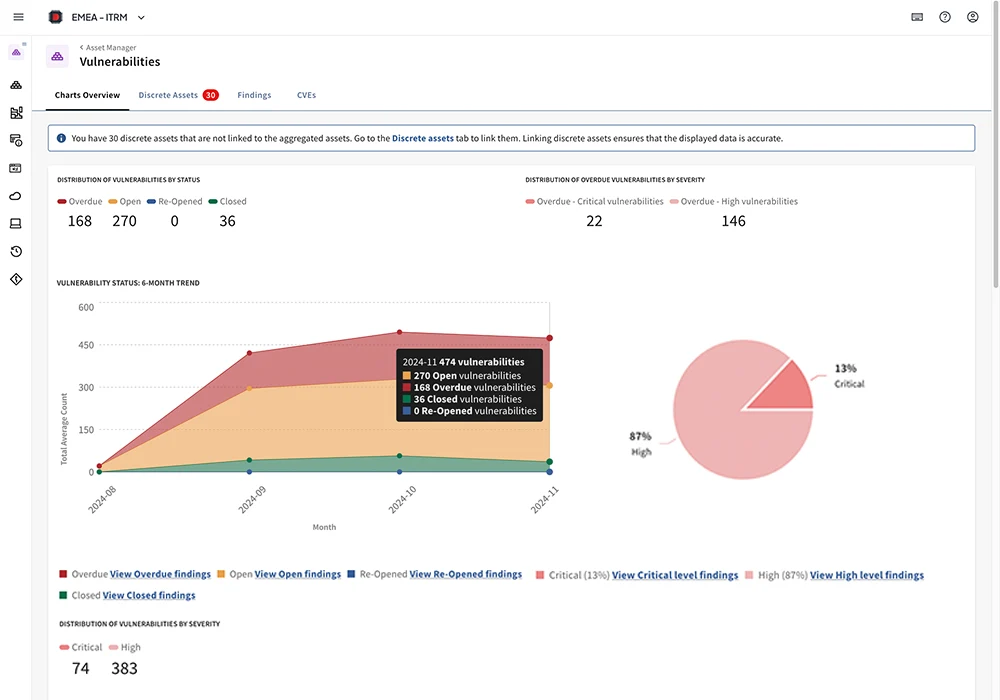
AI-powered risk scoring automatically evaluates the business impact of architectural vulnerabilities, helping leaders prioritize remediation based on strategic significance rather than technical severity scores. Organizations achieve a 50% reduction in risk review time and an 80% cost avoidance in cybersecurity through automated vulnerability aggregation from multiple scanners.
Building on this, Diligent ERM extends architecture risk visibility into comprehensive risk management frameworks. AI-powered risk identification benchmarks architectural threats against 180,000+ real-world risks from SEC 10K reports, helping enterprises understand how their architecture risks compare to industry patterns.
The platform's integration with Diligent Boards delivers risk intelligence directly to directors, enabling strategic oversight of architectural decisions that shape business capabilities.
Together, these capabilities create unified governance orchestration that connects architecture risk management with board reporting, enterprise risk frameworks and compliance automation.
Ready to see how Diligent transforms architecture risk management from fragmented oversight to strategic enablement. Request a demo today.
TOGAF, COBIT and NIST Cybersecurity Framework provide foundational architecture risk approaches, but effective integration requires customization to organizational context.
Leading enterprises combine framework elements rather than adopting single methodologies wholesale. Architecture risk frameworks should connect to enterprise risk management processes using consistent risk rating scales, reporting structures and governance oversight.
These regulations introduce explicit architecture governance requirements. DORA mandates operational resilience testing for financial services, requiring architecture documentation that proves recovery capabilities.
NIS2 extends cybersecurity requirements across supply chains, demanding architecture security assessments for critical infrastructure operators. Organizations must document how architectural decisions support regulatory compliance and build audit trails demonstrating architecture oversight.
Zero trust implementation requires phased approaches rather than wholesale architecture replacement:
Organizations typically achieve zero trust maturity over 3-5 year horizons, prioritizing critical systems and high-risk integrations first.
Organizations frequently implement architecture governance that slows innovation without improving risk mitigation. In addition:
Successful architecture risk management balances oversight with agility, implements risk-based standards and maintains leadership visibility through business-relevant reporting.
Ready to transform your architecture risk management approach? Schedule a demo to see how Diligent centralizes architecture oversight across your enterprise.