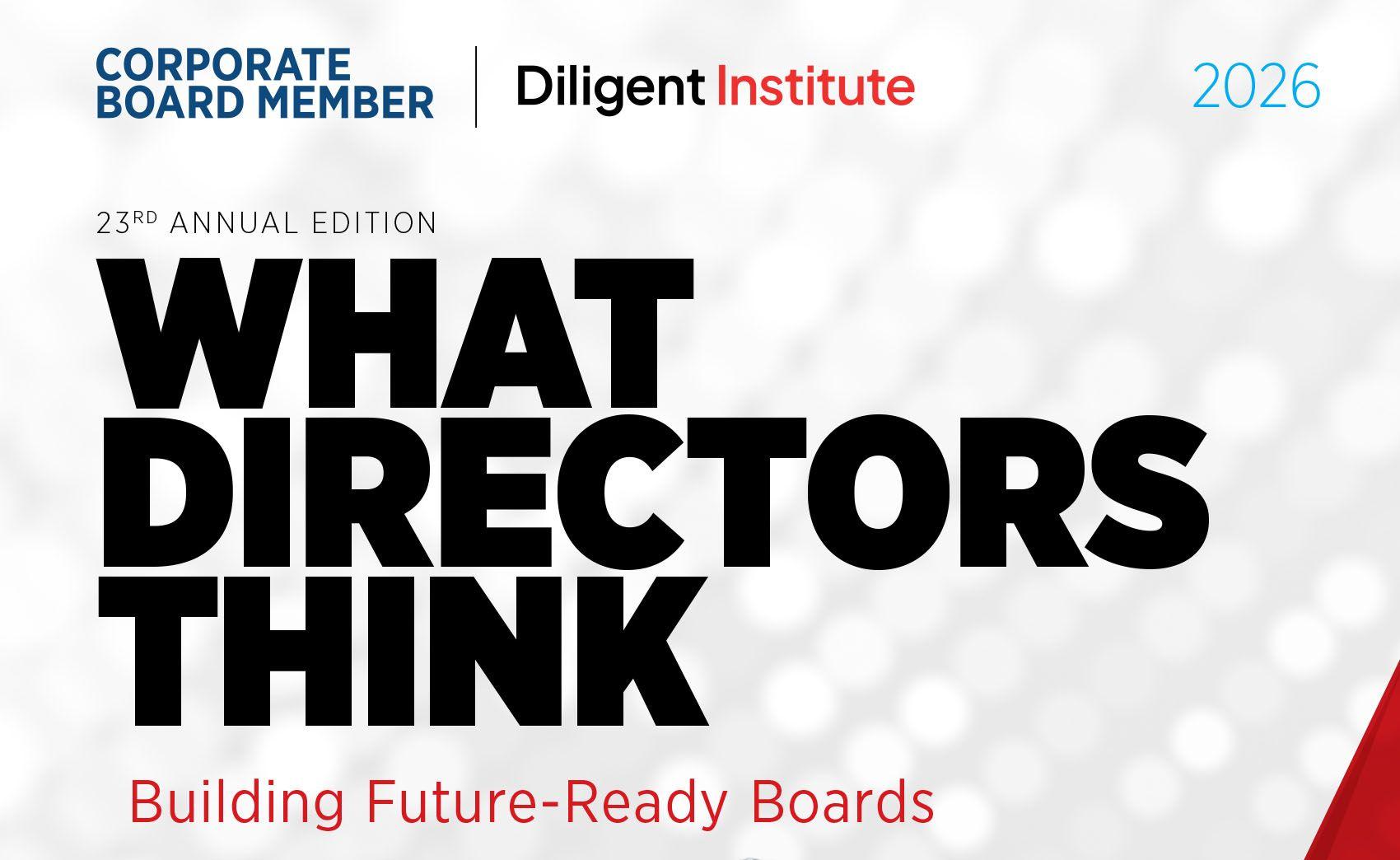
In this episode of the Corporate Director Podcast, Diligent Institute’s Kira Ciccarelli sits down with Melanie Nolen, Head of Research at Chief Executive Group, to unpack the latest findings from the long running What Directors Think survey of U.S. public company directors. Since 2002, this benchmark study has tracked how board priorities, risks and composition are evolving and the 2026 edition shows a striking shift toward growth through M&A, enterprise‑wide AI deployment and a new urgency around board effectiveness and meeting design.
Register for the webinar on What Directors Think 2026 hosted by Corporate Board Member.
Intro/Outro: Welcome to the Corporate Director Podcast, where we discuss the experiences and ideas behind what's working in corporate board governance in our digital tech field world. Here you'll discover new insights from corporate leaders and governance researchers with compelling stories about corporate governance, strategy, board culture, risk management.
Digital transformation and more.
Dottie Schindlinger: Hi everybody and welcome back to the Corporate Director Podcast, the voice of modern governance. My name is Dottie Schindlinger, executive Director of The Diligent Institute, and I'm joined once again by my amazing co-host Meghan Day strategy leader here at Diligent. Meghan. How are you doing today?
Meghan Day: Great Dottie, ready to rant today on a very interesting piece of data coming out of agenda.
One of the leading publications for board governance, news and research. And we just saw one of the biggest waves of board turnover in probably forever. Nearly five times more directors stepped off US public company boards in 2025 compared to the year before. And that goes against everything I've come to know about board members in
Dottie Schindlinger: Okay, so Meghan, you sent me this article. I had a chance to read it. And first of all, do I get like partial credit for years ago having said, I feel like this job is crummy and eventually we're gonna start to see directors stepping off in droves. Was
Meghan Day: I right? I mean, it's interesting. They talk about a number of different factors.
You know, and a huge contributor companies are contracting, emerging, going private. Those board seats go away. Shareholder activism is also, you know, has been for a long time. There's been a lot of settlements more than in recent years involving negotiation around board seats and those things. But I don't know.
I think there is something about sort of. Performance scrutiny being higher than ever. Even drivers like retirement ages, that like, organizations have relatively recently started to, to put in place even, tighter processes, around nom gov and assessment that we have long talked about on this show.
Dottie Schindlinger: Well, certainly that's, you know, all the different things that are playing it. Also, it also mentioned in this article that there were a handful of directors who left because they wanted a better work life balance, or they were, they took a different job, like they got hired into a C-suite role.
And decided to drop their board seat, which I find kind of fascinating. I mean, again, look, there's a lot going on here, so we can't just pin it on one thing. I think, you know, there's a few things. One, of course, being m and a, we saw a huge uptick in m and a activity. Not too surprising, you lose directors 'cause often you collapse the board, right?
So you, you have two companies, you merge, you have two boards, you have to merge them into one board. Some people are gonna step off that. That's just kind of the way that works. But it is also interesting to note. That we have more directors aging out now, and frankly, that's kind of just the way the demographics fall.
A lot of those directors are now getting to their top age limits. You know, a lot of boards still have age limits in place and some people are stepping off, so that's not so surprising. It's all the stuff in between that really interests me.
It's the stuff where people are leaving by choice. Mm-hmm. As opposed to having to leave because of some natural evolution of the company or, or something like that. That feels new to me. That feels like, I mean, especially if you go back, you look at their chart, the chart that they have in this article, and by the way, we'll put a link to this great article on the podcast page.
You know, back in 2020, the net change of number of directors was almost 600 positive, and now you've got almost 400 negative five years later. I mean, that's. That's really interesting. So, Meghan, I'm glad you grabbed this one.
Meghan Day: Do you feel like it’s a one year spike or are we entering some sort of new era where this type of turnover is gonna be the new norm?
Dottie Schindlinger: there's certainly a trendline. It's a question. Yeah, it's, it's, it's a good question. 'cause I mean, if you look at this chart, there's a clear trendline. You had 600 net positive in 2020. You only had like 250 net positive in 2021. Then starting in 2022, it's negative.
It gets really steeply negative that in 2025, like it was down less than a hundred in 20 22, 20 23, and 2024, and then boom, 2025 hit. And there's a stampede for the door. The other
Meghan Day: thing where my mind goes because, just 'cause this is my role on, on this podcast, it brings me back to this dystopian book that I read last year, in which the world is basically controlled by four companies and we each live in a quadrant that's run by a company,
Dottie Schindlinger: So that was called like the New York Times, honestly. Yeah. Yeah. It's interesting, Meghan.
Yeah. Which they're predicting for 2026 too, so. fair point. So, yeah, I mean, I don't know Meghan, it, to me, it's all part of a broader conversation that we've had a couple times in the podcast about what is gonna happen to the public markets anyway.
I mean, you're seeing so many companies delay or just never go, do their IPOs because they're perfectly fine and happy and can raise plenty of capital. As a private company, you're seeing lots of public companies make the decision to go private because being public is harder and involves more scrutiny and this, that, and the other reason, and the number of public companies is shrinking and their average length of lifespan is shrinking.
I don't know what happens from here. to me it sort of feels like at some point, isn't the SEC gonna turn around and go, we gotta do something about all these private companies and we have to have a way to protect investors. there's a thriving private investment market now.
Thriving. Well, it's thriving. So at some point, don't you think we need to have a couple of protections in place for investors in the private market? She said with a question mark at the end of her sentence. Oh, that sounds like naive optimism to me, Meghan, but maybe,
Meghan Day: Well, what I wouldn't give to know what the average board member is thinking these days.
Dottie Schindlinger: What a good segue, Meghan. Well done. I'm so glad you asked that question because we had the opportunity to have an interview with our very own producer, Kira Chiarelli, who also happens to be the head of research for Diligent Institute and one of the co-authors of this year's What Directors Think Report Who.
With Corporate Board Member Magazine, she had the opportunity to speak to the key author, Melanie Nolen. And so let's give that interview a listen, and then we'll come back and we'll ask Kira some questions about what directors think.
Kira Ciccarelli: Joining us on the Corporate Director Podcast today is Melanie Nolen, head of Research at Chief Executive Group.
Melanie Nolen: know it feels like time is just flying by, but thank you for having me, Kara.
Kira Ciccarelli: Absolutely. So before we dig into our main topic for the day, for some of our listeners who may not be familiar, why don't we start by having you just give our audience a quick intro and tell us a little bit more about your role at Chief Executive Group.
Melanie Nolen: So I am Chief Executive Group, research director, which means I oversee all of the quantitative research that we do across the leadership team.
That means beyond boards, we also include CEOs, CFOs, CHROs, basically decision makers, at US businesses. Our research here is absolutely benchmark driven, meaning we conduct research with the purpose of producing data that. The board and the C-Suite can use. We do this often during the year, and we try to touch on a wide variety of topics that, they tell us they're struggling with, whether that is, regulatory changes, macro issues, workforce matter, governance concerns.
We really cover all the issues that could impact the C-suite. We develop our service here to, make sure that we uncover the core of these challenges and how companies are overcoming them, what they've tried, what's worked, what hasn't with their planning, and the idea is to bring back considerations and ideas to the board and the C-Suite community to help them with their business.
Kira Ciccarelli: Great. And to that point, every year corporate board member conducts a survey of US public company directors called What Directors Think. This is a project that we've been thrilled to collaborate with you on at Diligent Institute for the last five or six years now.
So tell us a little bit more about the survey and its history and some of the basics of the 2026 edition.
Melanie Nolen: Yeah, absolutely. And yeah, you, you're right. It's been six surveys together, so seven years in total. We've been to working together, but what director thinks is a lot older than that. It's probably one of our longest running surveys, dating back to 2002.
It is probably also one of our broadest in terms of scope. So typically our surveys here touch on one issue at a time. For instance, we're surveying CFOs, right as we speak on the challenges they face with rising healthcare plan costs. So they are often one topic surveys, but what directors think is entirely different.
So it covers all aspects of governance. We dive into much of what goes on inside the boardroom, their top concerns. Priority issues, biggest opportunities. Who's sitting at the table? Who should be sitting at the table? How directors are allocating their time, where they go to for education.
I mean, it runs the gamut. One thing that's really interesting about the history of what directors think is that we try to repeat some of the questions every year to get trend lines on how all of this is evolving over time. And it's super interesting to see how boards get up to speed on emerging issues.
'cause as you can imagine, since 2002, there's been a lot of things that have popped up on the board agenda that weren't there to begin with. Just an example of that for the past decade or so, you know, cybersecurity has been one of the top concerns for directors. If not the top concern for director. So this year, all of a sudden we're seeing a down the list of issues that are keeping them up at night, which is one of the questions we ask.
And, uh, and I, I just, I just love finding these nuggets of data that show that something is changing. And that was one of the big, findings for me this year. But to see it down the list, not because it's no longer a concern, by the way, but just because there are other bigger concerns on the table.
Kira Ciccarelli: Absolutely. And I love having this piece come out every year, in January because it's just such a nice, timely piece of coverage to really set up the year ahead. And I know at the institute we use it as kind of a bellwether where we're maybe gonna take our research next. So because it's so wide ranging and because it's got this.
forward looking outlook, we're able to get a really nice look at, what some of the big priorities are. And like you said, that trend data is really crucial as well to kind of see how different topics have been trending on the agenda over the last few years. There's a lot changing and a lot to keep track of.
So from there, I think we can pivot into the key findings. And I know every year one of our big marquee questions is about. Organizational priorities for 2026. So tell us what top the list this year.
Melanie Nolen: Yeah, of course. I don't think it's gonna come as a surprise to anybody to find growth as the top priority this year as it is most years.
I think the big difference is what kind of growth, directors and their, leadership teams are looking at. And this year the top priority is growth through m and a specifically. Last year it was growth as well, but it was growth through, new products and innovation. So a little bit of a pivot here, though it is still growth.
We can argue, but m and a is definitely taking a lot of space in our survey this year. It's not only a top priority, it's also the second area where companies are expected to focus their capital allocation just behind AI and tech integration. And interestingly though, even if m and a is the top priority this year, directors are still placing AI conversations as more of a priority for the board than m and a talks.
So I think that we have to be careful on the questions the way they're asked, the top priority. Here we're asking directors, what's the top priority for your organization m and a, and what's the top priority for your board to discuss? Then that was ai.
Kira Ciccarelli: Right. And I always love looking at the confluence of those questions, right?
What's the organizational priority versus what the board wants to talk about next? And I hit this point pretty hard last year. I remember them bringing in the third piece, which is, what are they having the most trouble overseeing? So seeing what overlaps there and where some of the differences are is really interesting.
I know I was. Particularly interested to see growth through m and a be that number one organizational priority because we recently fielded a survey on transaction readiness a little bit earlier in 2025, I guess, in Q2 of 2025 into Q3, and we were definitely seeing m and a a little bit lower on the list there as far as looking at different ways companies were trying to grow and what kind of their primary.
I think seeing m and a maybe surge a little bit in terms of priority order has been interesting. And you mentioned a little bit there. AI and deploying AI across the business. So I think one of the biggest takeaways from the results this year was that intense focus around AI deployment.
what were some of the biggest AI findings in the survey this year?
Melanie Nolen: Oh, no, that AI was everywhere in the survey. It came through nearly every question we asked. It was second among the most pressing issues for boards to address. It was.
Second for, 2026 strategic priorities. It's first in capital allocation for the year, and perhaps the most surprising to me is AI expertise is now the fourth most sought after qualification for new directors to join a public company board. I think, the topic right now looking at the survey results.
Has permeated every part of the business. Finance, HR strategy, r and d, legal, it's everywhere on the table. When I'm looking at the data, two things surprised me here a little bit. The first one is, I'm happy to see that it's viewed as an enterprise or strategy issue, not a tech issue.
When cybersecurity became a concern on board agenda a decade ago or so, it was more of a tech siloed issue. Clearly that's not the case here with ai. So that's really interesting to view it that way. But I think most important in the data, what we're seeing is that even though directors are viewing AI as an opportunity.
They're not viewing it so much as a risk. There were less than a quarter, I think it was 19% if I recall, who said they view AI as having the potential to upend their business model. And then I think about the same number, perhaps a little bit more, perhaps about a quarter say that they include AI related risks and their scenario planning exercises.
So I think that there's an interesting gap that showed up in the results here about AI is that it is so. Everywhere in the conversation, but not as much as a risk. And that's interesting to explore for me now.
Kira Ciccarelli: Yeah, that is really interesting. I know that together you and I have been asking questions about AI on what directors think, and on the director confidence index surveys, I think maybe as far back as 20 20 22 or 2023.
So it has been fascinating watching. Director's view of the technology fluctuate and where it's kind of ranking on the priority order. And are they thinking more about the risks? Are they thinking more about the opportunities? What are they thinking about when it comes to integration? And I think we're seeing that play out in surveys that we've conducted in other regions as well.
So definitely fascinating to monitor. To that point, you said that directors maybe aren't viewing AI as. In more of a risk lens at the moment. So what are some of the biggest risks directors are keeping their eyes on in 2026, and how are they saying that risk oversight is evolving as a result?
Melanie Nolen: Yeah, I think that the risk question is also one, just like the opportunity one or the the priority one.
It's one that you need to be careful about how it's worded. So we asked them with the biggest risk to their growth strategy, I believe. So we asked them what the biggest risk was to the strategy and not necessarily the biggest risk happening to the business. And on that note, a sudden downturn in the US economy was by far the number one top risk that could derail the strategic plan for the year.
55% chose it as their top risk. And behind that way behind that 31% was the second item on the list, and that was a Black Swan event. So we're talking about very concrete. Risks that, you know, directors have seen before and they know that it can definitely derail plans. So I think that it's not necessarily a surprise to see it there ahead of everything else.
Kira Ciccarelli: Yeah, it's sort of a little bit of a retrospective answer. I think we got outta directors this year, so I think we saw what. Wild swings in economic policy can do for director confidence and for what, how it can upend their business and their strategy.
And I think Black Swan event is undoubtedly informed by our experience with the pandemic in the last five years. So I think definitely a little bit of a take stock moment from directors when they answered that question in particular this year. We also ask a lot of questions in the survey about how boards think they can improve both in composition and in process.
So what were some of the key findings this year in that regard, and how are boards maybe trying to become a little bit more future proof?
Melanie Nolen: Yeah, that's so interesting. It feels like I say this with every question you ask me. Um, but, but, but I, I find it fascinating. But, uh, yeah, I mean, based on my experience, directors have always been opposed to having specialists on board, if we can call them that, like those with a very narrow path in their careers.
They've always stopped members with, a broad business acumen, industry knowledge, A CEO or a C-suite background of some sort. Those have always taught the list of the most important attributes to sitting on a public company board. Basically, a member needs to be able to talk about every aspect of the business and, those attributes have always been at the top of the list, and they still do this year.
But AI expertise is the one that's surprised me again, because it's showing up right there in fourth place. Right behind those three critical. You know, no negotiating aspects of a board member's background, and it's outpacing every other area of specialized knowledge, and I find this interesting because.
To me it screams not that directors are wanting an AI expert, whatever that means to sit on their board, but that they're needing more education on this matter. They're not right now with their composition, where they're not allowed or not allowed, not able to speak to those issues as well as they would like to.
And I think that just shows that they're looking for somebody who can also bring that knowledge to the boardroom. Not just that knowledge, but the whole. C-suite experience and industry and business acumen.
Kira Ciccarelli: Yeah, it's interesting, and I'm glad you called that out because I like to think of those three traits that you just mentioned that typically take the top spots and what directors are looking for in their next board member as more of a yard stick.
So it's not necessarily about whether AI expertise ever takes that number one spot, right. But it's how it's performing. In relation to things like C-suite experience and industry experience and things like that. So to see it that high up I do think is incredibly noteworthy. Zooming out just a little bit as well, we also work together on a quarterly poll survey of us public company directors on their confidence in the economy and kind of regional business conditions.
And I know that we conducted our Q4 edition to kind of cap the year off. Just a couple weeks ago in late December, how do those findings align with what we've seen come out of what directors think?
Melanie Nolen: I think they align very well. The beauty of the director confidence index is it's short, it's quick, and it's really timely.
So we do it four times a year, which means that we have a, more timely pulse of what changes and so we'll often take. Data points from what directors think and revisit them throughout the years, especially if something's happened in relation to, something they had already flagged as a risk or an opportunity
not wishing that on anybody, but if there was a downturn in the US economy would be a good time to go with the director of Confidence index and say, okay, hold on. You know, what are you doing about this? What's the next step? And did you prepare for it because you hand flagged it as a top risk? So we're assuming that there are some plans being laid out for what if this happens, what's our next move?
So I think the Director of Confidence index is, is a great source of fresh data. And then of course, we had asked them about ai, as you mentioned several times in the past. If I'm to pull something from there that. Was reflected also in what directors think is the way that directors themselves use ai.
So they're definitely advocating for the business, digging into how can we, you know, drive value from this and how do we integrate it across the business? But how are they doing it for in the boardroom? How are they using AI for their own board work? And I think that that's still something that's lacking
They're not using it that much. Maybe a couple of dashboards or board books here and there that's, data driven. But there is great potential for them to use AI to help their oversight dig deeper into the metrics. Uh, and I don't know if it, this is something that's a risk matter of ai not.
Looking at the data correctly or the correct set of data, or if it's a matter of getting the right tools, the right training, the right data flow from the leadership team. I really don't know what the issue is here, but definitely there is, several of our data points that show that boards rarely use the benefits of AI to their advantage in the
Kira Ciccarelli: One of the things that stuck out to me the most in our most recent. Issue of the director confidence index was we hit our five year anniversary of running that survey. So we started fielding it in late 2020 and we asked directors what has changed in that amount of time it's really just.
The scope of the issues under their purview and the amount of things that you have to be able to oversee and link together and connect it back to your strategy and understand what the impacts might be in addition to all the other parts of their jobs as directors. And I think linking that to their experimentation with AI is so important.
And I really think the next couple years are gonna be very eye-opening as far as what can the technology do both for businesses as a whole. And how directors are gonna have to grapple with the oversight of AI use at their businesses, but also that other piece of how are they themselves gonna be using the tools and how can they use it to improve their oversight capabilities given that the job has become so expansive.
So lots of fascinating stuff. Any other findings from the survey that surprised you or that you think we should touch on that we haven't already?
Melanie Nolen: Is one thing that just is nagging me about findings. directors have been consistently telling us now for, I don't remember how many years, but they wish they spent less time on.
Management presentations and PowerPoints and basically rereading the board book on site. And they want more time to just discuss what's in it, to discuss the strategy, ask questions, probe further and I have trouble every time we ask this question and these answers come up. I still don't understand why this is not.
It seems like an easy thing to do, and maybe I'm completely wrong. But again, this year we saw the same results. We asked them what could improve their oversight process. More frequent or more structured risk discussions, clearer linkage, as you mentioned earlier, between risk oversight and strategy setting.
Improved management reporting and even they even said enhanced use of AI powered data and technology tool. So it seems to me that this is an overhaul internally. And such an easy thing to check off the list to improve the oversight process, and I don't understand what's keeping it from happening.
Kira Ciccarelli: Yeah, it is interesting. That's something that we do see year after year, and every time we ask about it, that's what comes up. And then I, I think sometimes in other questions, we find that directors are asking for more data. They want more data, or they want better data. So maybe that's contributing to why.
Things start to feel more like a readout and less like a strategic discussion. But I agree with you and I think we saw in one of the questions we asked about whether or not the board meetings themselves were more retrospective, more balanced, or more forward looking. Only 12% I think characterized their meetings as mostly forward-looking.
And then when we followed up on that in the next edition of the director Confidence Index, we. Found that boards on average do want their meetings to lean more forward looking rather than backward looking. So definitely a gap there and maybe something AI can help out with. And try and get that presentation time down a little bit tighter.
Melanie Nolen: The one thing I am hearing from directors, a lot on this is they don't necessarily, when they say they want more data, they don't want a data dump. I mean, they don't want just leadership to throw data at them and figure it out. They just want better data. So I think that that's where AI can come in and help clean it up and link, connect the dots, so to speak.
Kira Ciccarelli: So where can people go to find the full results?
Melanie Nolen: There's a lot of places. It's gonna be on board member.com under the research section. It's also going to be in the, first issue of Corporate Board Member magazine, where we take a different take at it, where it's a lot more editorialized with director interviews, speaking to the data.
And then we're gonna host two webinars the details will be on the recording page, if I'm not mistaken, Kira. But we're gonna host two webinars because there's so much to dive into, that we couldn't fit it all into one. Throughout the years, we're gonna be releasing articles, very short pieces that tackle one topic at a time, and the findings from the surveys.
Kira Ciccarelli: Yep, absolutely. So we will be sure to link to all of that research on the podcast page where you'll be able to listen to this episode as well. And as Melanie said, get ready to be sick of the What Directors Think results, because we will be talking about them a lot. There's a ton in the survey.
There's a ton that we didn't get to in this interview. And there's a ton, in the report and in the magazine coverage as well. So looking forward to all of that coming out throughout Q1, and beyond as well. So before we head out, Melanie, just a couple questions that we'd like to ask all of our guests here on the show.
What do you think will be the biggest difference between boardrooms today and 10 years from now?
Melanie Nolen: I mean if you think about it, companies have dropped the 10 year plan and to the five and now down to the three, four year. I mean, I don't know that I can predict, but boardrooms are gonna be like 10 years getting harder.
It's getting harder. I don't even know if I can say what's gonna be like five years from now. One thing I have noticed gradually is the degree of responsiveness. so I'm not so sure that serving on four or five, six boards now and having a day job makes sense for most directors.
So I doubt that in the future, unless we find a new way of, of doing business in governments, I don't think that sitting on more than two boards is gonna be commonplace anymore.
Kira Ciccarelli: what is your current passion project?
Melanie Nolen: Oh, that's interesting. I am just starting to learn German. My goal is to speak as many languages as I humanly can, and this will be my fourth, I studied linguistics in college and have been rekindling with that. I find the root of languages fascinating and it's the first time I will venture out to, I'm French, so French and Spanish were given.
English came because well. It was a second language in my country, German is gonna be the first language out of the Latin root, and so it is a little bit of a challenge, but I am really, really passionate about it.
Kira Ciccarelli: That's so exciting.
Melanie Nolen: Are you taking a class? I'm starting out with Duolingo.
I did, Babel last year, and it just didn't go very far. The style of learning wasn't for me. I think the Duolingo, interaction with ai, again, here it is, but I find it really easy to follow and learn and ask questions. So, yep, that's how I'm doing it for now.
Kira Ciccarelli: I'm about 1400 days into an Italian Duolingo exercise. So I've just been keeping the streak up every day. It's a good motivator. Used to take it in high school. So the Duolingo is like a slow but steady wins the race type of approach. I do feel like I'm picking stuff up.
Melanie Nolen: Put 15, 20 minutes, 30 minutes in each day.
It's nothing. It just goes. But then you're actually doing the work and progressing. Next thing you know, you're up a level. I do intend to get a tutor eventually, but I need to advance further before I get to that point.
Kira Ciccarelli: Fair enough. Well, good luck with language number four.
Thank you. We've been joined by Melanie Nolen, head of Research at Chief Executive Group.
Meghan Day: Great interview. Always thought provoking stuff, and welcome back to the show, Kira. We're happy to have you here.
Kira Ciccarelli: Thanks for having me and congratulations on 175 episodes. We haven't commented on that yet. Yeah.
Dottie Schindlinger: Wow. You know what, it's true. I, we made a big deal out of, 150 and now 175 just feels like Yeah.
It's more another day. Yep. There goes Thursday,
Meghan Day: so Kira, I have to call out. Something that you said in your, your interview with Melanie that really stuck with me, and this is around the information that boards really need and when it's just more versus when it's the right information and what, I think we are just in this a little bit of growing pains period, as there's just the opportunity to have so much flying in your face.
But how do we make sure that we solve what, as Melanie says, it's kind of, it seems like the easiest problem to solve, that it's very fixable.
Kira Ciccarelli: Yeah. I mean, so we talk about it a little bit in the interview, but the one constant over all the time that we've been working with corporate board member on what directors think is directors are constantly telling us that they want more time for strategic conversation and they want.
Less presentation in their board meetings. At the same time as risks expand, as the amount of issues under their purview expand, I think it can be hard on the management end to feel like you're really keeping the board informed. At the same time, make sure that you're leaving space for that strategic conversation.
And I think that kind of ties into a lot of threads about potential AI use cases that we saw come up in the report. So definitely.
Dottie Schindlinger: Well, I wanna ask you a little bit more about the AI thing too, because, you had a chance to talk about it at length with Melanie. there was a lot of AI in this report, right?
I mean, it was sort of like. The undercurrent behind every single question that was asked in the report. But I wanted to ask you, at the top of the show, we talked a little bit about this report from agenda and the number of directors exiting boards, and I know that one of the big.
Skillset that boards are looking for in incoming directors is AI expertise and AI knowledge. Do you think those two things are linked in any way? What do you think? Yes. Okay.
Kira Ciccarelli: And I'm really glad you brought that up. Um, and I'm really glad that we brought that agenda article and that research into the conversation because I think, we would probably need to do more research to figure this out for sure.
My suspicion is maybe some directors are just throwing in the towel because they're seeing the risk landscape evolve. The last year was absolutely not an easy one. I think we heard that loud and clear from pretty much every corner of the business world, particularly in the us.
So I wonder if for some directors who are maybe having. Served on their board for close to 20 years at this point, if they're just saying, I'm not learning ai. I'm sorry, what?
Dottie Schindlinger: What a very elegant and diplomatic way to say that, Kira Elli. But honestly, I kind of understand the feeling.
There are definitely days where I feel like saying unsubscribe, and that's where I wanna get off the bus.
Kira Ciccarelli: Maybe for some directors. The agenda article mentioned this PWCs annual corporate director survey. Every year an outrageous percentage of directors say someone on, they think someone on their board should go.
So maybe those directors are just saying, fine.
Dottie Schindlinger: finally, they listened to the PWC report and said, yeah, you know what?
We're gonna, this year, they're gonna get 'em off the board.
Kira Ciccarelli: I also think a lot about the numbers that we saw in 2023 and 2024. I haven't checked the numbers for 2025 yet, but about CEO turnover on public companies as well, and maybe that was a little bit of a. Canary in the coal mine. Yeah, I think a lot of the pressures that you brought up, I think we saw that play out with CEO turnover.
We saw succession planning come up pretty high on the list of agenda items and priorities and what directors think last year and now I wondered if that's trickled up or trickled down to the board.
Dottie Schindlinger: Well, and let's not forget, it's also been an incredibly active couple of years in terms of shareholder activism.
There's been a lot happening in that space. So I feel like there's just pressure coming from every quarter and you know, maybe this is a, to use that same euphemism. A lot of people are like, this is my stop. This is where I get off the bus because it just, I think I've, I'm done.
I'm good. I think I'm gonna step off here. I mean, it happens. I think it definitely happens. All right. Kara, I wanna also ask you, you know, you got to do this report every year. You get deep into the data. Is there any data point that you was like, just something you loved, you found particularly delicious, but just didn't make it in the report?
'cause it just didn't quite. Fit. It wasn't, it wasn't that big of a deal, but it was something that really you liked.
Kira Ciccarelli: maybe I'll go with something that we didn't get to talk about in the interview, which is we asked a lot of questions about AI and compliance in the survey this year that I thought was really, really interesting and you'll be able to read.
More about the findings in the full white paper, but AI was another through line. And basically all of the questions that we asked about compliance. So when it came to, what could kind of improve your oversight of compliance related matters, having more access to AI powered tools came up pretty high on that list.
AI risk was also the, most underestimated risk, as far as compliance concerns went that the board said, I think this is something people are. Forget about or leave out us included, and we probably shouldn't do that. So I think the compliance and AI survey data was pretty interesting to me this year, and this was the first year that we've been able to ask some questions like that.
So do you think unbalanced
Dottie Schindlinger: this year versus last year, directors are feeling more, excited about the opportunity that AI presents, or more cautious about the risk it presents, or more concerned that we're just actually at the top of a bubble that's about to burst? What are your thoughts?
Kira Ciccarelli: I feel a little bit of all of those things and I'll tell you why I think it has been in the us. We've been asking questions about AI for two or three years now and it's been fascinating watching it ebb and flow on the priority order and also on what directors think the top risks are.
A little bit more of an opportunistic phase, I'll say, as opposed to a risk one. We talked about that a little bit in the interview. Directors are ranking AI risk a little bit lower than some other things like black swan events or sudden downturns in the US economy, and they're thinking about AI with more of this opportunity lens in Asia Pacific though, that was not the case when we asked them a similar question just a couple months ago, they're thinking about AI very much in a risk lens.
Mm-hmm. So I think. It comes in waves and it's very much dependent on region and on what the regulatory landscape looks like where you are. But I would say for the US swinging a little bit more optimistically these days.
Dottie Schindlinger: Interesting. Well, Kira, I'm so glad you got an opportunity to do this interview with Melanie, and thank you so much for joining us on this rant.
I think it's always great to, pick your brain a little bit and find out, what's behind the report, what's behind the data. So thanks so much for taking the time to do this. Of course, this is one of my favorite episodes of the year, so always happy to hop on. Well, that wraps up another episode of the Corporate Director Podcast, the Voice of Modern Governance.
I'd like to say a few special thank yous. First and foremost, to our data Wranglers, Melanie Nolen and Kira Cicarelli podcast producers. Also Kira Cicarelli, Steve Clayton and Laura Klein, our sponsors for the show, including KPMG, Wilson Sonsini and Meridian Compensation Partners, and most especially, thank you to Diligent for continuing to support this show.
If you like our show, please be sure to give us a rating on your podcast Player of Choice. You can also listen to our episodes and see more from Diligent Institute by going to diligent.com/resources. if you serve on a nonprofit or public sector board, tune into our sister Diligent podcast leading with Purpose for expert conversations on governance, risk and compliance that makes an impact for mission-driven organizations.
Thank you so much for listening.
Intro/Outro: You've been listening to The Corporate Director Podcast.