
In this article

A proxy statement is an essential SEC-mandated document that public companies must provide to shareholders before annual or special meetings. Understanding what a proxy statement is — and how to prepare one strategically — has become increasingly important as investor expectations around disclosure, executive compensation and board oversight continue to evolve.
Beyond compliance, proxy statements serve a dual purpose: They enable informed shareholder voting while providing boards with opportunities to communicate governance priorities, address potential risks and demonstrate transparency around executive compensation. The 2025 proxy season introduced heightened expectations around AI oversight, ESG disclosure and board responsiveness to shareholder concerns — making strategic proxy preparation more critical than ever.
This guide will help you understand and navigate proxy statement requirements by explaining:
A proxy statement (SEC Form DEF 14A) is a document that publicly traded companies must file with the Securities and Exchange Commission and distribute to shareholders before annual or special shareholder meetings.
The document provides shareholders with the information they need to make informed votes on matters including director elections, executive compensation and corporate proposals.
Proxy statements serve three critical functions in corporate governance:
The SEC regulates the rules corporations must follow when releasing their proxy statements. Some important rules are:
Public companies with securities registered under Section 12 of the Securities Exchange Act must file proxy statements. This includes companies listed on major exchanges like the NYSE and NASDAQ.
The corporate secretary typically manages the proxy preparation process, working closely with the general counsel, investor relations team and board committees to ensure accurate and compliant disclosures.
SEC regulations specify detailed disclosure requirements for proxy statements. Companies must provide comprehensive information across several categories.
Proxy statements must offer detailed insights into executive pay practices:
Shareholders need comprehensive information about board composition and governance practices:
Growing investor expectations have expanded proxy disclosure requirements around risk management:
The 2025 Glass Lewis proxy voting guidelines introduced explicit expectations for board-level AI governance oversight — requiring companies that develop or use AI technologies to disclose how boards are overseeing this area and expanding their collective expertise.
Proxy statements must include properly submitted shareholder proposals, even when management recommends voting against them. Companies must provide:
Proxy statements make it possible for shareholders who can't attend the annual meeting to vote — called their proxy — to other shareholders, the board of directors or another representative so that the decisions made at the meeting are as legitimate as possible.
Shareholders can get all the information they need from the proxy statement, then instruct their proxy to vote according to their wishes by writing the vote on a proxy card.
Shareholders receive proxy materials and can vote through several channels:
The proxy card allows shareholders to vote "for," "against," or "abstain" on each proposal. Shareholders can also designate how their proxy should vote if they do not provide specific instructions.
SEC rules implemented in 2022 require universal proxy cards in contested director elections. This allows shareholders to vote for any combination of nominees from both the company's slate and dissident slates on a single ballot — a significant change from prior rules that required separate cards.
"The universal proxy keeps the perception that the bar is lower to get someone on the board," says Jon Solorzano, Counsel for Environmental, Social & Governance at Vinson & Elkins. "Activists are getting better at recruiting quality candidates."
Proxy statements specify the minimum number of shares that must be represented — either in person or by proxy — for votes to be valid. Without a quorum, companies cannot officially conduct business at shareholder meetings.
The SEC regulates proxy statement preparation and distribution through detailed procedural requirements.
Proxy season timing depends on a company's fiscal year-end date. For companies with December 31 fiscal year-ends (the most common):
Strong proxy statements require strategic planning and attention to evolving investor expectations. These practices help governance teams prepare effective disclosures.
Investors increasingly scrutinize how boards make decisions, not just the outcomes. According to Diligent Institute's What Directors Think 2025 research, 65% of board members actively monitor total shareholder return and executive pay-performance alignment — metrics that directly connect to proxy disclosures.
Explain your board's approach to:
"At least once a year, put your activist hat on and look at your potential vulnerabilities from an outside-in activist viewpoint," says Catherine Morris, Director at PJT Partners. "What are the proactive measures you can take about refreshing your board, improving disclosures and so on?"
Complex information becomes more accessible through thoughtful visual presentation. Consider using:
When communicating board composition, matrices and infographics often demonstrate a spectrum of director skill sets more quickly than paragraphs of text.
Environmental, social and governance (ESG) issues continue to appear in proxy statements, though shareholder proposal support has shifted. The 2025 proxy season saw environmental proposals average 13% support (down from 18% in 2024) and social proposals average 12% support (down from 15% in 2024).
Despite lower proposal support, companies should maintain clear ESG disclosures in proxy statements. "Be transparent about your ESG," advises Heindrek Allen, ESG Manager at Magnit Global. "If you're always transparent, it's harder to be accused of greenwashing."
Move beyond minimum disclosure requirements to communicate your governance narrative. Use the proxy statement to:
The board chair letter and CD&A sections provide opportunities to tell a compelling story about governance effectiveness.
See how leading corporate secretaries are reducing proxy prep time while improving disclosure quality.

For organizations preparing proxy statements, manual processes create inherent risk. Spreadsheet-based compensation tracking, email-driven data collection and fragmented document management leave gaps that compromise accuracy — often discovered only when proxy advisors flag concerns or shareholders vote against management recommendations.
Purpose-built governance platforms like Diligent eliminate this fragmentation, transforming reactive proxy preparation into proactive shareholder engagement.
Diligent Market Intelligence serves as the data foundation for proxy preparation, providing comprehensive benchmarking and activism tracking that transforms disclosure from guesswork into a defensible strategy.
According to Diligent Institute's What Directors Think 2025 report, boards proactively tracking activist vulnerability focus on revenue and earnings growth (66%), total shareholder return (65%) and executive pay-performance alignment (64%) — metrics that Diligent Market Intelligence surfaces automatically.
Diligent Boards streamlines proxy preparation workflows and ensures the accuracy of materials that feed into SEC filings:
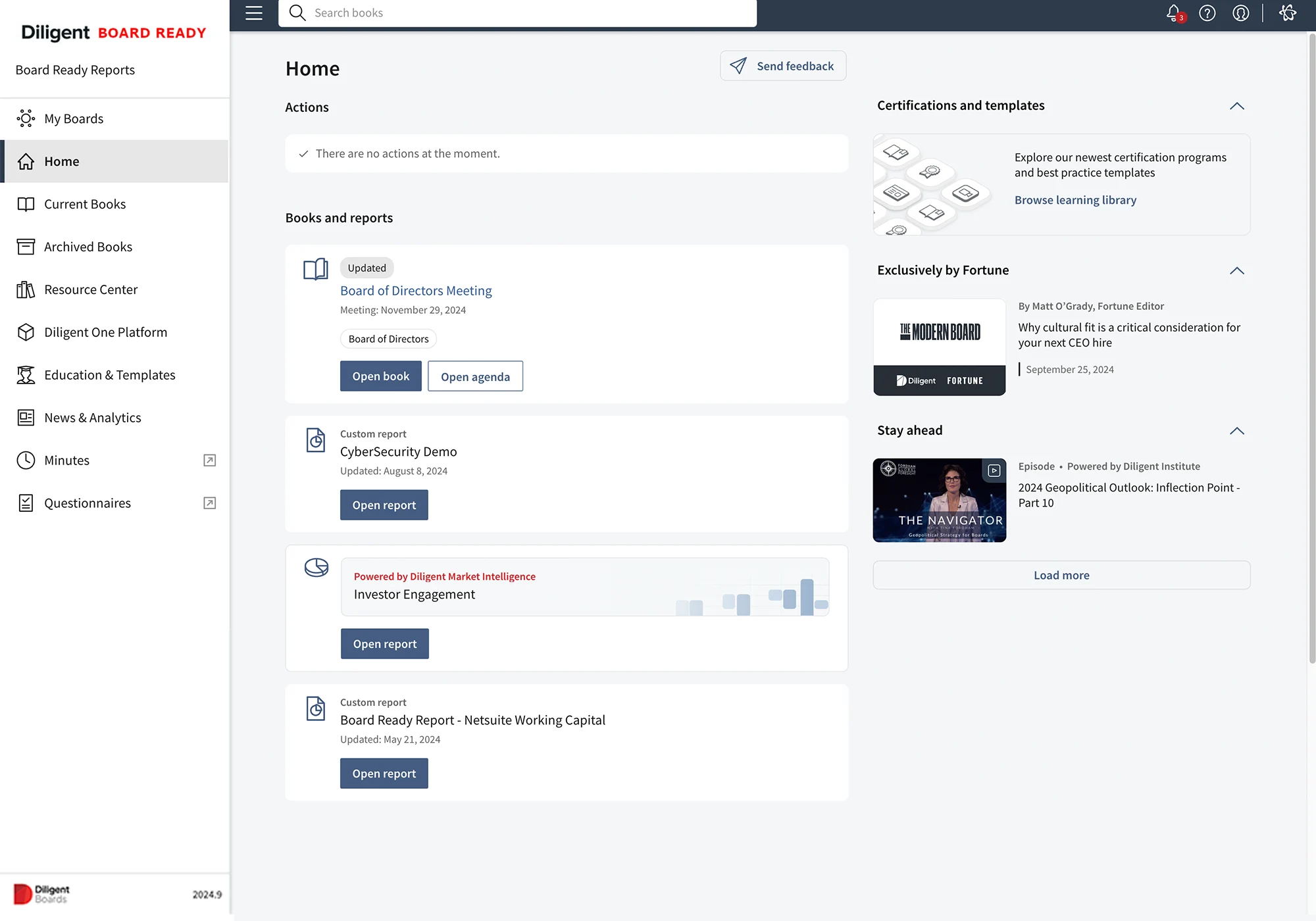
"Our platform has revolutionized how we access information, creating a seamless system of checks and balances across our committees," says Bing Goldsworth, Executive Assistant at Organically Grown Company. "Features like real-time updates and easy document management have streamlined our operations, making our meetings more effective and efficient."
These AI capabilities ensure that the governance disclosures in proxy statements reflect thorough oversight and informed decision-making — exactly what proxy advisors and institutional shareholders scrutinize.
Whether you're benchmarking executive compensation, preparing for proxy advisor evaluation or demonstrating board responsiveness to shareholders, integrated governance technology provides the accuracy and efficiency that manual processes cannot match.
Schedule a demo to see how Diligent helps corporate secretaries streamline proxy preparation while improving disclosure quality.
Proxy statement timing depends on a company's fiscal year-end date. For companies with December fiscal year-ends, proxy statements are typically filed between late March and early May, with annual meetings held between late April and early June.
Companies must distribute proxy materials to shareholders at least 20 days before the meeting date. The SEC requires definitive proxy statements (DEF 14A) to be filed before any solicitation of shareholder votes.
Search the SEC's EDGAR database by company name or ticker symbol, then filter for "DEF 14A" filings. Many companies also post proxy statements in the investor relations section of their corporate websites. Proxy materials are typically available four to six weeks before annual meetings.
A proxy statement focuses specifically on matters requiring shareholder votes and provides detailed information about director nominees, executive compensation and shareholder proposals.
On the other hand, an annual report (Form 10-K) provides comprehensive financial and business information for anyone following the company, including investors, analysts and regulators.
A preliminary proxy statement (Form PRE 14A) is filed with the SEC approximately 10 days before the definitive proxy statement when votes involve significant matters like mergers, acquisitions or contested elections.
The SEC reviews preliminary filings and may request changes before companies file the definitive version. The definitive proxy statement (Form DEF 14A) is the final version distributed to shareholders and filed with the SEC before soliciting votes.
Request a demo to see how Diligent helps corporate secretaries prepare investor-ready proxy disclosures.