

Companies preparing for transactions face mounting pressure to demonstrate governance maturity. As regulatory expectations intensify and investor scrutiny grows, organizations that relied on spreadsheets and manual processes now recognize that these approaches cannot scale with their growth trajectory.
The question isn't whether to implement GRC automation, but how to transition strategically before governance gaps become deal-breakers during due diligence.
Recent data reveals the urgency: according to Diligent's Transaction Readiness Report, 60% of companies report their GRC and finance systems are either completely siloed or only partially integrated. Meanwhile, legal and compliance leaders rate business risk at 7.9 out of 10 — a 36% increase since Q1 2025, per Diligent’s and Corporate Board Member’s GC Risk Index.
In light of the above, this article explains how organizations can transition from manual GRC approaches to integrated automation platforms, covering:
GRC automation uses technology to centralize, standardize and streamline governance, risk and compliance activities across an organization. Rather than managing obligations through disconnected spreadsheets, email threads and manual reporting, automated GRC platforms provide a single source of truth for all compliance requirements, risk assessments, policy management and regulatory tracking.
For companies moving toward transactions, GRC automation delivers three critical capabilities:
The distinction matters for organizations preparing for heightened scrutiny. Manual GRC processes may have worked when the company had 50 employees and operated in one jurisdiction.
But as the organization scales to 500 employees across multiple markets, the same approach creates governance gaps that emerge during investor due diligence — exactly when they're most costly to address.
The regulatory landscape has fundamentally changed since companies could manage compliance obligations with spreadsheets. Organizations now navigate overlapping frameworks, including Sarbanes-Oxley (SOX), GDPR, industry-specific regulations and increasingly stringent data privacy requirements. Each framework demands continuous monitoring rather than periodic attestation.
This becomes essential as organizations approach transactions. Investors conducting due diligence assess whether the company's governance infrastructure can scale. Manual processes signal operational immaturity that directly impacts valuation. On the other hand, automated systems demonstrate that the company has built institutional-grade capabilities that support growth.
The shift from manual to automated GRC also reflects changing board expectations. Directors now expect continuous risk monitoring rather than quarterly reports that reflect outdated information. They need real-time dashboards showing compliance status, emerging risks and control effectiveness. Manual data gathering cannot deliver this velocity or accuracy.
Automated GRC platforms deliver measurable improvements across operational efficiency, risk management and compliance assurance:
Companies preparing for funding rounds or acquisitions spend months compiling governance documentation that should be continuously maintained. Automated systems maintain audit-ready records in real time, reducing due diligence preparation from weeks to days.
This accelerates transaction timelines and preserves management focus on business operations rather than governance fire drills.
Rather than periodic assessments that create gaps between review cycles, automated platforms continuously monitor compliance status. Real-time alerts flag potential violations before they become material issues. This proactive approach prevents costly remediation when compliance gaps emerge during investor due diligence.
Siloed GRC efforts prevent organizations from recognizing overlapping controls across multiple frameworks. Automated platforms enable risk, audit and compliance teams to share data, coordinate assessments and eliminate duplicative work. The result is more comprehensive coverage with less effort.
Directors need strategic risk insights, not detailed compliance checklists. Automated GRC platforms aggregate data into executive dashboards that highlight material risks and emerging trends. This enables boards to focus on governance oversight rather than data validation.
Manual data gathering consumes significant staff time on repetitive tasks. Automation redirects these resources toward strategic advisory work that drives business value. The difference shows up during transactions — when compliance teams can focus on addressing investor concerns rather than scrambling to compile basic documentation.
Every action in an automated GRC platform creates timestamped records showing who assessed which risks, when controls were tested and how issues were resolved. These comprehensive audit trails satisfy investor and regulatory scrutiny while protecting the organization from compliance questions.
As companies expand into new markets, acquire other businesses or face new regulatory requirements, automated systems can scale to accommodate increasing complexity. The alternative — hiring additional staff for each new obligation — creates unsustainable cost structures.
Organizations encounter predictable obstacles when transitioning to automated GRC. Understanding these challenges enables proactive mitigation strategies:
GRC automation requires cross-functional coordination and significant change management. Without executive sponsorship, implementation stalls as departments protect existing processes. The business case must demonstrate how automation enables strategic objectives like transaction readiness or operational scalability, not just compliance efficiency.
"One of the things that helped the most was having our process well-documented, so that we could send it over to the implementation team," says Elizabeth Simon, Risk Vice President, Compliance at Progress Residential. "By knowing what we wanted to do, and then having a comprehensive document they could work off, that was key to the success of the project."
Teams comfortable with spreadsheets and email workflows often resist transitioning to new platforms. This resistance intensifies when employees fear automation will eliminate their roles. Successful implementations emphasize how automation redirects staff from manual data entry toward strategic risk management and advisory work that adds greater value.
Organizations operate multiple systems for financial reporting, audit management, risk assessment and policy management. Connecting these disparate platforms requires careful integration planning. The alternative — maintaining disconnected systems — defeats the purpose of centralized GRC visibility.
Companies often pursue GRC automation while simultaneously implementing new ERP systems, migrating to cloud infrastructure or building data analytics capabilities.
Without coordination, these overlapping initiatives create resource conflicts and implementation delays. GRC automation must be positioned as enabling other transformation efforts rather than competing with them.
Decision-makers sometimes assume GRC automation requires massive capital expenditure. Cloud-based platforms have fundamentally changed this equation. Modern solutions scale with organizational size and can be implemented at a lower cost than many organizations expect.
The ROI calculation should factor in avoided penalties, accelerated transactions and reduced manual effort.
Organizations want platforms that match their specific workflows. However, excessive customization creates a maintenance burden and complicates future upgrades. The most successful implementations adopt proven frameworks while configuring systems to address genuine business requirements.
Companies approaching GRC automation strategically follow a structured implementation framework that balances comprehensive planning with incremental progress:
Begin by articulating specific outcomes the automation must achieve. Are you:
Clear objectives drive vendor selection, prioritization decisions and success metrics. For transaction-focused companies, objectives typically center on creating audit-ready documentation, accelerating due diligence response times and demonstrating institutional-grade governance capabilities.
These goals differ from those of organizations primarily seeking operational efficiency or cost reduction.
Before automating anything, map existing workflows in detail. Which teams currently manage compliance requirements? What data sources feed risk assessments? How do policies route through approval chains? Where do audit trails exist, or not exist?
This documentation serves two purposes: It reveals opportunities for process improvement before automation, and it provides the implementation blueprint that technology vendors need. Organizations that skip this step inevitably discover gaps during deployment that require expensive rework.
Most organizations discover significant overlap across their regulatory frameworks during the documentation phase. SOX controls, industry-specific requirements and internal policies often measure identical metrics through different processes. GRC automation enables the consolidation of these overlapping controls into unified frameworks.
For example, data security controls required for SOX compliance, GDPR adherence and customer contractual obligations can be monitored through a single automated control framework rather than three separate processes. This rationalization reduces both implementation scope and ongoing maintenance burden.
Attempting to automate all GRC activities simultaneously overwhelms implementation teams and delays time to value. Successful organizations identify quick wins that demonstrate platform capabilities while building momentum for broader deployment.
Start with high-visibility, high-impact areas where automation delivers immediate benefits. Policy management often provides an ideal starting point — it's well-defined, affects the entire organization and demonstrates clear before/after improvements. Risk register automation or compliance tracking can follow once the foundational platform is established.
Vendor selection should evaluate platforms against specific transaction readiness requirements. Can the system generate audit-ready documentation automatically? Does it integrate with your existing financial and operational systems? Will it scale as you expand into new jurisdictions or regulatory frameworks?
For organizations preparing for transactions, prioritize platforms that offer comprehensive audit trails, board-level reporting capabilities and integration with deal room environments. These capabilities address investor due diligence requirements.
Discover how leading growth companies implement GRC automation that satisfies investor due diligence requirements.

"Process owner engagement is not just taking instruction and running with it. This is paramount to the deployment of the analytics program," says Brad Karn, Manager, Financial Data Analytics at Mercy Health. "We listen, we engage, we get process owners involved so they feel like they're a part of it. And when we deliver 100% of what they want, they love it and they want more of it. Keeping your owners engaged and part of the process is super important."
Process owners understand operational realities that implementation teams might miss. Their input ensures that automated workflows align with business needs rather than theoretical best practices. More importantly, their engagement builds adoption momentum, driving long-term platform success.
Rather than a full enterprise deployment, test the platform with a contained pilot that validates both technology capabilities and organizational readiness. A successful pilot might automate compliance tracking for a single regulatory compliance framework or implement policy management for one business unit.
Pilot projects reveal integration challenges, identify training needs and demonstrate tangible results that build executive confidence. They also provide opportunities to refine implementation approaches before scaling across the organization.
GRC automation is an ongoing capability that evolves with the business. As the organization expands, encounters new regulatory requirements or pursues transactions, the GRC platform must adapt accordingly.
Build feedback loops that capture user input, monitor platform utilization and identify opportunities for expanded automation. Organizations that treat GRC systems as static implementations miss significant value creation potential.
For companies building governance infrastructure that meets investor expectations, integrated technology platforms address the limitations of manual processes documented above. These solutions focus on three transaction-critical capabilities: creating comprehensive audit trails, enabling real-time compliance visibility and demonstrating institutional-grade governance maturity.
The Diligent One Platform provides unified governance, risk and compliance management in a single interface rather than disconnected point solutions.
For organizations preparing for transactions, the platform's board-ready reporting templates demonstrate governance sophistication to investors while 100+ third-party integrations connect GRC data across existing systems.
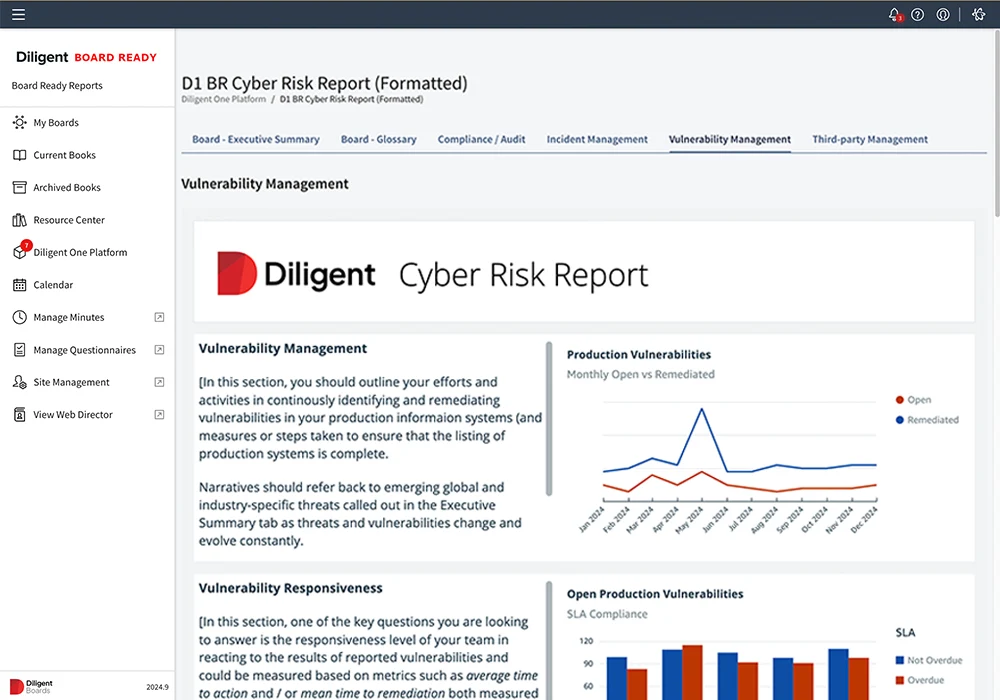
The platform's exclusive Diligent Market Intelligence data feed informs executive compensation and governance benchmarking discussions — particularly valuable for pre-IPO companies establishing institutional-grade compensation structures.
Integration with financial systems (SAP, Oracle, Salesforce) creates the single source of truth that investors expect during due diligence while eliminating the fragmented data environments that slow transaction processes.
Diligent’s Regulatory Compliance Management addresses the expanding compliance burden through AI-powered monitoring and centralized control frameworks. The platform's Regology partnership automatically updates regulation libraries as requirements change, eliminating manual regulatory tracking that consumes compliance team resources.
During transaction preparation, centralized controls demonstrate program maturity while automated monitoring catches potential breaches before they become material issues.
AI compliance assistants analyze regulatory updates, identify key changes and suggest mitigating controls — capabilities that enable lean compliance teams to manage increasing obligations without proportional headcount expansion.
Diligent’s Policy Manager establishes enterprise-grade policy governance through automated attestations, version control and configurable approval workflows. The platform creates comprehensive audit trails showing policy acknowledgment and compliance across the organization.
Advanced analytics demonstrate policy compliance metrics to investors and auditors while automated workflows ensure policies route through proper approval chains — addressing the governance process maturity that sophisticated investors evaluate during due diligence.
These integrated capabilities work together to address the transition challenges documented earlier — enabling organizations to build governance infrastructure that satisfies investor expectations without overwhelming lean teams during critical growth phases.
Ready to see how integrated GRC automation accelerates your transaction readiness? Schedule a demo of Diligent's unified platform.
Traditional GRC software digitizes manual processes but still requires significant human intervention for data entry, report generation and compliance tracking.
On the other hand, GRC automation uses AI and machine learning to continuously monitor compliance status, automatically flag potential issues and generate audit-ready documentation without manual compilation.
Implementation timelines vary based on organizational complexity and scope. Focused deployments, such as automating policy management or compliance tracking for specific regulations, can deliver value within 8-12 weeks.
Comprehensive enterprise-wide implementations typically span 6-9 months but follow phased approaches that generate incremental benefits.
Modern GRC platforms offer extensive integration capabilities with ERP systems (SAP, Oracle, NetSuite), compliance tracking tools, vulnerability scanners and business intelligence platforms. These integrations eliminate data silos that create gaps during investor due diligence.
When evaluating vendors, prioritize platforms offering pre-built connectors to your existing technology stack rather than custom integration projects that extend timelines.
Organizations typically report reductions in time spent on routine compliance activities, enabling redirection of resources toward strategic advisory work.
For transaction-focused companies, the most significant ROI comes from accelerated due diligence timelines and improved valuations resulting from demonstrated governance maturity. Companies also avoid penalties from compliance gaps and reduce audit preparation costs through continuously maintained documentation.
Discover how Diligent's unified GRC platform can accelerate your transaction readiness. Request a demo today.





