
In this article

Most organizations practice some form of risk management, whether tracking financial exposures in spreadsheets or maintaining department-level risk registers.
But as companies grow, regulatory pressure intensifies, and boards demand integrated oversight, the question becomes unavoidable: Is your current approach helping you manage risk strategically, or just documenting it reactively?
Choosing between traditional risk management (TRM) vs enterprise risk management (ERM) isn't simply a matter of organizational size or budget. It's a strategic decision that shapes how your company identifies threats, pursues opportunities and communicates risk to the board.
This guide helps you determine which approach best fits your organization's current maturity and future objectives, covering:
Traditional risk management is a department-level approach to identifying, assessing and mitigating risks within specific business functions. Each department – finance, operations, IT, legal – manages its own risks using methods and tools tailored to its domain.
All businesses conduct some form of traditional risk management. Those in regulated industries like financial services or healthcare may have more prescribed techniques, while others develop organic approaches based on operational needs. TRM typically focuses on protecting against downside scenarios: preventing financial losses, avoiding operational disruptions and meeting compliance requirements.
TRM remains appropriate for certain organizational contexts:
However, these contexts represent a narrowing set of circumstances as organizations grow and markets evolve.
As organizations grow more complex, TRM's limitations become increasingly problematic:
For organizations experiencing any of these constraints, the question shifts from whether to evolve their risk management approach to how quickly they can make the transition.
Enterprise risk management (ERM) is a holistic, organization-wide approach to managing all risks – strategic, financial, operational, compliance and reputational – in alignment with business objectives. Rather than treating risk management as a defensive function, ERM positions it as a strategic capability that informs decision-making and value creation.
The Committee of Sponsoring Organizations of the Treadway Commission (COSO) defines ERM as "a process, effected by an entity's board of directors, management and other personnel, applied in strategy-setting and across the enterprise, designed to identify potential events that may affect the entity, and manage risk to be within its risk appetite, to provide reasonable assurance regarding the achievement of entity objectives."
Board expectations for risk oversight have evolved significantly. According to What Directors Think 2025, 61% of directors believe a major cybersecurity incident would have a significant impact on their company's strategy, while 69% say the same about the sudden departure of the CEO or key executives.
These risks don't respect departmental boundaries; they require enterprise-level understanding and response.
For organizations preparing for IPOs, funding rounds or M&A transactions, ERM demonstrates the governance maturity that sophisticated investors increasingly demand. Siloed risk approaches create exactly the kind of gaps that surface during due diligence and can delay or derail transactions.
Discover how leading organizations implement ERM programs that satisfy investor due diligence requirements and board oversight expectations.

Some commentators pin the difference on timing: traditional risk management “typically only occurs after an incident has already happened and is done to prevent that situation from happening again.”
ERM, conversely, is future-looking, and “attempts to determine potential events and situations that could, or are even likely to, occur.”
TRM tends to focus on risk avoidance, while ERM assesses potential risks and identifies which are worth taking, thereby focusing more on opportunities alongside pure risk.
And as we noted above, ERM encompasses the entire enterprise and is top-down, whereas traditional risk management may focus on only one area, and not emanate from a holistic view of the entire organization.
Because traditional risk management (TRM) is well established and routinely practiced across businesses, it has become quite standardized. ERM is more dynamic, agile and adaptable to situations or organizations. Of the two, ERM is recognized as “far and away the more fluid, adaptable, and dynamic of the two methods.”
In the table below, we capture the differences between traditional and enterprise risk management.
The right choice depends on your organization's complexity, regulatory environment and board expectations, not simply size or budget.
TRM fits organizations that:
On the other hand, ERM fits organizations that:
"Keep it practical," advises Maurice L. Crescenzi, Jr., Industry Practice Leader at Moody's. "Keep the ERM program practically designed and not overly complex through the entire lifecycle of the ERM process. High, medium, low are good enough."
Moving from TRM to ERM doesn't require immediate wholesale transformation. A phased approach lets you build capabilities progressively while demonstrating value at each stage.
Develop a unified risk taxonomy, consolidate departmental registers into a single enterprise view and establish governance structures that clarify ERM ownership. These steps address TRM's fundamental limitation: inconsistent terminology that makes cross-functional comparison impossible.
Start by mapping existing risk categories across departments to identify overlaps and gaps. Finance might track "credit risk" while sales tracks "customer payment delays." These represent the same underlying exposure described differently. A unified taxonomy creates a common language that enables meaningful comparison and aggregation across the organization.
Work with leadership to define risk appetite and connect risk metrics to strategic objectives. This phase transforms risk management from a compliance exercise into a strategic tool that informs decision-making.
Risk appetite statements clarify how much risk the organization is willing to accept in pursuit of objectives. Connect specific risks to strategic goals: if international expansion is a priority, identify the regulatory, operational and reputational risks that could derail that objective. Track leading indicators that signal when those risks are escalating.
"The board really wants to understand, 'What should they be worried about? What are you doing about it? How are we doing in that program?'" says Derek Vadala, Chief Risk Officer at Bitsight Technologies.
Embed ERM into planning and decision-making cycles so risk considerations inform resource allocation rather than simply documenting decisions after the fact. Introduce cross-functional risk workshops and use existing board reporting cycles to surface enterprise-level risks.
Integration means risk assessment becomes part of standard processes: budget planning includes risk-adjusted scenarios, product launches include cross-functional risk reviews, and M&A due diligence incorporates enterprise risk perspectives from the outset. Cross-functional workshops bring together department heads to discuss risks that span boundaries, ensuring interconnections are visible and responses are coordinated rather than fragmented.
Platforms that consolidate risk data and automate reporting accelerate the transition significantly, providing the real-time visibility that boards increasingly expect.
Manual approaches like spreadsheets and departmental databases create exactly the fragmentation ERM aims to eliminate. Purpose-built ERM platforms centralize risk registers, automate workflows for risk assessment updates and generate board-ready dashboards that show enterprise exposure at a glance. Technology should support the program you've designed in earlier phases, not dictate it.
AI-powered ERM addresses limitations that have constrained traditional risk management: manual risk identification, siloed data, and reactive approaches. Modern platforms analyze vast external datasets to identify emerging threats and benchmark exposures against industry peers.
Diligent's approach varies by company stage and risk program maturity:
For companies with established risk programs or preparing for IPO, Diligent’s Enterprise Risk Management provides comprehensive enterprise risk management with AI-powered benchmarking against 180,000+ real-world risks from SEC 10-K reports.
Moody's integration adds external risk intelligence and credit sentiment scores that satisfy institutional investor expectations. This supports sophisticated board-level risk reporting and regulatory readiness for public company transition.
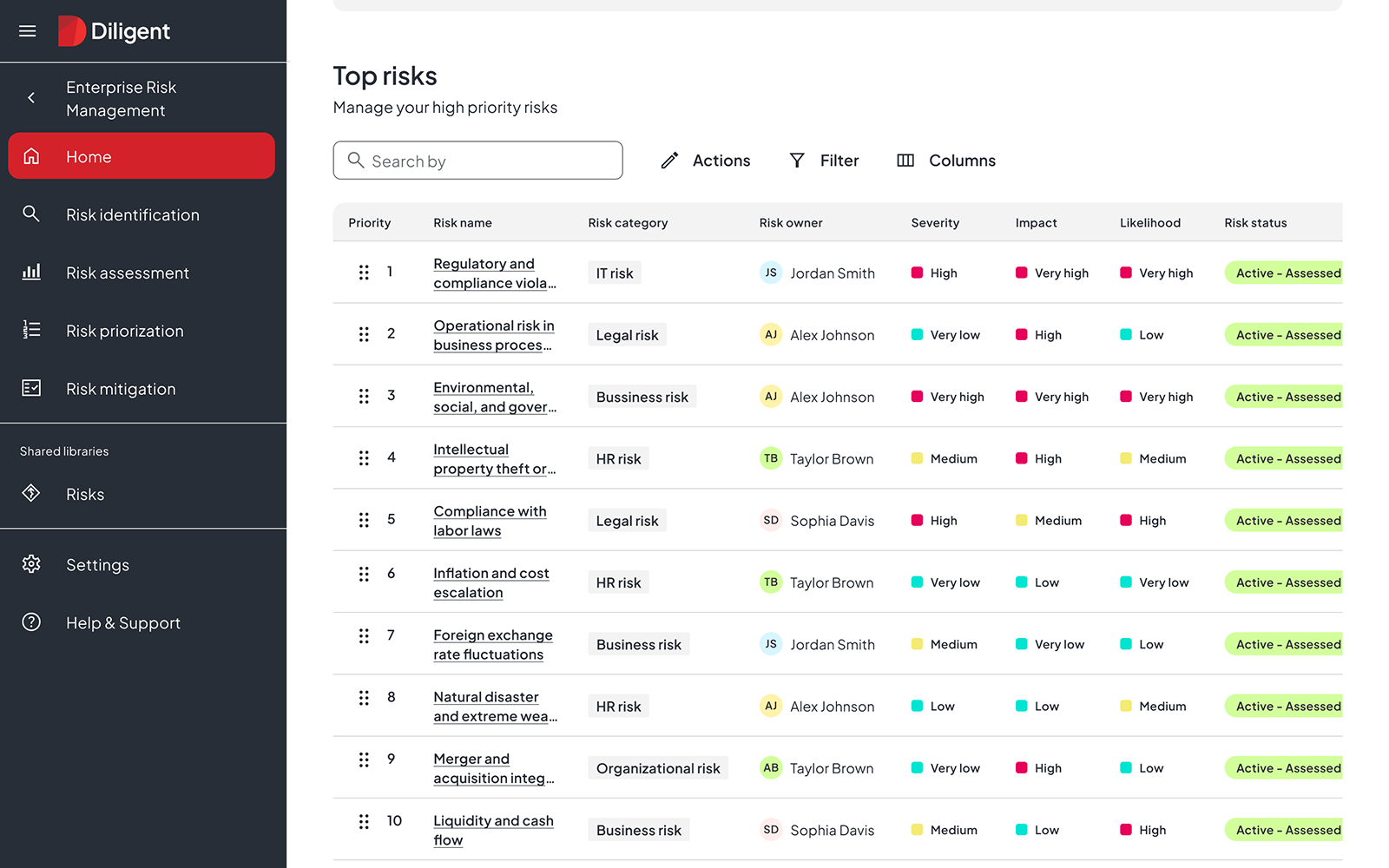
For companies launching their first formal risk program, AI Risk Essentials delivers AI-powered peer benchmarking with a 7-day implementation. This entry point helps growing companies establish professional risk management without enterprise complexity, demonstrating risk maturity to investors during funding rounds.
The choice between traditional and enterprise risk management ultimately comes down to whether your current approach can keep pace with your organization's trajectory. For companies preparing for transactions, facing board scrutiny or managing risks that cross departmental lines, ERM provides the integrated oversight that siloed approaches cannot deliver.
Ready to elevate your risk management approach? Schedule a demo to see which Diligent solution fits your governance maturity stage.
Yes, though implementation should match organizational scale. Growth-stage companies can adopt ERM principles (holistic risk view, strategic alignment, cross-functional integration) without enterprise-level complexity.
AI-powered platforms make sophisticated risk management accessible to lean teams through rapid implementation and automated benchmarking. Diligent’s AI Risk Essentials, for example, delivers 7-day implementation and AI-powered peer benchmarking that scales seamlessly to full ERM capabilities as organizations grow.
ERM directly supports board fiduciary duties by providing integrated risk intelligence that informs strategic decision-making. Rather than receiving fragmented departmental reports, directors see enterprise-wide risk exposure and can evaluate how management responds to emerging threats. This visibility is increasingly expected by regulators and investors.
The most widely adopted framework is COSO Enterprise Risk Management, which emphasizes how effectively the risk management program mitigates risks threatening organizational objectives. ISO 31000 provides principles-based guidance applicable across industries.
The transition makes sense when you experience clear signals that TRM no longer serves your needs: board members asking for integrated risk views you can't provide, upcoming transactions requiring demonstrated governance maturity, or growth creating risk interdependencies your siloed approach can't address.
Companies typically transition when preparing for IPO, responding to investor due diligence requirements, or addressing audit committee demands for enterprise-wide risk reporting. The key indicator is when departmental risk management creates more gaps than it fills.
Request a demo to see how Diligent's AI-powered platform helps organizations build risk management capabilities that satisfy board expectations and investor scrutiny.