
Ask leading executives from across industries to rank their top business concerns, and chances are, most of them will include compliance somewhere high on their list. If your company operates in the healthcare market, you’re likely concerned about changes to the Affordable Care Act. Or if you’re a business with customers from the European Union, no doubt you’ve been wrestling with the compliance standards of the GDPR.
According to Regology's State of Regulatory Compliance in 2025 survey, 92% of compliance professionals report their roles have become more challenging, with nearly half struggling to keep pace with constant regulatory changes. Despite this pressure, approximately 77% of compliance teams remain stuck using manual processes that increase workload and amplify risks.
Additionally, the Q4 Business Risk Index from Diligent Institute and Corporate Board Member found that business risk levels reached 7.9 out of 10 among general counsel, chief compliance officers and audit leaders — a 16% increase since Q1 2025, underscoring why automated compliance management has become essential.
Organizations at every growth stage need compliance automation software, but their specific requirements vary by company size, funding stage, and regulatory complexity.
This article explains how compliance automation software transforms governance and risk management across different organizational stages:
Compliance automation software provides continuous monitoring, intelligent alerts and automated workflows that streamline how organizations manage and adapt to regulatory requirements. Unlike traditional governance, risk and compliance (GRC) tools that rely on periodic assessments and manual tracking, modern compliance platforms deliver proactive intelligence through real-time data analysis and AI-powered regulatory monitoring.
These platforms integrate with existing business systems to aggregate information from regulatory feeds, internal databases and external compliance sources. Through machine learning algorithms and natural language processing, they provide visibility that enables organizations to:
Traditional compliance relied on legal teams manually monitoring regulatory websites, subscribing to newsletters and conducting quarterly reviews. This approach created blind spots in regulatory environments, while manual processes struggled to handle the volume and complexity of requirements organizations faced.
Manual compliance tracking faces critical limitations:
Compliance automation platforms address these limitations through continuous monitoring, automated impact assessment and scalable intelligent workflow management.
The global regulatory technology market continues to expand as organizations recognize that manual compliance cannot scale with business operations. QKS Group projects that the global governance, risk and compliance platforms market will grow at a compound annual growth rate of 13.22% through 2030, driven by organizations' increasing need for more effective compliance technology.
Enterprise adoption accelerates as companies realize these platforms do more than check compliance boxes. Organizations using automation systems see fewer regulatory violations, faster response times when requirements change and better relationships with regulators and stakeholders.
Growth-stage organizations face unique compliance challenges. They're transitioning from founder-led operations to corporate governance while preparing for funding rounds, acquisitions or other transactions that require demonstrable compliance capabilities.
Growth-stage companies struggle with compliance in ways that differ from larger organizations:
Compliance automation for growth-stage companies should prioritize:
1. Regulatory intelligence that automatically monitors applicable requirements across relevant jurisdictions, filtering out noise while surfacing regulations that affect specific business operations.
2. Policy management that centralizes compliance policies and procedures in a single system, enabling version control, approval workflows and distribution tracking.
3. Workflow automation that assigns compliance tasks, tracks completion and maintains audit trails.
4. Integration capabilities that connect with existing business systems like HR platforms, financial software and operational tools.
5. Risk assessment frameworks that help organizations prioritize compliance activities based on business impact, regulatory penalties and transaction readiness requirements.
Growth-stage organizations should focus implementation efforts on areas that accelerate funding timelines and demonstrate governance maturity:
"As a chief compliance officer, you need to understand what you are trying to achieve and then map a road to that support. Show that your compliance program adds value, goes above and beyond, and is best in class. Putting that message out there helps you get that support from the CEO and board," says Michelle Prohaska, Chief Compliance Officer at Nymbus.
Companies preparing for initial public offerings face compliance requirements that are different from those of private companies. Pre-IPO organizations need audit committee-ready capabilities, public company controls and regulatory frameworks that satisfy SEC requirements.
Pre-IPO compliance demands sophisticated capabilities. This includes the following:
1. Sarbanes-Oxley readiness: requires comprehensive internal controls documentation, control testing programs and management certifications that prove financial reporting effectiveness.
2. Audit committee support: includes materials preparation, compliance reporting and risk intelligence that enables independent directors to fulfill oversight responsibilities.
3. Regulatory compliance frameworks: spanning multiple jurisdictions, industry requirements and public company obligations that must be documented and tested before S-1 filing.
4. Corporate governance policies: addressing insider trading, related party transactions, whistleblower protections and other requirements that public companies must demonstrate to regulators and investors.
Organizations preparing for an IPO need compliance automation that handles the sophisticated demands of public company oversight.
Controls management becomes critical, documenting control design while automating testing and generating evidence that satisfies external auditors. Regulatory change monitoring tracks SEC rulemaking and emerging requirements, while committee management integration delivers this intelligence directly to audit committees through board portals.
The platform must also automate evidence collection and retention, capturing proof of compliance activities that support regulatory examinations. Scalable architecture ensures the system handles increasing complexity as the company grows while maintaining public company-grade security throughout the transition.
Pre-IPO organizations should structure compliance automation implementations to support transaction timelines:
Public companies and large private organizations manage compliance complexity that demands enterprise-grade platforms. These organizations face multi-jurisdictional requirements, comprehensive board oversight and stakeholder expectations that require sophisticated automation capabilities.
Large organizations navigate unique compliance challenges:
1. Multi-jurisdictional complexity: spans different regulatory regimes, reporting requirements and enforcement standards across global operations.
2. Board-level oversight: requires compliance intelligence that enables independent directors to fulfill fiduciary duties while satisfying heightened stakeholder scrutiny.
3. SEC compliance obligations: including Sarbanes-Oxley certifications, disclosure controls, financial reporting and regulatory filings that carry severe penalties for violations.
4. Stakeholder transparency: demands comprehensive compliance reporting to shareholders, analysts, regulators and other parties with legitimate oversight interests.
Enterprise compliance automation demands sophisticated capabilities that match the complexity of global operations and multi-jurisdictional requirements.
At the foundation, regulatory intelligence engines monitor thousands of sources across jurisdictions, automatically parsing requirements and assessing organizational impact. These systems work in concert with controls automation that continuously tests effectiveness and identifies gaps without the manual sampling that consumes compliance team resources.
AI-powered analytics take this further by processing comprehensive data to identify patterns, predict potential violations and recommend remediation before issues escalate. This intelligence flows directly to board members through secure portals, giving independent directors the real-time visibility they need to fulfill oversight responsibilities.
As organizations grow through acquisition or expansion, entity management capabilities track obligations across subsidiaries and affiliates, preventing the compliance gaps that emerge when entities operate inconsistently. Enterprise-grade encryption, comprehensive audit trails and granular access controls protect this sensitive information while satisfying regulatory requirements.
Together, these capabilities create platforms that scale with complexity while maintaining the control and visibility that large organizations require.
Large organizations should approach compliance automation as an enterprise-wide transformation rather than a point solution deployment:
"You need to swap your resource allocation so you can focus the majority of your resources on strategic and operational risk. Automate financial and compliance assurance, and use data and human insights for strategic and operational risks," says Tom Keaton, former Director of Internal Audit at Crown Castle.
Effective compliance automation delivers value through intelligent capabilities that reduce manual effort while improving outcomes. Organizations should evaluate platforms across critical feature categories that apply regardless of company size or maturity.
Core automation capabilities include:
These features transform compliance from reactive documentation to proactive risk management. Integration and reporting capabilities prove equally critical. Platforms should connect with existing business systems, eliminating manual data entry while providing role-specific dashboards for different stakeholders.
Security and scalability round out essential requirements. Enterprise-grade encryption, comprehensive audit trails and granular access controls protect sensitive compliance information while satisfying regulatory standards.
The platform must scale with organizational growth, handling increasing complexity without requiring replacement or extensive reconfiguration.
Discover how Diligent’s AI-powered compliance automation reduces manual effort while improving regulatory outcomes for organizations at every growth stage.

Platform selection requires careful assessment across technical capabilities, organizational needs and long-term strategic objectives. Organizations should evaluate solutions through a structured framework.
Technical capabilities assessment should focus on data integration options, analytics sophistication and scalability requirements. Organizations should evaluate platforms' ability to connect with existing systems, process enterprise-scale data volumes and adapt to changing business requirements.
Security and compliance features require particular attention, given the sensitive nature of compliance information. Platforms should provide enterprise-grade encryption, comprehensive access controls and detailed audit trails that support regulatory requirements.
User experience and adoption factors impact platform success. Intuitive interfaces, mobile accessibility and role-based customization ensure stakeholders can utilize capabilities without extensive training.
Enterprise compliance automation requires unified technology that connects regulatory monitoring, risk assessment and governance oversight into seamless workflows.
Organizations need solutions that eliminate information silos while providing role-specific intelligence for different stakeholders — from compliance teams managing day-to-day requirements to board members overseeing enterprise-wide governance.
Diligent addresses these challenges through integrated compliance automation capabilities that transform how organizations identify, assess and respond to regulatory requirements:
Diligent’s compliance management solutions, through the Diligent One Platform, centralize compliance data and monitor regulatory changes across multiple jurisdictions, delivering automated alerts and comprehensive impact analysis that enables proactive compliance management.
The platform's regulatory library, through its Regology partnership, provides coverage of regulatory developments while automated intelligence engines filter information for organizational relevance and business impact.
This targeted approach ensures compliance teams focus on regulations that actually affect their operations rather than processing irrelevant updates manually.
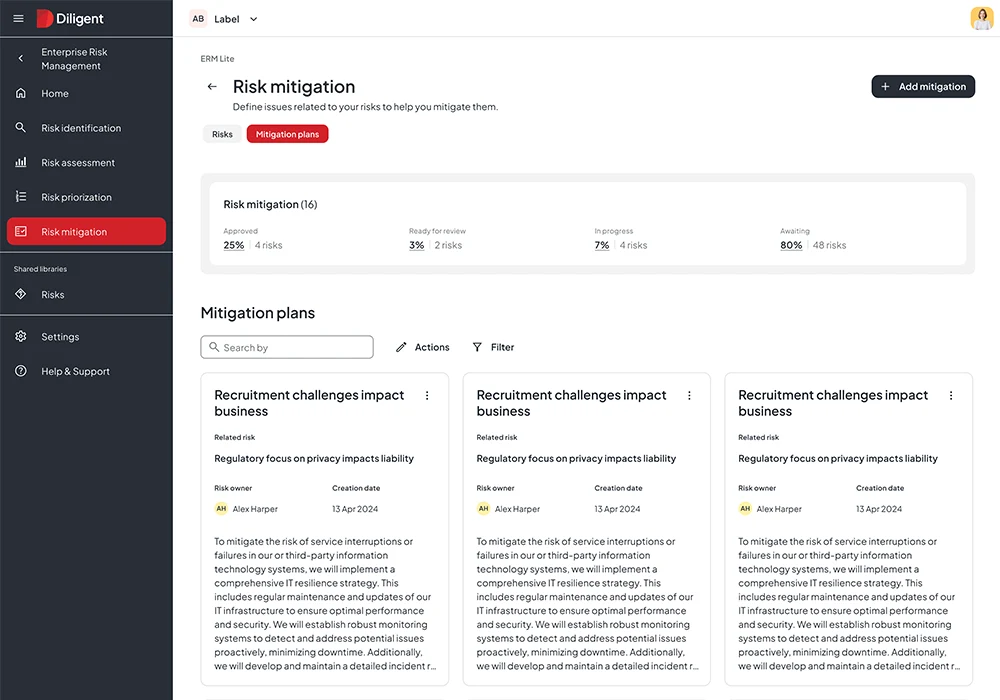
Building on this foundation, Diligent Enterprise Risk Management connects regulatory intelligence to broader enterprise risk assessment, enabling organizations to understand how regulatory changes affect strategic objectives, operational risks and stakeholder expectations. The platform scales from growth-stage companies establishing their first compliance programs to global enterprises managing multi-jurisdictional complexity.
Grafton Group, operating 11 businesses across multiple countries, unified their previously siloed Excel-based risk management processes using Diligent ERM — achieving board-ready reporting and cross-functional engagement through a single platform. The solution supports their continued ERM maturity while accommodating future growth.
The Diligent One Platform provides unified GRC capabilities that integrate regulatory change management with board management, risk assessment, audit activities and ESG reporting. This approach eliminates data silos while positioning regulatory compliance as part of holistic governance oversight.
These capabilities work in concert to reduce manual compliance effort while providing the real-time intelligence that boards and executives need for effective oversight.
Ready to transform your compliance management with AI-powered automation and comprehensive governance integration? Schedule a demo to discover how Diligent delivers regulatory intelligence that drives business success.
Compliance automation software continuously monitors regulatory developments, automatically assesses business impact and streamlines compliance workflows across multiple jurisdictions. Unlike traditional GRC tools that rely on periodic manual reviews, modern platforms deliver real-time regulatory intelligence and automated compliance processes.
Traditional systems focus on documenting existing compliance activities, while automation platforms provide predictive intelligence that enables proactive compliance management.
Essential capabilities include:
Organizations should prioritize platforms offering real-time monitoring, predictive analytics and seamless integration with existing governance, audit and compliance workflows.
The best enterprise compliance software combines three critical capabilities: scalability across global operations, seamless integration with existing business systems and comprehensive multi-jurisdictional regulatory intelligence. Look for platforms like Diligent that handle user growth without performance degradation, connect with ERP systems like SAP and Oracle and automatically track regulatory developments across all markets where you operate.
Enterprise organizations should evaluate platforms based on their ability to support global subsidiaries, provide board-ready reporting and maintain enterprise-grade security.
Budget-conscious organizations should evaluate governance software based on total cost of ownership rather than just license fees. Cloud-based platforms eliminate infrastructure investments while providing automatic updates. Look for solutions offering phased implementation options that let you start with core compliance needs and expand as budget allows.
Growth-stage companies gain transaction readiness and investor confidence through professional compliance capabilities without adding dedicated compliance headcount. Pre-IPO organizations build audit committee-ready processes and SOX compliance frameworks that support public company transitions.
Enterprise organizations manage multi-jurisdictional complexity while providing board-level visibility that enables independent directors to fulfill oversight responsibilities. The key is selecting platforms that match organizational maturity while scaling with future growth.
ROI measurement should focus on reduced compliance violations, faster regulatory response times, decreased manual effort and improved audit efficiency. Quantitative metrics include reduced compliance penalties, decreased audit preparation time and improved regulatory examination results.
On the other hand, qualitative benefits include enhanced executive visibility into regulatory risks, improved board oversight capabilities and stronger stakeholder confidence in organizational governance. Organizations typically see measurable benefits within 6-12 months of implementation.
Evaluate scalability across three dimensions:
Request vendor demonstrations showing how the platform handles complexity increases. Ask about customer organizations that have scaled from your current size to your target growth trajectory. The most scalable platforms use cloud architecture that adjusts resources automatically rather than requiring infrastructure upgrades at growth milestones.
Ready to modernize your compliance approach with intelligent automation? Request a demo to explore how Diligent can transform your regulatory compliance management.