
This article originally appeared in our September 24th edition of the Diligent Minute Newsletter. For more insights like these, delivered straight to your inbox, subscribe here.
AI conversations often begin with the question of what the technology can do. For boards, the more important question is becoming: What will this technology require of our workforce, and are we prepared to lead that change responsibly?
The answer is more complicated than a forecast of jobs gained or lost. AI is changing how work is designed, how decisions are made and what capabilities organizations need to remain competitive. It may automate some tasks, augment others and create entirely new forms of work. In every case, the impact will be felt by people before it is fully visible in the numbers. Two recent interviews on the Corporate Director Podcast offered valuable insights for directors on how talent strategy is shifting to fit the present moment.
In a recent conversation on the Corporate Director Podcast, Mary Lee Sharp, Executive Vice President of Human Capital at Beneficial State Bank, offered a useful framing: “What can humans do? What work should AI do? How do we redesign jobs?” Those questions move the discussion beyond tools and toward the organization that must operate with them. As Sharp noted, some roles may remain uniquely human, some may become hybrid and some may be performed by nonhuman systems. All of that is part of the talent strategy.
Our research points to the same shift. Directors see operations and workforce productivity as one of the biggest opportunities from generative AI, while also recognizing that a lack of leadership knowledge and capabilities is among the greatest risks.
Aniel Mahabier, Founder and CEO of INOP, adds another important lens: “AI transformation failures are often visibility failures.” Organizations may have extensive workforce data but still lack a clear view of how automation is changing work, capabilities and execution risk.
Traditional measures tell boards how many people are employed. They may not show which tasks are changing, where workflow friction is emerging or whether employees have the skills to deliver the strategy.
For directors, the oversight challenge is to connect technology decisions to workforce outcomes:
These are not questions for the technology team alone. They belong in conversations about strategy, enterprise risk, culture, succession, executive incentives and capital allocation. They also require a stronger partnership between the chief human resources officer and the board.
Sharp argues that the conversation is moving from AI pilots to AI ROI, and that the human capital function has a central role in proving whether adoption is real. “Our AI ROI depends on true adoption in the workplace,” she said. That means tracking training, experimentation, work-team progress, lessons learned and measurable outcomes, not simply counting licenses or announcing deployments.
She also offered a reminder that should guide every workforce discussion: “It’s not humans in the loop, it’s humans in the lead.” The point is not to slow innovation, but to ensure that people remain accountable for judgment, context and consequences while organizations learn where AI can genuinely improve the work.
AI may change the workforce, but it does not remove the board’s responsibility for human judgment. The boards best prepared for this next phase will treat workforce readiness as a core measure of AI readiness. They will ask better questions, demand clearer evidence and ensure that ambition is matched by accountability.
Explore the What Directors Think 2026 research and listen to the Corporate Director Podcast for more insights on AI, workforce strategy and the issues shaping board agendas.
From AI talk to real impact: How today’s leaders do more without adding headcount
Unlock the potential of AI in governance, risk, and compliance with our comprehensive guide. Learn how to streamline workflows, enhance reporting efficiency, and build a robust AI action plan while maintaining control and accountability. Download now to elevate your organization's AI oversight and drive measurable impact.
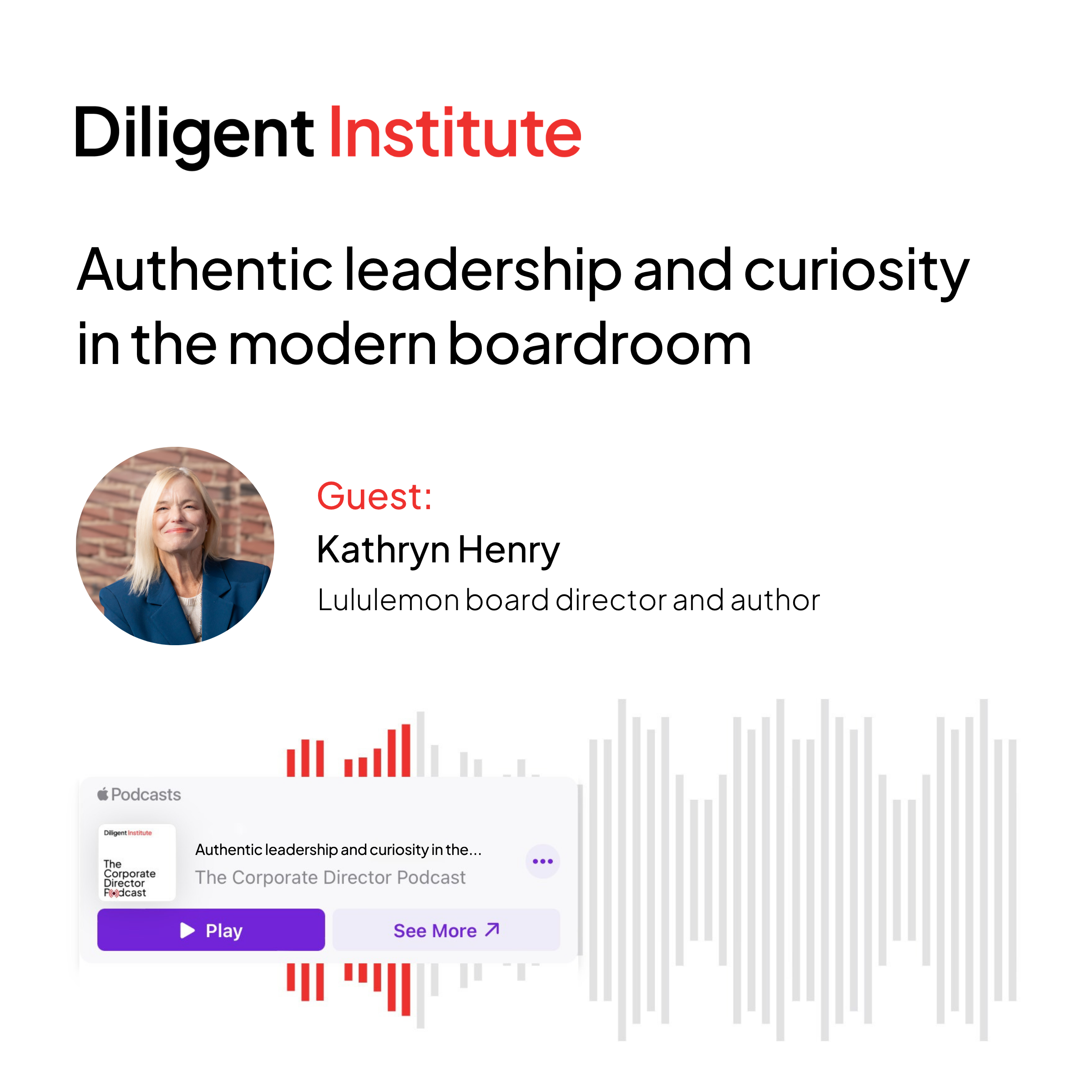
Curiosity, courage and authenticity in the modern boardroom

In this episode of the Corporate Director Podcast, Lululemon board director and author Kathryn Henry unpacks how personal adversity reshaped their approach to leadership and governance.
They discuss why today’s most effective directors lead with curiosity, emotional intelligence and service to all stakeholders – not just technical expertise.
Hear practical ideas for building trust in the boardroom, having the hard conversations, reading what’s left unsaid, and working productively amid uncertainty, AI disruption and competing stakeholder expectations.
Kathryn also shares their passion for mentoring the next generation of leaders and why boards must embrace broader, more diverse perspectives to meet the challenges ahead.
If you find this conversation useful, please rate and review the Corporate Director Podcast in your podcast app to help other governance leaders discover it.
Further resources:
Explore Diligent Institute’s latest research on board effectiveness, stakeholder governance and AI in the boardroom, and look out for Kathryn Henry’s memoir A Dime to Say I Love You for more on their leadership journey.