
This article originally appeared in our August 27th edition of the Diligent Minute Newsletter. For more insights like these, delivered straight to your inbox, subscribe here.
Lately, it seems like the role of the board director is getting more difficult with each meeting. When asked what they’re having a hard time overseeing, directors cite a litany of issue areas in our research at Diligent Institute: Technological developments (including AI), innovation/IP, capital allocation, contingency planning, and succession planning chief among them. In this hectic, challenging, and AI-fueled moment, I’m reminded of the importance of human courage and candor in the boardroom.
A board can look remarkably healthy from the outside. The agenda is uncomplicated, the discussion is cordial and decisions are recorded with apparent consensus. Yet a smooth board meeting is not always a rigorous one. Sometimes the most important contribution in the room is the question that interrupts that sense of ease.
When nobody challenges an assumption, asks a difficult question or raises a concern, a board may appear aligned without ever fully testing the decision in front of it. That is why boardroom candor is so vital.
Directors may see different pieces of the picture: an operational warning sign, a stakeholder perspective, a financial implication, or a question about whether the organization is prepared for a changing environment. These days, they are also leveraging AI to augment those diverse perspectives. But if those observations are unspoken, the board is not benefiting from the full range of its collective judgment.
I had a conversation over LinkedIn with Michael Marquardt, board member at Commonwealth Trust Company and Strategic Partnerships, LLC, about this topic. “Effective candor is not about saying the difficult thing at any cost,” he wrote. “It is about exercising the judgment to raise the right issue, at the right time, in a way that improves the board’s decision-making. The best boards create enough trust that silence can be challenged without making every disagreement a performance. That balance is where real board effectiveness lives.”
For me, useful boardroom candor has four qualities:
The chair has a huge role in establishing these conditions. The board chair can signal that respectful challenge is expected before the board reaches a vote, not tolerated only after a decision has been made. The chair can ask a quieter director to weigh in, pause when the conversation is moving too quickly, and distinguish between a point that needs further investigation and a point that requires resolution today. The chair can also make room for disagreement without allowing the discussion to become personal or performative.
To encourage that kind of candor, a board chair might ask:
These questions do more than invite dissent. They remind the board that candor is not an interruption to the work of governance. It helps boards surface risks earlier, challenge assumptions and make better-informed decisions.
Curiosity creates space for candor. Hear more in this episode of The Corporate Director Podcast.

From AI talk to real impact: How today’s leaders do more without adding headcount
Unlock the potential of AI in governance, risk, and compliance with our comprehensive guide. Learn how to streamline workflows, enhance reporting efficiency, and build a robust AI action plan while maintaining control and accountability. Download now to elevate your organization's AI oversight and drive measurable impact.
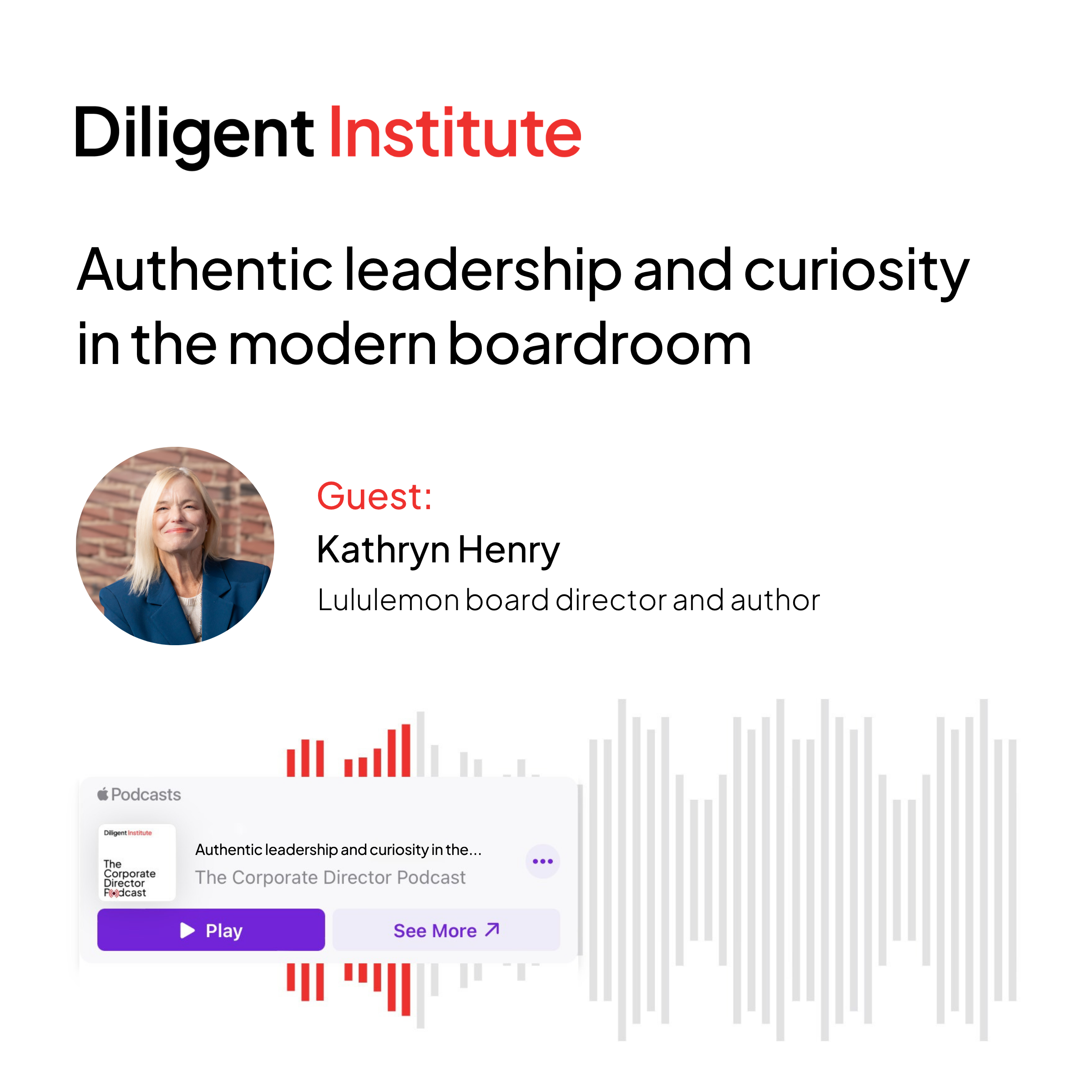
Curiosity, courage and authenticity in the modern boardroom

In this episode of the Corporate Director Podcast, Lululemon board director and author Kathryn Henry unpacks how personal adversity reshaped their approach to leadership and governance.
They discuss why today’s most effective directors lead with curiosity, emotional intelligence and service to all stakeholders – not just technical expertise.
Hear practical ideas for building trust in the boardroom, having the hard conversations, reading what’s left unsaid, and working productively amid uncertainty, AI disruption and competing stakeholder expectations.
Kathryn also shares their passion for mentoring the next generation of leaders and why boards must embrace broader, more diverse perspectives to meet the challenges ahead.
If you find this conversation useful, please rate and review the Corporate Director Podcast in your podcast app to help other governance leaders discover it.
Further resources:
Explore Diligent Institute’s latest research on board effectiveness, stakeholder governance and AI in the boardroom, and look out for Kathryn Henry’s memoir A Dime to Say I Love You for more on their leadership journey.