
This article originally appeared in our October 8th edition of the Diligent Minute Newsletter. For more insights like these, delivered straight to your inbox, subscribe here.
In the past two years, many boards have been discussing how to accelerate AI transformation and whether AI-specific metrics should be reflected in executive pay. But as AI becomes embedded in day-to-day operations, a broader question is emerging: What, if anything, should be incentivized?
The latest Director Confidence Index from Diligent Institute and Corporate Board Member found that 51% of directors have not discussed tying CEO or senior executive pay to AI-related goals and do not see a need to do so. Just 10% say their companies already include AI goals in compensation plans. That may be starting to change: 28% expect to discuss AI-linked compensation at an upcoming board meeting, while another 11% have either decided to introduce such measures or are still considering them.
For organizations early in AI transformation, an AI-related incentive may help spur progress when AI is a major strategic priority. For others, the better approach may be to tie incentives to the outcomes enabled by AI, such as sales growth, opening new markets or productivity gains, rather than to an AI-specific milestone. Boards need to decide which measures best fit their strategy, stage of transformation and long-term goals.
According to the survey results, directors appear more interested in the results AI helps deliver than in whether it has simply been deployed. Productivity or efficiency gains lead the list of potential metrics, cited by 61% of respondents. Financial return or ROI follows at 44%, and revenue or new business at 40%.
Only 28% would consider successful implementation or adoption.
That hierarchy is instructive: AI implementation is an input. Stronger productivity, financial performance and workforce transformation are the outcomes boards ultimately care about. Compensation should reinforce the latter, not reward activity for its own sake.
AI’s impact will rarely be captured by one number. Boards should consider a portfolio of measures that reflects both near-term performance and long-term resilience, such as:
The right mix will vary by company, industry and AI maturity. Larger companies are already more likely to consider financial return: 69% of directors at companies with at least $1 billion in revenue would do so, compared with 30% at smaller companies. But productivity remains the leading consideration across both groups.
Boards should also expect healthy debate about which measures matter most. That debate is often a sign that directors are testing assumptions and priorities before incentives are put in place. Compensation committee members are somewhat more likely to consider revenue growth and AI governance, risk or compliance, while placing greater weight on executive retention and shareholder alignment. That difference is a reminder that the best plans will be tested from multiple perspectives before they are put into practice.
The survey also highlights when directors believe boards should exercise discretion over incentive outcomes. Major company underperformance is the most frequently cited trigger, selected by 61%, followed by reputational or compliance failure at 52%.
These findings reinforce a broader principle: Compensation is not a mechanical scorekeeping exercise. It is a governance tool boards use to reinforce accountability and long-term value creation. Boards must be prepared to challenge targets that no longer reflect reality, while avoiding hindsight-driven decisions that undermine trust.
As AI investments mature, directors will need a shared language for progress, risk and value creation. The strongest compensation plans will not reward executives for chasing the newest technology. They will hold leaders accountable for turning AI ambition into durable, measurable performance responsibly and over time.
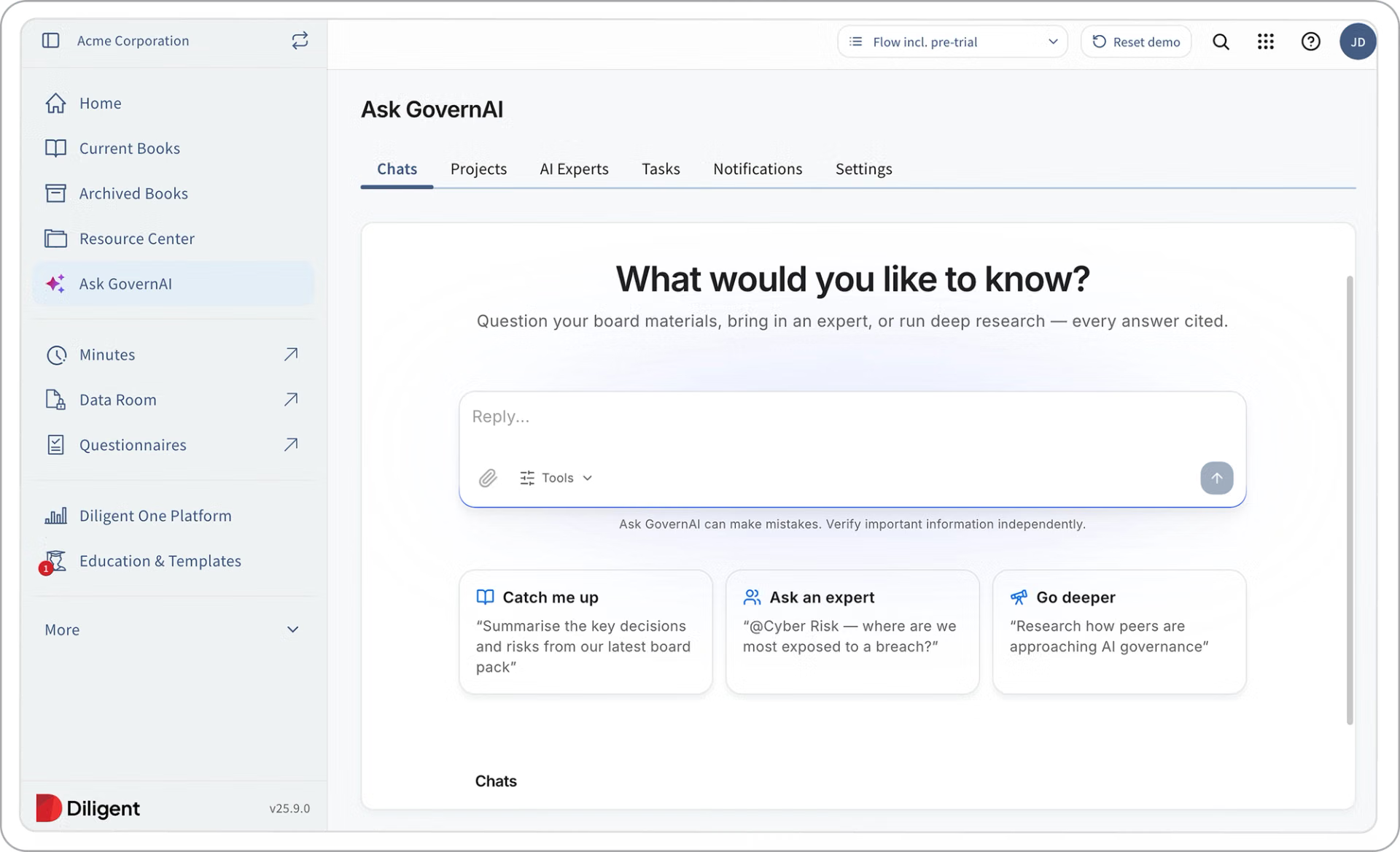
GovernAI: Secure AI for boards, directors and governance teams

Recent research shows directors are already turning to AI for board work, often without formal governance in place. This blog introduces the next generation of GovernAI, helping directors get secure, cited answers, expert perspective and boardroom context from their own materials, all within Diligent Boards.