
The compliance leader on your team is doing what they do every quarter: pulling a case export from one system, a policy attestation report from another, a training completion sheet from a third, requesting inputs from HR, and sorting through a stack of conflicts disclosures from wherever those happen to live this year.
Somewhere in the next two days, all of that becomes a narrative; a set of slides or a memo that's supposed to answer a simple question. Is the program working?
The honest answer takes longer to reach than it should. Not because the data doesn't exist but because the signals are spread across different parts of the program and someone has to bring them together, interpret what they mean, and turn them into a coherent view by hand.
Every part of a modern ethics and compliance program is better instrumented than it used to be. Policy management tracks attestations and exceptions. Speak up and investigations tools log reports and outcomes. Conflicts of interest systems capture disclosures and mitigations. Each of these products does its job well.
None of them, on their own, can tell you what's happening across the program, and its even harder to understand what they say together.
That work — noticing that a rise in reports in one region lines up with a policy exception spike, or that a drop in training engagement precedes a run of investigations — still falls to a person. Usually the same person who also has to rebuild the leadership narrative from scratch every quarter: export, reconcile, check for gaps, write it up, repeat.
The cost of that isn't only time. It’s capacity.
Patterns are hard to catch while they’re still weak signals. Risk is hard to quantify when it's split across multiple systems. And when the board asks whether the program is actually working, not just what it did, getting to a confident answer can require significant manual analysis.
Two things are happening at once.
Compliance programs are generating more activity than ever: more cases, more policy reviews, more training assignments, more conflicts to track. That's often a sign of a healthy reporting culture rather than a failure.
More signals don't automatically add up to more insight, however. Without a way to interpret them together, more data just means more places to look before you can say anything with confidence.
At the same time, the questions leadership ask are becoming more sophisticated. "What happened" isn't enough anymore. Boards and executives increasingly want to know where risk is changing, why, what the program is doing about it, and whether those interventions are working.
Those are harder questions to answer from individual program reports.
AI is already showing up inside individual compliance workflows helping to triage a case, draft a policy, facilitating intake, or creating training content. Those are useful, task-level gains.
Though making one task faster inside one tool doesn't make the program any easier to see as a whole.
The game changer is true compliance intelligence: using AI to help lean teams connect signals across the program, understand what deserves attention, and get to useful insight faster.
That's the question we've been sitting with at Diligent for quite some time. Not "how do we make reporting faster," but something more specific.
What if a signal in one part of the program, a spike in reports, a policy exception, a change in training engagement, could be understood in the context of everything else happening in the program, instead of read on its own?
What if a compliance leader could ask where the program's greatest risk exposure sits and get an answer grounded in signals across multiple program areas?
What if the quarterly report leadership reads could start from that connected view, instead of being rebuilt by hand each cycle?
What would a compliance leader need to see and trust before acting on that intelligence, and where does a system stop and a person's judgment take over?
Those are the questions that have shaped what we’re building next.
Connected compliance is the foundation we've been developing at Diligent: connecting signals across the compliance program — policy, speak up and investigations, conflicts, training, third-party risk — with AI adding context, surfacing patterns and helping practitioners understand where attention may be needed.
Compliance AI is on-demand intelligence across the program — helping leaders understand what matters, decide what to do next and move work forward without manually assembling that context every time.
We started with a concrete use case: the quarterly ethics and compliance report.
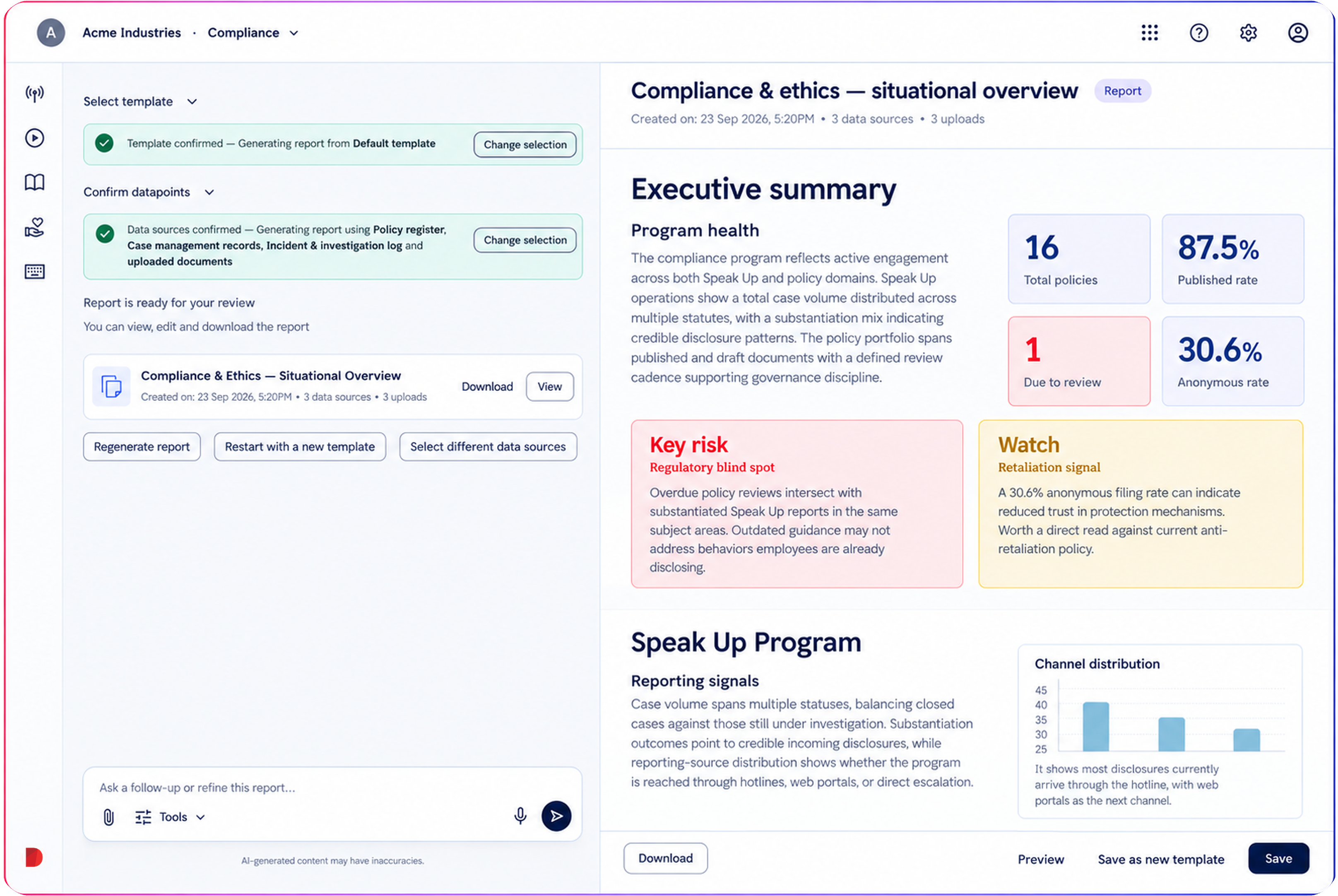
The experience we're building toward can bring together data from across the program, trace insights back to their sources and produce an editable starting point for the person who ultimately stands behind the report.
But where we are now is much bigger. Now you can ask AI:
That's a meaningfully different direction from simply putting AI inside another workflow. Most compliance AI today helps someone complete a task inside a single tool. We're exploring intelligence that can reason across the program the task sits within.
For leaders, the shift isn't another dashboard to check. It's getting to leadership-level insight faster, with the context and evidence needed to apply their judgment.
For practitioners, the shift is in where the hours go: less time exporting, reconciling and manually assembling analysis; more time validating what the data means and acting on what it surfaces.
What we have here is a clear problem, validated with real compliance teams, and a first use case modeled on how experienced compliance practitioners already perform today.
The Early Adopter Program for AI in Compliance is how we’re taking the next step.
We’re inviting a small group of innovative compliance leaders to work alongside us to shape what "connected" should actually mean: which signals matter, what context practitioners need to trust a system, and where a person's judgment has to stay firmly in control.
AI can surface a signal and the evidence behind it. It's still the practitioner who decides what that signal means and what, if anything, to do about it. That's not a caveat we're adding for comfort. It's the responsible, human-led AI model our products are led by.
If your team is spending meaningful time pulling together data before you can answer leadership-level questions about the program — and you want to shape the future of compliance technology — we'd like to hear from you.
Top 5 AI innovations for governance, risk and compliance announced at Elevate 2026

Discover the future of governance, risk, and compliance with Diligent's groundbreaking AI innovations unveiled at Elevate 2026. From transforming boardroom dynamics with the AI Board Member to streamlining enterprise risk reporting and enhancing vendor due diligence with Lexi, these tools are designed to empower GRC professionals by reducing manual tasks and increasing strategic impact. Join our early adopter programs today to be at the forefront of this revolution.
From hotline to speak-up culture: Change management for modern whistleblowing
Explore how to transform outdated hotline systems into robust, AI-driven speak-up programs that meet modern regulatory demands. This guide provides compliance and legal leaders with a practical roadmap to enhance whistleblowing practices, ensuring early issue identification and reporter protection. Download now to begin your transition to a strategic speak-up culture.