
For general counsel and corporate secretaries managing complex organizational structures, corporate entity compliance has become one of the most demanding responsibilities in the legal department.
Every subsidiary, joint venture and affiliate operating across your corporate family has its own registration requirements, filing deadlines, officer records and governance obligations. A single lapse in any jurisdiction can cascade into material consequences.
"One important trend is continuous compliance. Not from the perspective of complying with a regulation, but security policy compliance and regulatory compliance in one continuous loop. You're continuously gathering your risks and remediating them. That helps to reduce the amount of time that compliance teams take to do their work."
— Philip D. Harris, CISSP, CCSK, Research Director, Governance, Risk, and Compliance Services and Software at IDC
The challenge is not simply knowing what compliance requires. You already understand the obligations. The challenge is maintaining continuous visibility across hundreds of entities spanning dozens of jurisdictions, each with unique regulatory calendars and evolving requirements.
This guide provides a practical framework for building and maintaining entity compliance programs that scale with organizational complexity and adapt to shifting regulations.
This guide covers:
Corporate entity compliance is the discipline of ensuring every legal entity within a corporate structure maintains its registration, filing, reporting and governance obligations across all operating jurisdictions. It encompasses the full lifecycle of entity administration, from formation through ongoing maintenance to eventual dissolution.
This is different from broader regulatory compliance, which addresses industry-specific rules, environmental mandates or securities regulations at the enterprise level. Entity compliance operates at the individual entity level, focusing on the foundational legal requirements that allow each subsidiary, affiliate and holding company to exist and operate lawfully.
The scope includes:
For enterprise organizations with hundreds of entities, each category multiplies across entities and jurisdictions, creating thousands of obligations that require coordinated tracking and execution.
Entity compliance failures create exposure across three dimensions that directly affect enterprise value and operational continuity.
The SEC reported financial remedies totaling $8.2 billion for FY2024, with entity-level reporting violations representing enforcement actions at a meaningful scale.
At the state level, consequences escalate predictably: escalating penalties, interest charges, franchise tax forfeiture and, in persistent cases, automatic dissolution. Multiply those risks across a portfolio operating in multiple states, and the financial exposure from absent monitoring systems becomes material and entirely avoidable.
Transaction risk surfaces most painfully during M&A due diligence. Standard purchase agreements require representations that each entity is duly organized, validly existing and in good standing in every relevant jurisdiction.
When buyers discover entities that have lost good standing or carry unresolved filing deficiencies, the consequences are immediate: delayed closings, purchase price adjustments and restructured deal terms. Most enterprises have not fully integrated entity compliance data with their broader GRC systems, leaving fragmented visibility during transactions precisely when remediation costs are highest.
Directors carry fiduciary obligations that extend to entity-level compliance. The Nine West decision established that directors forfeited business judgment rule protection for failing to investigate post-closing solvency, creating personal liability exposure for oversight failures. Boards should receive structured compliance reporting at least quarterly, with exception-based alerts for any entity that has fallen out of good standing.
These risks compound as several regulatory shifts arrive simultaneously, leaving little margin for legal teams already stretched across complex portfolios.
The March 2025 FinCEN interim final rule significantly restructured Corporate Transparency Act obligations: domestic U.S. entities are now exempt from beneficial ownership reporting, but foreign entities registered in any U.S. jurisdiction remain subject to strict filing requirements. The rule's interim nature means that domestic exemption could be reinstated after the public comment period, so enterprise legal teams should maintain readiness across both scenarios.
In Europe, the EU CSRD phases in through 2027 on a consolidated basis that includes non-EU subsidiaries, while the UK ECCTA introduces a new corporate criminal offense for failure to prevent fraud, with extraterritorial reach. SEC cybersecurity rules finalized in 2023, meanwhile, require material incident disclosure within four business days — a timeline that demands entity-level incident response connect directly to existing disclosure controls.
The pattern across all of these developments is the same: Enterprise legal departments need real-time visibility into entity-level data, governance structures and compliance status across every jurisdiction. According to What Directors Think 2026 by Diligent Institute and Corporate Board Member, 39% of directors identify technology-enabled compliance monitoring as the single greatest improvement available for board-level compliance oversight.
This seven-step framework provides a structured approach to building and maintaining entity compliance programs that scale with organizational complexity. Each step builds on the previous one, moving from foundational data management through proactive monitoring and continuous improvement.
The foundation of any effective compliance program is knowing exactly what you are managing. Conduct a comprehensive audit of every legal entity across your corporate structure, capturing:
Cross-reference your internal records against the Secretary of State databases in every state where entities are incorporated or foreign-qualified. Verify registered agent information is current and reconcile entity records with tax registrations to surface any entities that exist for tax purposes but are missing from corporate governance records, or vice versa.
This audit will almost certainly reveal gaps: dormant entities that were never properly dissolved, foreign qualifications active in states where operations have ceased, and officer records reflecting personnel who departed years ago. Document these gaps systematically — they become the initial remediation workload in Step 7.
A complete inventory creates the baseline dataset that every other compliance control depends on.
With a complete entity inventory in hand, the next challenge is global entity management — documenting the specific compliance obligations for each entity across every jurisdiction where it operates. Annual report filing deadlines, franchise tax calculation methodologies and director filing requirements all vary significantly across jurisdictions.
Build a consolidated compliance calendar that captures every filing deadline, payment obligation and renewal date across your entire entity portfolio. Organize by frequency (annual, quarterly, monthly) and risk level. Group obligations by jurisdiction and entity so local teams can see their complete workload while central compliance monitors the enterprise view.
Effective calendars include both external regulatory deadlines and internal governance events — board schedules, committee meetings, policy review cycles and audit schedules — because internal events often generate filing obligations or compliance documentation requirements.
The goal is a single calendar that reflects what is due, when it is due and who owns completion.
Entity compliance fails most often not because requirements are unknown but because responsibility is unclear. Establish a governance structure with centralized oversight and local execution.
Central compliance function: Designate a single team, typically within the corporate secretary's office or legal operations, as the enterprise owner of entity compliance. This team maintains the entity inventory, owns the compliance calendar and provides reporting to leadership. They do not execute every filing, but are accountable for ensuring nothing falls through the cracks.
Local execution responsibility: Assign specific individuals or roles to each compliance task. Name the person responsible for each entity's annual filings, franchise tax payments and registered agent maintenance. Document backup coverage for critical deadlines.
Escalation protocols: Define clear escalation paths for approaching deadlines, identify compliance gaps and regulatory changes. Establish what triggers an escalation, who receives it and what authority they have to resolve it.
Without board-level and senior management support, compliance programs lack the authority to enforce accountability across business units. Clear ownership turns compliance from an aspiration into an operational system.
Fragmented entity data — scattered across spreadsheets, local file servers, email archives and physical documents — is the single greatest operational risk in entity compliance. Establish a centralized repository that serves as the single source of truth for all entity records.
This repository must contain formation and governing documents for every entity, current and historical officer and director records, filing receipts and confirmation documentation, good standing certificates, ownership records and organizational charts, registered agent agreements and tax registration certificates.
Centralization delivers immediate value in M&A contexts. According to Bloomberg Law's diligence checklist, standard purchase agreements commonly require good-standing certificates dated within 30 days of closing, updated annual reports through the closing date, and certificates of existence for each entity in the transaction. When due diligence requests arrive, your team needs to produce complete entity documentation quickly.
Implement role-based access controls so appropriate personnel can access the data they need while protecting sensitive beneficial ownership and governance information from unauthorized access.
The transition from reactive to proactive compliance management depends on automated monitoring systems that track deadlines and regulatory changes without relying on individual memory or manual calendar reviews.
Effective monitoring includes:
Monitoring systems should connect to centralized entity data repositories to ensure consistent tracking of compliance obligations across jurisdictions. The practical objective is simple: if something becomes due or changes, the right owner should know in time to act.
Entity compliance documentation must satisfy two audiences: external regulators and auditors, who require defensible records, and internal leadership, who need clear reporting on compliance status across the organization.
For external audit readiness, maintain complete filing histories with timestamps and confirmation receipts; store documents in tamper-proof formats with comprehensive audit trails; and apply a minimum 7-year retention period for audit-related records, as required by SEC Rule 2-06 and SOX compliance frameworks. Implement version control so that any historical state of an entity's records can be reconstructed.
For internal board reporting, structure compliance reporting in a hierarchy that flows from entity-level detail to board-level oversight. Effective reporting progresses through four levels: management-level detail on upcoming deadlines and remediation; audit committee aggregates and exception reporting; risk committee integration with enterprise risk management; and full board-level strategic compliance posture.
The goal is ensuring the board receives sufficient information to fulfill its oversight obligations without being overwhelmed by entity-level detail — while maintaining the ability to drill down when issues arise.
Entity compliance is not a one-time project. Establish a regular cadence of reviews that systematically verify compliance status and address gaps before they create material exposure.
Quarterly reviews: Verify entity standing across all jurisdictions, confirm every filing due in the prior quarter was completed and reconcile officer and director records against actual governance composition.
Annual reviews: Reconcile your full entity inventory against the Secretary of State databases, tax registrations and internal business records. Update the compliance calendar to incorporate regulatory changes, assess entity rationalization opportunities and evaluate whether processes are functioning as designed.
Remediation workflows for identified gaps should include prioritization by risk level, assignment of ownership with defined completion deadlines, escalation triggers if remediation falls behind schedule, and documentation of all remediation activities for audit-trail purposes.
RSM's rationalization framework provides useful decision criteria: dissolve dormant entities and redundant holding companies, merge entities with overlapping functions and retain entities that serve operational, regulatory, tax or liability protection purposes.
Simplify entity management at scale
See how Diligent Entities helps legal teams centralize records, automate filings and maintain good standing across jurisdictions.
The challenges outlined above — thousands of filing obligations across jurisdictions, constant changes in beneficial ownership requirements and the need for audit-ready reporting — are exactly where AI can reduce risk and manual effort.
Diligent Entities applies AI to entity data, documents and workflows so legal teams can move from spreadsheet-driven tracking to continuous, exception-based oversight.
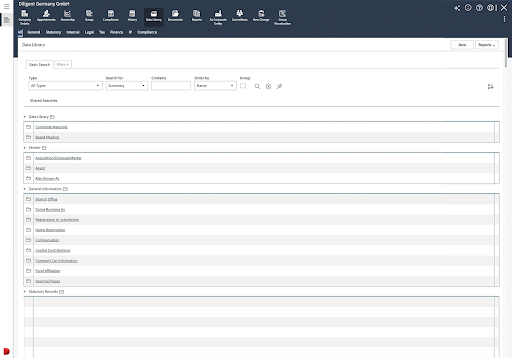
The outcome is the same one the framework aims for: entity compliance that scales with organizational complexity while improving timeliness, defensibility and leadership visibility.
Managing hundreds of entities across jurisdictions doesn't have to mean thousands of spreadsheet rows. See how Diligent Entities helps legal teams centralize records, automate filings and maintain good standing with AI-powered workflows. Book a demo
Loss of good standing creates immediate operational restrictions. Entities in this status may be unable to prosecute or defend lawsuits, obtain financing, establish credit facilities or maintain certain contracts.
States impose escalating fines, interest charges and ultimately involuntary dissolution proceedings for persistent non-compliance — including automatic dissolution after two consecutive years of non-filing in Delaware.
Remediation typically requires filing outstanding reports, paying penalties and interest and applying for reinstatement, which can take weeks or months depending on the jurisdiction.
Treat entity compliance as a three-phase workstream. During due diligence, verify good standing in every jurisdiction where target entities operate and confirm beneficial ownership obligations.
At closing, require current good standing certificates dated within 30 days, updated annual reports and certificates of existence — and tie any remediation gaps to closing conditions or holdbacks. Post-close, integrate acquired entities into your entity management system within 30 days, file required change-of-control notifications, and consolidate compliance calendars.
Quarterly reviews should verify entity standing status, confirm filing completions and reconcile officer and director records. Annual reviews should include full inventory reconciliation against the Secretary of State databases, compliance calendar updates incorporating regulatory changes and entity rationalization assessments.
Organizations in active M&A environments or jurisdictions undergoing significant regulatory change may benefit from more frequent cycles.
Ready to streamline entity compliance across your organization? Schedule a demo to see Diligent Entities in action.