
Newly appointed clerk Millie Gray wanted to improve city council meetings. The former mayor, she heard, was reluctant to stop council member discussions and digressions into off-topic conversations. The meetings were unstructured, with members unsure about when to call for a vote or to table an issue. As a result, meetings tended to go late into the evening, with not much being accomplished.
Gray decided to use a basic but essential tool to bring order to the meeting: the agenda. A strong agenda, which council members could access and comment on well before the meeting, would help this council make their meetings more efficient.
A meeting agenda is like a script. It outlines what items will be discussed, considered or decided on during the meeting. It lays out the order of who will speak and when. It serves as both a guide for council members and a notice to the public about what will be covered. An agenda keeps the meeting on track, ensuring that all necessary business is covered.
Municipal councils should follow their municipality’s regulations and traditions for their agenda, which is usually developed by an ordinance, resolution, city council rule or by informal customs and practices.
In most cases, the mayor, city clerk or city administrator takes the lead in preparing the agenda, with suggestions and feedback from council members and city or municipal staff.
An effective agenda is clear, structured, transparent and focused, helping the council use time wisely and keeping the public informed.
Here are the elements of an effective agenda. Firstly, the agenda should have a clear purpose and structure, organized in a logical flow from the welcome message to adjournment. Each item states whether it is for discussion, information, or decision. It should follow a standard format at every meeting so council members and the public know what to expect.
The agenda has time management built into its structure. Time-sensitive or major matters are listed first, with routine or minor items grouped together and addressed later. Approximate time is allocated for major items to prevent overruns.
The agenda should be posted in advance, as required by law, so citizens know what will be discussed, and include a public comment period. The agenda should be ADA compliant, and easily accessible and searchable.
An effective agenda helps the mayor or council president to preside over well-run meetings. Well-run meetings rely on respecting rules, assigning responsibilities clearly and consistently adhering to council policies. Here are some best practices for agenda management:
Post agendas publicly within the legally required timeframe. Ensure items are specific enough so the public understands what will be discussed or decided.
Use a consistent order of business (call to order → minutes → reports → business → adjournment). Ensure that motions, amendments and votes follow parliamentary procedures.
Clerks can simplify and strengthen their meeting minutes process with this practical checklist, designed to ensure accuracy, efficiency and regulatory compliance at every step.

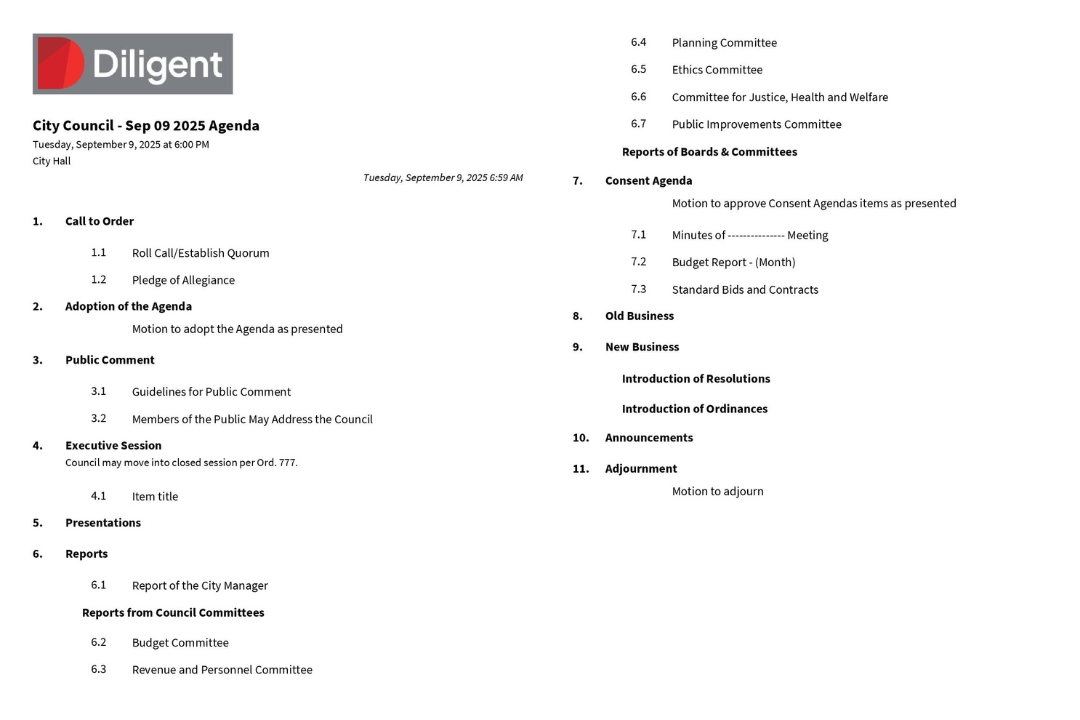
Every meeting agenda should follow the same structure for consistency and to avoid confusion. Diligent Community has agenda templates that you can use:
Meeting minutes document how the agenda was followed and what actions were taken. When questions arise in future meetings, council members and leaders and the public can refer to previous minutes.
Many cities and towns follow their own policies that outline how agendas should be structured, while others take a more flexible approach. Formats can vary significantly depending on the size, style and governance of the municipal council — so reviewing a few examples can help you identify what works best for your needs.
This example was taken from an actual city meeting agenda:
Anytown Regular Meeting Agenda
Notes for the agenda (including ADA, Addressing the Council, Public comment etc.)
Call to Order
Invocation
Pledge of Allegiance
Roll Call and Declaration of Conflicts of Interest
Presentations
Order of Business
Consent Agenda
Regular Agenda
Public Participation
Staff items
Council items
Adjournment
Using technology to create, send and store your meeting agendas makes this essential task easier, more efficient and effective, as well as allowing you to be transparent to your constituents.
Diligent Community is designed to streamline the entire meeting process for clerks including agenda creation and management. It can transform how councils prepare for and conduct meetings. It reduces paperwork, simplifies and automates key processes, ensuring both staff and the public stay informed and engaged.
The software offers an intuitive agenda builder that enables clerks and administrators to construct, revise, and publish comprehensive meeting agendas entirely online. Users can create, edit and attach supporting documents, use customizable templates and enjoy features like auto-save and one-click print. This centralizes all pre-meeting tasks and eliminates the complexity of handling scattered files or paper packets.
It supports seamless, customizable workflows for agenda item submission and approval. This ensures meeting agendas are accurate, timely and reflect collaborative input.
Council members can securely add private notes or public comments to agenda items and documents from any device. This promotes thorough preparation, enables instant sharing of context and ensures everyone is aligned before the meeting starts.
From agenda to minutes, Diligent Community automates routine but vital meeting activities such as agenda creation, voting, approvals and minute-taking. AI-supported minutes also generate a first draft of minutes from closed-caption transcripts, helping clerks capture key actions and motions efficiently even during fast-paced discussions.
Clerks who use Diligent Community can save up to half their previous time spent on meeting preparation, thanks to centralized information, automation and accessible digital tools.
“The [meeting preparation] process now runs much smoother and organizing a meeting is a pleasure now,” says Ian Dudla, chief administration officer of the Municipality of Resolute Bay.
Request a demo today to see how we can help support your local government governance and make your council meetings run even more smoothly.