
In this article

Data governance isn't something most growing companies think about until it becomes a problem. You're focused on closing deals, shipping product and scaling the team, and somewhere along the way, the volume of customer data, financial records and reporting obligations quietly outpaces your ability to manage it all. There's no formal system deciding who owns which data, where sensitive information lives or how to prove compliance when someone asks.
Then someone does ask. Maybe it's a prospective investor running due diligence on your Series B round. Maybe it's a state attorney general's office inquiring about your privacy practices. Maybe it's your own team, wasting hours reconciling conflicting reports before a board meeting. Whatever the trigger, the gap between the data your company generates and the governance around it becomes a liability, and one that gets more expensive to fix the longer you wait.
This guide provides a practical, resource-conscious playbook for building data governance that scales with your company rather than requiring enterprise-level investment upfront. Every step is designed for lean teams without dedicated risk staff, because governance at this stage shouldn't mean hiring a department. It should mean building smart infrastructure that compounds in value at every growth milestone.
This guide covers:
Data governance is the set of policies, roles and processes that ensure your company's data is accurate, secure, accessible to the right people and compliant with applicable regulations. Think of it as the operating system for how your organization collects, stores, manages and uses data, from customer records and financial reporting to the metrics you present to your board.
Data governance was once thought to be exclusively a concern of large public companies, something addressed alongside SOX compliance and SEC filings. That assumption is no longer valid. Growing companies now face governance requirements driven by three critical business events.
Private equity and venture capital firms increasingly evaluate data maturity during diligence. And when the data doesn't hold up — inconsistent records, unclear lineage or lack of controls — it can create real transaction risk and value impact, including documented valuation losses tied to data problems in deal contexts.
"Companies can do a lot of things day-to-day to improve readiness for a potential transaction, many of which would probably make life easier running the company absent a deal," says Rich Mullen, Partner at Wilson Sonsini.
GDPR and the California Consumer Privacy Act are not "big company only" frameworks. They apply based on activities and scope, and enforcement actions show that regulators do investigate and penalize organizations outside the Fortune 500. Tracking databases that compile enforcement outcomes likewise show meaningful enforcement activity across smaller and mid-sized organizations.
The pressure isn't limited to regulators. According to What Directors Think 2026 by Corporate Board Member and Diligent Institute, 40% of public company directors expect data privacy and protection to demand the greatest board attention in 2026, second only to AI and technology regulation. If boards at the largest companies are prioritizing data governance, growing companies preparing for institutional investment or public markets can't afford to treat it as an afterthought.
When your sales team works from one version of customer data, your finance team from another and your board reports from a third, every decision takes longer and carries more risk. Research from IBM's Institute for Business Value reports that poor data quality is associated with material financial losses for many organizations, with a significant share estimating losses in the millions annually.
The bottom line is, data governance is an infrastructure that pays dividends at your next funding round, regulatory audit or strategic transaction by reducing the time and uncertainty involved in proving what data you have, where it is, who can access it and whether it's reliable.
This playbook is designed for lean teams implementing governance for the first time, particularly at growth-stage companies that need to build governance foundations without dedicated governance staff or enterprise-scale budgets.
Rather than comprehensive enterprise frameworks, this playbook uses phased, agile approaches that emphasize automation, lean role structures and immediate business value delivery.
Each step is scoped to deliver measurable outcomes quickly, demonstrating ROI to secure continued executive sponsorship.
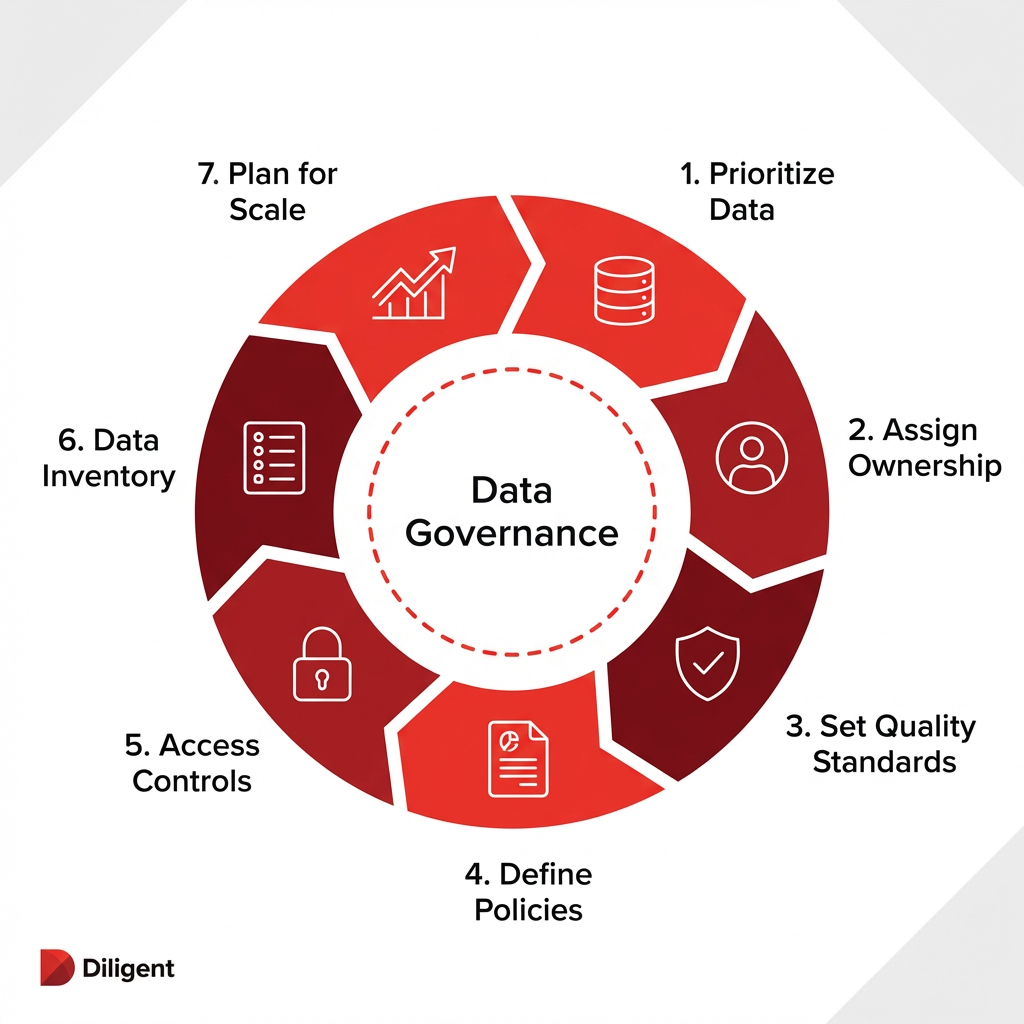
Identify the data that carries the greatest business risk and regulatory exposure, and prioritize it first.
For most growing companies, critical data falls into four categories:
What this looks like in practice: A Series B company might start with customer PII (high compliance risk), monthly recurring revenue data (high board reporting dependency) and financial records (high transaction readiness impact). Everything else can wait.
Governance doesn't require a dedicated team at this stage. It requires clear accountability. Assign data owners and stewards from your existing roles using a federated ownership model where domain experts take responsibility for their data.
Data owners play a critical role in governance by approving who gets access to their domain, defining business rules and data quality standards and maintaining accountability for their domain's data quality and resolving related issues when they arise.
Start with a pilot. Pick one domain, whichever carries the highest business risk and regulatory exposure from your Step 1 assessment, and assign stewardship for two months. Once that proves manageable, expand to additional domains.
Perfect data isn't the goal. Usable, trustworthy data is. Set minimum standards for your critical datasets across four dimensions:
Define what "good enough" looks like today and document what needs to improve as the company scales. Implement validation rules at the point of data entry and at ingestion points to catch errors before they propagate, which is dramatically cheaper than cleaning them after the fact.
A practical starting point: Implement automated completeness checks on your two to three most critical data domains in the first phase (Months 1–3). Flag records that fail validation and route them to the appropriate data owner for correction. This single step reduces downstream reconciliation work and helps you demonstrate measurable value early.
Lightweight policies beat comprehensive frameworks that require excessive resources.
Create practical policies covering four key areas:
Wherever possible, enforce these policies through technology. Access controls should be enforced through role-based permissions, retention policies through automated archival/deletion and quality rules through validation checks.
Five foundational controls form the security baseline that investors and regulators expect: Multi-Factor Authentication (MFA), Role-Based Access Control (RBAC), Asset Inventory, Centralized Logging and Access Reviews.
In addition to these five foundational controls, verify that encryption is enabled for sensitive data at rest and in transit.
These aren't aspirational security goals. They're table stakes. Any institutional investor running due diligence will ask about each of these controls. Having clear, documented answers accelerates the process. Not having them creates red flags.
A data inventory documents what data you collect, where it lives, who has access and what regulations apply. This single document serves as the foundation for privacy compliance, audit readiness, and transaction due diligence.
Build it in four to six weeks using this sequence:
Week 1: Define scope and business-aligned outcomes. Start by assigning a governance steward (part-time, from existing roles), then evaluate your two to three most critical data domains based on financial impact, operational criticality and regulatory requirements.
Weeks 2–3: Document each data asset. For every critical dataset, record: what data it contains, where it's stored, who owns it, who has access, what regulations apply, how long you retain it and how it flows between systems.
Week 4: Assign classifications. Tag each dataset with its classification tier from Step 4 (public, internal, confidential, restricted). Document the business purpose for collecting each type of data.
Ongoing: Establish quarterly inventory reviews to assess coverage and identify new data sources as they're introduced. Update access records when team members join or leave.
If you need a practical external model for the "what goes in the inventory" question, Thomson Reuters' overview of transaction data rooms underscores why having organized, auditable documentation ready before a deal process matters.
This inventory pays for itself the first time an investor asks, "what customer data do you collect and how do you protect it?" Instead of scrambling to compile an answer, you hand over a current, organized data inventory that demonstrates governance maturity.
What works at 50 employees should still work at 500, but not without intentional design. Build governance that adds complexity as needed, implementing phased frameworks that incrementally add capabilities rather than requiring a full rebuild at each growth stage.
Three design principles make this possible:
Federated ownership scales; centralized control doesn't. Domain teams owning their data, with a central function providing standards and tooling, accommodates growth without creating bottlenecks.
Automation compensates for limited staff. Invest early in automated checks for data quality, permissions and inventory upkeep. AWS's guidance emphasizes selecting and operating appropriate tools (often cloud-native capabilities you already have) and iterating as your environment grows.
Modular architecture avoids rebuilds. Choose tools and processes that support adding new data domains, new compliance requirements and new team members without restructuring your entire governance program.
The 12-month trajectory: Spend months one through three building the foundation (Steps 1–6 above). Spend months four through six operationalizing with automation and demonstrating business value. Spend months seven through twelve expanding to additional data domains and adding capabilities based on upcoming growth milestones, whether that's a new funding round, market expansion or transaction.
Learn how growing companies launch their first governance and risk programs with AI-powered insights, identifying and assessing risks in days, not months.

The resource constraints documented throughout this playbook, lean teams, limited budgets, and no dedicated risk staff, are exactly why growing companies struggle to implement governance using traditional approaches. Manual data classification, spreadsheet-based compliance tracking and document-heavy policy management don't scale when your team is already stretched across multiple priorities.
Diligent’s AI Risk Essentials is purpose-built for this challenge. Designed specifically for organizations launching their first enterprise risk management program, it enables lean teams to stand up a governance and risk program in under seven days without hiring dedicated risk staff or navigating enterprise-level complexity.
The platform's AI-powered peer benchmarking draws from a database of hundreds of thousands of real-world strategic and operational risks extracted from SEC 10-K filings. This means growing companies can identify relevant risks and potential blind spots by benchmarking against industry peers rather than building risk assessments from scratch.
For governance leaders implementing their first formal risk program, this eliminates the "blank page" problem that stalls most governance initiatives.
The implementation follows a streamlined three-step workflow: identify risks, assess risks, and mitigate risks, with interactive heatmaps and clear visualizations designed to communicate risk posture to leadership and board members.
This matters when your board includes institutional investors who expect professional governance reporting and can launch an enterprise risk management program in under seven days.
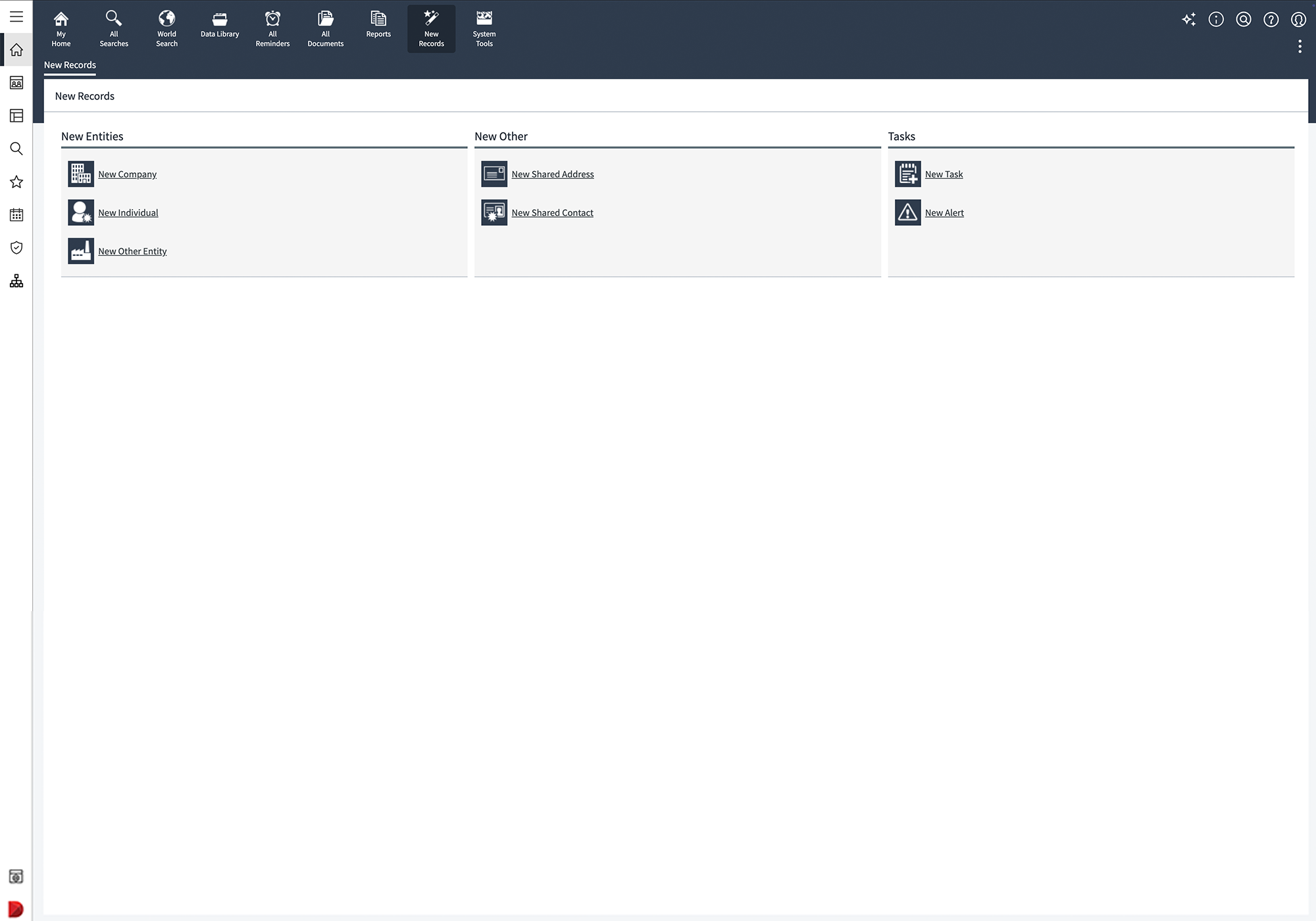
For companies scaling into more complex organizational structures, adding subsidiaries, entering new jurisdictions or managing entity-level compliance across multiple business units, Diligent Entities provides centralized corporate record management with AI-powered compliance tracking.
The platform automates deadline tracking across jurisdictions, proactively flags compliance issues, and scales with organizational complexity. The platform has been used by organizations to streamline compliance across hundreds of entities globally.
Together, these tools address the core tension growing companies face: the need for governance maturity that matches investor and regulatory expectations, delivered within the resource constraints of a scaling organization. The result is a governance infrastructure that supports transaction readiness and investor confidence without requiring the headcount or budget of an enterprise program.
See how growth-stage companies build governance infrastructure for funding rounds and exits, laying the groundwork for investor due diligence and successful transactions. Request a demo.
Most growing companies can establish a working foundation in three to six months using existing team members. The first three months focus on identifying critical data assets, assigning ownership, setting quality standards and building initial policies. Months four through six operationalize the program with automation and demonstrate business value. Full maturity, covering all data domains with comprehensive automated monitoring and impact analysis capabilities, typically takes 12 months.
Not at this stage. A federated ownership model, where existing leaders take responsibility for data in their domain, works effectively for companies with 50 to 500 employees. Each data steward commits 15–20% of their existing time. You need clear accountability, not new headcount. As the company scales past 500 employees or enters heavily regulated markets, a dedicated governance lead (one full-time equivalent) typically becomes necessary.
Start with the regulations that apply to the data you already collect. If you have customers in the EU, GDPR applies. If you have customers in California, CCPA applies. Map your data inventory against applicable regulations, and prioritize those with the highest enforcement activity and penalty exposure. Privacy regulations affecting customer PII should be a top priority for most growing companies. Regulators actively pursue organizations of all sizes, as enforcement action databases and penalty notices make clear.
Frame governance as transaction readiness and valuation protection, not compliance overhead. Lead with the diligence impact: governance gaps create delays, and data issues can translate into real valuation impact during transactions. For example, documented research on private equity decision-making has linked poor data to material valuation errors and deal value destruction. Then address the operational case: poor data quality creates measurable losses for many organizations. Governance is the infrastructure that pays off at the next funding round.
Ready to launch governance infrastructure that scales with your company? Schedule a demo to see how Diligent helps growing companies launch their first risk and compliance programs.