
After three quarters at a five-year low, director confidence jumped 23 percent in December—yet the outlook for 2026 remains muted. One director's advice: 'Defend and survive.'
America's corporate directors ended 2025 on an unexpectedly optimistic note.
After languishing at a five-year low for three consecutive quarters, the Director Confidence Index—a quarterly poll conducted by Corporate Board Member and Diligent Institute among U.S. public company board members on their sentiment for business—surged 23 percent in December, climbing from 4.9 out of 10 to 6.0 and finally breaking into "Good" territory.
A better understanding of how tariffs are impacting businesses and the economy, lower interest rates and increased CapEx spending are the most common factors directors shared to explain this rebound.
“[There’s] an expectation that companies will be able to work through any tariff impacts without significantly raising prices,” explained one director participating in the poll.
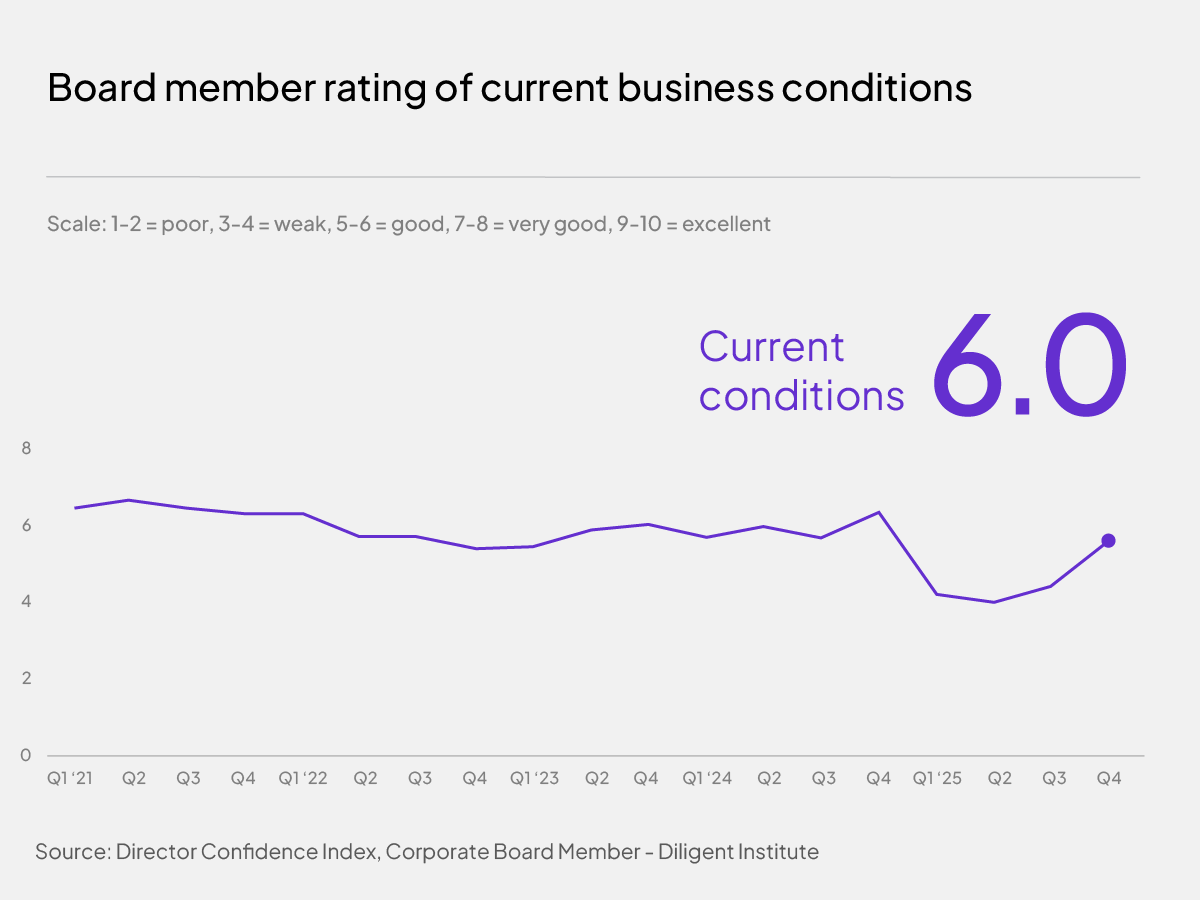
It's a remarkable turnaround for a year that tested boardroom resolve.
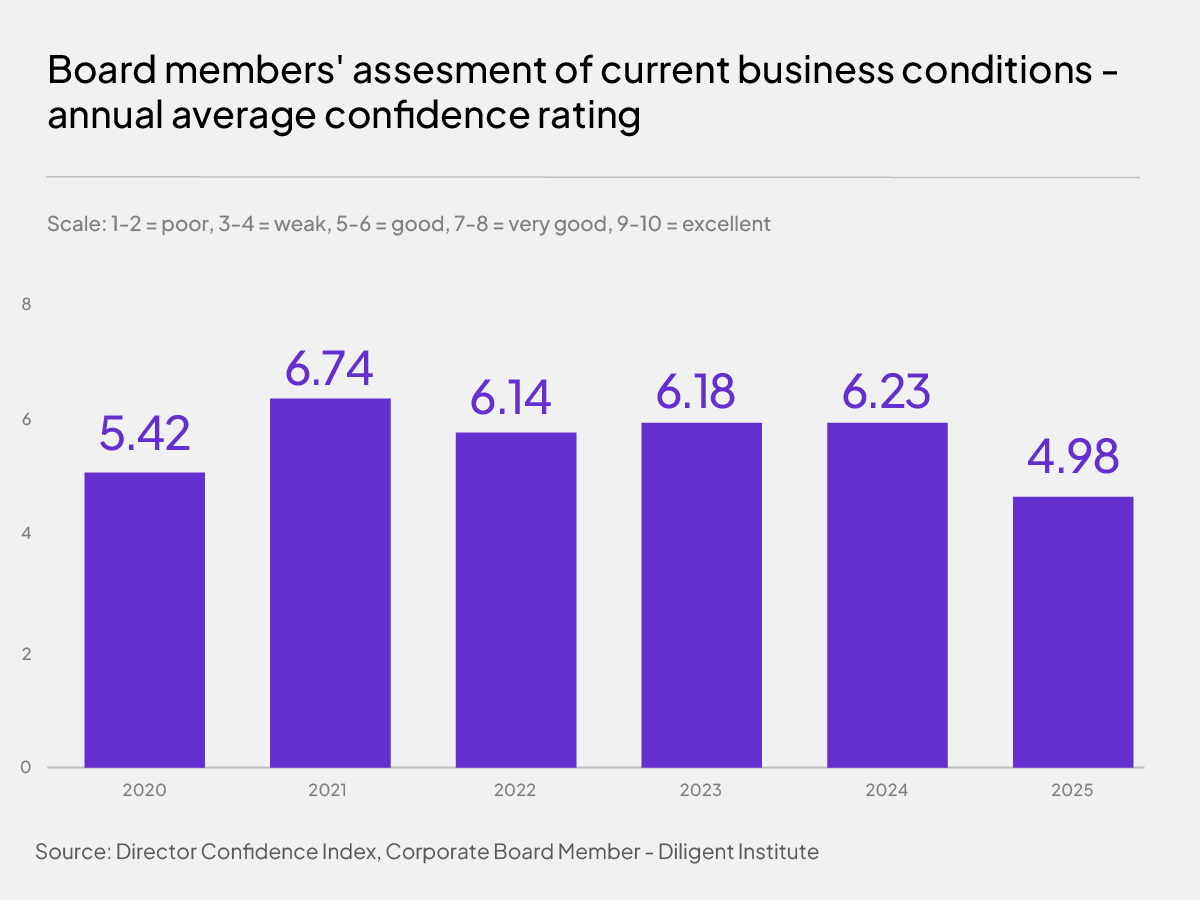
Yet even with the late rally, 2025's average confidence level landed at just 5 out of 10—well below 2024's 6.2 average and significantly short of the 6.9 that directors had predicted this time last year.
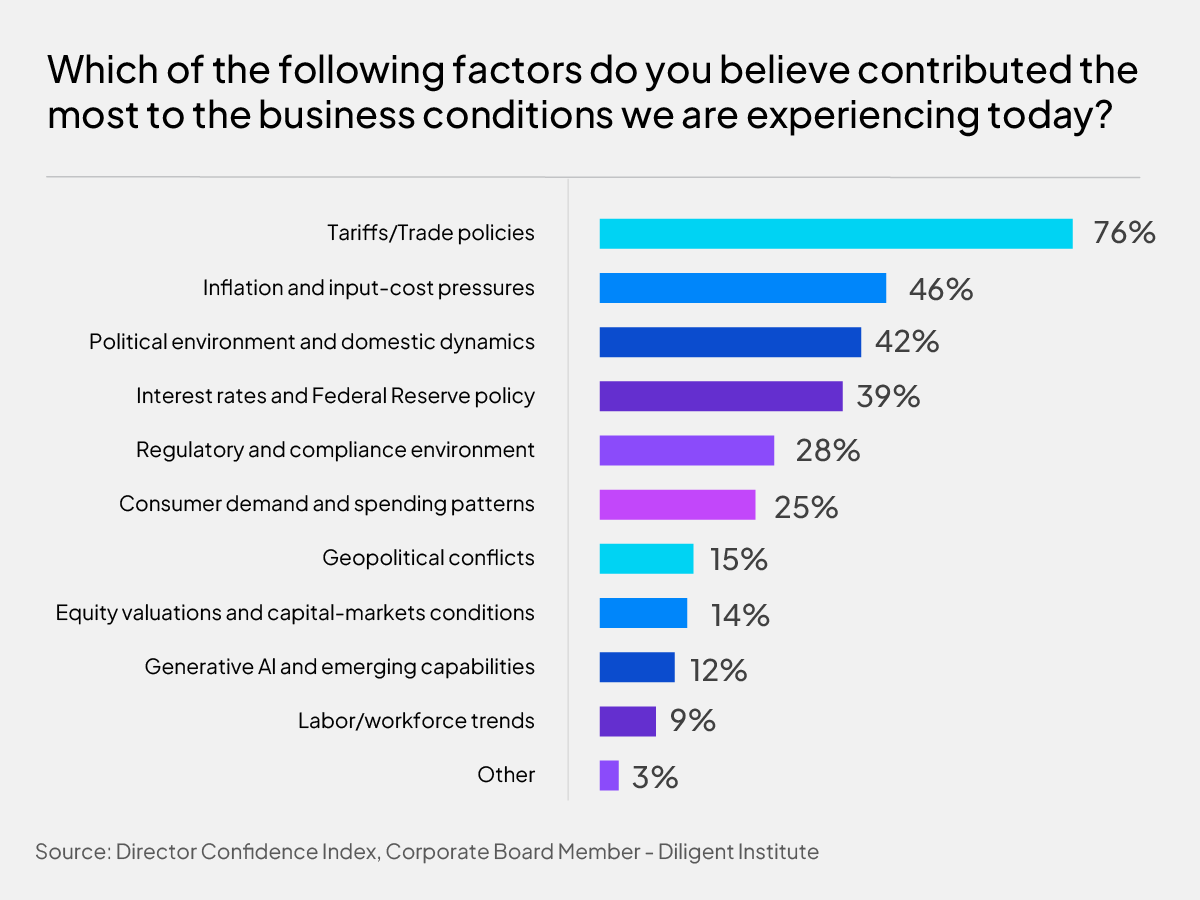
The 105 directors surveyed December 6-11 overwhelmingly point to one issue that slowed down business this year: tariffs.
Three quarters cited it as a top contributor to lower-than-expected business conditions, well ahead of any other factor, noting that standard playbooks don’t work when the environment keeps changing.
“No matter how much you try to prepare for the unexpected, you can never truly assess all outcomes,” said one director on the board of a publicly traded tech company. “We did not see the substantial impact the ever-changing tariff environment (much of which was likely unconstitutional) would have on our customers CapEx spending plans.”
“I have never experienced what we are seeing in our industry in my 30+ years,” said one director at a Nasdaq-traded life sciences company. “Pharma/biotech has always been recession-proof and has not been impacted by which party was in power at the time.”
Despite December's surge, directors aren't banking on momentum carrying into the new year. Their forecast for business conditions by this time in 2026 sits at 6.0—essentially flat from today's level.
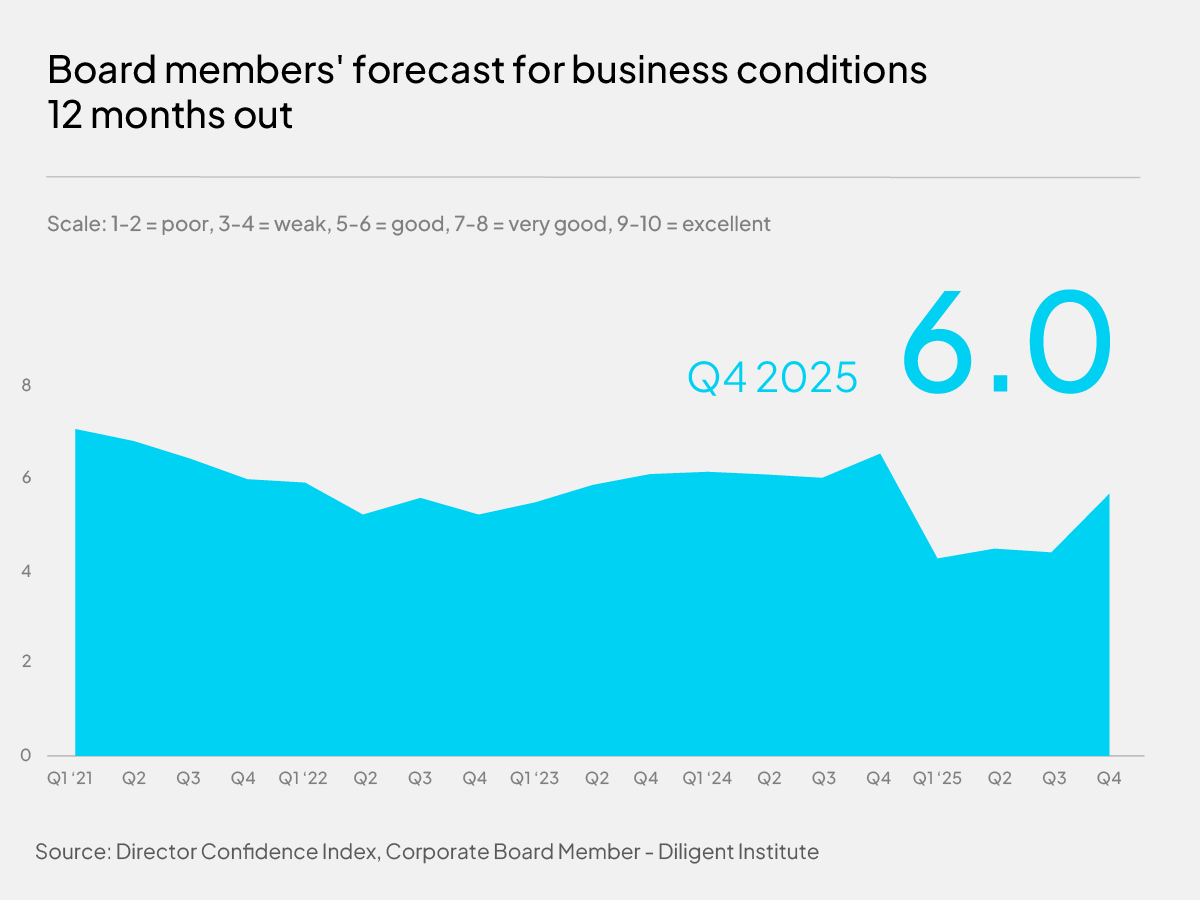
This is an interesting delta when compared to CEO sentiment. When polled by sister publication Chief Executive the first week of December, CEOs said they forecast conditions will improve by 6 percent in 2026, to land at 6.4 out of 10 next December.
Overall, 44 percent of CEOs are optimistic that conditions will improve, vs. 32 percent of board members.
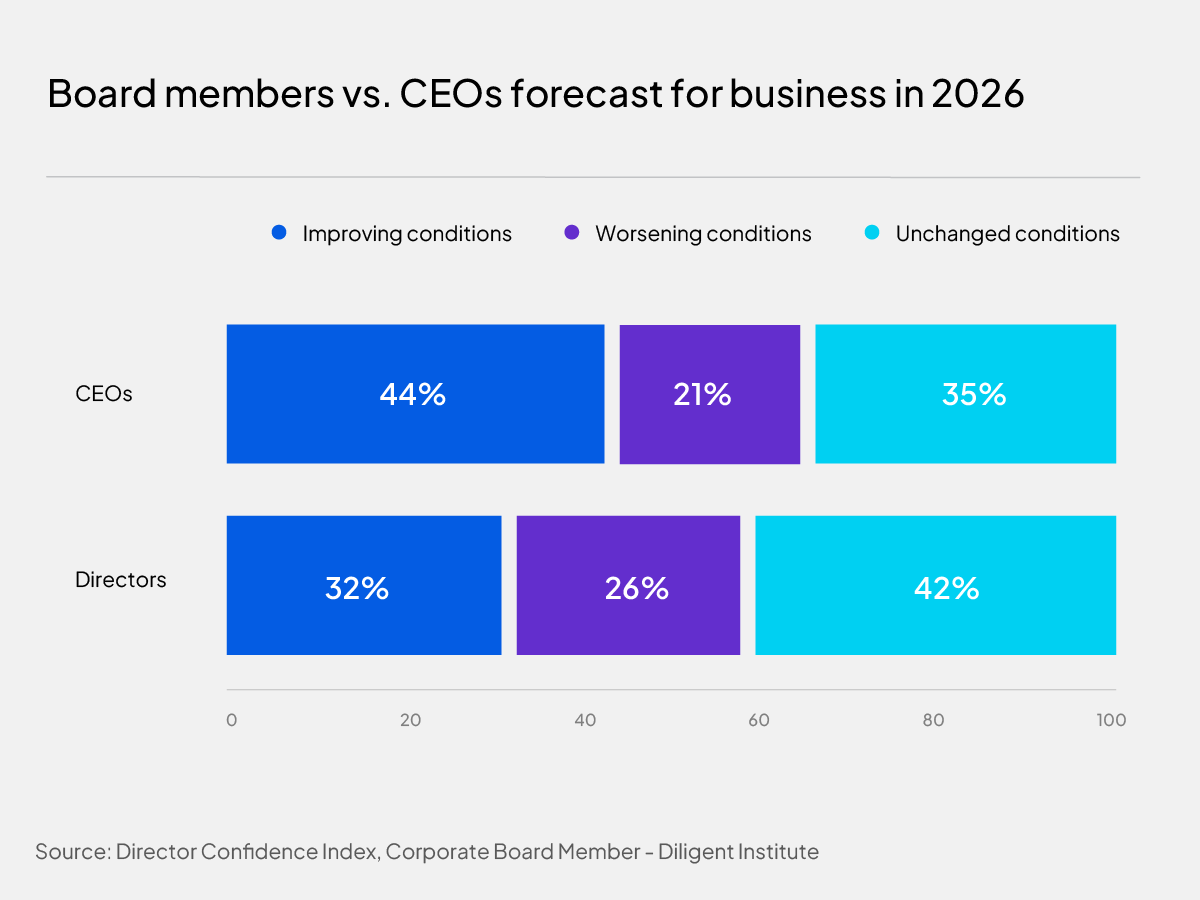
Among those directors who are optimistic, we observe a strong AI focus in their responses, far outpacing macro fears that are atop the list of concerns among directors who expect conditions to deteriorate in 2026. As for those neutral directors, the uncertainty they expect to continue in the year ahead rivals inflation as a key theme.
To navigate 2026 successfully, directors are prioritizing adaptability, deeper engagement and faster learning, recognizing that compounding risks demand boards connect dots more quickly than ever. "Work hard and smart, keep expenses tight, and survive until a rebound comes around," advised one director.
“Defend and survive,” concluded another.
To mark our fifth year of running the Director Confidence Index, we asked respondents this quarter to reflect on how their roles had shifted since we first fielded this survey at the end of 2020. Directors say they are spending far more time on risk in a “more complex and faster‑moving” environment—cybersecurity, AI, geopolitical shocks, supply‑chain integrity and policy volatility are now routine board agenda items, not edge cases.
Many describe a shift from “managing the present” to “understanding and planning for the future,” with scenario planning and strategic resilience now core to the role. Several also point to rising scrutiny from activists and a broader investor base, which has widened the mandate from overseeing financial performance to stewarding culture, human capital and corporate character.
Directors repeatedly flag the steep learning curve this entails. In their open‑ended comments, they emphasize the need to be more tech‑savvy on AI and cyber, more fluent in geopolitics and regulation, and more intentional about ongoing education just to remain effective in the boardroom. Committees are “very busy,” topics are broader, and some directors note a clear move away from informal business development toward disciplined governance, succession planning and risk oversight.
While a minority insist the formal role has not changed, the weight of the written responses is unmistakable: being a director today is more time‑intensive, strategically demanding and consequential than it was in 2020, and possibly than it has ever been.