
In this article

In April 2026, Diligent Institute convened the Elevate Leadership Summit to explore how boards and senior executives can lead effectively in an era defined by rapid technological change and geopolitical turmoil. The Summit brought together directors, C-suite leaders, and governance experts for a day of plenary sessions, breakouts, and roundtable conversations focused on M&A strategy, executive and board succession, executive compensation, AI strategy and governance, and board culture and leadership.
While sessions tackled distinct topics, several themes cut across the day: the centrality of people and culture, the need for continuous (rather than episodic) governance, and the imperative for boards to build fluency around AI and risk oversight.
Please note that all Elevate Leadership Summit sessions were held under Chatham House Rule, meaning that no individual attendees or speakers are directly quoted. Direct quotes in this paper were obtained in on-the-record discussions following the event.
"Continuous governance means accepting three uncomfortable facts: every company is a technology company, every board is now a succession board, and every director is now a geopolitical actor. The integration of those three — contextual intelligence — is the work. Treating them as separate agenda items is the dominant boardroom failure mode."
— Joe Hurd, CEO of The Katama Group, Partner of Alpha, Independent Director on the boards of Lloyd’s, Hays, and Trust Pilot
Before diving into the detailed findings, you can access the complete insights in one place: Download the full 14-page summit recap.
Panelists began with a frank assessment: many first-time or infrequent acquirers fail because they are unprepared, not just in deal mechanics but in integration discipline and culture management. Boards often underestimate how much M&A risk they truly own and over-index on spreadsheets at the expense of people and systems.
Key messages:
"Boards of companies with successful, repeatable M&A playbooks understand that integrating key personnel — often at two or three levels below the C-suite — and optimizing cultural alignment are two of the keys to long term M&A value creation."
— Brian Kushner, Senior Managing Director at FTI Consulting and Board Member at Resideo Technologies and Gibson, Inc."
Speakers stressed that the regulatory environment is now often the binding constraint on deals. Antitrust and cross-border reviews are more complex and geopolitical dynamics can upend once-routine transactions.
Boards were urged to:
Higher-performing boards:
The overarching insight: no acquisition will go exactly as planned. Effective oversight does not remove risk; it makes risk explicit, priced, and continuously managed.
Despite elevated CEO turnover, many boards still treat succession as a periodic exercise rather than a continuous process.
Common pitfalls include:
Better practice is to treat succession as an every-meeting topic: What has changed in the pipeline since we last met? Who is being stretched or tested? Where are our gaps?
"When succession planning is consistently addressed by the board it becomes a part of the culture and the fabric of the organization. When succession is only addressed when there is a crisis or when the CEO is not performing, it may create horse races and become a deep distraction for the organization."
— Ana Dutra, Independent Director, Pembina Pipeline and CarParts.com
Boards were encouraged to start with the future context, then define the role:
Succession planning should work backward from a well-articulated future role, not forward from a list of familiar names.
Succession in the boardroom raises parallel questions:
Boards can use skills matrices, planned refreshment, and candid one-on-ones to align composition with future needs and create space for new talent.
"AI fluency now belongs on every executive and CEO succession profile right alongside the traditional readiness competencies boards have always valued.
The fundamentals of leadership and judgment still matter; we just need to layer in AI stretch assignments and targeted leadership courses so key candidates can lead confidently in a business where AI touches everything. And succession itself can’t be an annual check-the-box exercise anymore. It needs to be a frequent, candid boardroom conversation about who’s being tested, where the gaps are, and how the pipeline is evolving.
Our nomination and governance committees are well-positioned to lead this shift, and the time to act is now. The committees that move first to build AI fluency into readiness profiles and make succession a continuous discussion will set their boards and executives up to succeed in the years ahead."
— Mary Lee Sharp, Founder and Board Advisor, People First Advisors
Speakers noted that most failed executive transitions stem from human factors like culture misalignment, poor assimilation, or unclear decision norms rather than technical gaps. The same is true for director transitions.
Effective boards:
The Summit’s authentic leadership session underscored that presence matters more than performance theater; that directors should stay grounded in their intrinsic worth rather than constant proof-seeking; and that crises can unify organizations when leaders respond with curiosity: "Help me understand" instead of defensiveness.
Taken together, the message was that succession and leadership at both executive and board levels are people systems, not paperwork — and AI and disruption only raise the bar.
"As risks become more complex and their consequences more far-reaching, a board’s ability to leverage the collective experience around the table is no longer a differentiator — it is a critical success factor. That requires trust, presence, and integrity not as aspirational qualities but as the baseline for effective governance. And as the gap between those who benefit from growth and those left behind continues to widen, boards must ask harder questions about who their true stakeholders are and what value creation actually means — and for whom."
— Kathryn Henry, Independent Director and Audit and Compensation Committee Member, lululemon
Speakers highlighted three pressing challenges: First, goal-setting under uncertainty. Business plans are more volatile and non-linear, complicating the calibration of performance curves and payout ranges. Second, sustaining pay-for-performance alignment. Investors scrutinize above-target payouts when shareholder returns are flat or negative, focusing on realized pay relative to performance and peers. Third, retaining scarce talent. Competition for executives in supply chain, operations, and digital/technology remains intense, and "make-whole" practices can blunt traditional retention tools.
Observed trends include:
The proxy environment is less centralized and more fragmented:
For boards, success on pay is now defined less by any single gatekeeper and more by maintaining trust across a diverse investor base.
"Overall, the executive compensation environment remains as complex and uncertain as ever. Companies are primarily focusing on ensuring alignment between pay outcomes and performance within the context of an ever-changing and fluid environment. We expect substantial governance and disclosure changes in the coming 1-2 years, making compensation decisions and resulting implications even more uncertain."
— Jim Kzirian, Partner, Meridian Compensation Partners
Speakers characterized AI as “still wet cement”: its use cases, norms, and controls are still being formed. When it comes to AI deployment, even advanced organizations often describe themselves as “crawling” or “walking,” not yet “running.”
Key points:
"While AI is still wet cement, the decisions boards and management make right now will define their company’s relevance for a decade. AI strategy is mission critical — and it demands every clock run in sync. Capital, talent, social license, and market position: any one out of rhythm, and the risk isn’t just falling behind — it’s becoming irrelevant."
— Roosevelt Giles, President & Chairman, Endpoint Consulting Group, Independent Director, JUST Capital
Patterns among more mature adopters include:
AI now sits squarely within board fiduciary obligations:
AI governance intersects directly with stakeholder trust and talent:
The central insight: AI strategy is not a “tech” issue alone. It is a governance, talent, ethical and business model issue.
"AI governance is not a future-facing topic, it is a present-day board responsibility. Earning trust and creating value means moving past experimentation into disciplined oversight: why does this use case matter, how does the data support it, where are the risks, and who is accountable? Board members do not need to be AI engineers. They need to be fluent enough to ask the right questions."
— Jean Harvey-Johnson, VP of AI Enablement & Process Optimization, Fiserv
Geopolitics appeared throughout the Summit as both a risk multiplier and a strategic variable. Rather than rare “black swans,” speakers framed many geopolitical risks as “grey rhinos,” which are large, visible, and insufficiently addressed.
Examples included:
Boards were encouraged to move beyond high-level briefings and ask how geopolitical dynamics intersect with:
Practical steps include:
Participants stressed that geopolitics must move from an annual slide to a standing part of the board conversation, woven into:
In short, geopolitics is now a core dimension of strategy, not an external backdrop.
Across the Summit, several through-lines emerged:
"The Elevate Leadership Summit underscored that while the environment is unprecedented, the best qualities of the board — curiosity, courage, discipline, and a commitment to continuous learning — remain powerful... The challenge now is to apply them with renewed focus to the intertwined questions of M&A, AI, geopolitics, talent, and culture that define the future of corporate governance."
— Dottie Schindlinger, Executive Director of the Diligent Institute
The Elevate Leadership Summit was sponsored by Meridian Compensation Partners and FTI Consulting.
Equip your boardroom for continuous governance in the AI age. Download the full 14-page summit recap to master these critical strategic frameworks today.
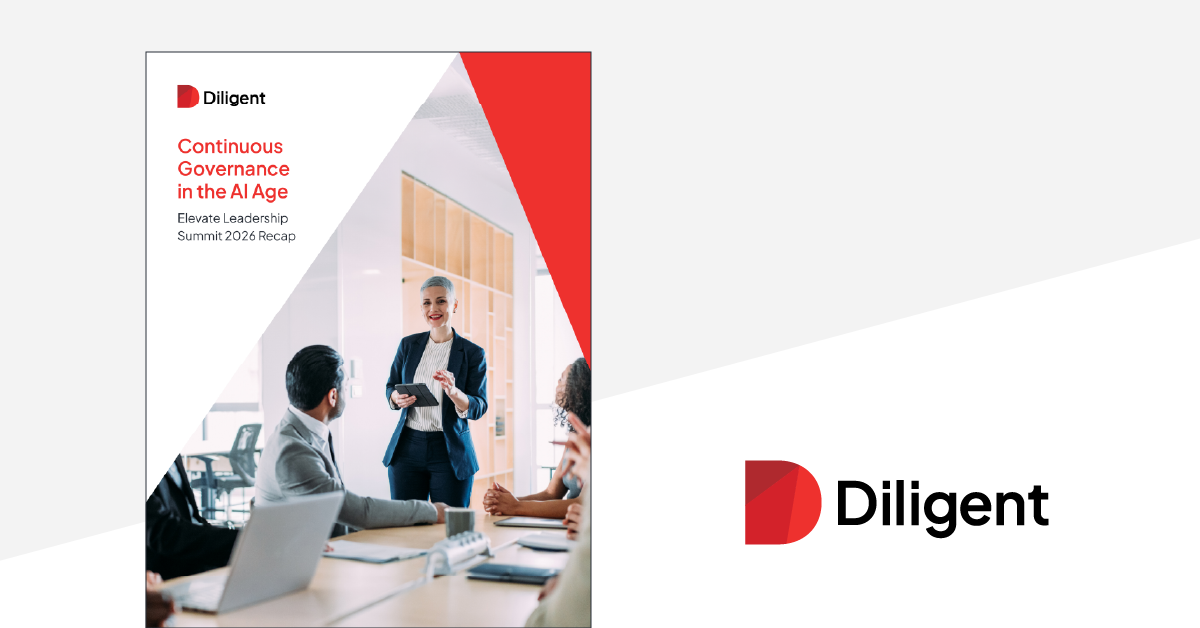
Continuous Governance in the AI Age: Elevate Leadership Summit 2026 Recap
At the 2026 Elevate Leadership Summit, directors, C-suite leaders, and governance experts came together to examine what effective board leadership looks like now. Across conversations on M&A, succession, executive compensation, AI governance, geopolitics, and board culture, one message came through clearly: governance can no longer be episodic. It must be continuous, integrated, and future-focused.

Continuous governance is the new board imperative
Explore how continuous governance is redefining board responsibilities in today's fast-paced environment, where AI fluency, succession planning, and geopolitical awareness are essential for effective oversight. Discover the insights from Diligent's recent Elevate Leadership Summit and understand why good governance now demands a proactive, interconnected approach.
AI action plan worksheet for GRC leaders
Unlock the potential of AI in governance, risk, and compliance with this practical 90-day action plan worksheet designed for GRC leaders. This guide helps you assess AI maturity, prioritize use cases, and establish essential guardrails, ensuring a structured and accountable approach to AI implementation in your organization. Download now to transform AI discussions into a clear, actionable strategy.