When you implement a governance, risk and compliance (GRC) platform, you're not just adding another piece of software. You're centralizing the most sensitive parts of your business: Security controls, vulnerabilities, audit evidence, risk registers, vendor data and remediation plans.
Think of it as handing over the keys to your kingdom, or the Rosetta Stone to your entire technology stack.
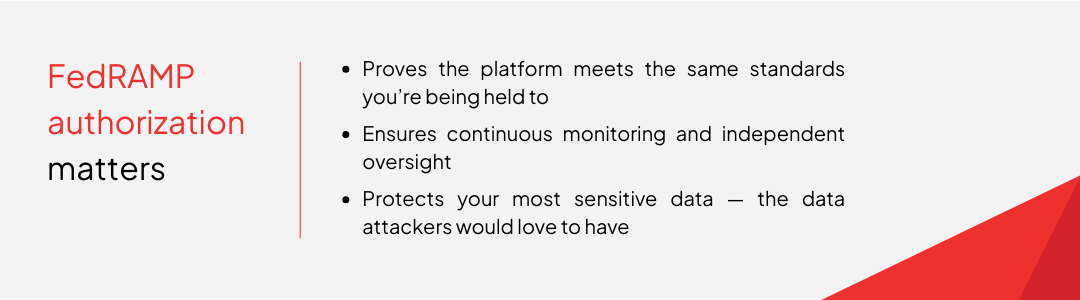
If that platform is compromised, the fallout doesn't just hit the platform provider. It hits every customer whose sensitive data was stored inside. That's why FedRAMP authorization matters.
Attackers know that GRC platforms contain:
In other words, everything an attacker would need to exploit your environment at scale. A breach here hands attackers a blueprint for targeting your systems.
The question is worth asking: Why would you entrust that level of information to a platform that doesn't meet the same security standards you're expected to meet?
FedRAMP authorization isn't a rubber stamp. It demonstrates that a platform has:
For customers, that means the platform isn't just claiming to be secure. It has to prove it, continuously, through monitoring and oversight by the FedRAMP Program Management Office and sponsoring agencies.
Imagine a contractor using a non-FedRAMP GRC platform. That platform suffers a breach, exposing customer data. The attacker now has:
Within days, the contractor's own systems are compromised using the attacker's new playbook. The breach isn't limited to the platform provider; it cascades to every organization whose data was stored there. That's the scenario FedRAMP prevents.
Some organizations assume FedRAMP only matters when working directly with federal agencies. That's a narrower view than the reality:
If a platform isn't secure enough for the federal government, the question worth asking is why it would be secure enough for your business.
Diligent One Platform has held FedRAMP Moderate authorization since 2019 and carries DoD IL5 authorization for Department of Defense workloads. The platform aligns with NIST, CMMC and ISO/IEC 27001, the same frameworks its customers are held to. Because FedRAMP requires continuous monitoring, customers benefit from ongoing oversight, reporting and transparency, not a one-time assessment.
The team includes Matt Goodrich, the founding director of the FedRAMP PMO, and James Bowman, the first person to achieve a FedRAMP authorization through the JAB. They built the program. When FedRAMP 20x guidance leaves room for interpretation — as it does on KSIs and risk evaluation — having the people who wrote the rules matters.
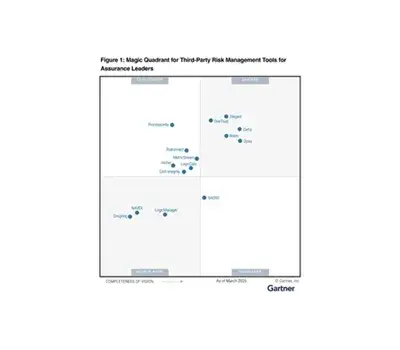
Recognized as a Leader in the 2025 Gartner® Magic Quadrant™ for GRC and the Q2 2026 Forrester Wave™ for GRC Platforms, Diligent is trusted by more than 25,000 organizations, including 75% of the Fortune 500, to manage risk and compliance at scale.
As FedRAMP moves to 20x, the continuous monitoring model extends further. For cloud service providers currently authorized under Rev5, VDR (Vulnerability Detection and Response) and VER (Vulnerability Evaluation and Reporting) requirements become mandatory from 7 December 2026. These standards replace the monthly Plan of Action and Milestones (POA&M) with a continuous, per-finding workflow: Every vulnerability evaluated within days of detection, every output machine-readable.
VDR and VER are the next layer of what maintaining that authorization now demands.
If you're evaluating GRC platforms, here are the questions to put on the table:
If a vendor can't answer those questions with clarity and proof, that's a red flag.
When you put your compliance posture into a platform, you're betting the business on that provider's security. Without FedRAMP authorization, that bet carries unnecessary risk.
In a market where every system is a potential attack surface, FedRAMP authorization sets the floor for what a trustworthy GRC platform looks like.
For organizations evaluating their options, the question is simple: would you trust your business to anything less?
Explore Diligent's FedRAMP-authorized solutions to protect your organization's critical assets with continuous monitoring, independent validation, and government-grade security.