

In this article

Large and ongoing projects don't stay on track on their own. A steering committee guides an organization through complex initiatives from start to finish, whether that's an operational transformation, regulatory compliance program or board-level oversight effort. For corporate secretaries and general counsel, understanding what a steering committee does and how to run one effectively is foundational to their role, because these committees represent one of the most important governance mechanisms under their direct authority.
But that responsibility is getting harder to execute well. According to What Directors Think 2026 by Diligent Institute and Corporate Board Member, 84% of directors have changed their approach to scenario planning, yet 53% say they don't often receive real-time data between meetings. When the board itself is struggling to stay informed between sessions, steering committees face even greater pressure to close that information gap and keep critical initiatives moving.
Here, we examine what a steering committee is, the specific challenges that make committee governance difficult today and how to develop effective steering committees that meet current regulatory and operational demands.
This guide covers everything you need to know about steering committee governance:
Steering committees are comprised of various people, including board officers, senior stakeholders, experts, executives, department employees and client representatives. These specialized teams serve as governance bridges between enterprise strategy and operational execution, providing expert oversight and direction.
Members of steering committees meet and collaborate to define, prioritize and control projects. They also provide guidance to the project manager on various issues while maintaining alignment with corporate objectives and regulatory requirements. For a deeper look at how board committees are structured, Diligent’s committee guide covers common structures and responsibilities.
Steering committees oversee and manage the progress of specific activities within organizations, ranging from special projects and compensation decisions to complete board oversight.
Though steering committees remain heavily involved in these activities, they aren’t the ones doing the work. Instead, they collaborate with project managers to ensure designated teams complete tasks on time and within budget. For the corporate secretary or general counsel managing this process, the challenge lies in ensuring the committee operates within its charter while maintaining clear decision-making authority.
Each steering committee operates under a committee charter that details the committee’s mission, roles and responsibilities, composition and decision-making authority. Current charters must also address emerging governance requirements, including cybersecurity oversight, ESG reporting under frameworks such as ISSB (IFRS S1/S2) and AI implementation governance.
While specific duties vary by organization, steering committee responsibilities generally fall into three areas. Each carries direct implications for the corporate secretary or general counsel managing the committee's operations:
Across all three areas, the common thread is keeping discussions focused on outcomes rather than status updates. According to What Directors Think 2026, 58% of directors want less presentation time and more time dedicated to strategic planning. Steering committees that adopt this same discipline, prioritizing decisions over updates, consistently deliver stronger results.
Steering committees can vary from organization to organization since all businesses have different needs. Here are the five most common steering committees in both non-profits and private corporations:
An executive committee is typically composed of the board’s officers and, in some cases, the executive director. In this capacity, the executive committee acts as a steering committee because it steers the direction of the entire board and prioritizes the board’s issues. They also often lead executive board meetings, set agendas and collect reports from other committees and board members.
A project steering committee focuses on single initiatives requiring close oversight, such as enterprise resource planning (ERP) rollouts, digital transformations or merger integrations. These committees support project managers to ensure that projects align with business objectives while managing cross-departmental interaction and multiple stakeholder involvement.
The committee is responsible for:
Project steering committees ensure that all viewpoints are heard and manage conflicts between stakeholders or departments while maintaining progress toward meeting benchmarks and goals.
Under current governance standards, project steering committees must also ensure projects meet enhanced documentation requirements for audit readiness and regulatory compliance. This makes their role more complex than traditional oversight functions and the committee chair bears primary responsibility for keeping these processes on track.
This committee ensures that the organization complies with privacy and security regulations, including GDPR, evolving U.S. state privacy laws and emerging federal privacy frameworks. The privacy committee collaborates with other stakeholders and subject matter experts to verify that the organization has adequate data privacy, a critical part of enterprise risk management.
Both corporate boards and non-profits typically create a compensation committee. This committee is the authority on executive compensation and benefits packages. Members of this committee should represent a diverse set of business and industry skills while maintaining independence requirements.
Since non-profits often have to do a lot with a little, they can significantly benefit from board committees, since they can streamline processes. Non-profit board committees generally support their boards of directors through strategic planning, budgeting, project management and more.
Despite their critical importance, steering committees face significant challenges in today’s complex business environment. For the corporate secretary or general counsel who ultimately owns committee governance, these challenges translate into direct operational and legal risk.
Many steering committees struggle to translate strategic initiatives into measurable business outcomes. Common failure patterns include unclear decision-making authority, misaligned project objectives with corporate strategy and insufficient escalation processes when projects encounter roadblocks. These governance gaps can lead to scope creep, budget overruns and initiatives that lose momentum despite initial executive support.
“There’s often an inclination to avoid bad news, with a hope that problems will be resolved before they escalate to the board level,” says Pav Gill, CEO of Confide. This avoidance pattern is especially damaging in steering committee settings, where delayed escalation can derail entire programs before leadership has the chance to intervene.
Steering committees must navigate emerging technologies while building greater trust in data management. AI implementation presents particular challenges, as internal audit functions increasingly provide advisory services to help set up processes and controls around new AI deployments.
According to the APAC Governance Outlook 2026 report by Diligent Institute, Governance Institute of Australia and Singapore Institute of Directors, 70% of boards identify agentic AI opportunities as their top upskilling need. Yet only 36% of respondents have audited their organization’s AI use, leaving significant governance blind spots that steering committees must help close.
Beyond technology-driven challenges, steering committees still face traditional difficulties:
Regardless of group size, steering committees face the persistent risk of groupthink. Groupthink occurs when committee members avoid expressing opinions that vary from the majority, instead voting along majority lines despite internal disagreement.
When committee members succumb to groupthink, it defeats the purpose of gathering diverse opinions and perspectives. Effective chairs must actively encourage dissenting viewpoints and create safe spaces for contrarian thinking, especially when addressing technology implementations or regulatory compliance decisions.
Practically, this means the committee chair, often working closely with the corporate secretary, should build structured dissent into the meeting agenda. Assign a rotating “devil’s advocate” role, require written pre-meeting input from all members on key decisions and create anonymous feedback channels for sensitive topics. These mechanisms make disagreement a procedural norm rather than a personal risk.
As mentioned earlier, every steering committee operates under a committee charter, a governing document that defines the committee's mission, authority, composition and decision-making scope. But having a charter and enforcing one are two different things.
For the corporate secretary or general counsel responsible for drafting and maintaining these documents, the charter must serve as both a governance blueprint and a living operational guide. Too often, steering committee charters are written once at the committee's formation, filed away and never referenced until a dispute arises or an initiative goes off the rails.
Every steering committee charter should clearly define the following elements:
Schedule an annual charter review, ideally aligned with the organization’s annual governance calendar. During this review, assess whether the committee’s scope still reflects current organizational priorities, whether emerging risks (such as AI governance or cybersecurity) require expanded oversight and whether any authority gaps caused delays or confusion during the past year.
For guidance on developing a governance policy framework, Diligent’s governance policy guide offers a step-by-step approach.
“Every conversation with the board is an opportunity to educate the board about your business. They’re not in your business every day, and they travel in other circles and often sit on other boards,” says Inna Barmash, Chief Legal Officer and Corporate Secretary at Amplify. The same principle applies to steering committees: The charter should anticipate what members need to know, not assume they already understand the operational context.
Discover how AI-powered governance platforms transform steering committee preparation and decision-making for large organizations.

Effective steering committees function best when they follow established governance practices while adapting to current regulatory and technological requirements.
Unless all steering committee members have experience on such a committee, it’s best to provide them with some training and coaching. Training should cover traditional governance responsibilities plus current requirements, including cybersecurity oversight, AI governance and enhanced regulatory compliance.
It’s a good idea to keep steering committees to a manageable size. About five to nine committee members is typically ideal, large enough to represent all appropriate parties while remaining small enough to facilitate efficient decision-making. The exact number should depend on the initiative’s scope and the organization’s complexity.
The steering committee chair sets the agenda and should provide a copy of it to all committee members at least seven to 10 days before the steering committee meeting. This timeframe gives committee members plenty of time to plan to attend the meeting, be ready to ask questions and participate actively.
Along with the agenda, committee chairs should attach the minutes of the last meeting, including an updated action list for completed actions and actions that are still in progress. The chair may also add a general progress report from the project manager and drafts of relevant documents that are being developed.
Preparation should also include cybersecurity briefings, regulatory updates and technology implementation status reports as appropriate to the committee’s scope. Good meeting etiquette and preparation practices directly determine the quality of committee decisions.
Define measurable objectives and decision-making parameters upfront. Create approval processes for scope changes, budget modifications and business pivots that account for current regulatory requirements and stakeholder expectations.
“The board fundamentally has to trust management. There are lots of ways the board trusts but verifies. Trust starts with communication. Communication is successful when it’s proactive, when it anticipates and addresses board members’ concerns, and speaks to their experience from other boards and their operational experience,” says Barmash. The same trust-building dynamic applies within steering committees: Clear frameworks establish the foundation for effective communication and confident decision-making.
Effective steering committees don’t just convene, they deliver measurable outcomes. Establishing clear KPIs ensures that committee governance remains accountable and continuously improving:
Tracking these metrics provides the corporate secretary or general counsel with concrete evidence of committee performance, useful for annual governance reviews and board reporting.
The challenges documented throughout this guide, from governance failures and AI oversight gaps to groupthink risks and the operational burden of meeting preparation, point toward a clear need for technology that moves steering committees from reactive oversight to proactive, data-driven decision-making.
Traditional committee preparation consumes weeks. Materials get compiled from scattered sources, risk scanning happens through manual review and members receive documentation too late for meaningful input. This makes the administrative burden shift focus from strategic oversight to logistics management.
Diligent Boards transforms steering committee operations through capabilities that directly address the challenges that committees face:
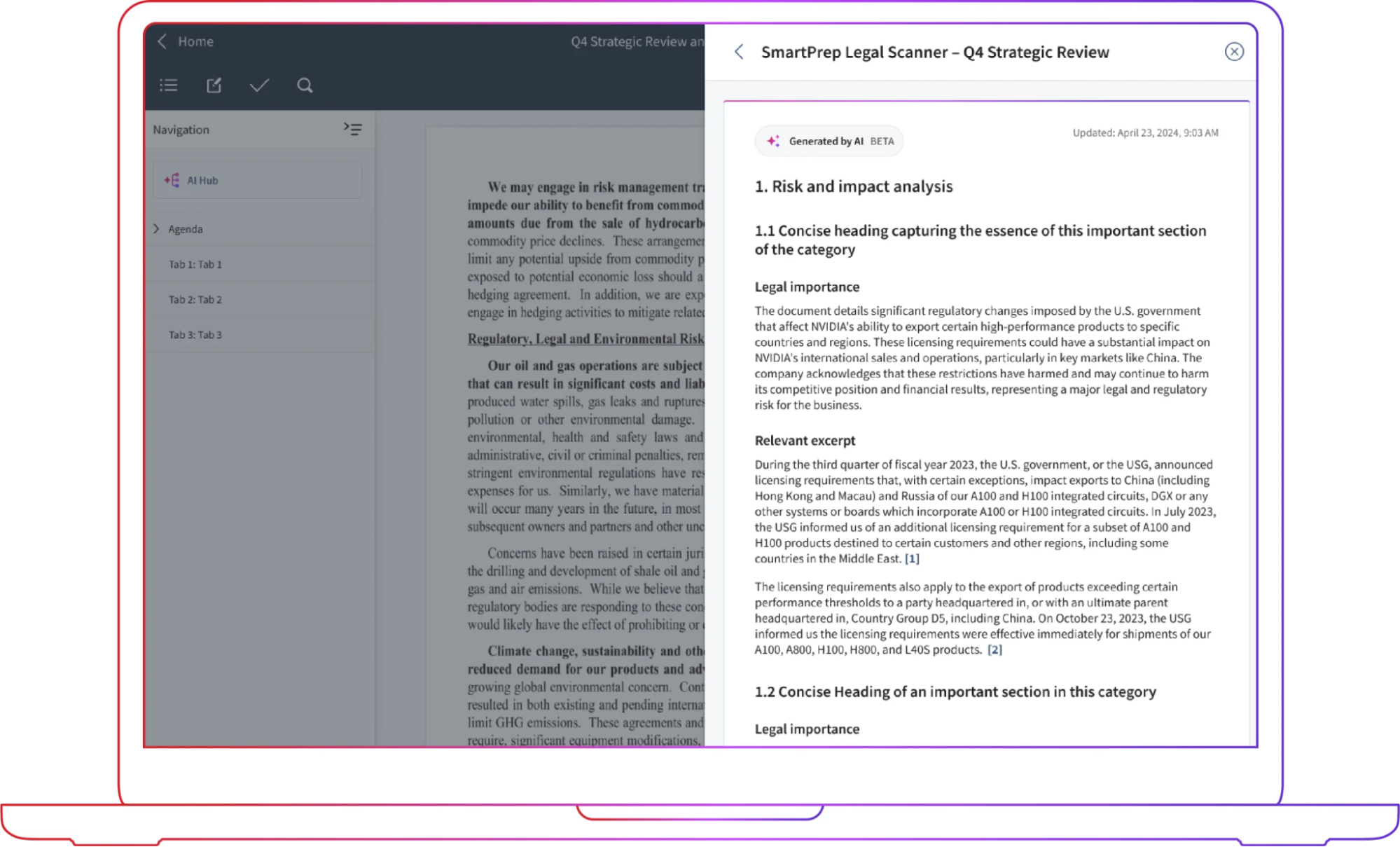
The platform also provides secure messaging, document collaboration and voting capabilities that enable committee members to contribute across time zones while maintaining enterprise-grade security and audit trails for regulatory review. Template support for agendas, approvals and action items helps define clear committee roles and responsibilities, all reinforcing the charter enforcement practices outlined earlier in this guide.
Effective steering committees combine well-defined charters, structured meetings, clear KPIs and the right technology to deliver results. But the difference between a committee that rubber-stamps decisions and one that drives real accountability comes down to execution: How consistently the charter is enforced, how rigorously preparation standards are maintained and how quickly the committee resolves escalated issues.
For the corporate secretary or general counsel who owns this process, the operational reality is demanding. Committee materials need to arrive on time, decisions need documented audit trails and members need enough context to challenge assumptions rather than default to consensus. When these elements break down, the consequences show up as missed compliance deadlines, stalled initiatives and governance gaps that surface at the worst possible moment.
The frameworks in this guide, from charter enforcement and structured dissent to KPI tracking, give committees the discipline to function at a high level. Technology closes the remaining gap by automating the preparation work that consumes the most time and creating the transparency that keeps every stakeholder aligned.
Ready to transform your steering committee performance? Schedule a demo to see how Diligent Boards delivers AI-enhanced meeting management, secure collaboration and enterprise integration that keep your projects on track and on budget.
A steering committee provides oversight and strategic direction for specific initiatives within an organization. It bridges the gap between enterprise strategy and operational execution by ensuring projects remain aligned with business objectives, stay within budget and comply with regulatory requirements.
An executive committee steers the direction of the full board and prioritizes board-level issues. A project steering committee focuses on a single initiative such as an ERP rollout or digital transformation. The key distinction is scope: Executive committees govern broadly while project steering committees govern a specific, time-bound effort.
The most effective steering committees share several characteristics: A well-defined and regularly updated charter, appropriate membership size (five to nine members), thorough meeting preparation distributed seven to 10 days in advance, clear decision-making authority and structured mechanisms to prevent groupthink. Tracking KPIs such as decision velocity and action item completion rates helps maintain accountability.
AI-powered governance platforms automate document preparation, flag compliance risks before materials reach the committee and generate strategic questions for meeting preparation. Secure collaboration tools enable members to contribute across time zones while maintaining audit trails. These capabilities shift committee time from administrative logistics to strategic oversight.
Meeting frequency depends on the initiative’s complexity and phase. Most project steering committees meet bi-weekly or monthly during active project phases and quarterly during maintenance periods. The key is finding the right balance: Too many meetings pull time away from project execution while too few create decision bottlenecks.
See how large organizations are running leaner, more accountable steering committees with Diligent's governance platform. Schedule a demo




