
In this article

According to the latest Director Confidence Index polling from Diligent Institute and Corporate Board Member, 82% of U.S. public company directors have used generative AI in their board work in the past six months, up from 66% just nine months earlier. Only 2% have ruled it out entirely.
For general counsels (GCs), corporate secretaries, business leaders and board directors, AI is already in the boardroom. The real test is whether it is being used responsibly, securely and with the oversight those roles demand.
Here is what the latest research shows, and what good AI governance actually looks like in practice. The article takes a look at:
Boards today find themselves under significant pressure: faster growth targets, accelerating AI disruption and rising regulatory scrutiny, all demanding more from directors in less time.
Against that backdrop, AI has quickly become one of the most discussed topics in boardrooms, and not just as a risk to oversee. According to the 2026 What Directors Think report, published annually by Diligent Institute, 38% of directors identify AI deployment as a leading organizational growth priority for this year. AI now sits alongside M&A and technology investment at the top of board agendas, a shift from just three years ago, when AI was still largely a management-level conversation.
Yet the same research reveals a significant gap between ambition and infrastructure. While 84% of directors have significantly changed their approach to scenario planning to address escalating risks, only 10% are currently using AI tools to manage the resulting complexity.
Boards are moving fast on AI strategy. Their own governance of AI is moving slower.
The 2026 Director Confidence Index reinforces the urgency: six in ten directors say generative AI is already creating at least moderate measurable change inside their companies today, and 27% say their organization is moving too slowly on adoption. The pressure to act is real and building.
"Board-level AI adoption remains nascent not because directors don't see the value, but because many lack the safeguards, best practices and governance frameworks needed to deploy AI responsibly in the boardroom. The opportunity now is to close that gap with structured approaches that boards can trust."
Dottie Schindlinger, Executive Director of Diligent Institute
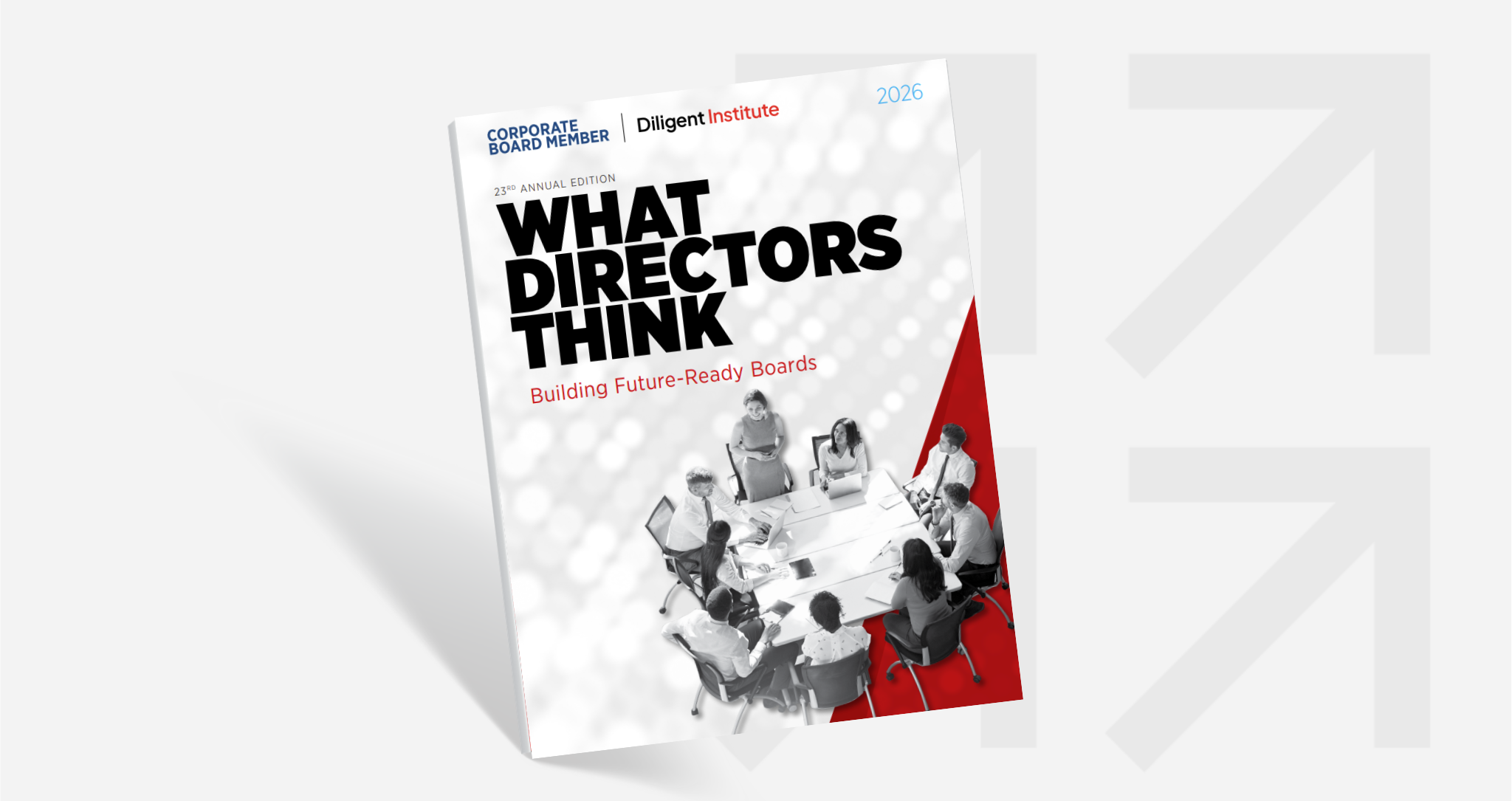
Diligent Institute's AI in the Boardroom report offers a clear picture of where AI adoption currently stands. Two-thirds of surveyed directors are experimenting with or regularly using AI for board activities, a notable acceleration from May 2023, when just 44% of boards reported using AI in any capacity.
The use cases span the full board lifecycle: directors are turning to AI to synthesize lengthy board packs before meetings, research strategic topics, prepare questions for management and draft written materials.
The desire is real, and the productivity upside is clear. The problem is how that experimentation is happening.
When directors reach for AI tools to support their board work, they frequently reach for the most familiar ones. According to Diligent Institute research, approximately 46% of directors who use AI for board activities are relying on consumer tools like ChatGPT or Gemini. In some cases, that means uploading sensitive board materials, financial reports, strategic plans, legal analyses, into platforms that were never designed for board-level confidentiality requirements.
The risks are not theoretical:
The latest Director's Confidence Index research adds a further layer to this picture. Nearly half of directors surveyed, 49%, say they have heard of board members using publicly available or consumer-facing AI tools for board work. Yet 96% say they are unaware of any instance where board materials have been entered into a tool outside the company's or board portal's approved environment.
That contradiction matters: directors believe they are operating within appropriate boundaries, while nearly half have heard direct evidence to the contrary.
As Kira Ciccarelli, senior manager of research at Diligent Institute, puts it:
"Directors are not waiting for perfect governance frameworks to experiment with AI, which makes it much more urgent for boards to define where these tools are appropriate and where confidentiality lines need to be drawn."
For GCs and corporate secretaries, the core concern is straightforward: directors are already using AI for board work, often without any formal policy or approved tooling in place. That gap is the real exposure.
Research from Diligent Institute's 2026 What Directors Think report makes clear that AI usage in the boardroom has outpaced the governance structures designed to manage it. Only 22% of boards report having AI governance processes in place to guide directors' use of AI.
Additional findings gathered from the 2026 Director Confidence Index sharpen that picture further: 54% of directors say there is no guidance whatsoever for their use of AI at their company, and only 6% report a formal policy specific to the board. With 82% of directors now actively using generative AI for board work, the gap between experimentation and oversight keeps growing.
That gap is compounded by a confidence deficit. Digital innovation and cybersecurity consistently rank as the two areas directors find most challenging to oversee, and AI now sits at their intersection. The result is what Diligent Institute researchers have described as a "bullish but under-governed" posture: boards enthusiastic about AI's potential but without the frameworks, training or tools in place to realize it responsibly.

For governance teams trying to close that gap, three areas warrant the most immediate attention:
1. Policy and acceptable use. Most boards do not yet have a formal AI acceptable-use policy. At a minimum, such a policy should define which AI tools are approved for board-related work, what categories of information may and may not be entered into those systems, and how AI-generated materials should be retained or classified. Consider including clear guidance on the distinction between consumer tools and enterprise-grade alternatives, and why that distinction matters for board data.
2. Oversight and accountability. AI governance cannot be effective if ownership is diffuse. Many organizations are establishing cross-functional AI governance committees, typically involving the CLO, CISO and CTO, to oversee AI risk across the enterprise. Boards should ensure they receive structured, regular reporting on how AI is being used across the organization, how associated risks are being managed and what incident escalation processes exist.
3. Director education and AI literacy. Only a small proportion of boards have strong AI expertise among their ranks. Directors who understand AI well enough to oversee it, and to use it responsibly themselves, are in short supply and increasingly sought after. Board education on AI governance, risk and responsible use is no longer optional. It is a component of the Duty of Care.
For a full breakdown of what it takes to build an AI governance framework, including oversight, accountability and legal guardrails, read the in-depth guide.
Moving from ad hoc AI experimentation to a structured, defensible AI boardroom roadmap does not require starting from scratch. It requires connecting the pieces (approved tools, clear policy, education and board-level oversight) into a coherent framework.
Step 1: Audit current AI use
Before you can govern AI in the boardroom, you need to know what is already happening. Consider a straightforward exercise: ask directors and board administrators which AI tools they currently use for board-related tasks, how frequently, and for what types of content. The results will likely confirm that AI is already in your boardroom and give you a baseline for policy development.
Step 2: Replace consumer tools with secure, purpose-built alternatives
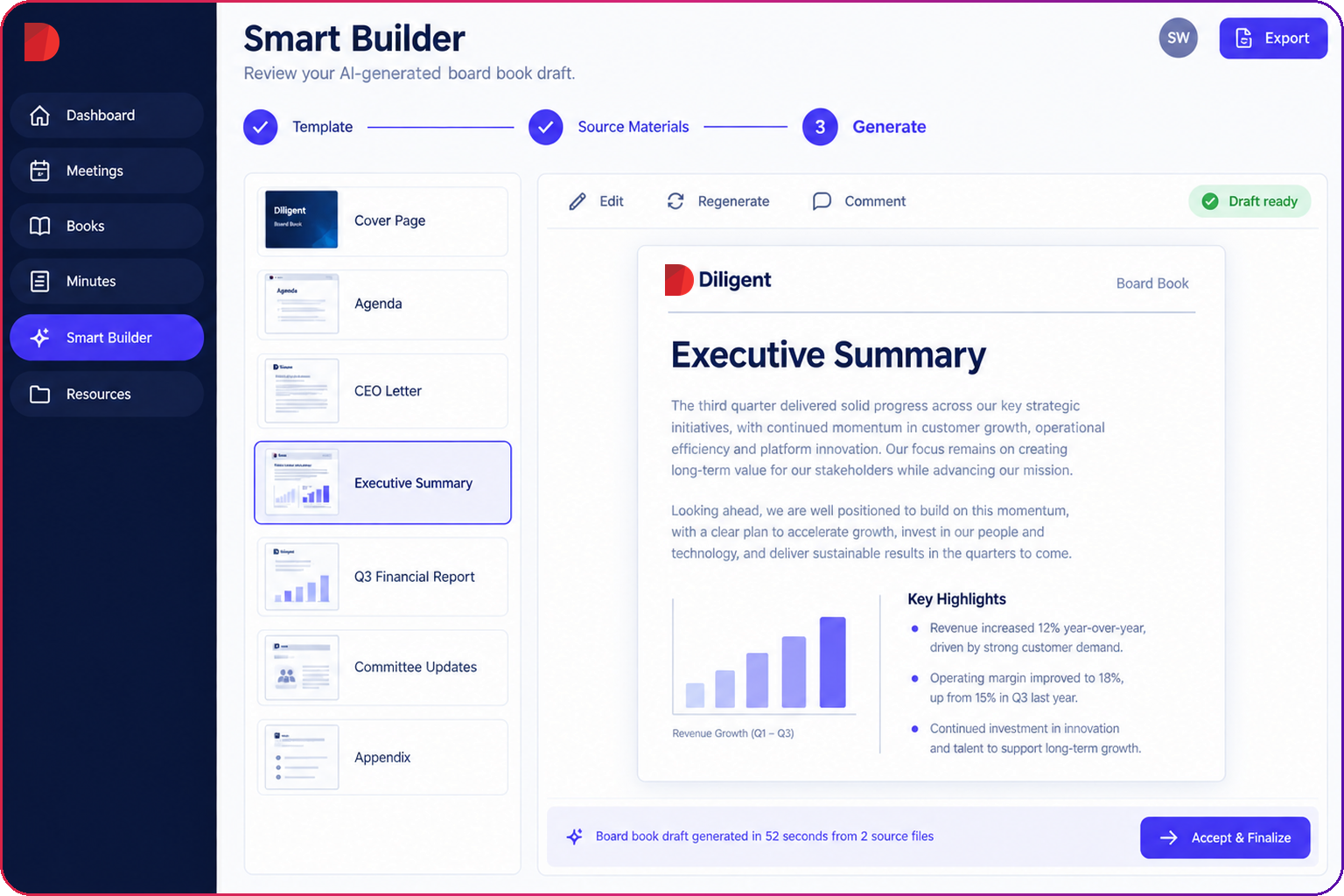
The most immediate risk reduction measure available to most boards is moving directors from consumer AI tools to purpose-built, governance-grade alternatives. Diligent Boards includes an AI capability suite, GovernAI, built specifically for this purpose: it summarizes board materials, flags risks ahead of meetings, helps structure board books, drafts minutes and surfaces AI-powered analytics, all operating within Diligent's enterprise-grade security and permissions infrastructure.
The distinction matters practically. Directors using GovernAI within Diligent Boards are working in an environment where:
Step 3: Draft your board-level AI policy. Boards that are further ahead in their AI journey are developing formal AI policies for directors' own use of AI. The policy does not need to be lengthy to be effective, but it should address approved tools, data classification, retention of AI-generated materials and the process for updating guidance as the regulatory landscape evolves. For organizations working through this for the first time, the AI Oversight Strategy Starter Kit provides a practical framework.
Step 4: Integrate AI risk into enterprise risk management. AI governance at the board level cannot be separated from AI risk management across the organization. Directors overseeing AI strategy must also oversee AI risk, and the two conversations need to be connected. AI Risk Essentials, Diligent's AI-powered ERM starter, helps organizations identify and monitor AI risks alongside other enterprise risks within the Diligent One Platform. For boards that want to move from discussing AI risk in the abstract to tracking it in real time, this provides the operational infrastructure to do so.
Step 5: Build toward continuous AI oversight. Effective AI governance is not episodic. AI systems and the risks they introduce evolve quickly, meaning governance structures built around annual reviews will quickly fall behind. Boards benefit from structured, regular AI reporting, ideally integrated into existing board committee cycles, that covers AI performance indicators, emerging risks, regulatory developments and incident escalation.
Most boards no longer need convincing that AI belongs in the boardroom. The open question is how to use it in a way that closes the governance gap rather than widening it.
Diligent is the only governance platform that combines boardroom-grade AI tools with the research, education and oversight infrastructure boards need to adopt AI responsibly. Trusted by 97% of WSJ's Top 250 directors, Diligent brings three decades of governance expertise to every AI capability it builds.
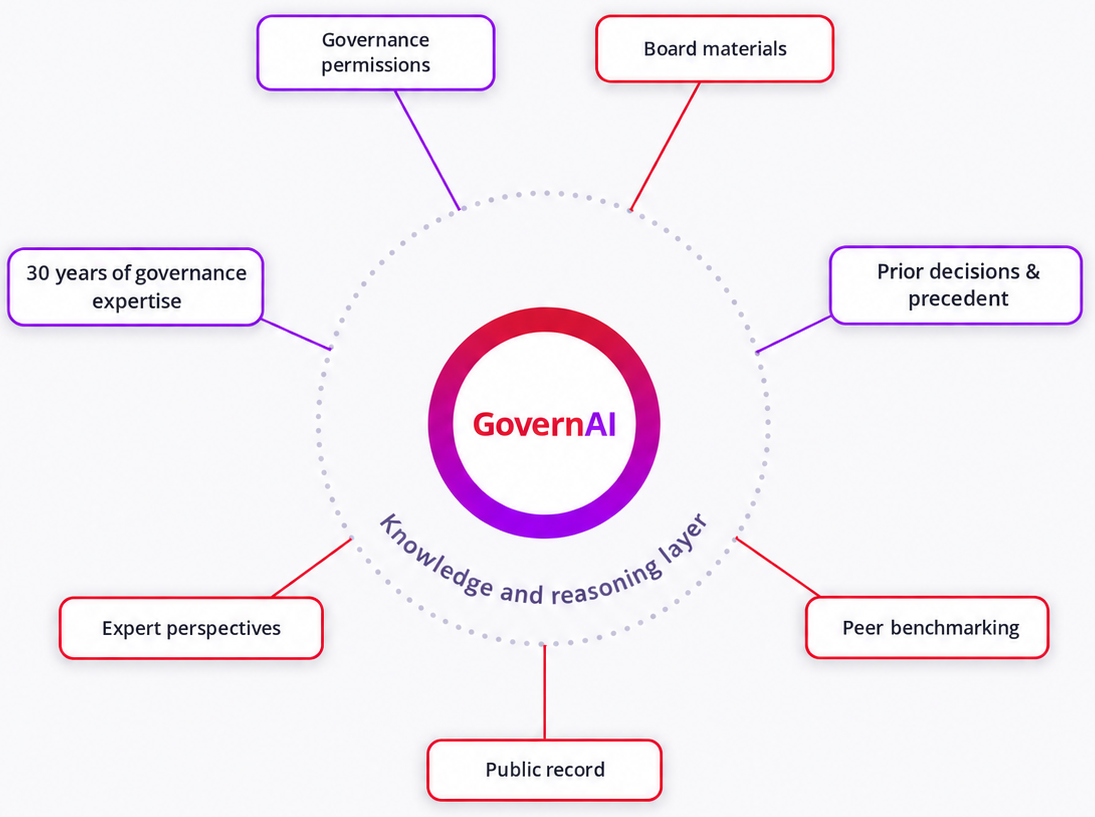
At the leading edge of that is GovernAI, which now provides a conversational, proactive AI assistant securely embedded within Diligent Boards. It connects automatically to each director's existing Diligent permissions, so board materials are available the moment they're needed, with nothing to upload, configure or expose outside that secure environment.
The conversatinal capability of GovernAI has been designed close three problems at once:
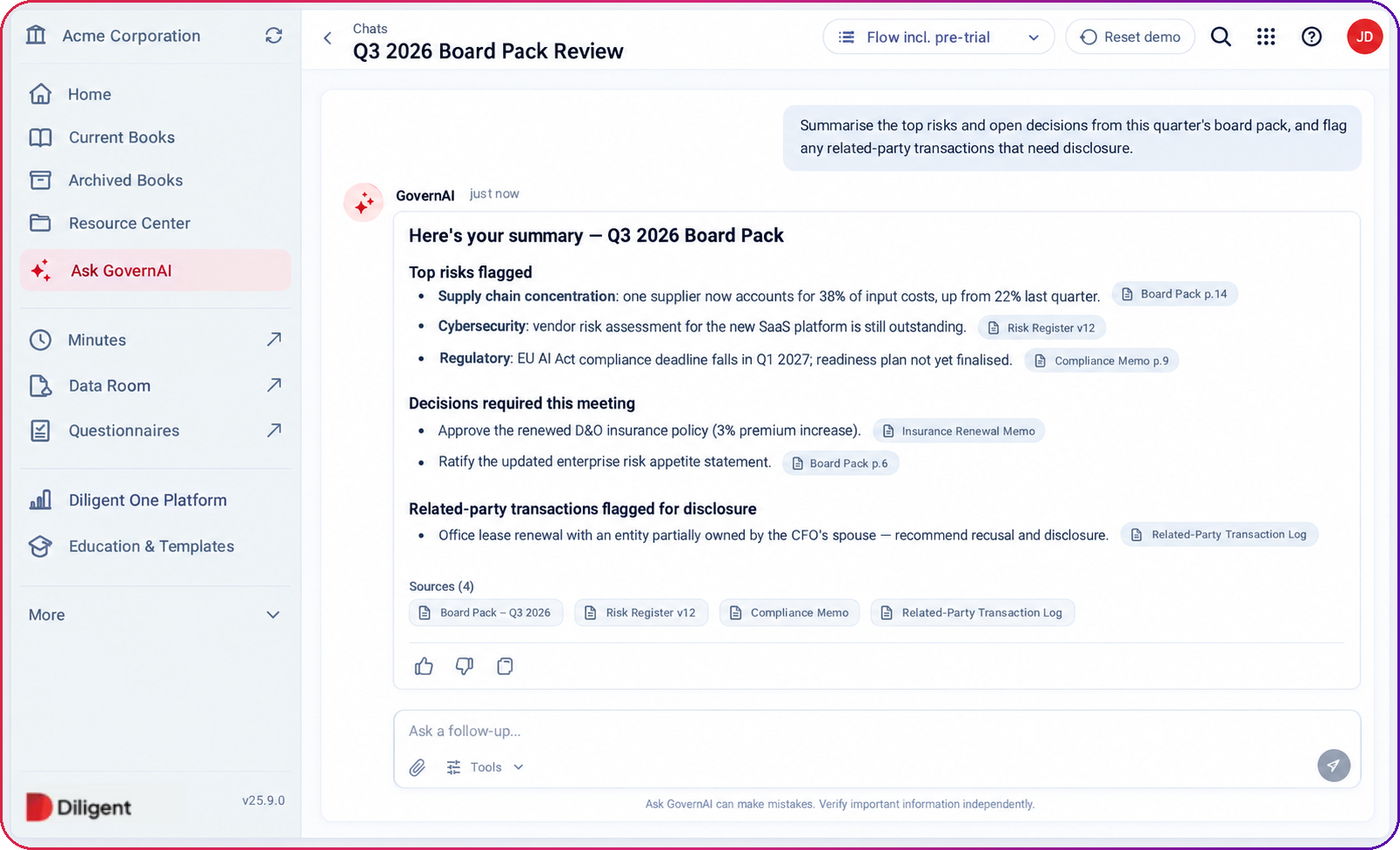
No director walks in an expert on everything their board oversees, cybersecurity one quarter, activist pressure the next, executive comp design after that. That's just the nature of the job. The real risk is in what gets missed: an angle nobody considered, a question nobody thought to ask, a signal buried somewhere in a 400-page pack.
That's where GovernAI helps. It gives directors access to specialist perspectives on demand, Activist Investor, Cyber, Audit, Executive Comp, Geopolitical Risk, and more, instead of leaving staff to track down and assemble that expertise meeting after meeting. It's a way to bring extra context into meeting prep, pulling in expert viewpoints and outside research without ever stepping outside the security of Diligent Boards to get it.
Every GC and corporate secretary knows the pattern: the same handful of director questions resurface before every meeting, someone has to go dig up the answer, then document that it was asked and answered. That's hours spent on retrieval and record-keeping, not advising.
GovernAI changes that. Board knowledge gets easier to pull up, instead of turning every historical question into a manual search through old packs and shared drives. Directors can go straight to the board's own materials and get an answer with a citation attached, drawn directly from the board's own documents and history.
That cuts down on the repetitive information requests landing on the GC's desk, and because every question and its sourced answer are logged automatically, nobody has to go back and manually reconstruct who asked what, when.
When a board portal doesn't make it easy to search its own materials, people improvise, usually by pasting something into a consumer AI tool that has no idea who's allowed to see what.
Unlike enterprise ChatGPT or Copilot licenses, which start from zero every session, have no awareness of governance permissions and produce no defensible record of board deliberation, GovernAI is connected to your board's actual context, respects its information boundaries and creates the kind of documented decision trail that fiduciary responsibility demands, for directors, and for the GCs and corporate secretaries accountable for proving it.
As the research in this article bears out: ungoverned AI, not AI itself, is the real risk organizations face.
Any board team that begins the move from ad hoc experimentation to structured, defensible AI adoption, with approved tools, clear policies, and an oversight framework that connects AI use to fiduciary responsibility, will be better prepared for the scrutiny that follows.
Those that allow directors to continue using consumer AI tools without guardrails will find the gap between usage and governance increasingly difficult to defend.
Diligent's combination of purpose-built AI tools, independent research from Diligent Institute and board-level education resources is designed to make that transition practical.
Ready to see how directors, GCs and corporate secretaries get governed, cited answers, instantly, from their own board materials? Request a demo
Already a Diligent customer? Log in and start asking GovernAI.
How are boards using AI in the boardroom today? According to Diligent Institute and Corporate Board Member research, two-thirds of directors are already using AI for board work, including meeting preparation, document review and strategic research. However, many are doing so through consumer tools like ChatGPT or Gemini, without formal policies or governance controls in place. For boards, responsible adoption, backed by appropriate guardrails, matters more than adoption alone.
What are the risks of using AI in the boardroom? The primary risks fall into three categories. First, confidentiality and data exposure: consumer AI tools have no governance permissions and may store or use sensitive board materials in ways that create real risk. Second, privilege and discoverability: AI-generated materials may become part of the corporate record and be subject to discovery in litigation, particularly if used without clear retention and classification policies. Third, accountability gaps: consumer tools produce no auditable record of the queries asked or the sources consulted, a growing concern as duty of care expectations evolve to require demonstrated active inquiry. Diligent Boards and GovernAI address all three by keeping board data within a permissioned, secure, auditable governance environment.
How should boards govern AI use by directors? Boards should consider a three-part approach: an acceptable-use policy that defines approved tools and what categories of information may be entered into AI systems; oversight structures that assign clear ownership of AI risk and deliver regular board reporting; and education programs that build AI literacy across the board.
Is it safe for directors to use tools like ChatGPT for board work? Consumer tools like ChatGPT were not built for board-level confidentiality requirements. They have no awareness of governance permissions, no cited or auditable responses, and no connection to the accountability structures that boardroom decisions require. GovernAI from Diligent provides a purpose-built alternative: it draws only from materials each director is authorized to access, operates within enterprise-grade security controls, and creates a defensible record of board inquiry. For boards that take fiduciary duty seriously, the difference is significant.
What does good AI policy look like at board level? A board-level AI policy should, at minimum, cover: which AI tools are approved for board-related work; what types of information may and may not be entered into those systems; how AI-generated materials are retained and classified; how the policy will be updated as the regulatory landscape evolves; and what training or education directors should receive. The policy need not be lengthy, but it should be explicit, documented and reviewed regularly. For a full breakdown of what it takes to build an AI governance framework, read the in-depth guide.
What is GovernAI, and how is it different from general AI tools? Ask GovernAI is the first AI agent built specifically for the governance environment. It combines instant, cited recall of board materials, expert perspectives across governance domains, peer benchmarking and proactive risk intelligence, all within each director's existing Diligent permissions. Unlike general-purpose tools like ChatGPT, Copilot or enterprise Claude licences, GovernAI understands your board's specific context, respects its information boundaries, and creates an auditable record of the questions asked and the sources consulted.