
If you’re on the audit team for a government agency or higher education, the following scenario probably sounds familiar: multiple spreadsheets of information, manual processes for cross-referencing data, endless chains of calls and emails to check status and keep everyone up to speed.
Thanks to automation and AI, audit in the public sector is being transformed through repeatable workflows that continuously execute in the background. For audit teams, it’s a transformative tool arriving at just the right time. Here are five reasons why.
Public sector auditors have a lot on their plates right now — just ask the Oregon Secretary of State’s Audit Division. Their team of just 70 audits more than $11 billion in federal funding.
“In one audit, I was looking at 200 million Medicaid claims, and it’s impossible to look at that many data points manually,” the principal auditor with the division shared.
Automation makes the impossible possible, for this task and others across the audit lifecycle, for a variety of compliance functions and audit organizations. Picture, for example, the following situation: Pre-built connectors pull control evidence directly from IT environments into dynamic workflows that assign ownership and initiate remediation if a test fails. The plan and milestones update automatically, as does the dashboard reporting progress.
In the world of audit, technology is a gamechanger. Automated data analysis and report generation enable teams to rapidly complete what would otherwise be hours of manual work. The savings of both time and money add up. Imagine, for example, taking 20% to 30% less time to generate an audit report. This efficiency can save an organization nearly $1 million over three years.
Automation also helps these organizations fulfill their missions as stewards of public funds.
The Oregon Secretary of State’s Audit Division implemented Diligent software to modernize their operations. “We’re finding millions of dollars in most programs that we look at,” said one audit manager. “So, we’re saving tax dollars every day.”
In practice, this kind of impact comes from replacing slow, manual processes with automated, repeatable workflows. In one federal agency, for example, audit teams automated loan sampling across datasets containing hundreds of thousands of records, reducing a process that once took weeks to just minutes, while ensuring consistent, defensible methodology and full audit traceability.
This not only accelerates audit delivery but also strengthens confidence in the results, helping teams demonstrate measurable value to stakeholders.
“We’re finding millions of dollars in most programs that we look at. So, we’re saving tax dollars every day.”
Audit manager, Oregon Secretary of State’s Audit Division
The costs of fraud, waste and abuse, along with inadvertent mistakes, add up, from wasted public funds and ineffectively delivered benefits to regulatory noncompliance and reputational harm. That’s why it’s more important than ever for audit teams to catch red flags and anomalies early, before they become big problems.
As every manual handoff introduces opportunities for error or exposure, automating tasks like the collection of evidence and validation of controls reduces risk. In the bigger picture, automation also minimizes the attack surface for cyber threats, shortens remediation timeframes and keeps records audit-ready.
Automation also enables audit teams to move risk monitoring from episodic, manual sample testing, which leaves public sector organizations open to hazardous blind spots, to an always-on system of record, operationalizing compliance as a living, dynamic capability for mission success.
Such continuous monitoring is more than just a goal for public sector organizations today. Increasingly — as regulators recognize the time, money and security costs of outdated compliance processes — it’s an expectation.
Automation rises to the challenge, making it easier for audit teams to operate in FedRAMP- and Department of War-authorized environments and keep up with compliance frameworks like FISMA and the Open Security Controls Assessment Language (OSCAL), a public-private initiative to modernize and automate security and compliance.
Finally, automation is the foundation for the two other pillars of modern governance, risk and compliance: AI that accelerates response and decision-making and analytics that turn live data into actionable intelligence.
The Oregon Secretary of State’s Audit Division has seen the power of such analytics in action. “You can spend an hour or two and find literally millions of dollars in a large state program of waste, fraud and inefficiencies,” said Jamie Ralls, an audit manager with the division when these analyses were being conducted.
Meanwhile, AI enables audit teams to redeploy time and talent toward strategic priorities that advance their mission and a cloud-based SaaS solution enables public sector organizations to avoid the long-tail costs of infrastructure, upgrades and maintenance.
Diligent One enables public sector finance, compliance, risk and audit teams to work faster, smarter and more cost-effectively, continuously analyzing 100% of transactions and keeping programs audit‑ready — all in one FedRAMP‑authorized platform.
Built on the Diligent One Platform, AuditAI is a suite of agentic AI capabilities that automate planning, evidence collection, control intelligence, compliance mapping and findings follow-up — helping audit teams move faster, reduce manual effort, and deliver higher-quality, risk-aligned assurance.
At the center of AuditAI is Agentic AI Request, which transforms audit request and evidence management from a manual, time-consuming task into an intelligent, automated workflow — freeing auditors to focus on insight, risk impact and remediation, not administration.
See Diligent’s audit-strengthening power in action. Schedule a demo today.
Combating public sector fraud with AI and analytics
Discover how government audit and finance leaders can leverage AI and advanced analytics to combat public sector fraud, improve program integrity, and maximize limited resources. This guide outlines practical steps for continuous monitoring, detecting duplicate payments, and implementing effective risk management strategies, illustrated by real-world successes in uncovering improper payments. Download now to protect taxpayer dollars and enhance compliance oversight.
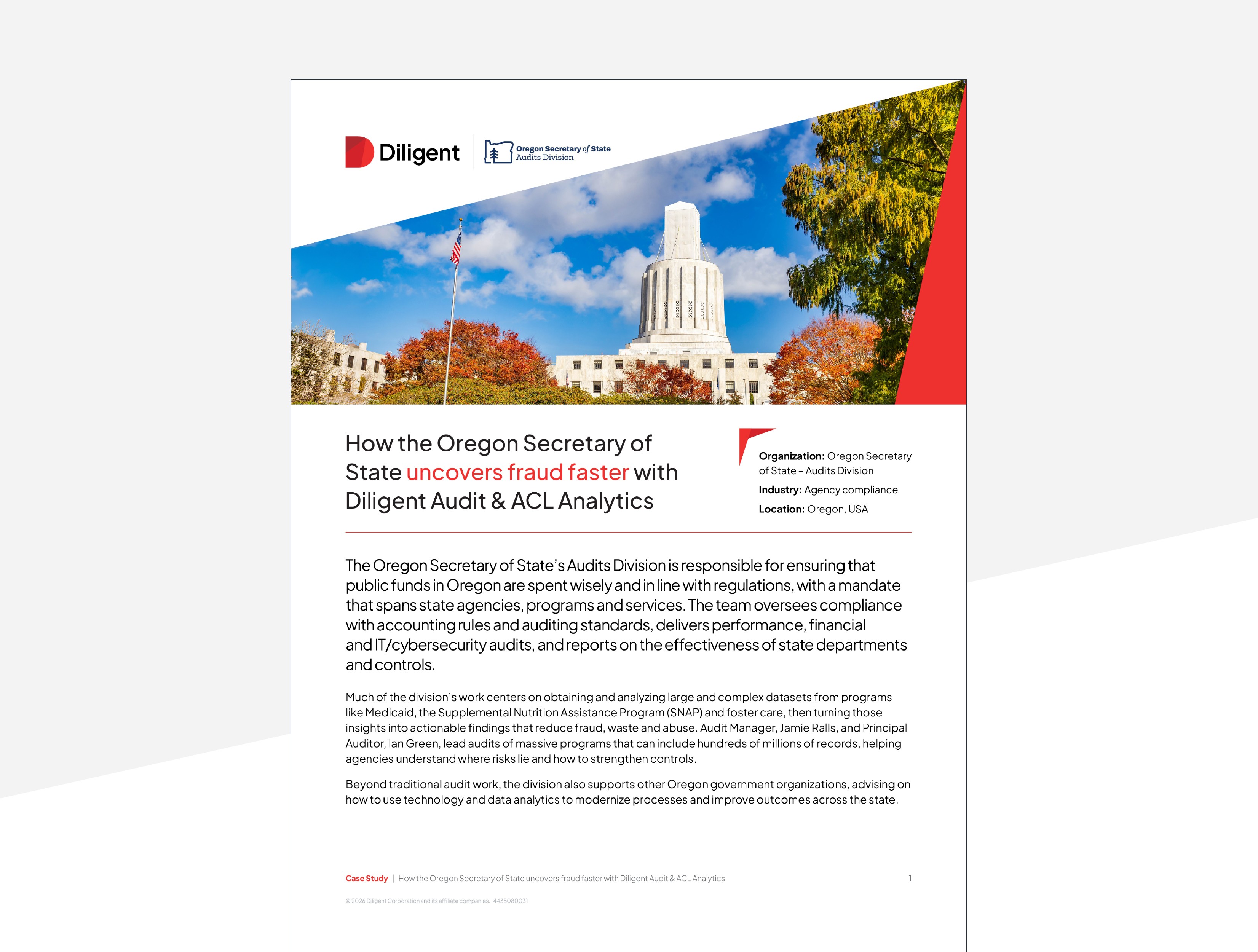
Oregon Secretary of State uncovers fraud faster with Diligent Audit & ACL Analytics
Discover how the Oregon Secretary of State's Audits Division transformed their approach to detecting fraud with Diligent Audit & ACL Analytics, enabling them to analyze massive datasets at unprecedented speed and efficiency. Learn how they leveraged advanced analytics to protect taxpayer dollars and enhance public accountability in their mission to combat fraud in programs like Medicaid and SNAP. Download the full case study to explore their innovative journey.