

In this article

Board management software for financial services has moved from a productivity tool to a regulator-facing system of record. Every minute, resolution, action item and access log inside the platform can show up in an OCC, FDIC, NCUA or Federal Reserve examination. Add the 2023 SEC cyber disclosure rules, the EU's Digital Operational Resilience Act (DORA) in force since January 2025 and a matured FCA Senior Managers and Certification Regime in the UK, and the stakes around board records are higher than they have ever been.
A board portal for financial services is software that centralizes board materials, communications, voting and minutes for banks, credit unions, insurance companies, asset managers and broker-dealers, with the audit trails, encryption and access controls that regulators expect. FIs need it because examiners can request board records on short notice, sensitive information sits on personal email or unmanaged drives by default and global FIs operate under U.S., EU, UK and APAC regulatory regimes simultaneously.
The list of organizations using it spans community banks, regional banks, money-center institutions, credit unions, insurers and asset managers. Diligent Boards is the platform built for this reality, with ISO 27001, SOC 2 Type II and FedRAMP-authorized environments serving FIs across 90+ countries.
This blog walks through what FI boards actually need from board management software, why the topic has changed since 2024 and how leading institutions are using it to defend the board record under regulator scrutiny. Specifically, it covers:
AI-enabled GRC is the application of artificial intelligence to three core governance jobs:
For a financial institution, that means the board portal, risk register, audit workpapers and policy manager are not separate islands. They feed one another, and AI surfaces the patterns a human would miss when reviewing each in isolation.
According to the GC Risk Index 2026 from Diligent Institute, only 19% of legal leaders say their organization's GRC systems are fully integrated, and just 21% are very confident their board receives the right mix of risk information. AI-enabled GRC closes that gap by automating the connective tissue between systems.
Traditional GRC platforms automate workflow. Documents move, approvals route and reports generated on schedule. The intelligence still sits with the human reviewer. AI-enabled GRC adds two capabilities on top: continuous monitoring that scans regulatory sources, transaction data and control activities for anomalies, and synthesis that turns thousands of data points into board-ready narratives. For an FI, that means a risk officer can spot a concentration issue in real time instead of finding it during the quarterly board pack assembly.
The GC Risk Index puts the current business risk environment at 7 out of 10, with regulatory change cited by 48% of legal leaders as a top driver of that rating. AI-related risks and cyber threats each appear in nearly four in ten responses. The What Directors Think 2026 report from Corporate Board Member and Diligent Institute found that 41% of directors see AI and technology regulation as the most underestimated area of board compliance oversight.
"Looking ahead, high performing boards will treat governance as a continuous discipline, built on real time data flows rather than periodic reports. And they will increasingly rely on integrated digital platforms, and over time AI-driven analytics, to surface patterns, flag emerging risks and point directors to where their judgment is needed most, while keeping human decision-making firmly at the center," says Dottie Schindlinger, Executive Director of the Diligent Institute.
For financial institutions, that "continuous discipline" is what regulators are increasingly looking for in the audit trail.
Financial services organizations operate in a regulatory environment where every board decision sits inside an audit trail that examiners, auditors and counsel may eventually review. A board portal for banks, credit unions, insurers and asset managers exists to make four things possible: secure access, defensible security posture, centralized governance and better decision-making at the board level.
Financial services move quickly, and boards are under pressure to adapt just as quickly. Board management software digitizes board and executive meeting materials, enabling directors to draw from documents at any time to make efficient, data-driven decisions. For FIs, this matters even more than in other industries. Bank and insurance directors often include former regulators, former senior bankers and other heavily traveled executives. They review materials from airports, hotels and overseas meetings, and the platform must support mobile-secure access with single sign-on tied to FI identity systems.
Because crises and opportunities will not always wait for a scheduled meeting, board management software gives directors a way to tap into essential board materials and real-time competitor and industry insights when they need them. That same access discipline is what allows an examiner to retrieve a specific board pack in seconds when the request lands on a Friday afternoon.
Cyber risk is now embedded in nearly every other risk on an FI's register. The What Directors Think 2025 survey found that 71% of CISOs or CIOs now regularly meet with the board to discuss the evolution of cyber risk, and a major cyber incident is rated as having significant impact by 61% of directors. The 2023 SEC cyber disclosure rules require material cybersecurity incidents to be disclosed on Form 8-K within four business days. Board records, including the discussions and decisions that led to disclosure, become part of that paper trail.
Board management software for financial services offers an encrypted platform for managing this sensitive information, supported by certifications that examiners and CISOs will ask about: ISO 27001, SOC 2 Type II, SOC 3 and, where applicable, FedRAMP authorization for FIs serving federal clients. Data residency controls matter when board members and subsidiaries cross U.S., EU and UK lines.
Many financial services organizations operate across locations and jurisdictions through branches, subsidiaries and foreign offices. A regional bank may have a holding company, a national bank charter, a trust company and one or more service-corporation subsidiaries, each with its own board. A global insurer may run a U.S. parent, an EU undertaking, a Lloyd's syndicate and a Bermudian reinsurer.
Board management software gives financial services organizations centralized access to data, files, workflows and communication across these structures. This lets each board tap into entity-wide context before making decisions, and it lets corporate secretaries enforce one retention policy across the group instead of stitching together five.
Governance grants boards decision-making authority, and those decisions can have far-reaching implications in regulated industries. With board management software, FI boards can see the factors that influence corporate strategy, from regulatory expectations to capital actions to compensation planning, in one place.
The What Directors Think 2026 report shows that 47% of directors now want real-time data integrated into oversight processes "often or always," and 58% want more time devoted to strategic discussions. Both depend on having materials, dashboards and supporting evidence in a single platform rather than scattered across email, file shares and PDF attachments.
The role framing above describes the function. Below is the specific set of capabilities FI boards now expect from a board portal, shaped by the way examiners and auditors are actually scrutinizing board records.
"Trust is the number one thing. Once you have trust that the executive teams believe in the data, believe in the risk you are identifying, then you can have fulsome conversations, you can create change," says Tom Keaton, Vice President, Business & Product Strategy at Diligent. For FI boards, that trust starts with the integrity of the platform that delivers their materials.
Learn how FI boards prepare for regulator review with the right governance infrastructure.

Examinations are the moment when the quality of board records becomes visible. Examiners typically request minutes, full board pack contents, action item logs, attendance records, conflict-of-interest disclosures and committee resolutions covering specific topics: capital actions, BSA/AML matters, credit concentrations, model approvals and incident response decisions.
A board portal supports this in three ways. First, retrieval. A searchable archive with role-based permissions lets a corporate secretary produce the specific materials an OCC or NCUA examiner asks for, with watermarks and access logging that prove who saw what and when. Second, retention. Federal Reserve guidance generally expects minimum retention windows of five to seven years for routine board records, with longer windows for capital actions and BSA/AML matters. The platform enforces those windows automatically rather than relying on manual file cleanup.
Third, the qualitative governance signals examiners increasingly look for. These include a documented director skills matrix, board AI literacy, cyber risk oversight evidence and model risk governance for any AI deployed inside the bank. A modern board portal makes those signals visible. A director skills matrix can be maintained alongside director bios and committee assignments. Cyber risk dashboards can be referenced inside board materials with full source attribution. Discussions of model approvals can be tied to the policy in force at the time, with a clear audit trail.
For credit unions, the same logic applies under NCUA examination. For insurance companies, state insurance commissioners and NAIC-driven examinations follow similar patterns. The platform's job is to make the board record defensible without forcing the corporate secretary into a manual document hunt every time a request lands.
AI inside an FI is not one risk. It is a portfolio. Models in credit, deposit, claims, underwriting and fair-lending decisions sit under model risk governance frameworks like the Federal Reserve's SR 11-7 in the U.S. and the PRA's SS1/23 in the UK. Generative AI deployed in customer service, document review or board materials sits closer to operational risk and regulatory disclosure. Vendor-deployed AI inside core banking, claims processing or treasury platforms sits inside third-party risk management.
Board oversight has to span all three. According to What Directors Think 2026, 50% of directors now cite AI and technology regulation as the compliance area demanding the greatest board attention in 2026, yet only 22% of boards have a formal AI governance process for their own AI use. The AI Board Readiness Report from Diligent Institute found that 64% of U.S. public company directors see AI as a top business opportunity, yet a clear minority feel their board has the expertise to govern it.
"There is a shortage of tech or AI conversant directors in the market, especially in financial services," says Dhawal G. Gadani, Company Secretary and Head of Governance at HSBC Australia and New Zealand. That shortage is exactly why the board portal has to bring AI risk into the same place where other risks are already discussed.
Practically, that means an FI board management platform should support four things:
"In too many companies the compliance team doesn't have a seat at the table when it comes to AI governance. Compliance plays a critical role in managing the ethics and legal obligations around AI, so board members need to ensure that they have a role in this key area," says Kristy Grant-Hart, Vice President and Head of Advisory Services at Spark Compliance, a Diligent brand.
Where AI shows up in board materials themselves, the board portal becomes the front line. Transparent outputs, source citations and clear separation between AI-generated drafts and director-reviewed final language are now table stakes for FI boards.
Most regulatory guides treat U.S., EU and UK frameworks as separate problems. For global FIs, there is one problem. A money-center bank may simultaneously fall under OCC, FDIC and Federal Reserve supervision in the U.S., DORA and MiFID II in the EU, FCA SMCR and PRA SS1/23 in the UK, and a long list of APAC frameworks. The board pack has to support all of it.
Three operational realities drive how this works inside a board portal.
First, data residency and document retention regimes vary. EU GDPR and DORA expect operational resilience evidence to live in the EU. U.S. bank regulators expect access to be granted under their own subpoena and supervision frameworks. The platform has to support data residency choices and retention policies set at the entity level, not just the parent level.
Second, board members themselves are multi-jurisdictional. Independent directors of global FIs typically hold seats on parent and subsidiary boards across countries. Access permissions have to follow the director, not the document, and the platform has to make this manageable for a corporate secretary handling 15 or more meetings per quarter.
Third, entity management is part of board governance. Parent, subsidiary, branch and joint-venture board materials must roll up cleanly. Resolutions adopted at the subsidiary level need to be traceable from the parent board view, and vice versa.
Diligent's "Driving Digital Resilience for Financial Services Boards" guide walks through how FI boards are operationalizing this in 2026. The shared theme: scale earned through global deployment is itself a credibility asset. Diligent's platform supports more than 1 million users and 700,000 board members and leaders across 90+ countries, which gives global FIs a partner already operating at the jurisdictional breadth their boards do.
A persistent argument in the board portal market is that platform breadth is a liability. The counter-position, increasingly held by FI risk and compliance leaders, is the opposite. Running five separate vendors for board management, GRC, audit, policy management and entity records creates exactly the integration burden examiners and auditors flag in the first place.
The GC Risk Index 2026 makes the cost of fragmentation explicit. Sixty-seven percent of legal leaders say the time they spend on enterprise-wide risk and compliance coordination has increased over the past year. Only 19% report fully integrated GRC systems. And only 21% are very confident their board receives the right mix of risk information.
"This 'partial integration' picture is important context for understanding why GCs may struggle to deliver the concise, forward looking risk narratives boards are asking for. Without a single, connected view, GCs must invest additional time to stitch together data manually," says Nithya Das, Chief Legal Officer and General Manager of Governance at Diligent.
For FI risk and compliance leaders, consolidating the board portal with the underlying GRC platform reduces three forms of friction. Vendor management overhead shrinks because there are fewer SOC 2 questionnaires to chase. Examiner response times shrink because the audit trail is in one platform. And board reporting becomes more defensible because the supporting risk data and the board record live under the same governance.
This is not an argument for buying every module on day one. It is an argument for choosing a board portal that does not put a wall between board oversight and the enterprise risk, audit and compliance workflows feeding it.
Under mounting regulatory pressure and continuous cybersecurity threats, many financial services boards feel the path to high performance is narrowing. A connected board portal is what widens it again. Four pressures are driving adoption in 2026:
The capabilities above show up differently across the FI sub-verticals. Below is how four common FI types are using board management software in 2026.
Bank boards manage OCC, FDIC and Federal Reserve examination cycles, BSA/AML committee oversight, capital action approvals and CRA-related disclosures. Board management software supports the multi-charter structures that holding companies, national bank subsidiaries and trust companies create, with one audit trail across all of them. For larger banks, integration with the GRC platform feeds credit, market and operational risk reporting directly into board committee workflows.
Credit unions answer to the NCUA and, for federally insured state-chartered institutions, to state regulators as well. Member governance adds a layer that public bank boards do not face. Board management software supports NCUA examination cycles, supervisory committee oversight, share insurance compliance and the member transparency that distinguishes credit union governance. The audit trail also matters for the supervisory committee's annual examination work.
Insurance boards operate under state insurance commissioner oversight in the U.S., NAIC model laws, capital adequacy reporting and reinsurance arrangements that may span multiple jurisdictions. Mutual insurers add policyholder governance to the mix. The Salvation Army General Insurance Company (Sagic), a UK subsidiary of The Salvation Army UK, illustrates how this works in practice. After moving from manual board management to Diligent Boards and then layering on Diligent's GovernAI capabilities, leadership reports faster, more confident board preparation with tailored insights for individual directors.
"We're seeing a real difference in how quickly and confidently we prepare for meetings, and the tailored insights have made our discussions much more meaningful," says Arran Gray, COO at Sagic.
SEC and FINRA oversight, Investment Company Act of 1940 board responsibilities and mutual fund board governance create one of the most documentation-heavy boardroom environments in financial services. Independent fund directors expect institutional-grade tools with strong audit trails. Board management software supports the fund-by-fund oversight and the cross-fund matters (chief compliance officer reporting, sub-adviser oversight, valuation committee work) that fund boards spend most of their time on.
Diligent Boards is purpose-built board management software for financial services boards, among other industries, that need to centralize and unify all board activities. It supports more than 1 million users and 700,000 board members and leaders globally, including a substantial share of the Fortune 1000, FTSE 100 and ASX 200, with ISO 27001, SOC 2 Type II and FedRAMP-authorized environments.
Good governance demands that directors have real-time access to documents and insights, including key materials, before meetings. Diligent Boards streamlines document sharing in a secure environment for FI boards, like the board of directors at Absa Bank, a South African financial services business.
"Diligent has made my life easier. It's also made decision-making very effective for the board as well," says Mwape Mondoloka, Company Secretary at Absa Bank.
Getting board members on the same page is challenging, especially when each has access to different information. Diligent's board management software gives boards and leaders a dedicated space to review mission-critical insights anywhere in the world. Using Diligent to drive visibility helped Aviva, a British multinational insurance company, create the dialogue that its board and leaders needed to align on business goals.
"It's a user-friendly system that supports that kind of active dialogue around the content," says Victoria Garvin, Head of Subsidiary Governance at Aviva.
Centralizing data and dialogue from multiple companies inside a group is challenging, yet it is essential to the success of subsidiaries and the entire entity. Diligent Boards unifies entity-wide insights in a single view for organizations like Nambawan Super Limited (NSL), the largest superannuation fund in Papua New Guinea.
"Diligent allows you to overlap companies if you have users in a group of companies. It's user-friendly and has a great support team," says Raka, Acting Company Secretary at Nambawan Super Limited.
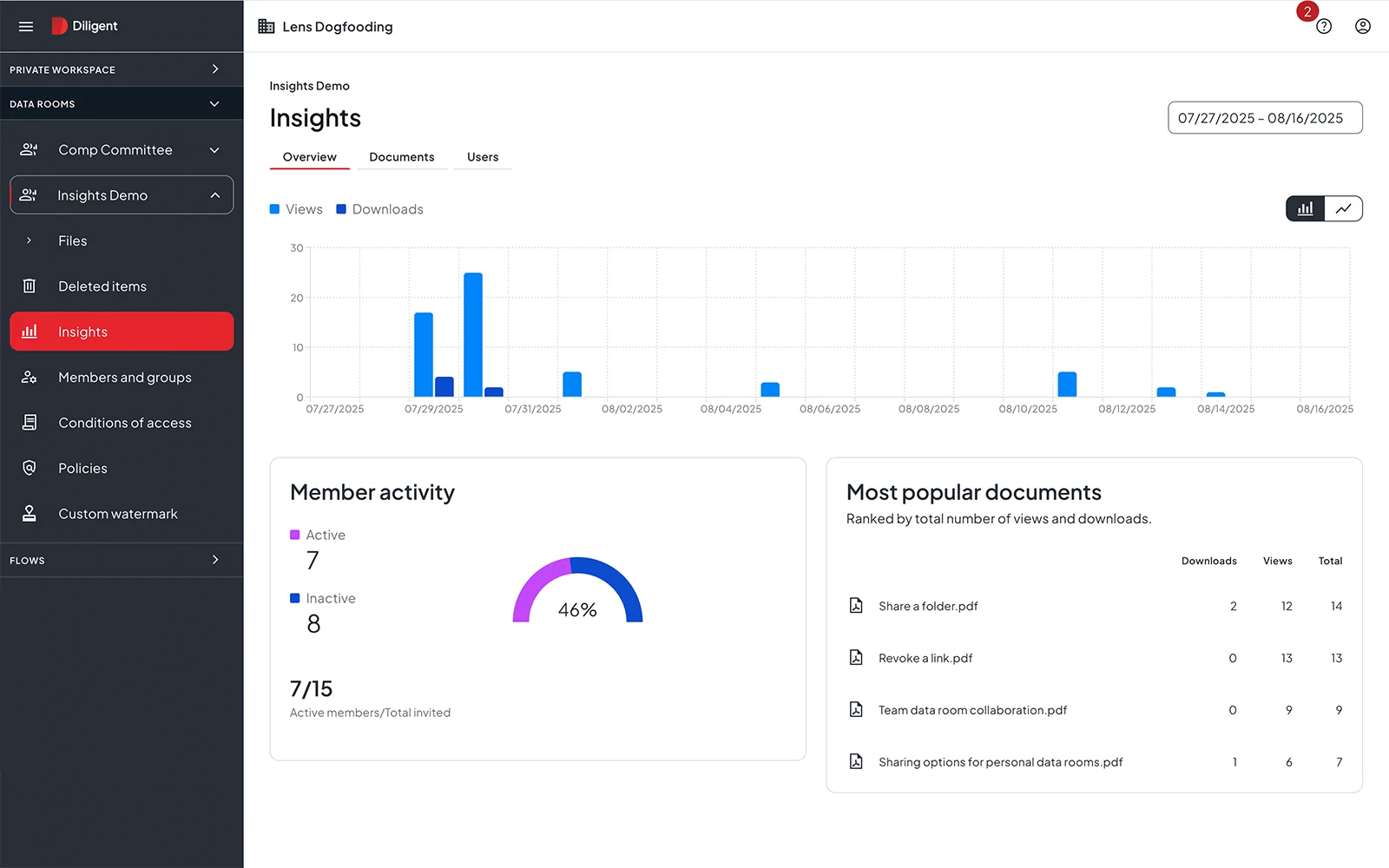
FIs house tremendous amounts of sensitive information that must be protected, but boards must also access it easily and frequently to make key decisions. Liberty Mutual Insurance, which offers business insurance solutions for asset managers, banks, insurance companies and other FIs, uses Diligent for that combination of access and security.
"Diligent Boards is a great tool for assembling and housing board materials. It saves us hours of preparation time for our five boards and related committee meetings. It also functions well for directors to be able to access materials securely from anywhere in the world," says Patricia S., Senior Paralegal at Liberty Mutual Insurance.
Preparing for a board meeting can take weeks of work, especially for FI boards with regulatory requirements to follow and sensitive topics to discuss. Diligent's board management software cuts preparation time by storing documents, automating workflows and distributing materials securely.
For FIs managing examination scrutiny, multi-jurisdictional regulation and rising board expectations, manual approaches do not scale. AI-powered board governance addresses three specific bottlenecks documented earlier in this article: the time corporate secretaries spend assembling board packs, the difficulty of catching risky language before publication and the gap between thick board materials and the strategic discussion FI directors want to have.
Diligent Boards delivers AI-driven efficiency through its GovernAI capabilities:
Smart Builder synthesizes raw information from multiple enterprise systems into professional board materials with one click, addressing the manual board book compilation that consumes corporate secretary time before every meeting. For FIs running 15 or more board and committee meetings per quarter, this is the difference between strategic governance work and document logistics.
Smart Risk Scanner automatically reviews board materials and flags risky language and legal red flags before documents reach the board, helping FIs avoid the oversights that show up in examinations and disclosure reviews. The tool acts as a second set of eyes on materials that ultimately become part of the audit trail.
SmartPrep 360 generates pointed discussion questions with source citations for each director, tailored to their committee assignments and expertise. For FI boards with independent directors who include former regulators and senior bankers, this lifts meeting effectiveness without lengthening the meeting.
For organizations that want to connect board oversight with the broader risk picture, Diligent ERM offers comprehensive enterprise risk management with Moody's benchmarking, FedRAMP authorization and built-in board reporting. It pulls risk, control and assurance data into the same governance environment the board already uses, which is exactly the integration GC Risk Index respondents say they need.
For FIs managing complex group structures across U.S., EU, UK and APAC jurisdictions, Diligent Entities centralizes legal entity data and supports the parent, subsidiary and branch board materials that global FIs maintain. It is the layer underneath the board portal that makes multi-jurisdictional governance tractable.
The Salvation Army General Insurance Company case study captures what this looks like in practice. With Diligent Boards and GovernAI in production, the board operates with what Sagic describes as "an AI-first mindset," with directors more engaged and better prepared, AI summaries supporting detail-oriented reviews on legal and financial topics, and integration with DocuSign and Google Drive reducing the administrative burden of running governance across a parent and its insurance subsidiary.
See AI-powered board management in action
Discover how Diligent transforms board preparation for FI corporate secretaries.
Board management software for financial services is a secure platform that centralizes board materials, communications, voting and minutes for banks, credit unions, insurance companies, asset managers and broker-dealers. It provides the audit trails, encryption and access controls that regulators expect, replacing email, file shares and paper board books. Diligent Boards is the platform purpose-built for FI boards, with ISO 27001, SOC 2 Type II and FedRAMP-authorized environments and global deployment across 90+ countries.
FIs should look for examination-ready audit trails, named security certifications (ISO 27001, SOC 2 Type II, SOC 3), data residency controls for multi-jurisdictional operations, integration with the broader GRC platform, conflict-of-interest disclosure workflows, retention policy enforcement and AI capabilities that meet board materials quality standards without replacing director judgment. Multi-entity support also matters for holding company structures.
A board portal supports FI examinations through three capabilities: retrieval (a searchable archive with watermarking and access logging so corporate secretaries can produce specific materials quickly), retention (automated enforcement of the five-to-seven year minimum windows for routine board records and longer windows for capital actions and BSA/AML matters) and governance signals (documented director skills matrix, cyber risk oversight evidence, model risk governance for any AI deployed inside the institution). All three reduce the manual scramble that examinations historically created.
Bank and credit union boards should treat AI as a portfolio of risks, not a single risk. Model risk should follow SR 11-7 in the U.S. or PRA SS1/23 in the UK, with documented validation cadence and independent challenge. AI in customer-facing operations should sit within operational risk and disclosure oversight. Vendor-deployed AI should sit within third-party risk management. Boards should set AI risk appetite, approve AI use cases touching credit, deposit, claims or fair-lending decisions, and align oversight to NIST AI RMF and ISO/IEC 42001.
At minimum, ISO 27001 and SOC 2 Type II. SOC 3 reports help with broader stakeholder review. FedRAMP authorization matters for FIs serving federal government clients or operating under similar security expectations. HIPAA may apply where the institution handles certain health-related data. CISOs should also confirm data residency options for EU operations and verify that the platform's identity integration supports the FI's SSO and conditional access policies.
A board portal supports global FIs by giving each entity its own data residency choice and retention policy while letting directors who sit on multiple subsidiary boards move between materials with appropriate access. Entity management features tie parent, subsidiary, branch and joint-venture board records together. The platform supports the compliance reality of running simultaneously under U.S. (Fed, OCC, FDIC), EU (DORA, MiFID II, GDPR), UK (FCA SMCR) and APAC frameworks. Diligent's global deployment across 90+ countries is purpose-built for this complexity.
Yes. Diligent Boards is used by FIs ranging from community banks and credit unions to global insurers and asset managers, including named customers such as Absa Bank, Aviva, Nambawan Super Limited, Liberty Mutual Insurance and Sagic. Diligent supports more than 1 million users and 700,000 board members and leaders across 90+ countries, with security certifications and FedRAMP-authorized environments built for FI governance.
Ready to defend your board record with the platform built for financial services? Schedule a demo to see Diligent Boards in action.




