

Last week, I finally went to see You Can See Everything, the hugely hyped, critically acclaimed meta-documentary in which comedian-documentarian Nathan Fielder embeds himself with Theranos founder Elizabeth Holmes during the 34 days before she reported to federal prison.
By the end of its nearly three-hour run time, Fielder has moved into Holmes’ rented beach house, spent weeks with her partner and their children, and asked her, point blank, whether she has ever told a lie in her life. “I don't think so,” she says with her trademark unblinking stare.
I walked out of the theater entertained but unsettled, replaying the moments that show what happens when credentialed, capable people fail to adequately evaluate the thing they’re supposed to be overseeing.
The Theranos fraud case itself wasn’t what stayed with me. That’s old news now, adjudicated years ago and already covered by books, podcasts, documentaries and a scripted miniseries. What stuck was something smaller and stranger: a scene where Holmes pulls the original Theranos blood-testing device out of storage.
“So this is the famous scam device,” Fielder says. “It is not a scam device,” she replies, and the two of them spend an uncomfortable number of minutes litigating what the word “can” means.
Can the machine run any test, right now? No. Holmes says it can, eventually, once somebody develops the chemistry it would still need. (Since the film's release, a Theranos whistleblower has claimed the device Holmes shows on screen isn't genuine, but a prototype that was never finished and never run on a single patient.)
Everyone in the scene except Holmes seems to understand how much weight that one word, “can,” is being asked to carry. Shrink that scene down and you have a microcosm of the main problem with Theranos’ board of directors.
The Theranos board, at times as large as twelve directors, included two former U.S. Secretaries of State, a former Secretary of Defense, a retired Navy admiral and a former U.S. senator who had trained as a heart surgeon. Yet, none of the directors was equipped to adequately evaluate diagnostic devices. There were no clinical chemists, no lab directors, nobody whose job had ever included asking a founder exactly "what can this device do?” and then demand the data to support the claims.
These were serious, accomplished people. None of them were strangers to challenging situations. And, the Theranos board asked plenty of good questions.
What they lacked was the technical footing to recognize a wrong answer when they heard one, and they didn’t seek enough independent expert input from outside the company either. They got swept up in the founder’s enthusiasm and checked their own skepticism at the boardroom door.
Right now, boards around the world are facing a new oversight challenge: how to ensure their companies are providing adequate oversight of AI while precious few directors are technologists (and even fewer are AI experts).
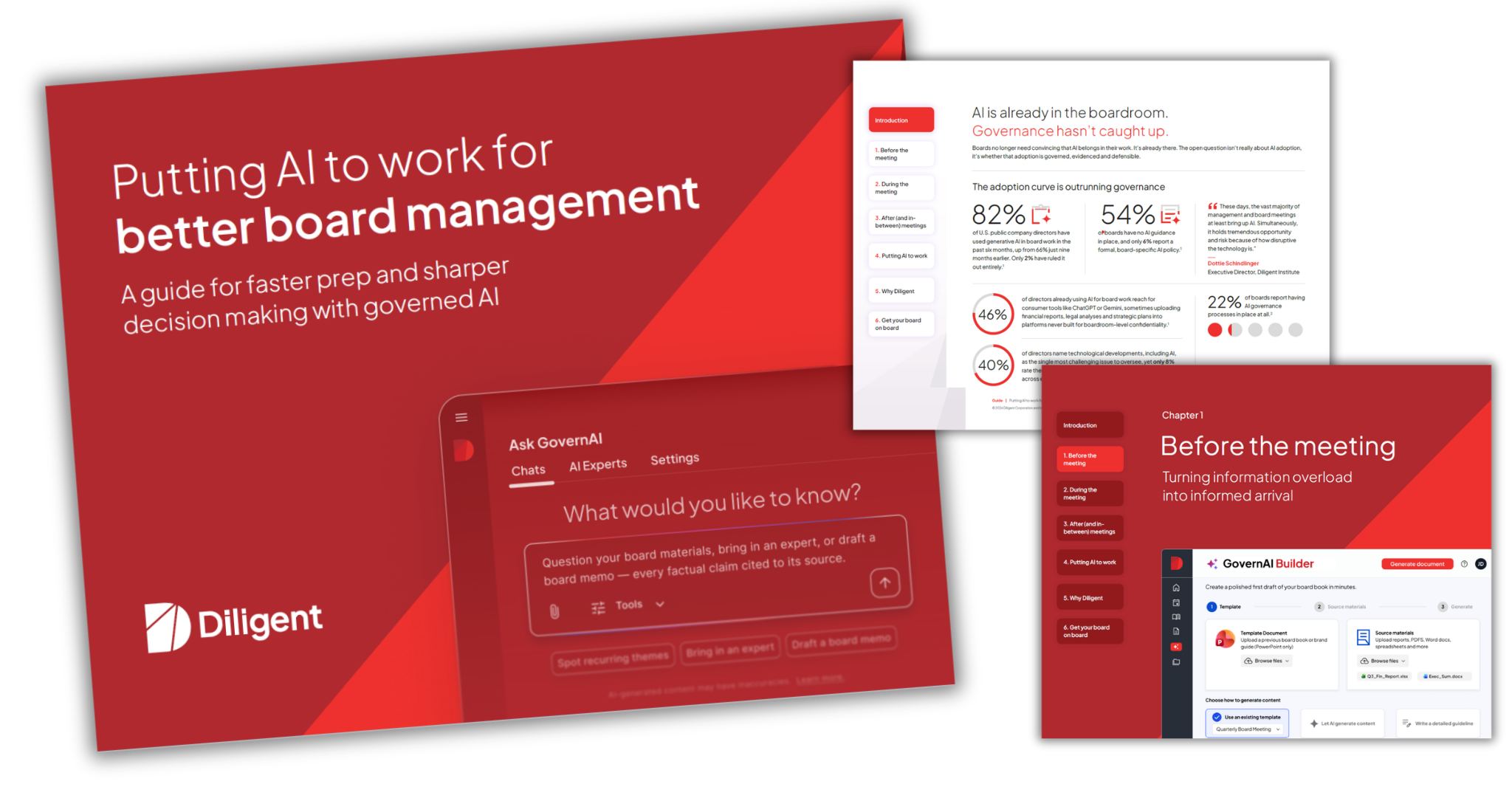
Diligent Institute's recent research points to an alarming governance gap when it comes to the use of AI in boardrooms. We found that while 82% of U.S. public company directors have used generative AI for board work in the past six months, only 31% have any type of policy governing their usage of AI. Worse, only 6% have a policy specific to using AI in board work.
Most directors today are standing in front of a new machine, being told what it “can” do, holding roughly the same toolkit the Theranos board held: good judgment, deep experience, but very little individual ability to check the claim.
Good governance treats skepticism as part of the job, not a personal insult to the founder or the vendor.
Board directors like those at Theranos don’t fail just for lack of an expert in the room. They fail because verification wasn’t considered anyone’s specific job.
That’s the theme behind the Diligent Institute’s new initiative in partnership with the New York Stock Exchange (NYSE). We’re hosting a global series of closed-door sessions with directors, policymakers and governance leaders around one central consideration:
How can we ensure that corporate governance is “fit for purpose” for the AI era?
This feels like an urgent moment to have these conversations. Corporate governance – unlike nearly every other aspect of corporate life – is largely the same as it was in the 1980s. We felt it was time to peel back the layers and consider three central themes:
The outcome will be a blueprint report to help every board reconsider how its approaching its oversight role in this new era.
And as AI-fueled, founder-led ventures abound, many boards will face similar choices to the ones the board of Theranos faced: either be impressed by what the technology (or the founder!) promises, or be ready and equipped to ask, “can it do what you claim?” followed by, “show us the data to prove it.”
Join the Chartered Governance Institute and Diligent for the on-demand webinar: The governance confidence gap: Are boards really ready for what they’re accountable for?
Register here and we'll send the recording to your inbox.

Board AI use rises: Director Confidence Index June 2026

A new survey reveals a significant rise in generative AI adoption among U.S. public company directors, with 82% using the technology for board work in the past six months. However, most lack formal guidelines or oversight, raising concerns about legal and operational risks as AI's influence expands in corporate governance.