In this article

Key takeaways:
Until now, most FedRAMP compliance programs have been designed around a monthly cadence. However, FedRAMP's new Vulnerability Detection Response (VDR) and Vulnerability Evaluation and Reporting (VER) measures are changing that.
FedRAMP VDR and VER requirements, mandatory for all Rev5 authorized cloud service providers from December 7, 2026, replace the monthly Plan of Action and Milestones (POA&M) with a continuous, per-finding workflow. From then on, every vulnerability needs evaluation within days of detection, every finding carries an owner, a score, and a tracked SLA clock, and every report comes straight from that same live data record.
This guide covers what that change in scope now demands of FedRAMP compliance teams, where existing approaches typically fall short and what a compliant, sustainable program looks like.
FedRAMP's shift to 20x is the program's first major overhaul in a decade. The existing Rev5 model asks cloud service providers (CSPs) to describe their security posture through documentation: System Security Plans, periodic assessments and a monthly Plan of Action and Milestones (POA&M). VDR and VER replace the POA&M with a continuous, evidence-based operating model. In FedRAMP's documentation they are two separate standards, but in practice a compliant program must address both.
FedRAMP VDR is a continuous vulnerability management standard that requires authorized cloud service providers to detect, evaluate and respond to every security vulnerability within days of it being found, not on a monthly reporting cycle. Each finding must be formally assessed for reachability, exploitability and potential impact on federal agencies, producing a PAIN score from N0 to N5. Findings are then dispositioned as remediate, mitigate or formally accept, with accepted risk re-evaluated on a 192-day clock.
FedRAMP VER governs how those evaluations are conducted and shared with agencies. The methodology must be consistent, repeatable and defensible to assessors. All outputs must be machine-readable: Not a document, a spreadsheet or a PDF. FedRAMP requires outputs in a machine-readable format, such as XML, JSON or YAML. VER requires that the reasoning behind every risk decision is transparent and auditable and that agencies can access it in a standardized format.
VDR & VER is the process of continuously finding, rating and fixing (or formally accepting) vulnerabilities. It replaces the POA&M. VDR asks whether vulnerabilities are being fixed on time. VER asks whether each one was judged correctly and documented to prove it.
VDR applies to every cloud service provider (SaaS, PaaS and IaaS) currently authorized under FedRAMP Rev5. The requirement is not optional: FedRAMP authorization is what allows providers to sell to US federal agencies and failing to meet VDR means risking that authorization.
New FedRAMP applicants from June 2027 onward will apply directly under the 20x framework, which includes VDR from the outset. For existing Rev5 providers, December 2026 is the relevant deadline.
A compliant VDR & VER program covers four areas in sequence. Each step maps to one of the two standards: VDR governs detection and response, VER governs evaluation and reporting.
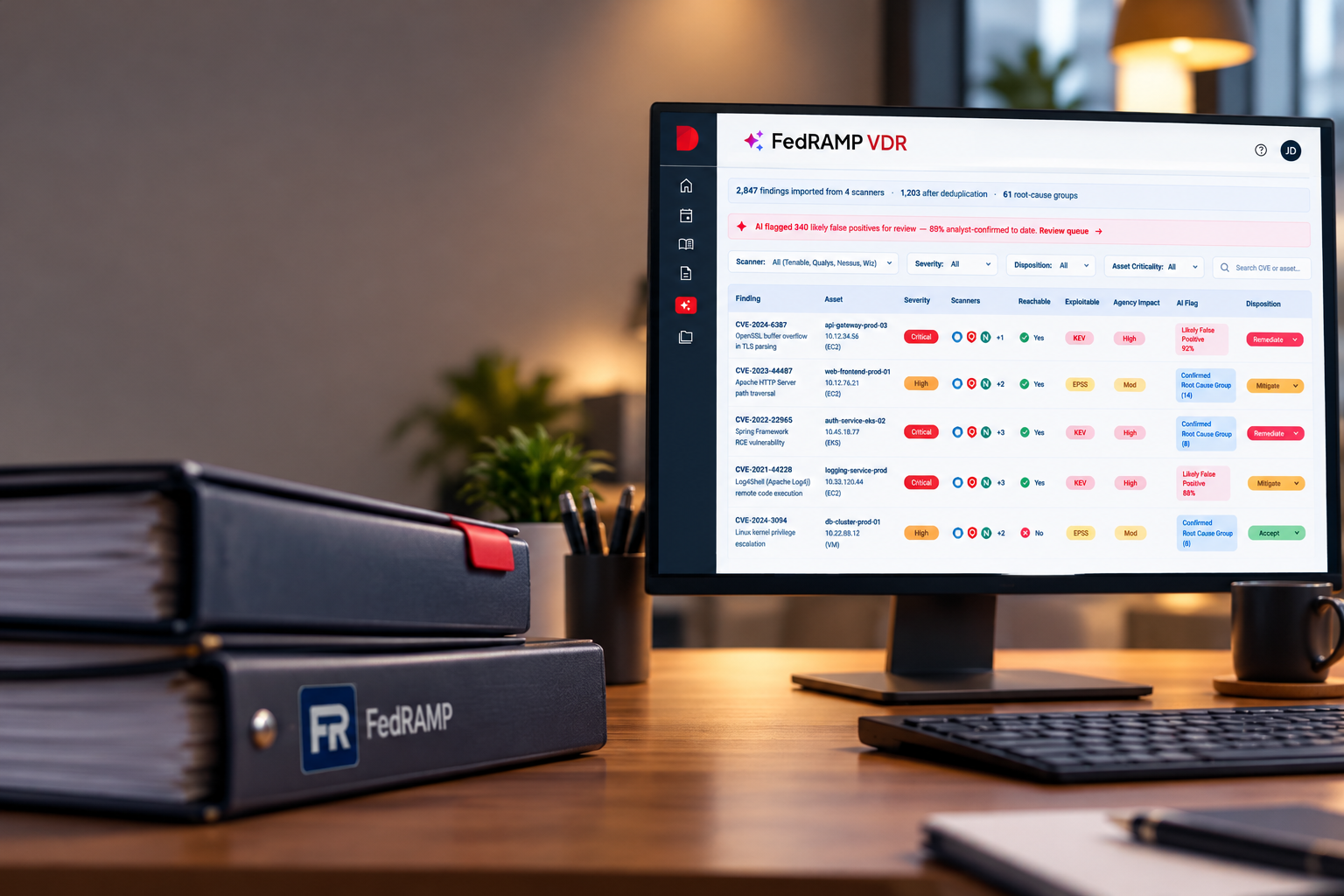
Ingest (VDR): Scanner findings from multiple sources (such as Tenable, Qualys and Rapid7) need to be consolidated, normalized and deduplicated into a single inventory. Without this step, analysts spend most of their time reconciling data rather than acting on it.
Evaluate (VER): Each finding goes through a structured assessment against FedRAMP's criteria: Likely exploitability (LEV), internet reachability (IRV) and potential agency impact (PAIN, N0 to N5). The assessment must be consistent, the reasoning must be recorded and a PAIN score must be assigned. Grey areas (likely false positives, findings sharing a root cause and non-CVE findings without a clean CVSS score) need a documented judgment call, not a blank field.
Respond (VDR): Every evaluated finding needs an owner and a response plan. Remediation, mitigation and accepted risk all carry different SLA clocks under FedRAMP's requirements and every clock needs to be visible. Nothing should sit unowned.
Report (VER): Machine-readable outputs must come from the same record used for evaluation and tracking, not assembled separately at month-end. That requires a single data model from detection through to reporting. FedRAMP asks two things of every vulnerability: Respond to it (VDR) and prove you judged it correctly (VER). Both must come from the same workflow.
If any of these four areas runs in a separate tool or a spreadsheet, the seams between them become the compliance risk.
Most teams running a FedRAMP program were built around a monthly cadence. Scans run, findings are imported, analysts update the POA&M, the report goes out. It's a documentation exercise and many teams have become efficient at it.
VDR evaluates every finding within days of detection, continuously, replacing the monthly batch cycle. For a Moderate-baseline provider, findings from multiple scanners can run into the thousands. Under VDR, each one requires a formal evaluation within days (inside FedRAMP's SLA clock, not on the old monthly cycle) and the evaluation must account for asset context, exploitability signals and agency-specific impact, not just a CVSS score. Non-CVE findings (STIG results, cloud configuration failures and CIS benchmark gaps) need their own handling on top of that.
The unit of work changes too. Rev5 produced one row per CVE across an inventory. VDR produces one record per finding, per asset, with its own owner, rating, response plan and SLA clock. At that volume and frequency, spreadsheets and manual triage don't hold.
There's a compounding challenge: Rev5 doesn't go away. Most providers will run both authorizations in parallel, with the same team and budget. FedRAMP's own Phase 1 pilot recap was direct: CSPs would need to engage engineering teams heavily to operationalize the new approach. Monthly compliance reporting was built for a different model and the gap shows up quickly under continuous obligations.
The June 11, 2027 date applies to new entrants only. Existing Rev5 authorized providers are subject to the December 7, 2026 requirement.
Implementation takes time: Data readiness, scanner mappings, asset structure and team onboarding all need to be worked through before go-live. Every week spent evaluating options is a week not spent getting operational.
Building a compliant FedRAMP VDR & VER program? See how Diligent's solution works and speak to our team about what implementation involves for your environment.
VDR and VER are the first of FedRAMP 20x's three new requirements to apply to Rev5 authorized providers. The others follow later: 61 Key Security Indicators (KSIs) proven continuously through live telemetry, and a Trust Center that publishes live security posture to agencies, both arriving in Q3 2027.
All three replace the documentation-based model with continuous, machine-readable proof of security. Proving security continuously is more defensible than describing it once a year. But it requires new data pipelines, new processes across security and engineering teams and tooling built for continuous operations rather than periodic reporting.
Providers who put a durable VDR & VER process in place early, on a platform that supports the full 20x journey, avoid rebuilding their compliance operations when KSIs and the Trust Center arrive in 2027.
Meeting VDR's continuous demands doesn't have to mean rebuilding your compliance function. Diligent's VDR & VER solution covers the full workflow: Ingest, evaluate, respond and report.
Tenable is a native integration. Other scanners connect through a standard integration layer and will require some configuration.
Diligent's approach is context-first. Asset context is built once, so evaluations run automatically as new findings arrive instead of being gathered case by case. That takes more initial setup than a lighter-weight point solution. But for teams processing thousands of findings on a continuous cadence, it substantially reduces the manual work at evaluation time, and that is where the effort sits under VDR.
Diligent One Platform has held FedRAMP Moderate authorization since 2019 and holds DoD IL5 authorization. Diligent's FedRAMP team includes Matt Goodrich, former Director of the FedRAMP PMO, and James Bowman, the first person to achieve a FedRAMP authorization through the JAB. Their experience helps teams make the decisions that matter when building a program that satisfies complex requirements and stands up to assessors. They know where the program catches people out.
Ready to talk through what FedRAMP VDR & VER implementation involves for your environment? Visit Diligent's FedRAMP compliance page or speak to our team directly.
For cloud service providers currently authorized under FedRAMP Rev5, both VDR and VER become mandatory on December 7, 2026. A grace period runs until March 7, 2027, after which there is no extension mechanism. Providers that do not meet the requirement risk losing their FedRAMP authorization and with it, access to US federal agency contracts.
VDR (Vulnerability Detection and Response) covers the operational side: Detecting vulnerabilities, evaluating them within days and tracking remediation against FedRAMP's SLA clocks. VER (Vulnerability Evaluation and Reporting) covers the evidentiary side: How each finding is scored, what methodology was used and how the results are reported to agencies in machine-readable format. Both are required from December 7, 2026 for Rev5 authorized providers and in practice, a compliant program runs them as one connected workflow.
PAIN stands for Potential Agency Impact N-rating. It is FedRAMP's composite risk score for vulnerabilities, defined in FedRAMP's official VER rules. Each score is derived from three factors assessed during VER: Internet reachability (IRV), likely exploitability (LEV) and potential impact on the served federal agencies. The scale runs from N0 to N5 and determines the SLA deadline for remediation or mitigation: A higher score means a shorter window to respond. N0 (exploitation extremely unlikely to have adverse agency effects) was added to the standard on October 5, 2026. Providers whose rating logic pre-dates October should confirm N0 is included.
Providers that do not meet the VDR and VER requirements by March 7, 2027 (the end of the grace period) risk losing their FedRAMP authorization. Without that authorization, a provider cannot sell cloud services to US federal agencies. FedRAMP authorization is a revenue asset and for providers with significant federal revenue, losing it threatens the federal revenue the authorization was protecting.
New applicants from June 2027 onward apply directly under the FedRAMP 20x framework, which includes VDR as part of the full authorization process. Rev5 closes to new applicants on June 11, 2027. For providers not yet authorized and considering pursuing FedRAMP, the path into the program will require full 20x compliance from the outset, including VDR, KSI management and the Trust Center.
Yes. Rev5 and VDR run in parallel for the foreseeable future. Existing Rev5 authorizations are not invalidated by the introduction of VDR. Providers must meet VDR requirements on top of their existing Rev5 obligations, which is part of what makes the transition demanding: The same team carries both programs simultaneously. Legacy Rev5 certifications are expected to sunset around 2029.
Yes. The Diligent One Platform has held FedRAMP Moderate authorization since 2019 and holds DoD IL5 authorization. For teams evaluating compliance tooling for federal workloads, that authorization matters: Diligent operates within the same regulatory environment as its customers.
Diligent's VDR & VER solution is available from December 1, 2026 via Asset Manager in the Diligent One Platform. Implementation requires upfront data preparation, including asset mapping and scanner configuration, so teams should allow time before the compliance date rather than starting at launch.
Yes, via a standard integration layer, though non-Tenable scanners will require some configuration. Native integration is with Tenable. If you're running a different primary scanner, speak to our team about what the configuration involves for your environment before committing to a timeline.