

In this article

Paperless board management software has moved from "nice to have" to operating standard for boards under pressure to move faster, govern with cleaner records and free directors from the logistics of paper packs. Boards now expect to find materials instantly, mark up documents from a plane seat and trust that the version on screen is the only version that exists.
According to Diligent Institute's What Directors Think 2026, 42% of directors expect technology to dominate capital investments this year, and 38% rank deploying AI across the business among their top board priorities. That shift starts with getting the boardroom itself off paper.
The change is not just about saving printing costs. It is about closing the gap between how the rest of the business operates and how the board still works, in many organisations, on bound packs couriered to hotel rooms. For corporate secretaries, board administrators, executive directors and clerks of public boards, paperless is the entry point. The platforms that replace paper now also automate book building, draft minutes from transcripts, flag risky language before publishing and give general counsel a defensible audit trail.
If you are moving from paper-based or hybrid processes, or you have a paperless tool that no longer keeps up, this guide will help you make the case, choose well and run a clean transition.
This blog covers:
Paperless board management software is a secure digital platform that replaces printed board books and the manual processes that surround them. It centralises agendas, board packs, minutes, resolutions, votes and supporting documents in one access-controlled environment that directors reach from a laptop, tablet or phone. The category is sometimes called paperless board meeting software, paperless board portal software or digital board management. The underlying job is the same.
If you are coming off paper or a mix of paper and email, the value compounds: digital pack assembly, real-time updates, encrypted access, audit-ready records and, increasingly, AI-powered preparation and minute-taking. Going paperless is the doorway. What sits on the other side is a connected governance platform that supports the corporate secretary, the general counsel and the board chair across the full meeting lifecycle.
In a paperless setup, you stop printing, collating and couriering board packs. You stop emailing 100-page PDFs and chasing whether directors received the right version. Minutes are not reconstructed from sticky notes; they are drafted from notes captured in the platform. Resolutions are voted and signed inside an audit log, not on paper passed around a table. The shared drive of "Board Q3 v7 FINAL FINAL.docx" is replaced by a single, current source of truth.
The platform touches almost everyone involved in running a board.
Corporate secretaries and board administrators are typically the heaviest day-to-day users. They are the ones assembling the board pack, chasing contributors for late submissions, managing version changes in the 48 hours before a meeting and making sure every director has what they need. For them, paper-based processes are rarely a minor inconvenience, they often mean late nights reprinting 100-page packs because finance sent a revised slide that morning.
Directors and committee chairs use the platform to read and annotate materials, vote on resolutions and review minutes. The accessibility difference matters: a director sitting on three boards, travelling frequently and reading materials between flights will use a well-designed tablet app very differently to how they use a couriered binder.
General counsel and governance teams use it as their audit trail. Every document view, version change and vote is logged, which means that when a regulator asks for evidence of board oversight, the answer is an export rather than a reconstruction from email.
Executive assistants and legal operations teams use it to coordinate meetings, publish agendas and manage the administrative side of committee cycles.
The CFO and chief information officer tend to be involved in the buying decision rather than day-to-day use, the CFO is usually looking at the hidden cost of paper logistics, the CIO at whether the platform integrates with the identity stack and meets data residency requirements.
The corporate secretary lives in it, directors read and vote in it, general counsel relies on it for records and the broader governance team uses it to run the meeting cycle end to end.
Paper-based and hybrid board processes still dominate at many organisations, but the operational drag is becoming harder to defend. According to Diligent Institute's What Directors Think 2026 survey of more than 200 U.S. public company directors, 47% of directors say they do not often receive real-time data between meetings, and 58% want less time on presentations and more on strategic discussion. Both pressures push boards toward platforms that surface the right material faster, between meetings as well as during them.
Below are the six reasons that come up most often when boards make the switch. They are not in order of importance, the right ranking depends on your sector, board size and current process.
Paper packs carry a cost that rarely appears on a single line of the budget. It shows up across print spend, courier and overnight shipping, last-minute reprints when a 24-hour change lands and the days corporate secretaries lose to printing, collating and labelling.
Krystyna Kwintal, Manager of the Executive Office at Flexco, describes the pattern that pushed her to digitise the company's quarterly board cycle: "Assembling the packets took an entire day, and collating and packaging would often go late into the evening. Any last-minute change meant reprinting and redistributing pages for every board member." Flexco's packets ran past 100 pages, with distribution to ten or eleven directors and six executives each cycle. Multiply that by four quarters and you start to see the real bill.
Paperless board management software collapses that workload. Books are assembled once, updated in place and pushed to every director instantly. There is no reprint, no courier and no scramble when finance sends a revised slide the night before.
How to position this to the CFO: the comparison is not "buy software or do nothing." It is "buy software or keep paying for paper, courier and the time the corporate secretary spends on logistics."
Physical board books are difficult to control once they leave the room. They get left on planes, in hotel rooms and on dining tables. Email attachments are worse, because they sit indefinitely in personal inboxes and on consumer cloud storage that IT cannot see.
A paperless platform replaces that exposure with encryption, multi-factor authentication, role-based permissions and the ability to revoke access when a director rotates off. Sensitive resolutions stay inside the platform; they do not travel by SMS or personal email. For organisations with global directors, configurable data residency lets you keep board content in the jurisdiction your regulator expects.
Phil Venables, Chief Information Security Officer at Google Cloud, puts the strategic case bluntly: "Invest not just in cybersecurity but in technology modernization. Boards are starting to think about how they get to a place where they think about not just one risk but this whole collection of risks." Paper packs and email attachments are the easy end of that risk surface to fix.
Directors travel, sit on multiple boards and read materials in airports as often as offices. Paper packs cannot follow them; tablet and mobile apps can. Paperless board management software lets directors read packs offline, annotate during a flight and sync notes when they land. For boards that span time zones, asynchronous review replaces the all-hands scramble in the 48 hours before a meeting.
This matters for board chairs and nomination committees too. When recruiting non-executive directors, charity trustees, school board members or local government officials, "the materials show up on your iPad" is a noticeably easier ask than "we will courier you a binder."
Paperless platforms close the gap between the pack being "final" and the pack being current. When the chief financial officer revises Q3 figures the morning of the meeting, every director sees the update with a notification. Annotations sync. Voting happens inside the platform with a full audit trail. Discussions about a specific page stay attached to that page rather than disappearing into a side email thread.
"Our [Diligent] platform has revolutionized how we access information, creating a seamless system of checks and balances across our committees," says Bing Goldsworth, Executive Assistant at Organically Grown Company. "Features like real-time updates and easy document management have streamlined our operations, making our meetings more effective and efficient."
For organisations with multiple boards, committees or subsidiaries, the gain compounds. One platform replaces a patchwork of shared drives, email threads and printed packs.
Discover how AI transforms board preparation and decision-making for growing companies.

This is the reason that often persuades the general counsel and the chief information security officer, and it is the reason the brief from the procurement team should be reframed around.
Paperless board management software produces a defensible record by default. Every document view, download, annotation and version change is logged with timestamp and user. Retention policies are configurable rather than dependent on whether anyone remembered to file a printed copy. Granular permissions ensure that a board observer sees the agenda but not the executive session pack. Single sign-on and multi-factor authentication tie access to the corporate identity stack rather than personal credentials.
For organisations in scope of the Sarbanes-Oxley Act, the controls inside a paperless board portal contribute directly to evidence of board oversight. For organisations subject to the GDPR or UK GDPR, configurable data residency and clear retention rules make subject access requests and regulator queries materially easier to handle. For organisations preparing for an IPO, a clean digital record of board decisions, dated and attributable, is exactly what underwriters and due diligence teams ask to see.
The shorthand: reconstructing a paper trail from email after the fact is slow, expensive and never quite complete. Producing an audit-ready export from a board portal takes minutes.
If you are a corporate secretary or governance lead making the case internally, the people you need to bring along will each care about something different. Framing the conversation around their priorities is what moves a decision forward.
The common thread across all three is that the case is "paper and email create risks that a governed platform closes."
The reason paperless is now strategically valuable, not just operationally easier, is that AI sits on top of it. Once meetings are digital, AI can summarise long board packs into concise briefings, draft minutes from notes and transcripts, surface suggested discussion questions for each director and extract action items mapped to owners and due dates.
Adoption is real and growing. Diligent Institute's What Directors Think 2026 finds that 66% of directors are using AI in some form for their board work, even as only 22% report formal AI governance processes for how AI is used in the boardroom. That gap matters: it is the reason governance-grade AI matters more than consumer-grade tools.
Governance-grade AI is controlled, auditable and ring-fenced to the board's data. It does not train on your board pack to improve someone else's model. It logs every prompt and output so general counsel can defend the workflow. That is the difference between AI you can put in front of the audit committee and AI you cannot.
The actual change management is not about the software. It is about getting the board chair, the directors and the corporate secretary comfortable in a 30-day window without disrupting the meeting cadence. The lightweight framework below is what most successful transitions follow.
This is the lightweight version. For boards in regulated industries or with multi-entity structures, the full pillar guide on paperless transition will go deeper into change management and data migration.
Paperless is not only a corporate story. Public sector boards, school districts, community colleges, local councils and academy trusts face a particular version of it, where transparency and accessibility obligations sit alongside the same paper-fatigue problem.
For these organisations, Diligent Community, our meeting and governance solution for public and elected boards, is the focused fit. Built by the team behind BoardDocs, Diligent Community is designed for the way that K-12 districts, community colleges and local government boards actually work, including public meeting publishing, livestreaming, agenda and minutes workflows aligned to statutory procedure and accessibility standards.
For UK and Ireland-based boards, charity trustees and academy trust governors, the same pattern applies: trustees and governors sit on multiple boards, expect tablet-based access and increasingly want the same audit trail discipline expected of corporate boards. The platform comparison conversation tends to come down to two things: data residency in the UK or EU and alignment with UK GDPR, both of which the platform should be able to demonstrate without bespoke configuration.
You can read more about Diligent Community for public sector boards here.
Once the case to switch is made, evaluation often becomes the bottleneck. Buyers fall into one of two traps: shopping on price (which leads to free or near-free tools with gaps that surface six months in) or shopping on feature lists (which leads to a platform no director will adopt). A short list of evaluation criteria saves time:
Key criteria, evaluation templates and tips for moving your board from paper to digital

The reasons above (time and cost, security, accessibility, real-time collaboration, compliance defensibility and AI-powered preparation) all point to the same need: a single platform that replaces paper without forcing the corporate secretary or directors to learn a new way of working every quarter.
Diligent Boards is the AI-powered board management platform that pairs the operational basics (secure book assembly, distribution, annotations, voting and minutes) with the AI capabilities that make paperless strategically valuable. Smart Builder synthesises raw inputs into a first-draft board book, removing weeks of manual compilation.
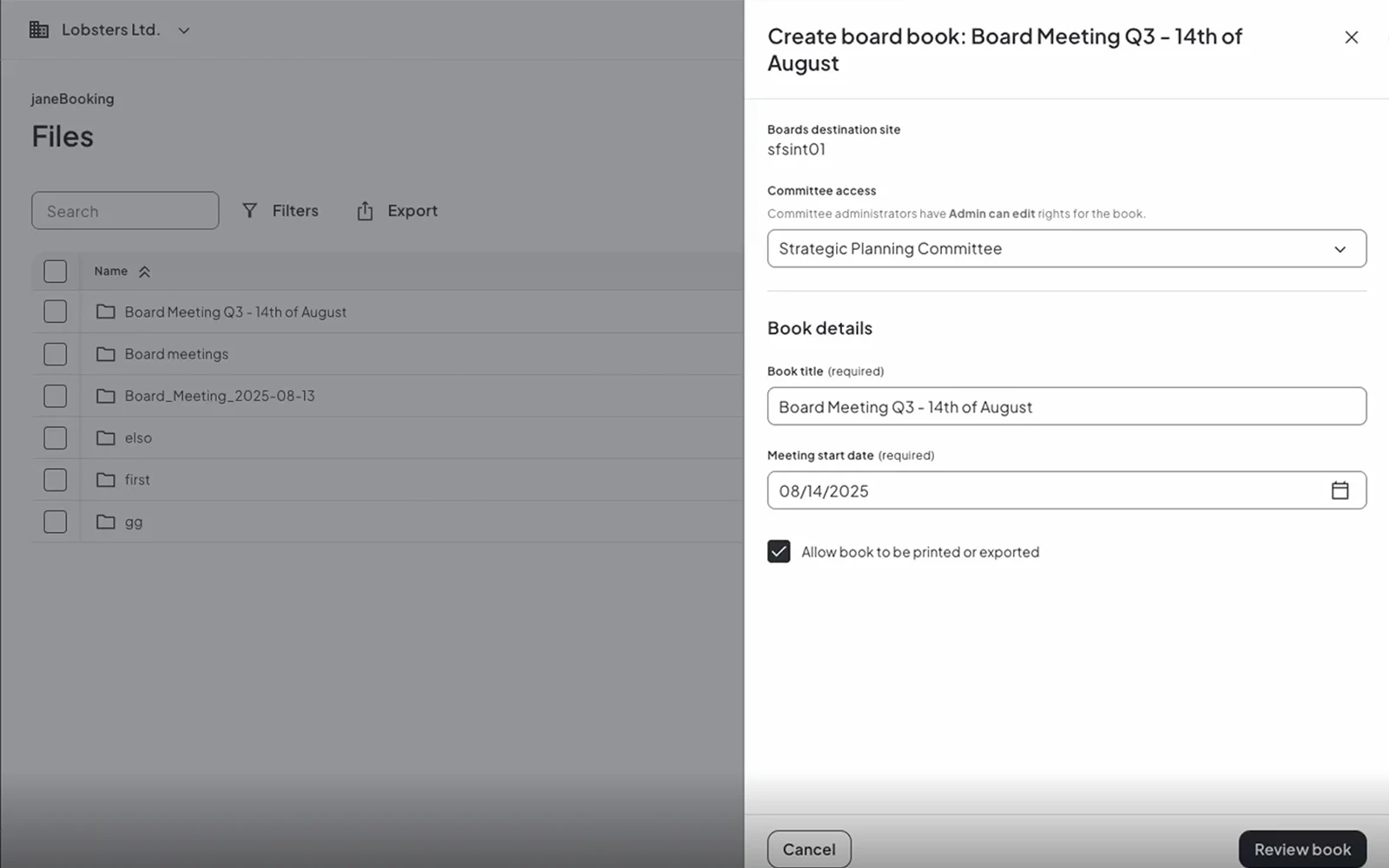
Smart Risk Scanner reviews board materials for risky language before publishing, giving general counsel an early read. Smart Book Summary gives directors a digestible version of a 100-page pack so they can prepare on the train, not at the desk. SmartPrep generates pointed discussion questions for each director, with source citations to the relevant page. Smart Minutes drafts meeting minutes from notes or transcripts, which the corporate secretary reviews and approves.
The AI is governance-grade. It is auditable, ring-fenced and built for the way regulated boards have to defend the use of new technology to the audit committee. See the Boards AI features and the Boards Minutes features for the underlying capability detail.
Flexco's experience shows what the transition looks like in practice. After moving onto Diligent Boards and Diligent Data Rooms, the manufacturer replaced a paper-heavy quarterly cycle that involved overnight shipping, full reprints on every change and three days of administrative work into a unified, secure ecosystem for board collaboration and deal content. Krystyna Kwintal's team is now rolling out AI Smart Builder and AI Smart Minutes to automate the documents themselves.
For public sector boards, school districts and local councils, Diligent Community delivers the same paperless promise inside a platform designed for public meetings, accessibility obligations and statutory procedure. For boards that also need to manage transactions, fundraising rounds or M&A material, Diligent Data Rooms sits next to Diligent Boards in the same ecosystem, with shared identity and audit trail.
Explore the Forrester Total Economic Impact study of Diligent Boards for a structured view of the financial outcomes.
Paperless board management software is a secure digital platform that replaces printed board books and the manual processes around them. It centralises agendas, board packs, minutes, votes and supporting documents into one access-controlled environment that directors can reach from a laptop, tablet or phone. Diligent Boards is one example of a platform that delivers this, with AI-powered preparation, secure distribution and audit-ready records built in.
The cleanest path is a pilot-first approach. Audit your current board pack process, then choose one committee and one cycle for the pilot. Run a 15-minute director onboarding focused on access, navigation and voting. Hold the pilot meeting, gather feedback, then roll out to remaining committees with the feedback incorporated. Update governance policies for digital records and retention, and track preparation time, distribution time and director satisfaction against your baseline. For public sector boards, Diligent Community is purpose-built for this transition.
Look for three buckets of capability. First, secure document handling: encryption, SSO, MFA, granular permissions, audit logs and configurable data residency. Second, meeting workflows: agenda builder, board book assembly, minutes, voting, e-signature and resolutions. Third, director experience: offline tablet and mobile access, annotation, real-time updates and easy navigation. AI capabilities for summarisation, draft minutes and suggested discussion questions are increasingly table stakes for the category.
A paperless platform produces a defensible record by default. Every view, download, annotation and version change is logged with timestamp and user. Retention policies are configurable. Granular permissions ensure observers, directors and committee members see only what they should. For organisations in scope of the Sarbanes-Oxley Act or the GDPR and UK GDPR, this combination materially reduces the effort of subject access requests, audit committee inquiries and regulator queries. Audit-ready exports take minutes rather than the weeks needed to reconstruct a paper trail.
Reputable enterprise-grade platforms combine encryption in transit and at rest, role-based access controls, multi-factor authentication and comprehensive audit logs. For UK and EU-based boards, look for configurable data residency in the UK and EU, alignment with UK GDPR and GDPR and clear retention rules. Compliance certifications such as SOC 2 and ISO 27001 are the baseline you should expect; FedRAMP authorisation matters if your remit touches U.S. federal contexts.
Once the meeting lifecycle is digital, AI can do work that paper made impossible. It summarises long packs into briefings directors can absorb in a fraction of the time. It generates suggested discussion questions tied to specific pages. It drafts first-cut meeting minutes from notes and transcripts. It extracts action items and maps them to owners. Diligent Boards' AI capabilities (Smart Builder, Smart Risk Scanner, Smart Book Summary, SmartPrep and Smart Minutes) are governance-grade, meaning controlled, auditable and ring-fenced to your board's data.
Yes, and it is often where the operational case is strongest. For nonprofits, BoardEffect is the focused fit. For public sector boards, school districts, community colleges and local government, Diligent Community is purpose-built for public meeting publishing, accessibility obligations and statutory procedure. Both are designed for boards where directors are not full-time technology users and where transparency obligations sit alongside the same paper-fatigue problem corporate boards face.
Ready to move your board from paper to digital? Request a demo.




