
We invited Amanda Carty, General Manager, Governance and Compliance at Diligent, to talk about what's changing in corporate ethics and culture and what leaders need to know.
Do you have a defensible speak-up program? This interview is part of the 2027 resilience guide: Six regulatory shifts redefining governance, risk, audit and compliance, alongside a practical readiness checklist for spotting hidden AI concentration risk and testing supplier exit-ability before you need it. Download your copy of the 2027 resilience guide here.
Carty: Right now, compliance leaders are focused on enforcement finally catching up to expectations that have been building for years, more than any new law landing on the books. The DOJ's updated guidance on corporate compliance programs now spells out what they expect around whistleblower protections and anti-retaliation, and for the first time we've got a formal, department-wide policy that rewards self-disclosure and cooperation. Add an active whistleblower awards program, and the message is pretty clear: if you don't have a credible way for people to speak up, and proof that you act on what you hear, then you're exposed.
That also means treating your ethics and culture program as a living, breathing part of the business, not something you build once and leave alone. Leaders need to be able to show how they measure whether the program is working, what they're learning from the data and where they're making changes as risks and expectations evolve. Regulators now expect organizations to demonstrate that policies and processes work in practice, not just that they exist. That's what's keeping leaders up at night.
Carty: For years, ethics and culture was something you checked on once a year. It was a training cycle, or an annual survey, or a line in the board deck. That doesn't cut it anymore. Scrutiny is constant now, so your program has to be constant too.
I talk a lot about moving from reactive GRC to proactive GRC, and ethics and culture is a perfect example of that shift. It needs to be something you're monitoring and acting on in real time, not something you dust off when the audit calendar tells you to. The organizations getting this right are the ones connecting the dots: speak-up data, training completion, conflict-of-interest disclosures, exit interviews, subsidiary data and jurisdictional requirements, all feeding one picture, instead of living in five different spreadsheets that nobody cross-references.
That connected view helps leaders spot emerging risks earlier, understand whether the program is working, and make informed changes before an issue escalates.
Carty: If I had to pick one thing, it would be to connect your data so you can hear the signals through the noise. The programs that get caught out as "box-checking" are the ones where nobody can show the thread between a policy, the training on it, who's been read into it and what happened when someone raised a concern. That's not really a credibility problem. It's a visibility problem.
When your data is fragmented, the signals that should prompt action are easily missed. The fix is making sure leadership can see, in minutes, how a concern maps to the entity, the jurisdiction and the people involved, and spotting the patterns that need attention. That's the difference between a program you can defend to a regulator and one where you're just hoping nobody asks hard questions.
Source: Diligent Institute, GC Risk Index Q4 2026
Carty: AI gives teams the ability to scale without adding headcount, which has always been the central constraint ethics and compliance programs run into. You're asked to do more with the same team every single year. With AI, you can do that.
The bigger opportunity is orchestration. AI can tee up the administrative work that consumes compliance practitioners' days. It connects information, coordinates routine steps and brings the right issues forward for review. That gives teams more time to focus on the work that really improves organizational culture. When it's used well, AI doesn't replace human judgment. It handles more of the manual coordination, so people can spend their time on the decisions, conversations and interventions that genuinely need a human.
Carty: Be smart and intentional about how you invest in your ethics and culture program. Regulation and enforcement aren't going to slow down, and regulators will expect you to show that your processes work consistently and reliably, not just that they exist on paper. That becomes even more important as organizations implement AI. Of course, AI can make a process faster. But leaders also need confidence that it behaves consistently, supports the right outcomes and remains aligned with the needs of the organization. Efficiency for efficiency's sake isn't the goal.
The organizations that come out ahead will be the ones that build ethics and culture into how the business runs every day, with a program they can monitor, improve and demonstrate to regulators. It needs to be both effective in practice and defensible under scrutiny, moving from a once-a-year check-in to a program that's monitored continuously, before the next headline forces the change.
Carty's interview is one of six inside the 2027 resilience guide: Six regulatory shifts redefining governance, risk, audit and compliance. Download it for the full ethics and culture checklist plus five more deep-dive regulatory conversations for 2027.
Get the full guide and checklist →
"Scrutiny is constant now, so your program has to be constant too." — Amanda Carty, General Manager, Governance and Compliance, Diligent
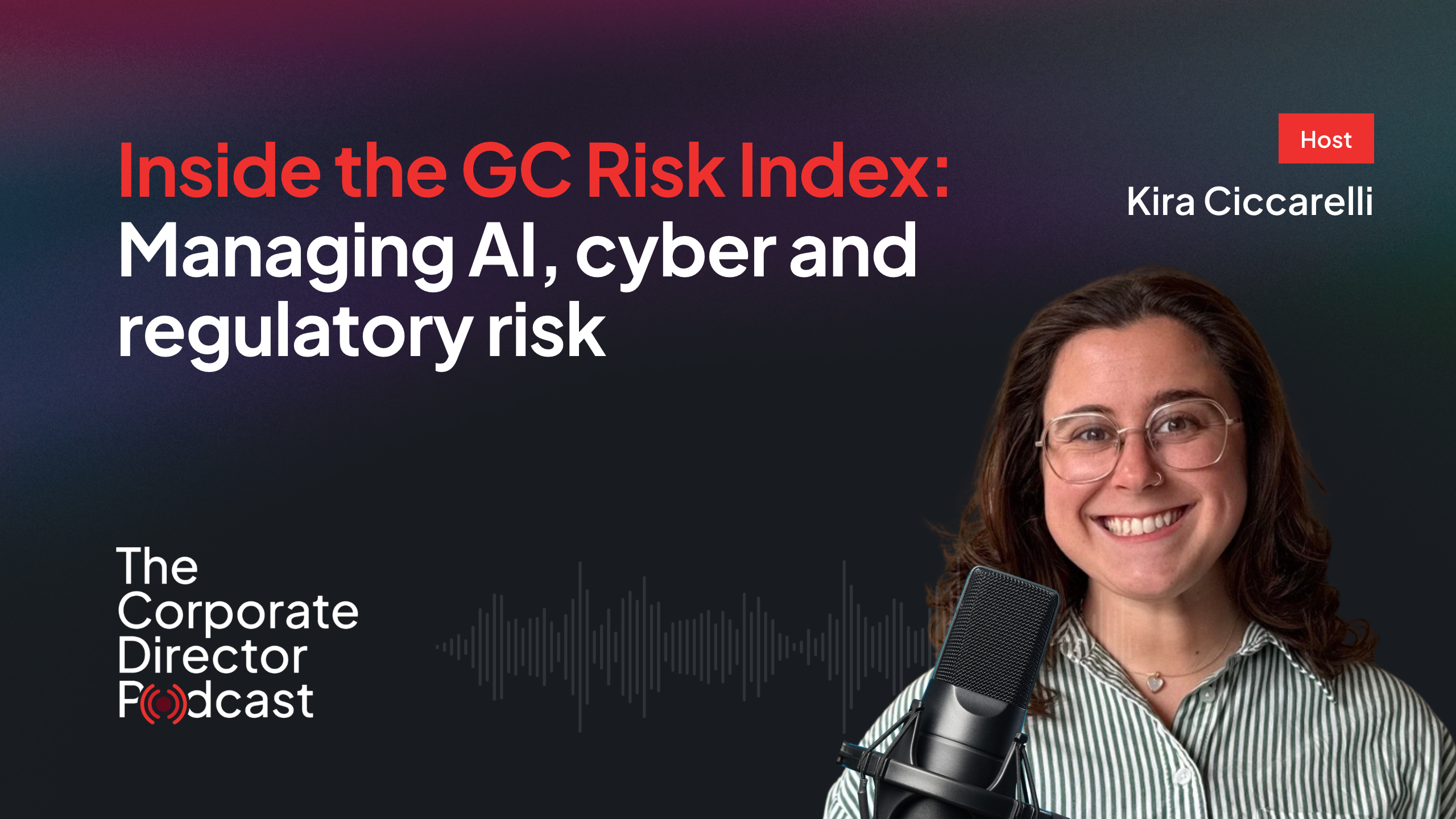
Inside the GC Risk Index: Managing AI, cyber and regulatory risk

In this episode of the Corporate Director Podcast, Sachin Kohli and Demian Ahn of Wilson Sonsini examine the risk environment facing organizations and the implications for boards, general counsel, chief legal officers, and executive teams. The latest GC Risk Index found that respondents rated their organizations’ current risk level at 6.6 out of 10, with approximately 60% falling into the high-risk range. The discussion explores why risk is expected to remain elevated through 2027, even as the primary drivers continue to change.