
In this article

Every seed-stage startup faces the same tension: You need to move fast on product, but the governance gaps you skip now are the ones that stall your next raise. Missing board consents, messy cap tables and undocumented IP assignments don’t just create legal risk. They erode investor confidence at exactly the moment you need it most.
According to The Transaction Readiness Report by Diligent Institute and its research partners (2025), companies rate their transaction readiness confidence at just 5.7 out of 10. For seed-stage founders, the gap between “we’ll clean it up later” and “investor-ready” is where deals slow down, valuations compress and term sheets expire.
This guide covers what to build now so your next raise feels like sharing progress, not reconstructing history:
A seed-stage startup sits at the earliest institutional funding phase, after friends-and-family capital but before the sustained traction required for Series A. These are among the riskiest and most dynamic companies in the venture ecosystem: young, fast-changing and still proving the fundamentals.
At this stage, your core objectives are straightforward:
What separates seed from adjacent stages is the investor evaluation lens. At seed, investors often overweight team quality and learning velocity because hard metrics are limited. As you move toward Series A, investors increasingly expect demonstrated results and repeatability.
Investors fund learning velocity at seed. Your job is to prove you’re turning customer insight into product progress, then product progress into measurable demand.
A practical validation framework:
Traction signals seed investors want to see:
With a validated problem and early traction signals in place, the next step is identifying the right capital sources, choosing the right instrument and running a process that keeps momentum from first meeting through close.
Sources and how they differ: Angels write small checks for early validation; accelerators add structured mentorship; micro-VCs and seed funds can anchor larger rounds. Most seed rounds combine several investor types to fund enough runway to reach the next major milestone.
Seed round sizes vary widely by sector, geography and the maturity of your traction. Use market data as a sanity check, not a target: build a milestone-based budget (team, product and go-to-market experiments) and raise the amount that credibly gets you to your next financing narrative.
A practical fundraising process:
For many seed-stage founders, a post-money SAFE is a common default because it’s simpler to execute and avoids debt-like mechanics. Convertible notes can be appropriate when investors require interest, maturity or other lender-style protections. Priced rounds make sense for larger raises or when investors require formal governance rights (like a board seat) at closing.
A focused data room typically includes your pitch deck, fully diluted cap table, historical P&L and burn, usage data and unit economics. Exclude detailed long-range projections and tax returns unless specifically requested.
The most common diligence failure mode isn’t legal complexity. It’s capacity. The Transaction Readiness Report found that 56% of leaders cite limited resources as their top transaction challenge. Build your data room as an ongoing workflow: assign a single owner, keep a standard folder structure and update it in small increments after each board cycle and each material contract, so diligence never becomes an all-hands scramble.
Download the free board meeting preparation checklist to streamline materials, align your agenda and keep investor updates on track.

Lightweight governance is how you stay fundraising-ready without slowing the business down. After seed, investors will still care about your product and traction, but they’ll also pressure-test whether your documentation and approvals are clean enough to scale.
“During a strategic transaction, it is so important to build a clear process that is designed to neutralize conflicts.”
— Deborah Birnbach, Partner at Goodwin Law
Startup-focused legal teams repeatedly see financing rounds derailed by avoidable basics: missing financial statements, poor equity records, unresolved compliance issues and IP ownership ambiguity. The five governance fundamentals below prevent that.
If you can run this cadence consistently, governance stops feeling like paperwork and starts functioning as a repeatable advantage in fundraising, hiring and decision-making.
“With requirements nowadays around cyber, financial and diversity, you want to start early. It’s not just a matter of having directors on the board. You want them in enough board meetings to see how you operate.”
— John Egan, Partner at Goodwin Law
The goal isn’t perfect compliance. It’s a clean, repeatable operating baseline that prevents painful fixes during diligence.
Cap table hygiene: Track all equity instruments (common stock, preferred stock, SAFEs, convertible notes and option pool). Reconcile regularly using professional cap table software, not spreadsheets. Cap table errors compound over time and become exponentially harder to fix after multiple rounds.
Option pricing support: For U.S. companies, option pricing is commonly supported by an independent 409A valuation process. Refresh the valuation when the business changes materially, such as after financings or major shifts in traction.
IP protection: Execute IP assignment agreements with every founder, employee, contractor and consultant before work begins. Retroactive assignments may not be enforceable, making this one of the few governance items where timing is everything.
Financial reporting: Establish monthly reporting with reconciled P&L, balance sheet and cash flow statements. Use accrual-basis accounting from the start; cash-basis is often insufficient for institutional investors.
ESOP sizing: Plan for a meaningful pre-Series A option pool. Investors will factor future hiring needs into valuation math, so size it properly now with guidance from experienced counsel.
A common diligence-gap example: You built core product features with a contractor, but never signed an IP assignment or the agreement language is incomplete. At seed this can go unnoticed. At the next priced round, it turns into a last-minute scramble that delays signing while counsel chases signatures and clarifies ownership. Do these basics consistently and your next raise feels like sharing progress rather than rebuilding history.
According to the APAC Governance Outlook 2026 by Diligent Institute, Governance Institute of Australia and Singapore Institute of Directors, 63% of directors want more time for strategic discussions, underscoring how clean governance foundations free boards to focus on growth rather than administrative catch-up, regardless of company stage.
By Series A, investors want to see what you’ve produced with your seed capital: Evidence of repeatable growth, customer retention dynamics and a credible go-to-market motion.
Competitive candidates today typically show:
“You have to stand up an audit committee, a nom/gov committee and a comp committee. Having the people in place ahead of the IPO is critical. The underwriters will tell you, the lawyers will tell you to be compliant with higher regulations before you need to.”
— Egan
Beyond metrics, Series A investors will scrutinize your governance infrastructure. Plan to tighten revenue recognition practices, professionalize financial controls and upgrade your data room with comprehensive corporate records. The governance habits built at seed, clean documentation, predictable board meeting cadence and a maintained data room, are exactly what makes the transition from seed to Series A feel like an upgrade rather than a scramble.
The three friction points documented throughout this guide, manual board pack assembly, ad-hoc document sharing during diligence and the last-minute scramble to close compliance gaps before a raise, each represent a solvable operational problem. For lean founding teams that can’t afford dedicated governance headcount, integrated tooling addresses all three.
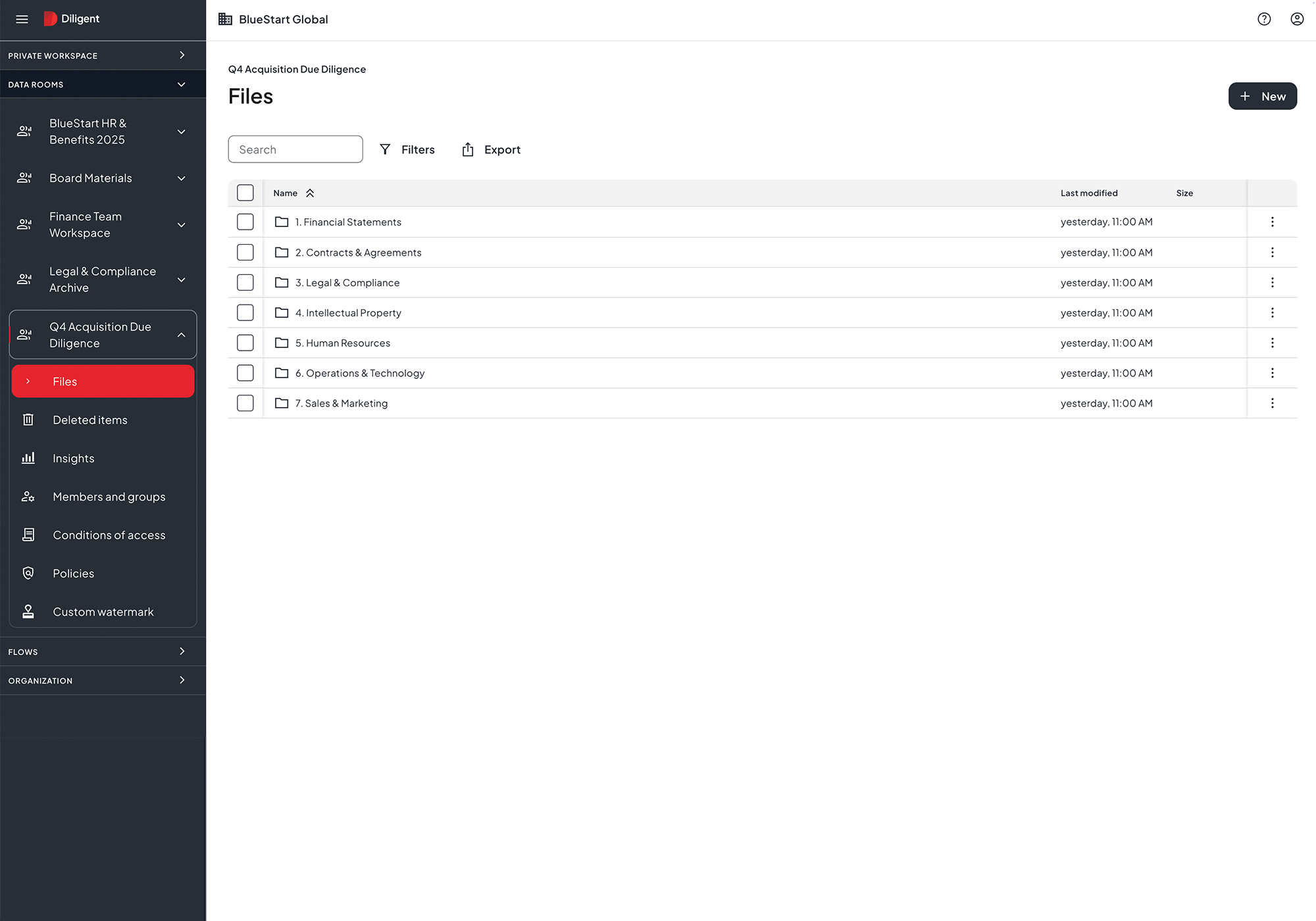
Investor-ready governance doesn’t require enterprise overhead. The infrastructure you build at seed, clean board records, a maintained data room and a basic risk posture, is the same infrastructure that scales through Series A, growth stage and beyond. The companies that treat governance as a continuous workflow rather than a pre-raise scramble consistently raise faster, at better terms and with fewer surprises.
See how Diligent helps growing companies stay investor-ready at every funding stage. Schedule a demo.
Dilution varies widely based on round size, valuation and whether you need an option pool increase as part of the financing. Build a cap table model before you raise: pressure-test how option pool refreshes and different round sizes change founder ownership, then choose a raise size that gets you to the next milestone without selling more of the company than necessary.
Both defer valuation to a future priced round. SAFEs have no interest and no maturity date, which makes them simpler and often more founder-friendly. Convertible notes typically add interest and a maturity date, providing additional investor protections. For most seed rounds, a post-money SAFE is the more common default.
Form a board at incorporation, even if it’s just the founders initially. Add an investor director when your lead investor requests a seat, often at a priced round, and recruit an independent director when you want additional operating credibility or when board governance expectations from incoming investors require it.
Keep it focused: current pitch deck, fully diluted cap table, historical financial statements, burn summary, key product metrics, unit economics, certificate of incorporation and material contracts. Exclude speculative long-range projections and tax returns unless an investor specifically requests them. Maintain the data room as an ongoing workflow, not a pre-raise project.
Build investor-ready governance from day one. Schedule a demo to see how Diligent supports growing companies at every funding stage.