
In this article

For leaders in compliance management and ethics, few challenges are more consequential, or more difficult to solve, than building a genuine speak-up culture that gets employees to raise concerns before they escalate into regulatory violations, financial losses or reputational crises.
The real test comes when employees notice something concerning and must decide whether it feels safe, worthwhile and supported to say something. Reporting channels alone don't create that trust. It takes visible leadership commitment, consistent follow-through and a workplace where employees believe concerns will be handled fairly.
What proves speak-up culture in organizations is not the existence of a policy or a reporting channel, but the pattern of behavior those mechanisms produce: consistent use, visible follow-through and employee willingness to report again after a first experience.
This guide covers:
A speak-up culture is an organizational environment in which employees feel safe raising concerns, reporting misconduct and questioning decisions without fear of retaliation, dismissal or social consequence.
Psychological safety in the workplace is the underlying condition that makes speak-up culture possible: a shared belief that the work environment is safe for interpersonal risk-taking and for speaking up about questions, concerns, ideas or mistakes.
The distinction from a compliance hotline is critical. A hotline is a reactive mechanism: one channel designed to detect suspected wrongdoing after it occurs. A speak-up culture is a proactive condition in which employees surface concerns early, before they escalate to compliance violations.
Culture represents the way things really work versus written policies, and it functions as a foundational internal control without which all other controls can be rendered ineffective.
Amy Edmondson, the Harvard professor who popularized the concept of psychological safety, has written that it is "belief that one will not be punished or humiliated for speaking up with ideas, questions, concerns or mistakes." For compliance leaders, that definition matters because it shifts the focus from whether a hotline exists to whether employees believe using it is safe.
Some frameworks describe this as a "speak up, listen up" culture, recognizing that the leadership obligation to listen and respond is just as foundational as the employee obligation to raise concerns. Both sides of that equation have to function for the environment to hold.
A genuine speak-up culture delivers measurable benefits across compliance, risk management and organizational trust. When employees feel safe raising concerns early, organizations detect problems sooner, reduce enforcement exposure and build the internal credibility that makes all other controls more effective.
Boards should treat speak-up culture as an active board governance responsibility, not a delegated compliance task. Three external pressures now make that expectation explicit.
Use that as a prompt to make speak-up metrics a standing audit-committee agenda item rather than an occasional escalation topic. Build a recurring board packet that covers reporting activity, retaliation oversight, case aging and remediation follow-through so directors can see whether the program is functioning, not just whether a policy exists.
The financial case is equally compelling. The ACFE's 2024 Report to the Nations shows that tips remain one of the most effective ways organizations detect occupational fraud. If tips are one of the most effective detection methods, then barriers to reporting should be treated as control weaknesses, not communication issues. Review whether employees can report easily, whether managers reinforce non-retaliation and whether reporters receive enough follow-up to keep trust in the process high.
Each barrier demands a specific program response, which is why diagnosis matters before designing solutions.
Fear of retaliation: Industry research consistently confirms that retaliation is the single largest deterrent to speaking up. The SEC's whistleblower programs give employees who fear internal retaliation a strong financial incentive to bypass internal channels entirely and report directly to regulators.
Trust gaps between policy and practice: Most organizations have written non-retaliation policies on paper, but there is limited benchmark data on how consistently they involve compliance teams in retaliation cases or report retaliation data separately to boards. According to What Directors Think 2026, 10% of directors say culture and integrity risks, including whistleblower protections, are among the most underestimated compliance areas.
If boards underestimate whistleblower protections, management teams should overcorrect by separating retaliation reporting from general case metrics and reviewing it explicitly with the audit committee.
Manager-level suppression: Managerial inaction on employee concerns directly erodes trust and leads to withdrawal behaviors, making middle management the critical leverage point for speak-up culture.
Low psychological safety: In many organizations, employees still hesitate to raise concerns even when formal channels exist. Segment your survey and case data by team, manager and business unit. Where low reporting activity appears alongside low safety scores, intervene with manager coaching, communication refreshes and closer retaliation monitoring.
Cultural and geographic differences: Anonymous reporting preferences vary dramatically across geographies, and global programs that apply one-size-fits-all benchmarks miss critical regional signals. Global consistency should apply to principles and protections, while channel design, language access and awareness tactics should be localized.
Procedural uncertainty: When employees don't understand who investigates or what protections exist, that opacity acts as an independent deterrent to reporting. As ethics expert Mary Gentile has argued, people are more likely to speak when they have both values and a practical script for action. That's why effective programs help employees understand exactly what to do, whom to tell and what will happen next.
From anonymous intake and collective reporting to AI-powered case routing, Vault gives compliance teams the tools to build a speak-up program employees will actually use.

Building a speak-up culture requires coordinated action across leadership, process and communication. The most effective programs strengthen several components at once so that policy, management behavior and employee experience reinforce each other.
Leadership behavior determines whether employees actually use available channels. Make accountability tangible: incorporate ethical conduct metrics into executive performance evaluations, share de-identified case studies demonstrating leadership response to concerns and schedule regular C-suite communications addressing ethics topics. Building a culture of compliance starts with the tone set at the top.
Reporting should be easy, confidential and available in the ways employees already expect to engage. Effective channels combine always-available access, web and telephone reporting, multi-language support and secure two-way communication that preserves anonymity. Mobile-first, multilingual reporting can be especially important for global industrial workforces and other distributed employee populations.
TI Fluid Systems provides a useful example. Using Speak Up Manager, the company built a mobile-first speak-up approach with multilingual support for a global industrial workforce across 107 facilities in 28 countries. The practical lesson is straightforward: channel design should reflect how employees actually work, especially when large portions of the workforce are distributed, frontline or non-desk based.
Similarly, Neptune Energy adopted Speak Up Manager by Diligent to replace an outdated hotline with secure anonymous reporting across a complex supply chain. The platform improved the organization's ability to address human rights and modern slavery risks with granular data, enabling proper investigation of anonymous reports with faster closure cycles. For organizations operating in industries with extended supply chain exposure, Neptune's experience illustrates how speak-up channels can extend beyond the internal workforce to capture third-party risks.
Managers are often the first point of contact, so their response shapes whether concerns move forward or go silent. Train every manager on recognizing protected activity, responding appropriately when concerns are raised and distinguishing legitimate performance management from subtle retaliation, which includes schedule changes, assignment modifications and exclusion from meetings. Provide scripted responses for common scenarios and structured one-on-one meeting frameworks that invite concerns proactively.
Trust is built through repetition, not a single campaign. Use regular microlearning, physical signage, leader-led team messages and scenario-based onboarding content. Frame speaking up broadly: process improvement suggestions, safety concerns and innovation ideas, not just misconduct reporting. Making Compliance and Ethics Week a launchpad for year-round programming rather than a standalone event helps sustain momentum.
Employees decide whether to speak up again based on what happened after the last report. Standardize investigation protocols with risk-based prioritization, prompt case assignment for high-priority matters and timeliness targets scaled by complexity. Apply a just culture framework distinguishing human error from at-risk behavior and reckless conduct. Close the feedback loop with status updates at key milestones and outcome communication within confidentiality constraints. Strong compliance and internal audit partnership supports consistent investigation standards across the organization.
Learn how four global companies built proactive, inclusive speak-up cultures across borders with Vault by Diligent.

Measurement should show whether the program is credible and trusted, not just active. Hotline volume alone is too narrow, so boards should review a focused set of indicators together. According to What Directors Think 2026, 15% of directors identify a breakdown in organizational culture, ethics or employee voice as a top organizational risk. Treat that as a reminder to measure silence risk, not just case volume.
Use the following metrics as a connected dashboard:
| Metric | What it measures | Red flag signal |
|---|---|---|
| Report volume per 100 employees | Whether employees are using channels. Track trends rather than absolute numbers. Rising volumes after awareness campaigns indicate growing trust. | Anomalously low volumes in specific departments signal potential suppression requiring targeted investigation. |
| Substantiation rates | Quality of incoming reports and investigation rigor. Compare trends over time and across issue categories rather than relying only on external benchmarks. | Consistently falling rates may indicate intake quality issues, weak triage criteria or narrow investigation scoping. |
| Time-to-resolution | Speed and efficiency of investigations. Track by complexity tier and regional context. Establish timeliness targets and document extensions for complex cases. | Persistent delays erode reporter trust and may indicate under-resourcing. |
| Reporter satisfaction | Whether reporters felt heard. Establish internal baselines. Ask reporters whether their complaint was taken seriously and whether they would recommend the channel. | Low satisfaction scores predict declining reporting volume in future periods. |
| Psychological safety survey data | Whether employees feel safe raising concerns. Integrate items from a validated assessment into annual engagement surveys. Score by team and department. | Low reports combined with low safety scores indicate fear-driven silence, not absence of misconduct. |
| Board-level oversight | Whether governance structures support the program. Audit committees should receive GRC reporting on report volume, issue types and resolution status. | Chief compliance officer lacks unfiltered access to audit committee or private sessions. |
A simple audit-committee scenario makes the pattern easier to see: One region shows below-average report volume, cases take longer to close and psychological safety scores are lower than the company average. The likely implication is underreporting risk, not necessarily lower misconduct risk. The board response is a targeted review of manager behavior, retaliation controls and local investigation capacity.
The barriers described above, retaliation fear, reporter drop-off, manual triage delays and board reporting gaps, are the same operational challenges that technology can help address. Speak Up Manager by Diligent supports speak-up programs by improving access, case handling and oversight without replacing the leadership and cultural work the program still requires.
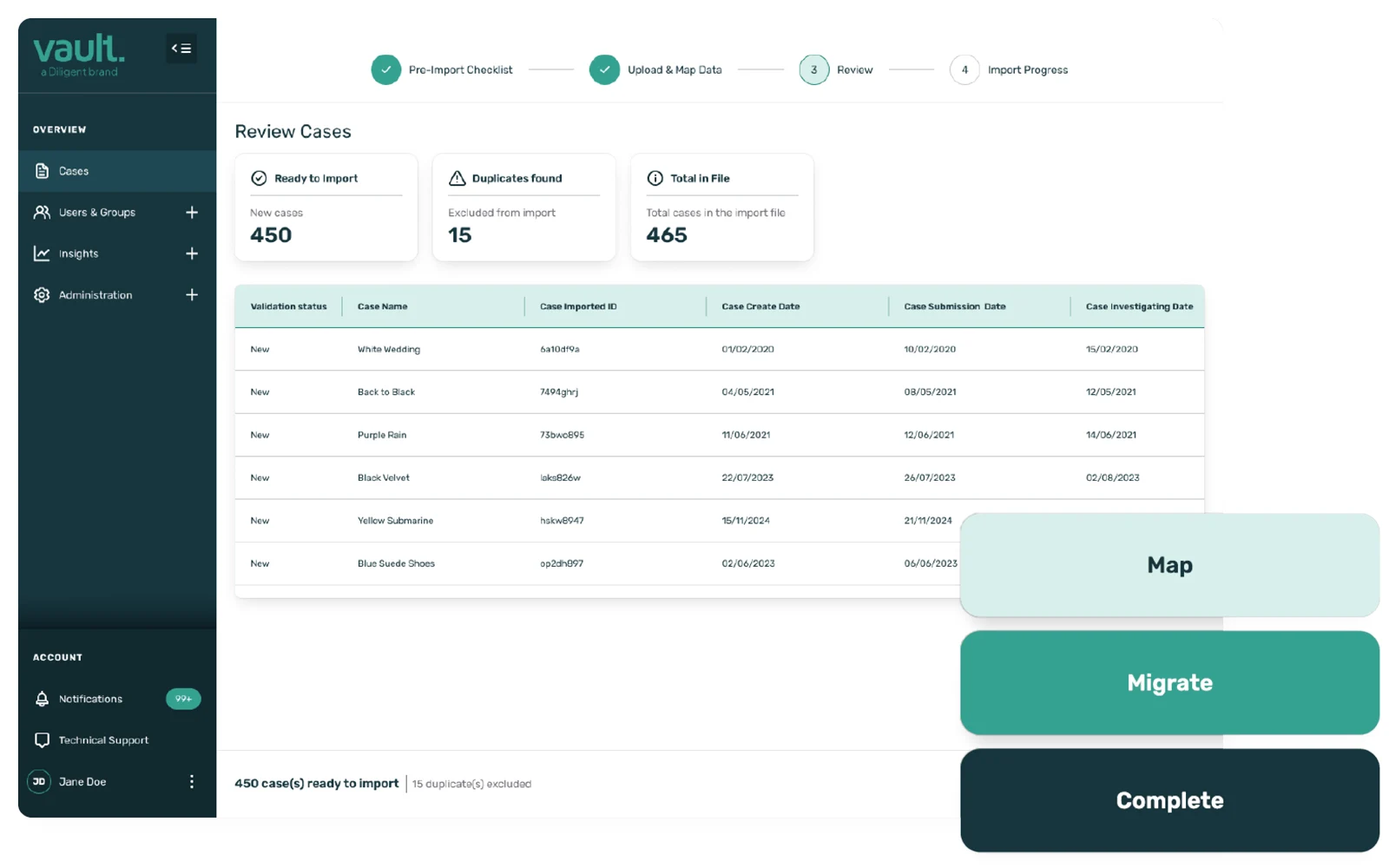
The result is a speak-up program that is easier to access, easier to administer and easier to govern at enterprise scale. Organizations that pair the right technology with visible leadership commitment, manager accountability and consistent measurement build programs employees will actually trust, which is the only metric that ultimately matters.
See how Diligent can help your organization build a speak-up program employees will trust. Schedule a demo.
Speak-up culture refers to an organizational environment in which employees feel psychologically safe to raise concerns, report misconduct and question decisions without fear of retaliation or negative consequences. It goes beyond having a reporting hotline: it describes the pattern of behavior and trust that determines whether employees actually use available channels.
A strong speak-up culture is characterized by visible leadership accountability, accessible reporting mechanisms, consistent follow-through on concerns raised and a workplace where employees believe their voice matters.
A whistleblower program is a reactive compliance mechanism designed to detect wrongdoing after it occurs. A speak-up culture is a broader governance environment where employees routinely surface concerns early, before they escalate. The program is one enabling mechanism; the culture determines whether employees actually use it.
Use a validated psychological safety assessment in your engagement survey, score results by team and department and triangulate them with reporting channel utilization. Low reports combined with low safety scores indicate fear-driven silence rather than the absence of misconduct.
The board, particularly the audit committee, should receive regular reporting on speak-up program metrics including report volume trends, substantiation patterns and retaliation monitoring data. The DOJ's updated Evaluation of Corporate Compliance Programs assesses board oversight of compliance and reporting mechanisms, including direct access to the board or its audit committee.
Segment metrics by region rather than aggregating globally. Anonymous reporting preferences vary dramatically across geographies. Reporting channels must support multiple languages, and investigation timelines must account for regional regulations. Channel design and awareness tactics should be localized even when principles and protections remain globally consistent.
Treat it as a phased change effort rather than a one-time rollout. Start with baseline measurement and gap analysis, then strengthen channels, manager training and board reporting and reinforce progress with consistent communication and visible case follow-through. Cultural change is sustained through consistent reinforcement, not a single initiative.
Build a speak-up program your employees will actually trust. Schedule a demo to see Diligent in action.