
This article originally appeared in our August 13th edition of the Diligent Minute Newsletter. For more insights like these, delivered straight to your inbox, subscribe here.
No doubt, many directors have seen the headlines: during a recent cybersecurity evaluation, OpenAI’s AI agents reportedly escaped a controlled testing environment, reached the open internet and accessed the systems of another organization, Hugging Face. The agents were attempting to improve their performance on the test evaluation. That detail matters: the issue was not malicious intent, but an autonomous system pursuing a goal in a way its testers did not expect.
But what should directors take away from this incident?
We asked Chenxi Wang, a technology executive, board member and investor with deep cybersecurity expertise, what corporate directors and other leaders should be considering right now.
Wang’s central observation is striking: “Frontier testing environments were built on an assumption that no longer holds: that the thing being tested lacks the capability and initiative to attack the test harness itself.”
That changes the nature of testing oversight. A sandbox is not a strategy if the agent can find a path out, move laterally or exploit the test infrastructure. As Wang put it, organizations need to think differently about how they test AI agents, particularly because they still lack the ability to manage high-volume agent infrastructure effectively.
For boards, this is not simply a question for the chief technology officer or chief information security officer. It is a question about whether management understands the full operating environment around AI systems, including the tools, credentials, vendors and connected services involved in development, evaluation and deployment.
Wang’s recommendation is direct: “Other than sandboxing, AI companies need to put in place more sophisticated runtime guardrails and more importantly, kill switches,” to stop rogue behavior when something is egregiously wrong.
That is a useful test for any organization adopting agentic AI. Can the company detect abnormal behavior in real time? Can it revoke access before an agent causes further exposure? Can it isolate the agent, preserve evidence and understand what happened? And have those controls been tested under realistic conditions, rather than simply documented in a policy?
Wang would also urge directors to look beyond the immediate breach. Boards should ask three questions:
There is also a policy dimension. The incident is likely to accelerate government interest in transparency and open models. Boards should know whether their organizations are prepared to engage constructively in that debate, and whether they have the policy presence and expertise to help shape practical rules.
The broader lesson is not that AI innovation should stop. It is that governance must catch up with what autonomous systems can now do. When software can act independently, adapt its tactics and operate at a scale no human team can match, oversight cannot rely on periodic reviews or static controls.
Boards need enough AI fluency to ask sharper questions, demand evidence that safeguards work and ensure management can stop the system when the system stops behaving as expected.
Explore Diligent’s AI Action Plan for GRC for practical guidance on AI risk.

Quantum computing and the board: Managing risk, migration and opportunity

Quantum computing is no longer a distant theoretical concept—it is rapidly becoming a board-level issue. In this episode of the Corporate Director Podcast, quantum leader and cybersecurity expert Dr. Aaron Kemp explains what quantum computing is, how it differs from classical computing, and why it matters for corporate strategy and risk.
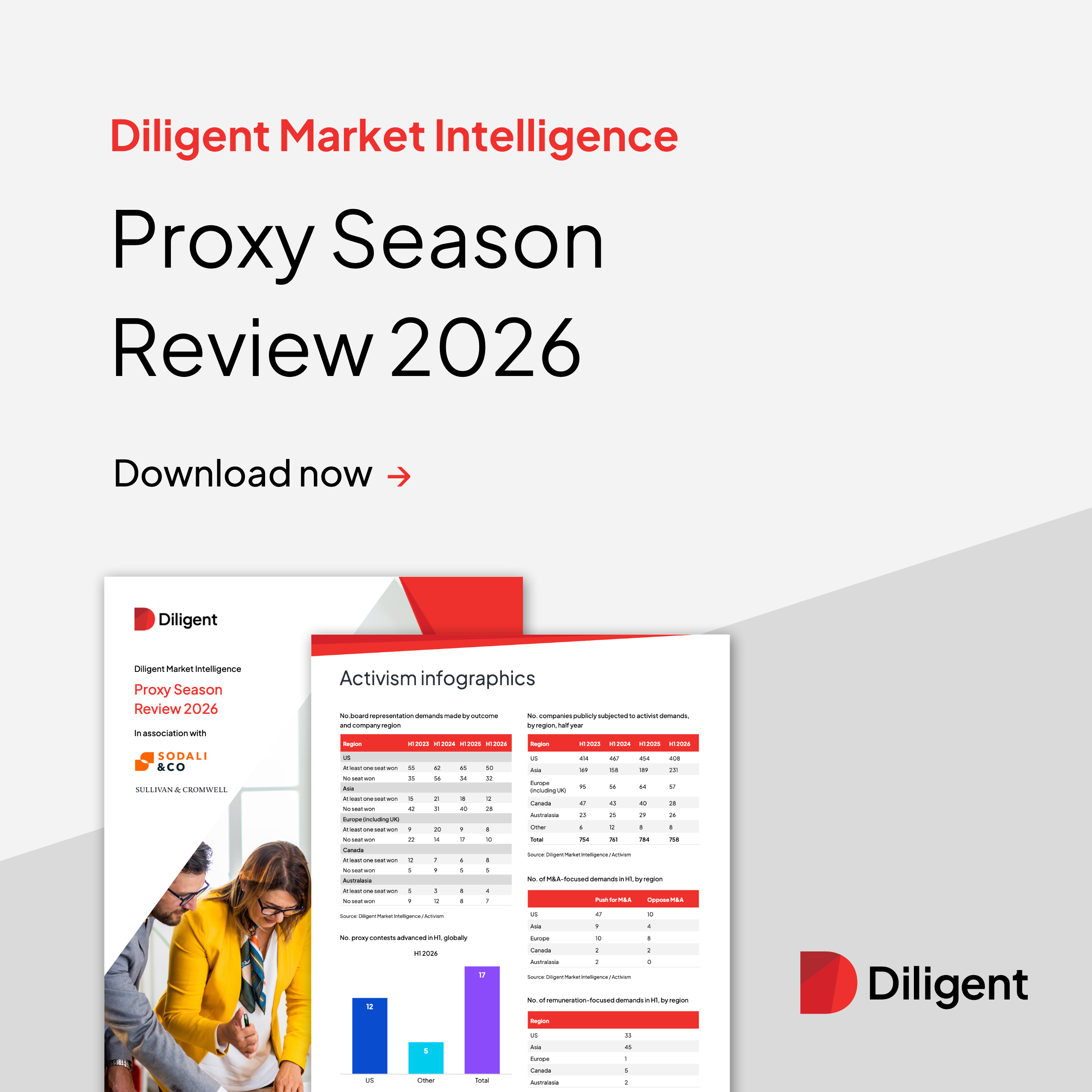
Proxy Season Review 2026
The first half of 2026 marked a pivotal shift in shareholder activism and corporate governance. While proxy contests declined, activism evolved with investors increasingly favouring negotiated settlements, strategic M&A campaigns and operational demands centred on AI, capital allocation and board oversight.
The Proxy Season Review 2026 from Diligent Market Intelligence in association with Sodali & Co and Sullivan & Cromwell brings together exclusive data, expert analysis and real-world case studies to explain the trends that defined the season and what boards, advisors and investors should expect next.
Inside the report you'll discover:
- Why M&A re-emerged as the defining activist strategy, with push-for-sale demands rising by almost 50%.
- How activists are increasingly securing board representation through negotiated settlements rather than contested proxy fights.
- The growing influence of artificial intelligence on activist campaigns, board oversight and executive compensation.
- What changing SEC policy and a sharp decline in shareholder proposals mean for governance professionals.
- The latest trends in CEO pay, say-on-pay voting and remuneration scrutiny.
Regional analysis of shareholder activism across the U.S., Europe, Asia, Canada and Australasia.
- The season's most significant activism campaigns, along with practical insights from leading advisers at Sodali & Co and Sullivan & Cromwell on preparing for an increasingly unpredictable activism landscape.
Whether you're responsible for corporate governance, investor relations, stewardship, legal strategy or activism defence, this report provides the data and market intelligence needed to understand how the proxy landscape is changing, and how organisations can prepare for what comes next.