
According to the GC Risk Index from Diligent Institute and Corporate Board Member, business risk has surged 36% since the start of 2025, with general counsel and compliance leaders rating the current risk environment at 7.9 out of 10 — up from just 5.8 in Q1.
As geopolitical pressures combine with regulatory volatility and tariff disruptions, companies face mounting pressure to move beyond reactive compliance toward proactive risk intelligence. AI-enabled governance, risk and compliance (GRC) provides the answer.
Board directors see the opportunity. According to the Director Confidence Index by Diligent Institute and Corporate Board Member, 64% identify AI adoption as their organization's biggest opportunity. Yet only 10% use AI regularly for oversight purposes
This disconnect reveals a critical challenge: Organizations recognize AI's transformative potential for governance, risk and compliance functions, but struggle to move from consideration to effective implementation.
For companies preparing for transactions, building institutional-grade governance or scaling compliance operations without proportional headcount growth, AI-powered GRC platforms deliver the strategic intelligence that stakeholders expect.
The question? How do governance teams implement it effectively? To this end, this article covers:
AI-enabled GRC is the application of artificial intelligence to three core governance jobs: monitoring compliance obligations, identifying and assessing risks, and maintaining control effectiveness across your organization.
The technology combines two distinct AI capabilities:
Together, these technologies transform how companies manage governance, risk and compliance:
Traditional GRC approach:
AI-enabled GRC approach:
Think of it as the difference between a security guard who walks the building every four hours versus security cameras that watch continuously, combined with an AI analyst who can instantly answer "What security incidents occurred last week?" or "Which areas show the highest risk patterns?"
Traditional GRC approaches rely on periodic reviews, sample-based testing and quarterly reporting that provide point-in-time snapshots of organizational risk.
By the time compliance teams identify regulatory changes, risk assessments reach executive leadership, or audit findings surface control gaps, the business environment has often evolved beyond the data being analyzed.
AI-enabled GRC replaces this reactive approach with continuous monitoring across all risk domains:
While AI-enabled GRC begins with compliance efficiency, the strategic value extends far beyond regulatory adherence. Beyond compliance efficiency, AI-enabled GRC delivers strategic value across multiple dimensions.
Decision velocity increases as executives access real-time risk intelligence rather than waiting for quarterly reports. When boards evaluate acquisitions, expansion opportunities or strategic pivots, AI systems can provide immediate analysis of regulatory requirements, compliance costs and risk exposures that inform go/no-go decisions.
Resource optimization allows compliance and audit teams to focus expertise on judgment-intensive advisory work rather than manual data gathering. Additionally, stakeholder confidence strengthens when companies demonstrate sophisticated risk management capabilities to investors, acquirers and regulators.
Moving from AI consideration to actual adoption requires systematic planning that addresses technology selection, organizational readiness and governance frameworks.
These eight steps provide a practical roadmap for implementation:
The first step toward building stronger AI-powered GRC processes is looking at the processes you currently have — and, more importantly, where they're letting you down.
Begin by documenting existing workflows to understand where manual processes create bottlenecks, compliance gaps emerge, or strategic intelligence fails to reach decision-makers in time to influence outcomes.
Focus diagnostic efforts on three critical areas:
For board preparation workflows, measure administrative hours required for meeting materials compilation, version control challenges when multiple contributors update content and time lag between operational developments and board awareness. These metrics establish a baseline performance that AI implementation improves.
In compliance monitoring, assess regulatory update identification speed, policy review cycle times and control testing coverage. And for risk management, evaluate assessment frequency, mitigation tracking effectiveness and board reporting clarity.
Transform diagnostic findings into SMART goals — specific, measurable, achievable, relevant and timely — that connect GRC improvements to business outcomes stakeholders care about.
For organizations preparing for transactions, objectives should emphasize governance maturity signals that influence valuations and accelerate due diligence.
Target metrics might include "achieve 100% control testing coverage prior to due diligence kickoff" or "reduce compliance exception resolution time from 45 days to 10 days."
Growth-stage companies scaling operations might prioritize objectives like "maintain compliance monitoring effectiveness while revenue doubles without proportional GRC headcount increase" or "reduce regulatory compliance cost-per-dollar-revenue by 40% through automation."
Public companies managing complex oversight requirements often focus on board effectiveness metrics such as "increase director preparation time for strategic discussion by 50% through administrative automation" or "reduce time from risk identification to board awareness from 3 weeks to 3 days."
Technology selection determines implementation success more than any other factor. The platform you choose should match your organization's current sophistication while providing room to grow as requirements evolve.
Evaluate platforms based on four critical capabilities:
Discover how Diligent delivers the governance intelligence and risk oversight capabilities that match your organization's scale and complexity.

Successful AI implementation extends far beyond software deployment. Organizations should also address organizational readiness, process redesign and change management systematically.
Your implementation plan should cover:
As AI becomes embedded in GRC operations, organizations need governance structures that ensure responsible deployment, manage associated risks and satisfy board oversight requirements.
The GC Risk Index shows us that only 29% of organizations have comprehensive AI governance plans, while another 38% are actively drafting guidelines. Yet 44% of compliance leaders say their current policies need refinement, and 33% consider them entirely insufficient. This gap between adoption and governance maturity creates significant risk.
Your AI governance framework should address:
Technology adoption succeeds only when people understand capabilities, trust recommendations and apply tools effectively. Training programs should address both technical proficiency and strategic judgment.
Structure training across three levels:
Training should not be one-time events but continuous programs that evolve as AI capabilities expand, new use cases emerge and organizational sophistication increases.
Don't attempt comprehensive AI implementation across all GRC functions simultaneously. Instead, successful organizations begin with focused pilots that deliver measurable results. These pilots build organizational confidence and generate executive support for broader deployment.
Select initial use cases based on three criteria:
Strong pilot candidates often include board preparation automation, regulatory change monitoring or high-volume control testing where AI delivers obvious efficiency gains.
Consider a board governance pilot focused on a single committee. Implement AI-powered document synthesis for that committee's materials. Then measure three outcomes: preparation time reduction, director satisfaction improvement and discussion quality enhancement.
Success in this limited scope builds momentum for expansion across all board activities.
A compliance monitoring pilot might focus on a single regulatory domain — for example, data privacy requirements across operating jurisdictions. Measure how quickly AI identifies regulatory updates compared to manual monitoring, how accurately it assesses relevance and what time savings compliance teams achieve.
Risk management pilots often target specific risk categories where assessment frequency matters for business decisions. Implement continuous AI-powered monitoring for supply chain risks or cybersecurity threats, demonstrating how real-time intelligence changes decision-making compared to quarterly risk reviews.
"Trust is the number one thing. Once you have trust that the executive teams believe in the data, believe in the risk you are identifying, then you can have fulsome conversations, you can create change," says Tom Keaton, Vice President of Business & Product Strategy at Diligent.
Document pilot results comprehensively, capturing both quantitative metrics and qualitative feedback. This evidence base supports business cases for expanded deployment and helps refine implementation approaches before broader rollout.
AI systems improve through use, but only when organizations implement systematic monitoring that measures performance, identifies refinement opportunities and ensures continuous alignment with business objectives.
Your monitoring framework should assess:
Regular reviews — monthly for new implementations, quarterly for mature deployments — should assess these metrics, identify improvement opportunities and guide strategic decisions about capability expansion.
Effective GRC transformation requires platforms specifically designed for governance, risk and compliance challenges rather than generic AI tools adapted for these purposes.
Organizations should evaluate technology based on domain expertise, integration capabilities, transparency and scalability that match their specific requirements.
The Diligent One Platform provides unified GRC capabilities across your organization. The platform integrates regulatory compliance management, enterprise risk oversight, internal audit management and board governance into cohesive workflows.
This comprehensive approach eliminates data silos while streamlining governance as part of holistic oversight.
For organizations building enterprise risk management capabilities, Diligent ERM delivers AI-powered risk identification that benchmarks against 180,000+ real-world risks from public company disclosures, Moody's external risk intelligence and real-time reporting through interactive dashboards.
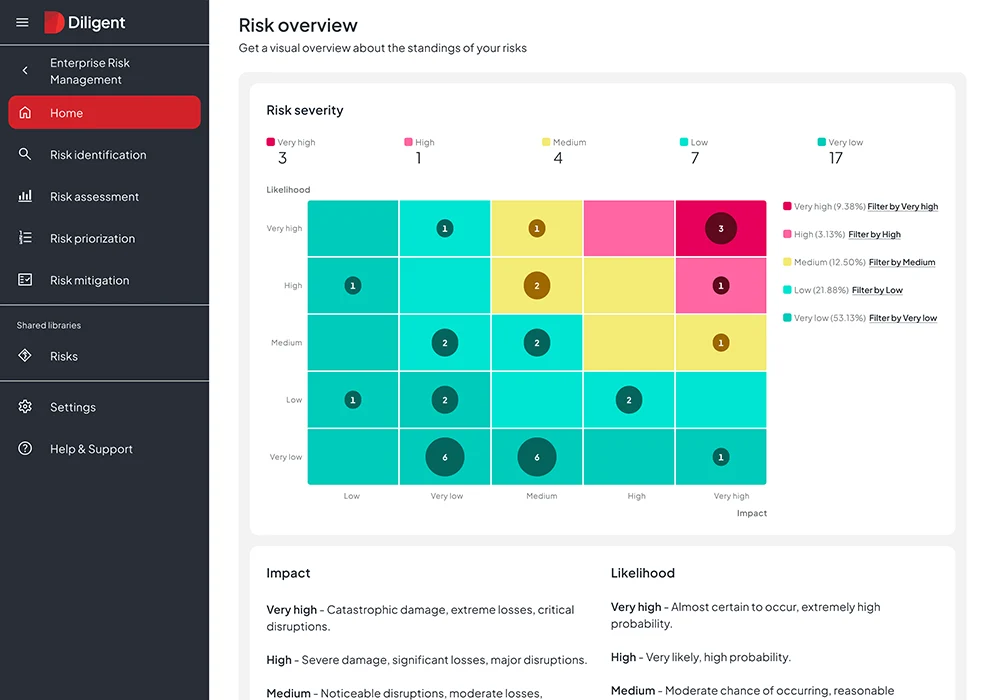
The platform enables centralized risk management across business units with workflow automation that scales from pre-IPO companies establishing foundational programs to global enterprises managing complex operations.
Companies launching risk programs with resource constraints can implement Diligent’s AI Risk Essentials in as little as seven days.
The solution provides AI-powered peer benchmarking that identifies relevant threats from public company disclosures, training tools and templates that accelerate program maturity and unified workflows that professionalize risk management without hiring consultants.
This entry point delivers immediate value while establishing foundations for comprehensive ERM as organizations scale.
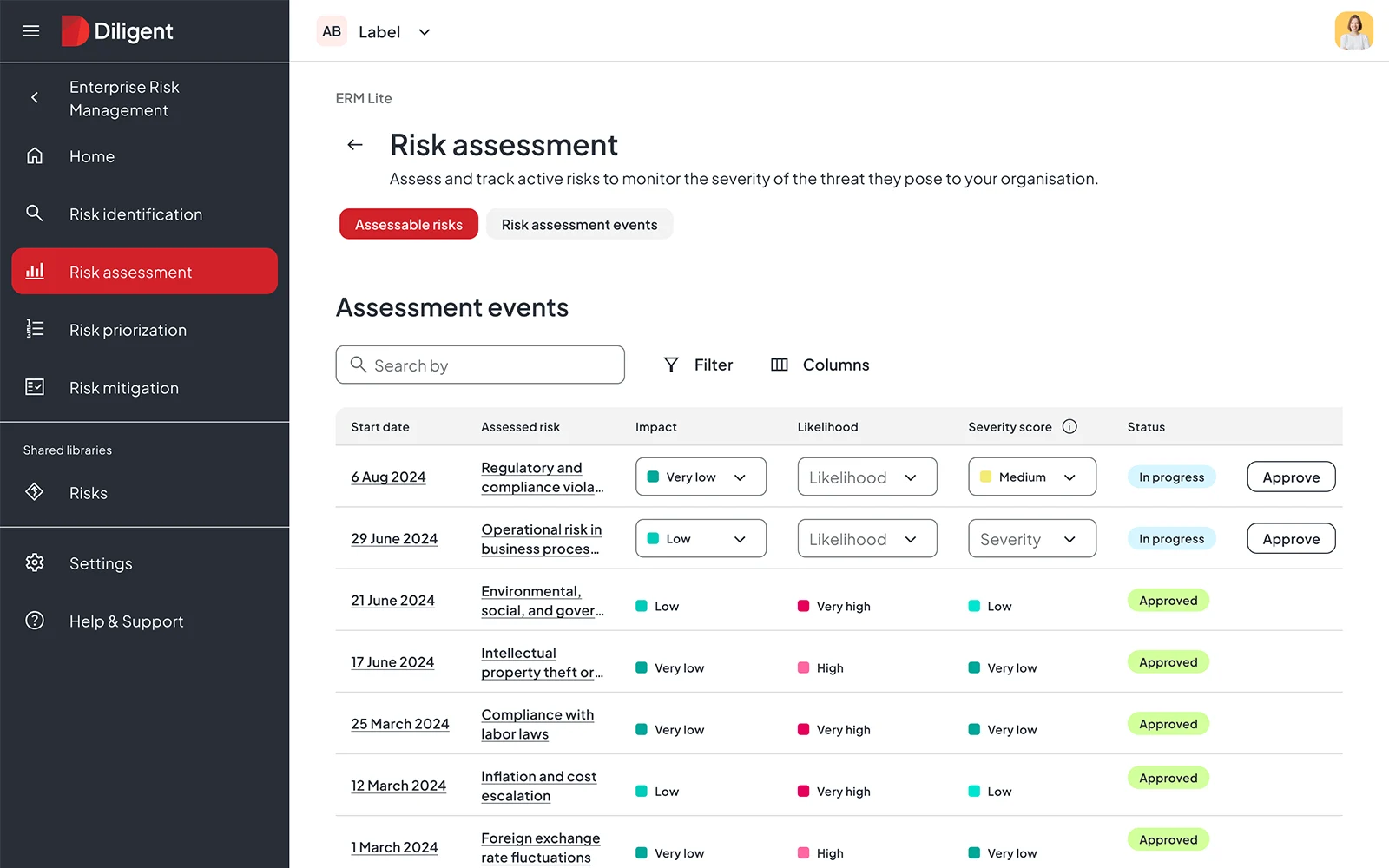
These integrated capabilities address the full GRC lifecycle. They cover initial risk identification, control implementation and board-level reporting in unified workflows. This eliminates the data silos and workflow friction that plague organizations assembling solutions from multiple point products.
Ready to see how AI-powered GRC transforms governance, risk and compliance operations? Request a demo to explore Diligent's integrated platform capabilities.
Implementation timelines vary based on organizational readiness, existing technology infrastructure and deployment scope. For focused solutions addressing specific pain points, organizations can achieve operational value within days to weeks.
AI Risk Essentials, for example, provides AI-powered risk identification in as little as seven days. Comprehensive enterprise implementations spanning board governance, risk management, compliance monitoring and internal audit typically require 3-6 months for full deployment.
Leading platforms partner with regulatory content providers who monitor thousands of sources across jurisdictions, automatically updating regulation libraries as requirements change.
AI engines analyze these updates for organizational relevance, assess potential impacts on existing controls and recommend mitigation strategies. This continuous monitoring replaces manual regulatory tracking that typically identifies changes weeks after publication.
Boards should establish clear oversight structures for AI strategy, risk management and ethical deployment. This includes:
Many boards establish dedicated technology or innovation committees that provide specialized AI oversight, particularly for organizations where AI capabilities create competitive advantages or significant operational dependencies.
Discover how Diligent's AI-powered platform transforms GRC operations from reactive compliance to strategic intelligence. Schedule a demo today.