
In this article

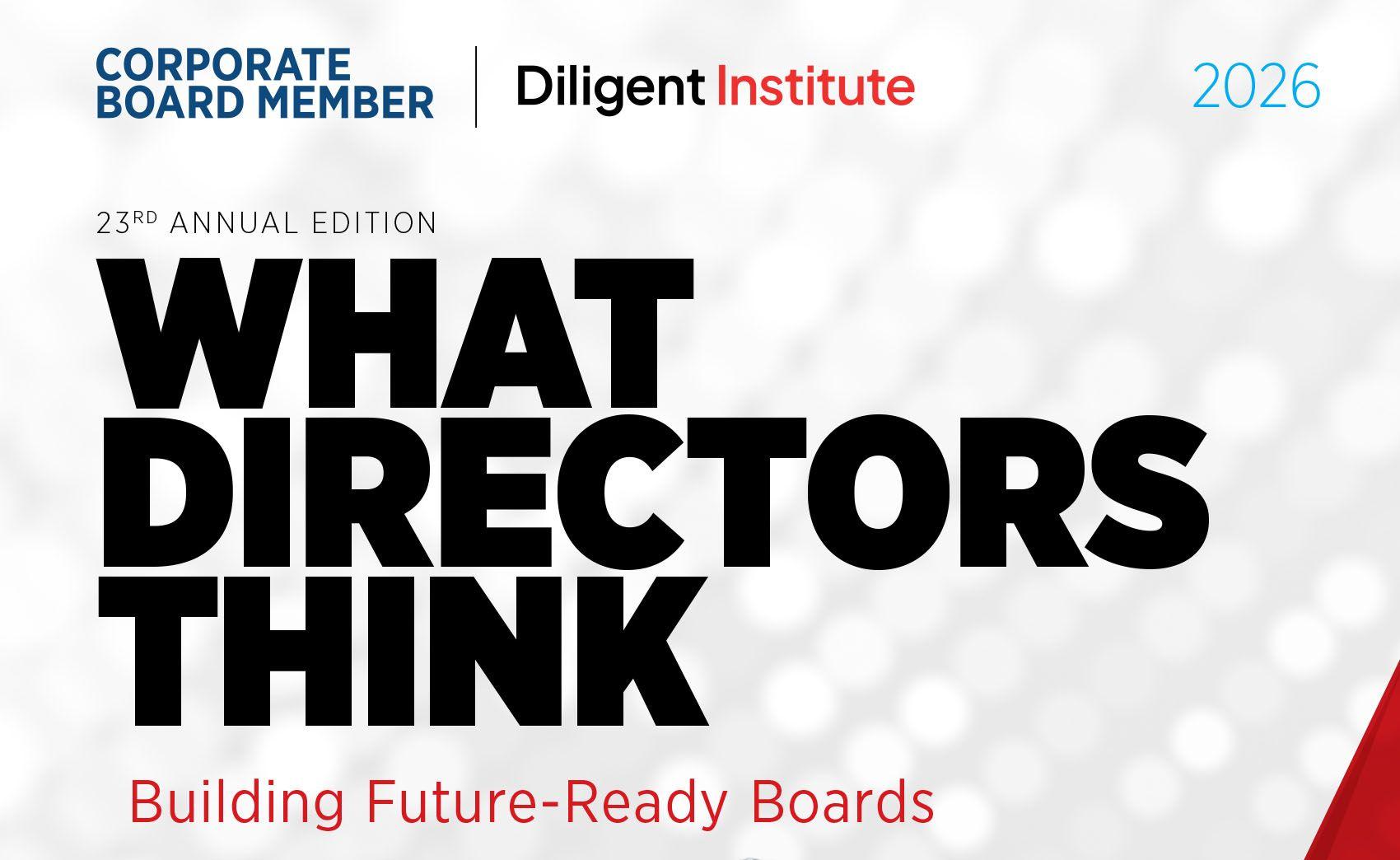
AI in board management has moved from a peripheral conversation to the center of how governance teams run board operations. According to What Directors Think 2026 (Diligent Institute and Corporate Board Member), 65% of directors now cite digital transformation, including AI risks and opportunities, as a top agenda item for the year ahead. That made it the most cited issue in the survey.
Board agendas are fuller, expectations around AI oversight are escalating and the time directors spend on strategy keeps getting compressed by the volume of materials they need to absorb. At the same time, AI adoption inside the board's own tools introduces a new governance obligation on top of the familiar ones.
For corporate secretaries, chief governance officers and the directors they support, the work ahead is twofold. Governance professionals need to use AI to reduce preparation overhead and improve board discussions, while building the oversight structures required to govern AI responsibly in their own workflows. This article covers both sides.
This guide explains how AI in the boardroom is reshaping board management and what governance leaders need to know to use it responsibly:
Each section builds on the last, moving from definitions and context to capability evaluation, risk management and a step-by-step implementation path.
AI in board management refers to the use of artificial intelligence, large language models, machine learning and document intelligence, embedded in the platforms and processes boards rely on to run operations and oversee the enterprise. It spans two connected domains: AI for board operations and AI as a board oversight responsibility.
In practice, this looks like AI-generated board book summaries that distill lengthy packs into decision-ready briefs. Structured minutes are drafted from meeting notes in minutes rather than days. Risk scanning flags legal or regulatory red flags in materials before they reach directors. Each of these capabilities changes the day-to-day mechanics of board operations.
Directors are expected to oversee how AI is used across the enterprise, and that expectation now extends to the board's own tools. While many organisations have incorporated AI into their work processes, far fewer have audited how it is being used, according to the 2026 APAC Governance Outlook published by Diligent Institute, the Governance Institute of Australia and the Singapore Institute of Directors. The gap between deployment and audit is a governance exposure that falls directly to the board.
Closing that gap starts with understanding what AI the organisation uses, where board data flows and who is accountable for AI-generated outputs. For governance teams, the practical first step is inventorying the AI used in board workflows and assigning clear ownership for reviewing AI-generated outputs.
"You need to adapt the environment so it's safe for everyone. How do you engage with the key partners who are already thinking about where the regulatory environment is leaning, so you can scale when the regulatory environment changes?"
— Sophia Velastegui, AI Business Leader, Director and Committee Chair at BlackLine; former GM of AI Products and Chief AI Officer at Microsoft
Three forces are converging to move AI in board management from a future-state discussion to an active agenda item: director workload, regulatory pressure and a readiness gap between adoption and oversight.
Board materials are voluminous and preparation remains largely manual. Directors want more time for strategic discussion, but administrative overhead keeps crowding it out. What Directors Think 2026 adds that 58% of directors want more time for strategic planning. Governance teams are being asked to create more room for discussion without lowering the quality of board materials, and AI addresses that tension directly by shifting information synthesis from human hours to platform capabilities.
The EU AI Act has begun staged enforcement, with high-risk AI system obligations covering data governance, transparency, documentation and human oversight now approaching. In the U.S., the NIST AI Risk Management Framework and ISO/IEC 42001 are emerging as reference frameworks that regulators, auditors and insurers cite when evaluating AI governance maturity. For governance leaders, the primary work is to document how AI is used in board workflows, define who reviews outputs and align internal controls to recognized frameworks before scrutiny intensifies.
Boards are adopting AI faster than they are governing it. What Directors Think 2026 also found that 66% of directors use AI for board work, but only 22% report having AI governance processes for board AI usage. That mismatch is the governance problem in plain terms: usage is here, and control frameworks need to catch up.
The practical response is to document approved AI use cases, assign ownership for review and oversight and establish governance structures before usage expands further. Acting now is easier than reconstructing oversight after the fact.
"In the era of AI, the greatest risk isn't the technology itself, but the governance gap that it is creating."
— Dottie Schindlinger, Executive Director, Diligent Institute
See how governance leaders automate board book creation, strengthen compliance oversight and support directors across the meeting lifecycle.

The most practical way to understand AI in board management is to follow it through the four stages of the board meeting lifecycle. Each stage has distinct pain points, and AI now addresses them with capabilities that are deployed in production rather than in theory.
Most of the corporate secretary's work sits here. AI-powered board book assembly pulls from multiple source documents and structures them into a professional board package. Executive summaries distill lengthy packs into actionable briefs that highlight key themes, risks and decision points. Risk scanning flags legal or regulatory red flags before distribution.
Personalized director preparation tools generate topic-specific questions with citations, tailored to each director's committee role and helping directors arrive having already identified the areas that require their attention. With synthesis and scanning handled upstream, meeting discussions shift from presentation review to the strategic debate directors are actually there to have.
Assore Holdings, a South African mining enterprise managing a high volume of meetings across multiple jurisdictions, adopted Diligent Boards with GovernAI and saved up to 60% of the time previously spent on board meeting preparation. For governance teams, the takeaway is straightforward: AI-supported preparation can materially reduce the manual burden before a meeting even begins.
During the meeting, AI supports rather than replaces human judgment. Current capabilities include note capture from transcripts using a capture-then-process model rather than live audio listening, digital voting with audit trails and annotation tools for flagging follow-up items. Human judgment remains central to the meeting itself.
After the meeting, AI-generated minutes and AI meeting summaries convert notes and transcripts into structured legal prose: governance-grade records with decision attribution, vote documentation and action item extraction. Action items are surfaced automatically with assigned owners and deadlines and integrated into tracking systems so commitments carry forward.
The accountability model is straightforward. AI produces the draft; the corporate secretary and board review and authenticate it. Human sign-off on the record is not optional and should be built into the workflow.
Between meetings, AI-curated intelligence feeds surface regulatory changes, market developments and peer activity in board dashboards on an ongoing basis, so directors are not relying on stale snapshots when they assess enterprise risk. Fully autonomous between-meeting monitoring, where AI agents independently track regulatory shifts and surface governance implications, remains directional rather than production-deployed. But the structural demand is clear: platforms that connect board oversight to real-time enterprise data are where governance technology is heading.
Understanding what AI does across the board lifecycle is one thing. Knowing what to evaluate when selecting board management technology is another. Four capability categories matter most when assessing a platform.
The platform should turn raw source content, financials, committee reports, presentations and prior meeting materials, into structured board packages, summaries and director-ready briefs. Personalized preparation tools should generate topic-specific questions and cited references tailored to each director's committee role, so directors arrive equipped to ask informed questions.
The platform should identify legal, compliance or reputational risks in materials before they reach directors — a pre-distribution safeguard that catches issues during preparation. Minutes output should be structured governance records with decision attribution, vote documentation and action item extraction, feeding directly into retention and compliance documentation systems.
Requirements include enterprise-grade encryption, data residency support, SOC 2 Type II certification, ISO 27001 certification and strict data confidentiality controls, with each organization's data kept separate and never shared with other customers.
The platform should connect to enterprise risk management, ESG, entity management and audit systems, so board oversight reflects the same data the rest of the organization runs on. General-purpose AI tools lack the platform security, audit trails and governance-specific workflows that board management platforms embed by design.
AI adoption in board operations creates real governance exposure. Four categories of risk deserve direct attention from boards and general counsel.
Board discussions involve some of the most sensitive information in any enterprise: pre-announcement financial results, acquisition targets, CEO succession plans and privileged legal advice.
Tools that train models on customer data or lack clear data residency controls are not suitable for board use. Once board materials are incorporated into a third-party model's training data, they cannot be retrieved or deleted, which makes confidentiality a threshold question rather than a trade-off.
AI-generated minutes and summaries can contain fabricated facts, misattributed statements or omitted deliberations. Board minutes are legal records that establish the basis for fiduciary decisions and are discoverable in litigation, which means AI-drafted content must be reviewed and signed off by governance professionals before it becomes part of the record.
Governance-focused analyses have flagged hallucination risk in boardroom use cases and the need for human review before AI outputs are finalized.
Directors using unapproved consumer AI tools to summarize confidential materials represent a growing exposure. Directors may be subject to distinct governance and security practices, including organization-defined cybersecurity standards for board communications and tools.
The governance response is policy: define what tools are approved, where data can and cannot go, and make the right tools available with proper security controls and contractual protections in place.
The EU AI Act, state-level AI regulations in the U.S. and sector-specific guidance are raising AI accountability and governance expectations that boards are often expected to oversee. Delaware's Caremark standard holds that directors can face liability for a sustained failure to exercise oversight, and recent governance analysis has linked that standard to risk management and compliance concerns. The NIST AI Risk Management Framework and ISO/IEC 42001 are the frameworks regulators and auditors reference most often when evaluating maturity.
A workable roadmap starts small, sets policy early and connects board use of AI to wider enterprise oversight.
Pick one workflow, typically AI-generated meeting minutes or board book summarization, and run a defined pilot. Agree on evaluation criteria before you start: time saved, accuracy of AI-generated output, director adoption and security posture verified. A well-scoped pilot produces the evidence governance teams need to build the case for wider adoption.
Document what AI can and cannot touch: confidential board materials, draft legal advice, HR data and MNPI all require explicit handling rules. Specify where data is processed and stored, who reviews AI-generated output before it becomes a legal record, what tools directors and staff are authorized to use and what training is required. This becomes the board's AI-use policy for its own function and a model for the enterprise.
Directors do not need to become machine learning engineers. They need enough fluency to ask the right questions, challenge weak AI implementations and recognize governance gaps. Few boards have AI governance processes in place, yet AI is likely to remain a top agenda item. Closing that gap calls for structured director education on AI: foundational awareness for all directors and governance-specific training for audit, risk and technology committees.
Track meaningful metrics: board prep time saved, director engagement signals, risk findings surfaced pre-meeting and audit trail completeness. The aim is demonstrating improved board effectiveness, not AI adoption for its own sake.
The AI running inside the board platform connects to the AI running across the enterprise. Ask management to confirm who holds accountability for AI governance outcomes, how AI systems are classified by risk level, what controls are in place for high-risk applications and how incidents are detected and reported.
"One mitigation that sophisticated companies are already implementing is to deliberately make certain specific AI tools available to board directors, and to ensure that proper security controls, licenses and contractual protections are in place for those tools. Making the right tools available and educating directors on its appropriate use will become best practice over time."
— Keith Enright adds (AI and Data Privacy Leader at Gibson Dunn; former VP and Chief Privacy Officer at Google; Board Director)
The challenges covered throughout this article, manual pack assembly, security gaps, underprepared directors and expanding AI governance obligations, are the same problems Diligent Boards is designed to address across the full meeting lifecycle.
Smart Builder helps governance teams turn raw source documents into a structured first draft of a board book, reducing manual compilation and speeding preparation. Smart Risk Scanner helps identify risky language and legal red flags before distribution, giving legal teams visibility into issues during preparation.
Smart Minutes converts meeting notes or transcripts into structured minutes drafts, while Smart Summary distills lengthy board packs into concise briefs that help directors focus preparation time on what matters most.
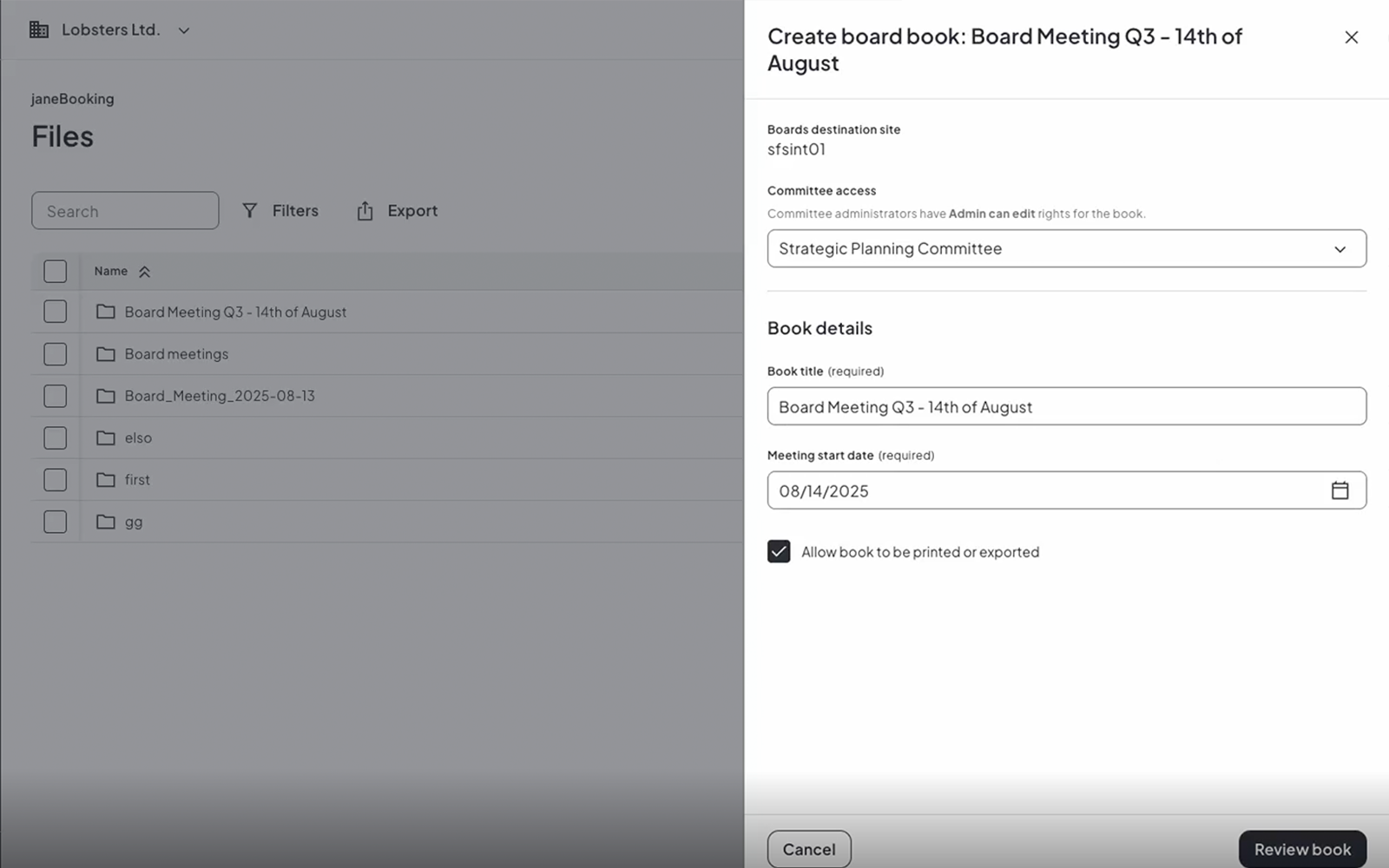
For director readiness, SmartPrep 360 generates topic-specific questions with cited references tailored to each director. Between meetings, Smart News surfaces regulatory changes, peer activity and market developments so directors stay informed. Action Tracker extracts action items from meeting records with assigned owners and deadlines, helping teams carry commitments forward between meetings.
Diligent Boards sits on the Diligent One Platform, connecting board management to risk, compliance, audit and entity governance. The platform is ISO 27001 certified, undergoes annual SOC 2 Type II audits and supports data residency requirements across jurisdictions.
Sagic (Salvation Army General Insurance Company) adopted Diligent Boards with GovernAI to centralize board materials, streamline meeting preparation and make board packs easier to digest. According to Arran Gray, Chief Operating Officer at Sagic, "We're seeing a real difference in how quickly and confidently we prepare for meetings, and the tailored insights have made our discussions much more meaningful." For governance teams, the takeaway is that AI-powered board tools translate directly into better-prepared directors and more substantive discussions.
Board management is under two pressures at once. Directors need less time on administrative review and more time on strategic questions, and boards need a credible answer when regulators, auditors or insurers ask how AI is being governed inside the organization. These pressures have the same solution: board management technology that reduces preparation work while giving governance teams the controls, audit trails and documentation to demonstrate responsible use.
This is where platform choice matters. A generic AI summarizer pointed at confidential board materials might save time, but it creates exposure the corporate secretary and general counsel will own when something goes wrong. Purpose-built board management platforms handle the same synthesis work inside an environment built for governance, with data residency controls, certified security audits and integration with the risk, compliance and entity systems the board already relies on.
The roadmap earlier in this guide, scoped pilot, documented policy, director literacy, enterprise-level governance connection, sets out how to adopt AI responsibly. The right platform makes each step easier to execute and easier to evidence when scrutiny arrives
See how Diligent Boards supports the full meeting lifecycle with AI that governance teams can defend. Request a demo to see it applied to your board's workflows.
It refers to two connected uses: AI embedded in board operations — including pack assembly, minutes generation, risk scanning and director preparation — and AI as a governance obligation the board oversees across the enterprise. Contemporary platforms bring both together, giving governance teams operational efficiency alongside the audit trails and controls needed to demonstrate responsible AI use.
The main risks are data confidentiality exposure from tools that train on customer content, hallucinations in AI-generated minutes or summaries and shadow AI adoption by directors using unapproved consumer tools. Inadequate oversight of any of these areas can also create regulatory or fiduciary liability, which is why policy and platform selection need to be addressed together.
Directly, where AI use falls within regulated contexts under the EU AI Act, depending on the system's risk classification and intended purpose. Indirectly, because the Act is shaping the broader reference point for AI governance expectations that regulators, auditors and insurers apply globally. Boards should expect to document their AI oversight posture, including the AI in their own tools.
Core capabilities are document synthesis, risk scanning, structured minutes with decision and vote attribution, personalized director preparation with citations and secure data handling that keeps each organization's data separate and is never used to train shared models. Integration with the broader governance stack, data residency support and SOC 2 Type II certification are threshold requirements for any board portal under evaluation.
Start with a scoped pilot — minutes generation or board book summarization — with defined evaluation criteria. Document an AI-use policy before scaling, invest in director AI literacy so the board can ask informed questions about any tool it adopts and connect the AI inside the board platform to the broader enterprise AI governance program.
Bring AI into your board operations with confidence. Request a demo.