

In this article

Corporate secretaries, general counsel and board administrators evaluating AI tools for board meeting minutes face a distinction most governance teams overlook: These tools are not the same as AI meeting assistants.
Many organizations are under pressure to leverage AI for efficiency, but they're still working out how to implement it responsibly with the right governance and risk oversight. That tension makes the choice of board meeting minutes software a governance decision, not just a technology one.
The best board meeting minutes software in 2026 are purpose-built governance platforms: Diligent Smart Minutes, Board Intelligence Minute Writer, OnBoard Minutes AI, Convene AI and BoardEffect.
These tools generate structured, legally defensible minute drafts from meeting inputs with vote attribution, human review workflows and enterprise-grade data security. General AI note-takers like Otter.ai or Fireflies.ai are not suitable for board-level documentation without significant governance customization.
Board minutes are structured legal records that document attendance, motions, votes, deferred items and assigned actions. Generic AI meeting tools summarize conversations, but governance teams need records that can stand up to regulatory and legal scrutiny.
This guide covers:
Board minutes carry a legal weight that no other type of meeting documentation shares. The core purpose is to create an impartial and reliable record of meetings: not merely a practical reminder of actions taken but evidence that directors have fulfilled statutory duties. Courts give greater weight to minutes that read as contemporaneous records of deliberation and less weight to those that appear algorithmically produced.
That evidentiary standard has direct implications for AI-generated content. A generic AI summary that compresses a board meeting into narrative prose misses the governance layer entirely: votes and vote attribution, resolutions passed or deferred, recusals and conflicts declared, quorum confirmation and action items with named owners and deadlines. These elements are the difference between a legally defensible record and a liability.
Security compounds the problem. Board discussions routinely involve material nonpublic information, executive compensation details, merger and acquisition deliberations and privileged legal advice. Generic AI tools that store recordings on third-party servers or train models on meeting data introduce risks governance teams cannot accept.
Governance teams evaluating tools should treat that policy gap as a prompt to establish policies, review checkpoints and vendor requirements before deployment. Require vendors to show how policy controls, approval workflows and review checkpoints operate before any pilot begins.
Before comparing specific tools, governance teams need a clear evaluation framework. As Dottie Schindlinger has observed, governance professionals see the benefits of more efficient processes but many still lack the safeguards and governance frameworks needed to deploy GenAI responsibly.
The criteria below reflect what distinguishes a governance-grade minutes tool from a repurposed productivity application. The OECD guidance reinforces that deployed AI systems require ongoing monitoring and intervention, not one-time procurement review.
Structured minute formatting: Attendance records, agenda item references, motions with movers and seconders, vote tallies and resolution language.
Decision and motion capture with vote attribution: Every formal action recorded with the specific vote outcome, including dissenting votes and abstentions.
Human oversight architecture: AI output should be positioned as a draft requiring corporate secretary review, with workflows that enforce review checkpoints before minutes are finalized.
Audit-ready export with version control: Finalized minutes should export in standard formats with version history distinguishing AI-generated drafts from human edits.
Data security and privacy: Evaluate where recordings and transcripts are stored, whether data trains the vendor's AI models, what encryption standards apply and what deletion rights exist. Enterprise certifications and clear contractual commitments matter most here.
Board portal integration: Tools that connect natively with existing board portals eliminate the parallel workflows that create version control risks.
Compliance with retention requirements: Corporate governing documents and board meeting notes are subject to retention obligations. The tool should support formal records retention schedules and legal hold capabilities.
Meeting type differentiation: Boards, audit committees, compensation committees and executive sessions each have different documentation requirements. The tool should accommodate distinct handling protocols.
Multi-language support: Global boards operating across jurisdictions may need minutes generated in the language of record.
Speaker identification and diarization accuracy: Accurate attribution of statements to individual directors is essential for vote records and fiduciary documentation.
Not every AI minutes tool is built for governance. The platforms below span the range from purpose-built board portals with embedded AI to general meeting assistants that may suit less regulated environments. For each, the key question is the same: Does it produce structured, defensible governance records or just a meeting summary?
| Tool | Structured formatting | Vote attribution | Enterprise security | Portal integration | Human review workflow | Pricing tier |
|---|---|---|---|---|---|---|
| Diligent Smart Minutes | Yes | Yes | Yes | Native | Yes | Enterprise (contact for pricing) |
| Board Intelligence | Yes | Yes | Yes (no stored recordings) | Standalone | Yes | Enterprise (contact for pricing) |
| OnBoard Minutes AI | Yes | Yes | SOC 2, role-based access | Native | Yes | Tiered (contact for pricing) |
| Convene AI | Yes | Partial | AWS Bedrock environment | Native | Yes | From ~$15/user/month |
| BoardEffect | Yes | Yes (digital voting) | Yes | Native | Yes | Enterprise (contact for pricing) |
| Boardable | Partial | Limited | Standard | Native (own video only) | Basic | From $20.99/user/month |
| Zeck | Partial | Yes (digital voting) | Standard | Native | Basic | Contact for pricing |
| General AI tools (Otter.ai, Fathom, etc.) | No | No | Varies | None | No | Free tiers available |
Note: Capabilities reflect publicly available information as of early 2026. Contact vendors directly to confirm current feature sets and pricing.
Diligent Smart Minutes generates governance-quality minute drafts from typed notes, board materials or transcripts within the Diligent One Platform. Minutes capture decisions, action items and key discussions mapped back to agenda items. Because the tool sits inside the full board management workflow alongside Smart Builder (for board book compilation), SmartPrep (for director preparation) and Action Tracker (for post-meeting follow-ups), the draft, review and approval process happens in the same environment as the meeting itself.
In practice, the results speak for themselves. At ELCO Mutual Life and Annuity, General Counsel and Corporate Secretary Eric Myers used Diligent Boards to slash board prep time from two days to one or two hours. Minutes preparation dropped from hours of manual work to minutes, and Executive Committee meetings shortened from two and a half hours to an average of 30 minutes.
For governance teams evaluating board meeting minutes software, that kind of operational impact illustrates what happens when AI-assisted minutes sit inside the full governance workflow rather than operating as a standalone tool.
Best for: Enterprise governance teams managing complex board and committee structures that need minutes connected to the full meeting lifecycle, from agenda creation and board book distribution to secure voting, action tracking and risk oversight, in one platform.
Growth-stage and pre-IPO companies also benefit from building governance-grade documentation practices early, with a platform that scales as board structures and regulatory requirements evolve. Because Smart Minutes sits inside the Diligent One Platform, organizations at any stage avoid the cost of stitching together separate tools for board books, voting, minutes and action tracking.
Pricing: Enterprise. Contact Diligent for a custom quote.
Board Intelligence's Minute Writer is a governance-focused AI minutes tool that generates a real-time transcript within the platform, structures minutes by agenda item and allows customizable formatting and detail levels. The tool leaves no audio recording and saves no data in the AI after processing.
Best for: Governance teams that want a dedicated, privacy-first AI minutes tool with no stored recordings and granular control over minute formatting and detail level.
Pricing: Enterprise. Contact Board Intelligence for pricing.
OnBoard is a cloud-based board portal that includes Minutes AI alongside Agenda AI and Book Builder AI. The platform transcribes meetings with AI to capture discussion, motions and votes in real time and produces drafted minutes as soon as the meeting ends. OnBoard also offers SOC 2 compliance and role-based access controls. OnBoard's AI tools are well-suited for intuitive insights during meeting preparation and follow-up.
Best for: Organizations seeking a user-friendly board portal with AI-assisted minutes, agenda creation and board book compilation in one system. Particularly strong for mid-size boards and nonprofit governance.
Pricing: Tiered plans (Essentials, Premium, Ultimate). Contact OnBoard for pricing.
Convene is a board management platform that integrates AI capabilities powered by AWS Bedrock. The platform supports automatic video meeting transcription, AI-generated meeting summaries with editable outputs, automated action item extraction and real-time minute-taking with automatic syncing of notes and actions. All conversations with Convene AI remain within a secure AWS environment.
Best for: Boards that rely heavily on video conferencing and want automated transcription and minutes within a secure board portal. Strong for organizations that need meeting discussions automatically captured and searchable for compliance and follow-up.
Pricing: Starts at approximately $15 per user per month. Contact Convene for exact pricing.
BoardEffect (a Diligent company) offers AI-enhanced minutes and action items within a board management platform designed for nonprofit, healthcare and higher education governance boards.
The platform supports AI-powered board book summarization, agenda management, digital voting and e-signatures. BoardEffect emphasizes structured meeting cycle tools from scheduling through approval.
Best for: Nonprofit and mission-driven organizations that want AI-enhanced minutes alongside board development tools, evaluation workflows and compliance features tailored to their governance model.
Pricing: Enterprise. Contact BoardEffect for pricing.
Boardable offers AI-generated minutes and summaries alongside a built-in AI meeting assistant and governance consultant. The platform automatically transcribes meetings held within Boardable Video and creates formatted minutes. The AI meeting assistant provides real-time answers during meetings without disrupting the flow. AI features require the Professional+ tier.
Best for: Small to mid-size nonprofit boards that want AI minutes, an AI governance assistant and task management in one affordable platform. Less suitable for enterprise boards or organizations that conduct meetings via external Zoom or Teams.
Pricing: Starts at $20.99 per user per month (Essentials plan, billed annually). AI features require Professional+ tier.
Zeck provides AI-driven dynamic commenting, automated minute generation, smart agendas and digital voting. The platform emphasizes a consumer-grade user experience for board collaboration and document sharing. Zeck positions itself as a visual alternative to traditional board portals.
Best for: Boards looking for a visually modern, consumer-style board communication platform with AI-assisted minutes. Stronger for startups and growth-stage companies than for heavily regulated public company boards.
Pricing: Contact Zeck for pricing.
General-purpose AI meeting tools like Otter.ai, Fathom, Fireflies.ai and Fellow excel at transcription, summaries and action item extraction for team meetings. Several offer free meeting minutes tools. However, their output is closer to narrative summaries than structured governance minutes.
They typically lack vote attribution, resolution tracking, conflict-of-interest handling, board portal integration and the data security architecture required for sensitive board discussions.
Best for: Team-level meetings, sales calls and operational standups where structured governance minutes are not required. Governance teams should evaluate these tools carefully before applying them to board-level documentation, particularly around data storage, model training policies and the absence of governance-specific formatting.
Pricing: Free tiers available. Paid plans vary by vendor.
The right tool depends less on feature lists and more on how your board actually operates. Start with these decision factors.
Board complexity: A single-entity private company with one board has fundamentally different needs than a holding company managing multiple subsidiary boards and committees. Multi-board environments need tools that handle distinct configurations, committee-specific templates and cross-entity reporting.
Regulatory exposure: Public companies navigating SOX requirements, SEC disclosure implications and audit committee documentation standards need tools built for that scrutiny. Private companies may prioritize usability and workflow fit over regulatory features, but those preparing for an IPO should evaluate tools that scale to public company requirements before the transition.
Existing technology stack: If your organization already uses a board portal, evaluate whether the AI minutes tool integrates natively or creates a parallel workflow. Tools embedded in existing governance platforms eliminate the version control risks and duplicate data storage that standalone tools introduce.
Security posture: Ask every vendor three questions directly: Where is meeting data stored? Does any data train your AI models? What happens to our data when the contract ends? Vague answers to any of these should disqualify the vendor.
Meeting format: Some tools require integration with specific video conferencing platforms. If your board meets in person, hybrid or across multiple platforms, confirm compatibility before evaluating features.
Volume and frequency: Quarterly board meetings generate different workflow demands than weekly committee meetings. Match the tool's design cadence to your actual meeting frequency.
Before evaluating any vendor, governance teams should score their current minutes process on four dimensions: completeness of governance elements captured, consistency across meeting types, accessibility for directors and auditors and verifiability of the official record. That baseline assessment clarifies which tool capabilities matter most for your specific gaps.
See how governance teams reduce meeting overhead while improving board effectiveness.

The evaluation criteria documented throughout this guide, from structured formatting and decision capture to security architecture and platform integration, reflect the challenges governance teams describe when moving from manual minutes to AI-assisted workflows. Diligent Boards addresses these by embedding minutes within the full board meeting lifecycle rather than treating documentation as an isolated post-meeting task.
The workflow starts before the meeting begins. Smart Builder compiles board books from documents, PDFs, Excel and PowerPoint files, producing a polished draft that directors can review alongside the agenda. SmartPrep then generates recommended questions categorized by subject and cited for reference, helping directors arrive prepared for substantive discussion.
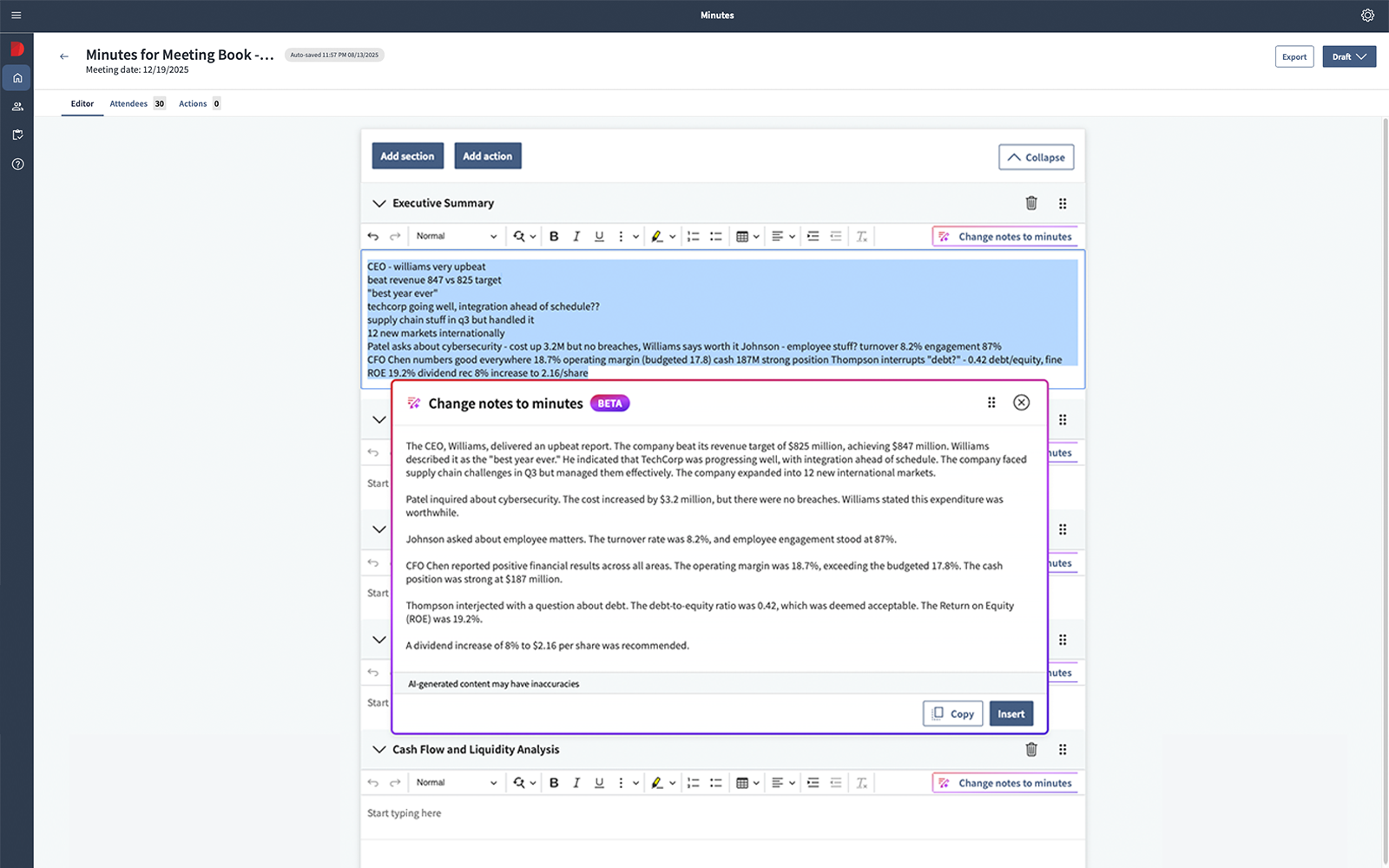
During the meeting, Diligent supports secure voting. After the meeting, Smart Minutes generates a first draft of governance-quality minutes from typed notes, board materials or transcripts, capturing decisions, action items and key discussions mapped back to agenda items. Action Tracker converts follow-ups into trackable deliverables with owners and deadlines.
Everything lives within the Diligent One Platform, which means minutes feed directly into the same environment where risk workflows already operate, including Smart Risk Scanner, which identifies compliance concerns in board materials before they reach directors.
For organizations already using Diligent for entity governance, risk management or compliance, board minutes become part of the broader oversight picture rather than a standalone document.
AI can transform how boards document meetings, but only when the tool is built for governance rather than retrofitted from a general productivity workflow. The right platform produces structured, defensible records inside the same environment where your board already operates.
See how Diligent embeds AI-assisted minutes into the full board meeting lifecycle. Schedule a demo.
AI-generated board meeting minutes are draft governance records produced by artificial intelligence from meeting inputs such as typed notes, transcripts or board materials. The AI structures these inputs into a formal minutes format, covering attendance, motions, votes, resolutions and action items, which a corporate secretary then reviews, edits and approves before the draft becomes an official record.
Board meeting minutes are structured legal documents that record specific governance elements: quorum confirmation, motions raised, vote outcomes with attribution, resolutions passed or tabled, recusals and action items with owners. AI meeting summaries produced by generic tools compress conversations into narrative prose, which may capture discussion themes but typically omit the formal governance elements courts and regulators expect. That distinction determines whether the record is legally defensible.
At minimum: structured governance formatting, motion and vote capture with attribution, human oversight checkpoints, audit-ready export with version control, enterprise-grade encryption, clear prohibitions on using board data to train AI models and integration with existing board management platforms. Tools that lack these features may work for general meetings but create risk when applied to board governance.
AI-generated minutes may be more defensible when they are treated as drafts subject to corporate secretary review, edited for accuracy and approved through the same governance process applied to manually drafted minutes. The risk arises when AI output is accepted without review or when AI tools generate verbatim transcripts that expand the volume of discoverable material beyond what curated minutes would produce. Governance teams should establish clear policies on AI use in documentation before deployment.
Some AI minutes tools are embedded within board management platforms, which means the draft, review and approval process happens in the same environment as the meeting itself. Others operate as standalone tools that require manual import and export. For governance teams, embedded tools reduce version control risks and eliminate the parallel workflows that create duplicate data storage and reconciliation problems.
An AI note-taker transcribes and summarizes conversations for any type of meeting. AI board minutes software is purpose-built for governance: it produces structured records with attendance, motions, vote attribution, resolutions and action items in formats that satisfy legal and regulatory requirements. The key differences are governance-specific formatting, human review workflows, data security controls and board portal integration. General note-takers lack these features, which makes them unsuitable as an automatic meeting minutes generator for board-level documentation.
Free AI meeting tools can handle basic transcription and summaries, but they typically lack the governance features boards require: vote attribution, structured minute formatting, enterprise-grade security and audit trails. Most free tools also store data on shared infrastructure and may use meeting content to train AI models, which creates unacceptable risk for discussions involving material nonpublic information or privileged legal advice. For team-level meetings, free meeting minutes software may be sufficient, but boards should invest in purpose-built tools.
They can. AI tools that produce verbatim transcripts or store raw recordings create a larger volume of discoverable material than curated, governance-quality minutes. If a transcript captures informal director commentary, preliminary legal analysis or candid strategic discussion, that content may become subject to discovery in litigation. Governance teams should select tools that generate structured drafts rather than full transcripts and establish policies requiring corporate secretary review and approval before any AI-generated document becomes part of the official record.
Ready to improve board meeting documentation? Explore practical guidance and related resources at Diligent resources. Schedule a demo to see how Smart Minutes fits into the full board meeting lifecycle.




