
In this article

For founders and CEOs at growing companies, an exit plan for startup success is about more than choosing between an acquisition, an IPO or a PE buyout. The gap between having an exit strategy and being ready to execute one is where millions in valuation go to die.
You've probably discussed timing with your board and your investors. But when the moment arrives, when a buyer sends a term sheet or the IPO window opens, the companies that capture top-dollar multiples aren't the ones with the best pitch decks. They're the ones with the operational infrastructure that lets a deal close fast, clean and at maximum value.
According to the Transaction Readiness Report by Diligent Institute in partnership with Wilson Sonsini, NetSuite, CFO Alliance and CFO Leadership Council, companies rate their confidence in transaction readiness at just 5.7 out of 10, and limited resources rank as the top challenge for 56% of organizations. For growing companies with lean teams, that confidence gap translates directly into valuation risk.
What separates founders who capture premium multiples is an operational playbook that turns exit readiness from a someday aspiration into a continuous discipline, directly increasing what you walk away with.
This guide covers:
A startup exit plan is the strategic framework that defines how founders and investors will eventually realize a return on their equity, whether through acquisition, IPO, management buyout or another liquidity event. But defining the route is the easy part.
Directors are adjusting to that reality across the board. In What Directors Think 2026, 84% say they have strengthened their approach to scenario planning, expanding both the scope and depth of the risks they prepare for. Exit readiness follows the same logic: it’s not a one‑time decision, but infrastructure built to withstand uncertainty.
The harder, higher-value work is building the operational readiness that makes any route executable at maximum value. That means clean governance records, organized financial documentation, audit-ready entity structures and board materials that tell a compelling growth story.
Investors and PE firms increasingly expect this infrastructure from the companies they back as a foundational signal of management quality. As the National Association of Corporate Directors (NACD) puts it: "Companies with strong board practices often command higher valuation multiples and better deal certainty." Exit readiness isn't just a slide in your pitch deck. It's the infrastructure behind every slide.
"Companies can do a lot of things day-to-day to improve readiness for a potential transaction, many of which would probably make life easier running the company absent a deal," says Rich Mullen, Partner at Wilson Sonsini.
Before diving into the operational playbook, here's a concise overview of the exit routes available to growing companies. Each has distinct governance implications, but the operational readiness that drives maximum value is consistent across all of them.
Acquisition by a strategic buyer: A larger company acquires your company to gain technology, talent, market share or customer base. Strategic buyers focus heavily on integration compatibility and IP ownership, so your governance documentation must clearly demonstrate both.
Initial public offering (IPO): Taking your company public through a stock exchange listing. IPOs carry the most stringent governance requirements: majority-independent boards, formal committee structures, SOX compliance and multiple years of audited financials. The preparation timeline is the longest among all exit paths.
Private equity buyout: A PE firm acquires a controlling stake, typically with the goal of improving operations and a subsequent exit at a higher valuation. PE buyers scrutinize operational maturity, management quality, and value-creation levers, and they use your governance documentation as a proxy for all three.
Management buyout (MBO): The existing management team acquires the company, often with financing support. MBOs require clear cap table documentation and board authorization records to execute cleanly.
Secondary sale: Existing shareholders sell their stakes to new investors without the company changing hands. Secondary sales require precise ownership records and clean transfer documentation.
Acqui-hire: A company acquires yours primarily for the team rather than the product or revenue. While valuations tend to be lower, employment documentation and IP assignment records must be airtight.
Liquidation: The company winds down operations and distributes remaining assets to stakeholders. Even in liquidation scenarios, clean governance records determine how efficiently assets are distributed and disputes are avoided.
Most exit planning advice stops at growing revenue and reducing churn. That matters, but the operational levers below are what separate companies commanding premium multiples from those leaving money on the table, and none of them require a single new customer.
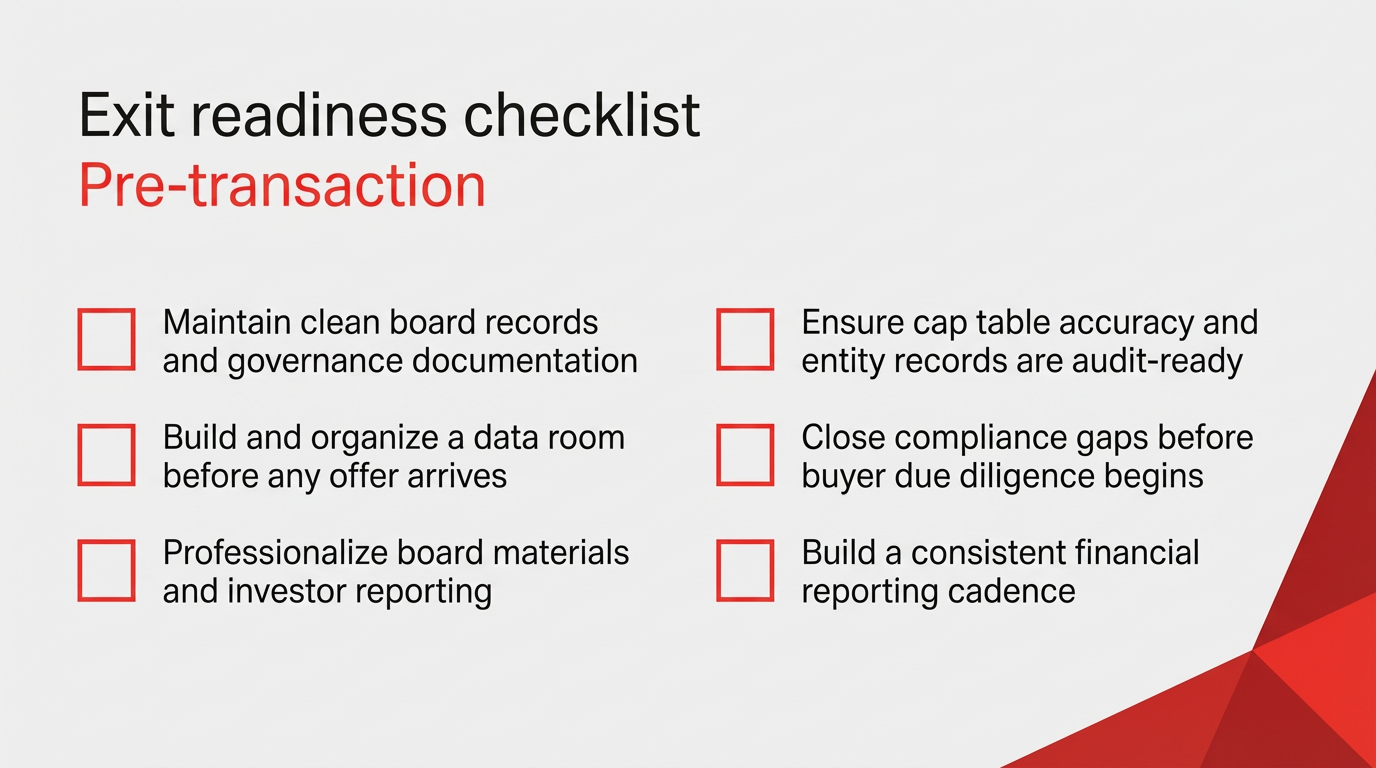
Buyers review 18–24 months of board meeting minutes, resolutions and committee records during due diligence. Missing minutes or unsigned consents raise immediate questions about whether management had proper authority for material decisions like option grants, executive compensation changes and strategic pivots.
Document all board decisions through formal meeting minutes that demonstrate proper governance procedures for future investor due diligence. Start treating every board meeting as one that a buyer will eventually review, because they will.
The companies that command the best outcomes maintain a current, organized data room as standard operating procedure. The companies that scramble to assemble one when an offer arrives signal exactly the kind of operational immaturity that triggers buyer discounts.
A PitchBook analysis of EY's Private Equity Exit Readiness Study found that 72% of PE respondents identified access to robust data and KPIs as their biggest exit challenge from a finance perspective. Build your data room now, organized across corporate documents, financials, legal agreements, IP, HR and commercial operations, and update it monthly.
PE partners and institutional investors evaluate governance sophistication as a proxy for management quality. If your board materials are inconsistent slide decks cobbled together the night before each meeting, buyers notice. Professional, consistent board books with clear financial summaries, operational metrics and strategic updates signal a company that operates with discipline, not one that's performing governance theater for the transaction.
"One of the clearest gaps I notice is between governance and finance systems... Organizations that close this gap gain speed, credibility, and control in transactions," says Jack McCullough, Founder and President of the CFO Leadership Council.
Cap table errors like phantom equity disputes, unclear convertible note treatment and option pool miscalculations create ownership uncertainty that PE buyers in particular will not tolerate. Any ambiguity about who owns what gets priced into the valuation as risk or used as justification to walk away entirely. Review your cap table quarterly and reconcile it against all outstanding agreements.
Employment misclassification, IP assignment gaps and regulatory lapses are hidden liabilities that compound over years and surface at the worst possible moment. Akerman LLP's M&A practice identifies employment misclassification as one of the top issues that can materially reduce valuation or kill deals if uncovered late. Conduct your own compliance audit so you find and fix these gaps before a buyer's diligence team does.
Buyers don't just want to see the numbers. They want to see that you've been consistently tracking, reporting, and making decisions based on those numbers. A regular cadence of board-ready financial reports with clear KPIs demonstrates the operational maturity that justifies premium multiples and reduces the perceived risk a buyer is taking on.
Diligent Institute's Transaction Readiness Report shows that only 4% of organizations have their GRC and finance systems fully integrated into a single platform, with private companies nearly three times more likely to have completely siloed systems than public companies. That fragmentation creates exactly the kind of reporting gaps that erode buyer confidence during due diligence.
Explore how growth-stage companies prepare for funding rounds and exits.

The most common and most expensive mistake founders make is treating exit preparation as a 90-day sprint. It's an 18-month minimum. Buyers review your governance history during diligence, and improvements made in the final six months before a transaction are visible but provide insufficient evidence of sustained operational maturity.
This is when the structural work happens. Recruit independent directors if your board is currently all founders and investors. Establish a formal board meeting cadence, quarterly at minimum, with documented minutes and resolutions for every session. Review and clean up your corporate charter, bylaws and entity structure.
Eliminate dormant subsidiaries and restructure related-party transactions that won't survive buyer scrutiny. Review IP assignments and employment classifications. These processes take months to complete properly and cannot be compressed.
Commission a quality of earnings study to identify and normalize one-time items before a buyer's team does it for you. Build or update your data room with comprehensive document categorization across all major categories.
Finalize your advisor team: accountant, attorney, investment banker and tax advisor. Standardize your revenue recognition practices and ensure they align with GAAP requirements. For IPO candidates, PwC's Tech IPO Readiness Guide reports that 83% of successful IPO companies had scalable ERP and financial reporting systems in place at least a year before going public. Deploy the financial infrastructure now, not later.
"The most effective finance leaders are turning the discipline of transaction readiness into a year-round capability," says Nick Araco, CEO of CFO Alliance.
Develop your management presentation with a compelling equity story reconciled to your financial statements and forecasts. Ensure your data room is detailed and self-service so buyers can work efficiently without constant hand-holding.
Address any remaining tax and legal issues proactively. Align stakeholders, including board members, key executives and major shareholders, on transaction terms and timing. And critically, maintain management focus on running the business. Nothing kills a deal faster than performance deteriorating during the sale process because the team was distracted.
Even well-run companies leave money on the table or lose deals entirely by making avoidable mistakes during the exit process. A solid exit plan for startup founders addresses these before a deal is live, not after. Here are the most common ones to watch for.
By the time a term sheet arrives, you need 18–24 months of clean documentation already in place. Buyers aren't just reviewing your current state. They're evaluating your governance history. Rebuilding that history under deal pressure is expensive, time-consuming and often incomplete.
PE buyers conduct intensive due diligence over 60–90 days. Strategic acquirers may take several months to over a year, depending on deal complexity. IPO preparation spans 12–18 months of regulatory work. If your documentation isn't ready before diligence begins, every week of delay erodes buyer confidence and your negotiating leverage.
Missing board minutes don't just look sloppy. They raise questions about whether material decisions received proper board authorization. Option grants approved without documented board consent, executive compensation changes without recorded votes and strategic pivots without formal resolutions can create legal liability or give buyers leverage to renegotiate.
A compelling revenue forecast matters, but buyers discount projections from companies that can't demonstrate the operational infrastructure to deliver on them. Clean governance records, a professional reporting cadence, and audit-ready financials give your projections credibility.
PE buyers focus on operational due diligence, value-creation levers, and management quality. Your cap table must be precise, and your operational metrics must be defensible. Strategic buyers prioritize IP due diligence, integration readiness and cultural fit. IPO underwriters require majority-independent boards, formal committee structures and SOX compliance. Building toward the most rigorous standard, IPO governance, positions you to pursue any path.
The preparation challenges outlined above, from manual board materials and disorganized documentation to compliance gaps discovered too late and financial reporting that doesn't scale, are exactly what Diligent's platform addresses for growing companies.
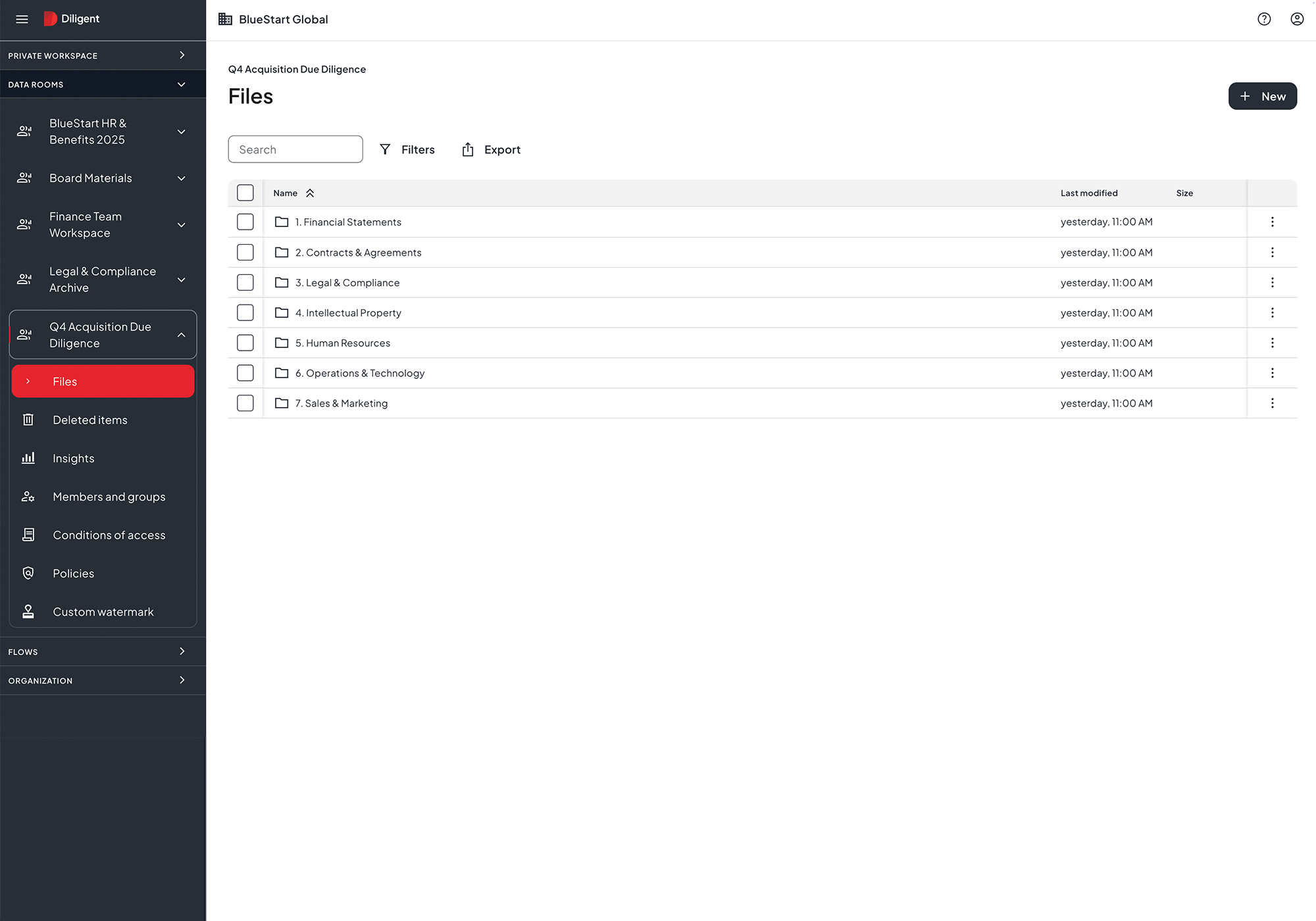
Together, these tools address a persistent gap: maintaining transaction-ready governance as a continuous operating discipline rather than a last-minute project.
The companies that command the highest exit multiples don't treat governance readiness as a box to check when a deal materializes. They build it into their daily operations. Clean board records, organized data rooms, proactive compliance monitoring and professional financial reporting aren't just exit preparation. They're the habits that help growing companies make better decisions, raise money faster and operate with the discipline that investors and buyers reward.
Start building exit readiness now, not because you're planning to sell tomorrow, but because the infrastructure that maximizes your eventual payoff also makes your company run better today. See how Diligent helps growing companies turn exit readiness into a daily operating advantage. Schedule a demo to get started.
An exit plan for startup founders is a strategic framework that defines how you and your investors will realize a return on equity through an acquisition, IPO, PE buyout or other liquidity event. Beyond choosing a route, it includes the operational readiness, governance documentation and financial infrastructure needed to execute any transaction at maximum value. Without this foundation, growing companies risk leaving significant valuation on the table when opportunities emerge.
The minimum viable preparation timeline is 18 months; 24 months is ideal. Buyers review 18–24 months of governance history during due diligence, so improvements made in the final six months before a transaction appear rushed and don't establish sustained operational maturity. If your exit horizon is shorter, prioritize the highest-impact gaps: cap table accuracy, board documentation completeness and compliance review.
A comprehensive data room should cover corporate documents, financial information, legal agreements, intellectual property, human resources, commercial operations, technology, IT systems and ESG documentation. Organize with a clear folder hierarchy that places summaries before source documents. Update financials and operational metrics monthly, conduct a full document review quarterly and add materials immediately when material events occur, like financing rounds, key hires or major contracts.
PE buyers focus on operational due diligence, management quality, value-creation levers and precise cap table documentation. Strategic acquirers prioritize IP ownership, integration compatibility, cultural fit and the identification of synergies. IPO underwriters impose the most stringent requirements: majority-independent boards, three mandatory committees and multiple years of PCAOB-audited financials. When uncertain about your exit path, build toward IPO governance standards since they're a superset of what other buyers require.
The most damaging mistakes include cap table inaccuracies that create ownership uncertainty, missing board minutes that raise questions about the authorization of decisions, undisclosed employment misclassification liabilities, IP assignment gaps and disorganized data rooms that signal operational immaturity. Each of these can trigger valuation reductions or deal termination when discovered during buyer due diligence.
Yes. The governance habits that maximize exit value, including clean documentation, professional board materials, accurate cap tables and proactive compliance, are the same practices that help companies raise funding faster, make better strategic decisions and operate more efficiently day to day. Building exit readiness as a continuous discipline creates compounding value regardless of whether or when you ultimately pursue a transaction.
Ready to build transaction-ready governance for your growing company? Schedule a demo to see how Diligent helps founders stay exit-ready.