
In this article

Board effectiveness has become more complex for enterprise organizations. A PwC and Conference Board survey of the C-suite found that while 35% of more than 500 executives rate their boards' effectiveness as excellent or good, 93% want at least one director replaced, the highest level the survey has recorded.
Only 32% believe their boards have the right mix of skills and expertise needed for today's governance challenges.
Systemic misalignment reduces board effectiveness. Today's enterprise boards manage AI governance, cybersecurity oversight, ESG reporting and traditional fiduciary duties simultaneously, while some directors are overstepping into management roles. This expansion creates role confusion where board oversight gets muddled with operational execution. That confusion reduces governance effectiveness.
Organizations that solve these challenges through systematic approaches see faster decision-making and stronger stakeholder confidence, which can improve competitive performance.
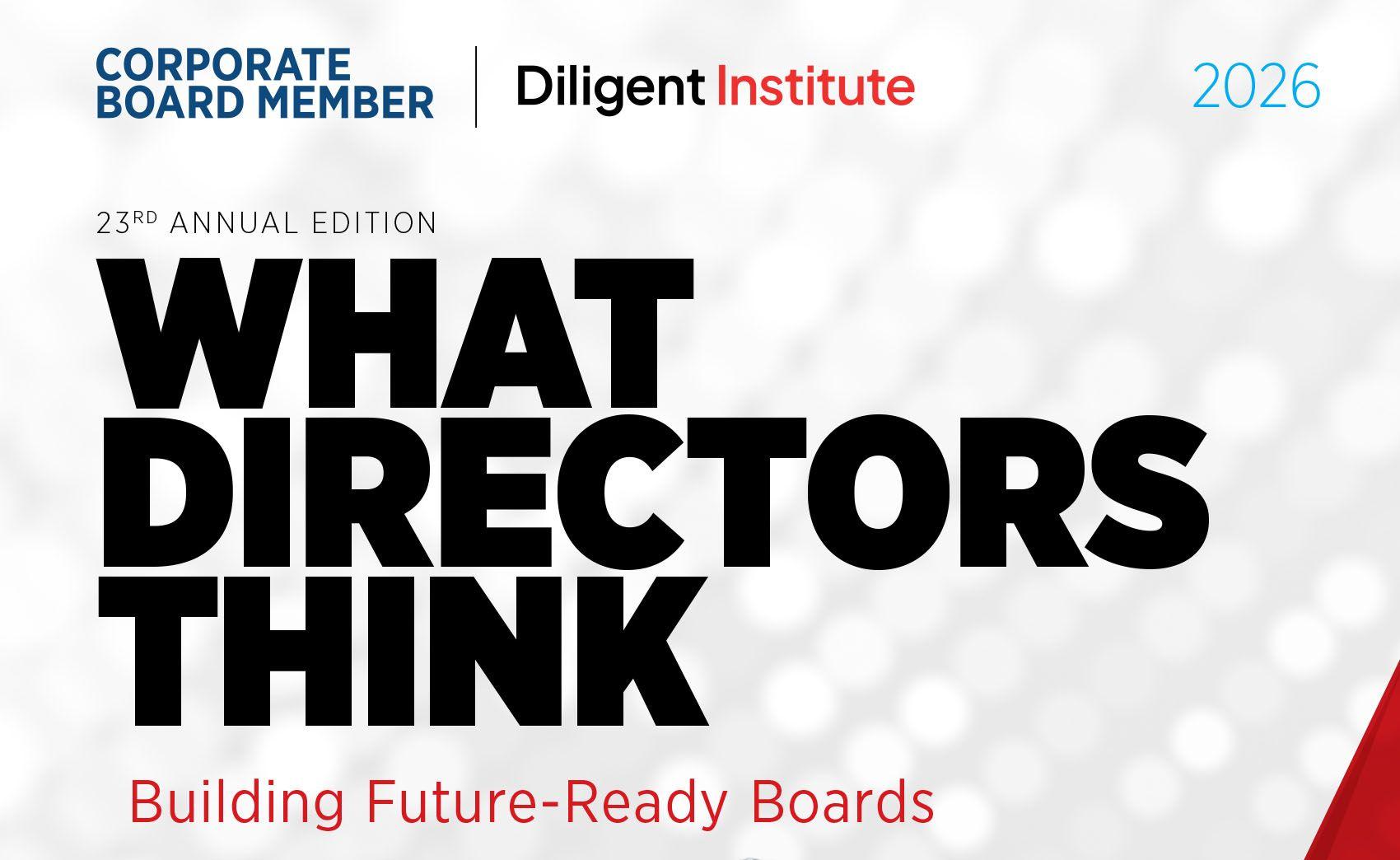
According to the What Directors Think 2026 report by Diligent Institute and Corporate Board Member, a survey of more than 200 U.S. public company directors, 58% want fewer presentations and more time for strategic planning.
Processes supported by technology can clarify director roles and help directors apply their expertise.
This guide covers what board effectiveness means for enterprise organizations:
Board effectiveness is a term used to describe how well a board of directors fulfills its day-to-day responsibilities across an organization. An effective board of directors provides direction and support to its organization, manages and mitigates risk and helps a business achieve its goals. Board effectiveness reflects both individual performance and how directors function together as one unit. It supports organizational success, stakeholder confidence and sustainable growth across the business.
An effective board can communicate and collaborate internally and externally to set the organization's direction and take action to get there. They:
When boards are effective, they lead by example and galvanize the entire organization to achieve its goals without compromising values like integrity and ethics.
Four key components provide a framework for measuring what makes a good board of directors across industries and sectors.
The effectiveness of a board relies on its members. While a board may comprise talented and experienced individuals, it could lack the knowledge to perform its responsibilities as a board member. An effective board of directors should educate its board members and have performance and knowledge standards to abide by.
Board evaluations should then be carried out to ensure board members meet these standards. A mix of people of different ages, races and genders brings different skills and experiences to the boardroom.
Boards can formalize this work through a board skills matrix: a competency map comparing current director expertise with future oversight needs. PwC's Governance Insights Center identifies AI, cybersecurity, capital allocation and operational resilience as emerging matrix areas. The practice has become standard disclosure: 80% of S&P 500 boards disclose a director skills matrix, according to the Spencer Stuart U.S. Board Index 2025. Governance committees can use it to identify gaps for succession planning.
Boards are most successful when they have real-time insights into their organization and market and regulatory conditions. This pillar addresses how information is collected and presented to the board, and the communication strategies the board uses to gain information from managers.
For enterprise organizations managing multiple business segments, effective information architecture means centralizing data from diverse operations, including regional divisions, product lines and subsidiaries, into consolidated views that support portfolio decisions. Directors need unified visibility into performance patterns, cross-segment risks and resource-allocation opportunities to improve enterprise value. A well-structured information architecture ensures the board receives the right insights, data and analysis to make informed decisions and eliminates the information silos that compromise oversight in complex organizations.
Directors must set and follow a clear governance model to ensure their actions are ethical, compliant and aligned with the organization's direction. This pillar also includes following the correct rules of procedure and ensuring that board activities align with ethical standards and any necessary legal requirements.
This pillar relates to the relationships, interactions and behaviors between board members. Effective board management cultivates a culture of open communication, trust and safety to challenge the status quo. The culture pillar encourages diverse perspectives and collaboration while minimizing conflicting or potential power imbalances.
Effective board culture depends on psychological safety: Directors need to be able to disagree with each other, and with management, without cost to their standing in the room.
Effective board management supports informed decision-making and improves how directors use their time. For enterprises, this means implementing governance systems that support complex oversight without drowning directors in administrative complexity.
Enterprise boards need sustained focus on organizational direction and decision-ready information. Directors spend time on decisions that affect strategy. Successful boards should dedicate a majority of meeting time to discussions about direction. Directors also receive relevant, actionable information that directly supports decision-making. This includes predictive insights and analysis of competition and risk, with historical data compilation kept to the necessary minimum.
For enterprises managing multiple business segments, information intelligence also means consolidating data across regional operations, product divisions and subsidiary companies into unified views that support portfolio-level decision-making and segment analysis.
Governance processes should minimize administrative overhead. Technology automation handles routine tasks and frees directors to focus on oversight and board guidance.
The survey points to where board information practices are heading.
"Looking ahead, high performing boards will treat governance as a continuous discipline, built on real time data flows rather than periodic reports. And they will increasingly rely on integrated digital platforms — and, over time, AI-driven analytics — to surface patterns, flag emerging risks and point directors to where their judgment is needed most, while keeping human decision-making firmly at the center," says Dottie Schindlinger, Executive Director, Diligent Institute.
Managing a board is a delicate balance of people and leadership skills. It cultivates various personalities and communication styles while highlighting the value of each director's unique skills.
Effective board management requires:
A rigorous board evaluation process reviews full-board and committee performance. It also assesses each individual director's contribution. These reviews should assess agenda quality, decision follow-through, mandate fulfillment, participation and whether director skills match current oversight needs. In the same survey, 74% of directors said their board uses self-assessments to evaluate director performance, while 38% use peer reviews and 30% bring in an external facilitator. Twelve percent do not conduct individual director evaluations. Whatever method a board chooses, it should produce documented actions on skills, composition, meeting practices or director development. Well-designed evaluation questions and board assessment software can support that work.
Use our board effectiveness checklist to identify gaps in composition, information, culture and evaluation practices.

Enterprise boards face distinct challenges that require focused responses instead of basic governance improvements. These challenges include:
Enterprise boards now oversee AI governance, cybersecurity oversight and ESG reporting while maintaining traditional fiduciary duties. This expansion creates gaps where directors lack sufficient background for effective oversight.
Boards need directors whose expertise matches management's needs and will actually be used. Concentrating a specialty in one director can work against that. "If you have an expert on the board in one area, they become the person to handle that and the rest of the board tunes out. So it's incumbent on boards and the nom/gov committee to think critically and look at their own boards like an activist does," says Jon Solorzano, Counsel — Environmental, Social & Governance at Vinson & Elkins.
Enterprise boards can lack this targeted expertise match. Traditional committees now handle responsibilities including AI oversight and ESG reporting, which require expertise many directors don't have. This skills gap shows why boards need diversity in both expertise and background.
Enterprise boards struggle with information systems that hinder decision-making about strategy. Without clear, relevant information, directors get pulled into operational details and lose time for board oversight.
Traditional document compilation consumes weeks of corporate secretary time while producing materials that don't support decision-making. Administrative preparation consumes management time that could support decision analysis, while directors receive information packages that obscure key issues.
Clear information helps boards access data and reports efficiently, so they can focus on high-level problem-solving and spend less time hunting for information.
Enterprise boards manage multiple demanding relationships simultaneously:
Each group has different timelines, formats and priorities. This creates practical coordination challenges. Who speaks to which stakeholders? When should boards communicate directly versus through management? How do you balance transparency with competitive confidentiality? Many boards struggle with these basic questions.
Enterprise organizations with multiple business segments face additional coordination complexity. Boards must synthesize stakeholder feedback across different divisions while maintaining consistent messaging about enterprise strategy.
Centralized governance platforms help boards manage this complexity by consolidating stakeholder communications, board responses and messaging about organizational direction across all business units into unified workflows that ensure consistency without sacrificing segment-specific nuance.
Role boundaries become blurred when stakeholder demands increase. Directors may feel compelled to engage directly with investors or respond to activist pressure and cross into management territory. Without clear protocols, boards risk inconsistent messaging or overstepping their oversight role.
A practical self-audit can start with these board effectiveness improvements.
See secure preparation, risk review and director decision-making in action through board collaboration.

These practices establish the governance model, responsibilities and controls an effective board needs. Technology can reduce the manual work required to apply them consistently across meetings, committees and business segments.
Artificial intelligence addresses inefficiencies that limit enterprise board effectiveness by automating routine tasks for preparation and risk review. It also supports director discussion. Board expectations and practices also differ. What Directors Think 2026 also found that 40% of directors do not use AI at all for strategic oversight, while another 33% use it only on an ad hoc or limited basis.
Non-use can leave boards dependent on manual review as the volume and complexity of information increase. Ad hoc use can also make it harder to establish controls, assign accountability or evaluate whether AI improves governance outcomes. Boards should begin with approved use cases, review standards and clear human decision rights.
Diligent Boards is AI-powered board management that supports meeting preparation, secures sensitive information and helps directors identify important issues faster. Its AI-powered board features support board book creation, risk review and director preparation.
Traditional board book preparation consumes corporate secretary time and can make last-minute changes difficult to manage. Smart Builder reduces manual compilation by synthesizing PDFs and spreadsheets into professional board books. It can also incorporate presentations. The corporate secretary starts from a draft, reviews the result and retains responsibility for the final board book.
Enterprise risk oversight spans regulatory compliance, cybersecurity threats, operational risks and emerging challenges such as AI governance. Smart Risk Scanner identifies risky language and legal red flags in board materials before publication. Legal and governance teams monitor compliance by flagging passages while there is still time to revise or remove them before materials reach directors.
SmartPrep 360 generates pointed discussion questions with source citations for meeting preparation. Questions are organized by subject so directors can focus on the themes, concerns and implications for organizational direction most relevant to the agenda. The feature supports preparation without replacing director judgment or accountability.
Assore Holdings reported up to 60% time saved in board meeting preparation after adopting Diligent Boards with its AI-powered features, including Smart Risk Scanner. Governance teams considering similar changes should benchmark current preparation time and compare results after implementation.
Board management becomes more critical as companies grow larger and face greater complexity. Talented directors still need secure information, effective preparation and processes that support their best work.
Diligent's Smart Builder supports preparation, and Smart Risk Scanner reviews materials. SmartPrep 360 supports board discussion so enterprise boards can devote more time to oversight of strategy. Human review and decision-making remain central. Start by identifying where manual effort most limits board performance.
A good board combines complementary skills, independence and diversity of thought while operating as one unit. Directors challenge management constructively, respect the boundary between oversight and execution and work within clear roles. Timely, decision-ready information and regular evaluations help the board adjust as needs change.
Measure effectiveness across the full board, its committees and individual directors. Review meeting quality, decision follow-through, information timeliness and the share of meeting time devoted to strategy. Each evaluation cycle should produce documented actions on director development, board composition, committee mandates or meeting practices and extend beyond scores alone.
Warning signs include groupthink, weak challenge of management, unclear roles, skills gaps, operational overreach, poor follow-through and evaluations that produce no action. A 2025 analysis by PwC governance specialists on the Harvard Law School Forum also identifies a poor CEO relationship and underperforming directors as red flags requiring candid evaluation and clearer responsibilities.
Board size and board composition should follow the organization's strategy, complexity and committee needs. The Council of Institutional Investors recommends five to 15 members absent compelling circumstances. A forward-looking skills matrix can then map current expertise to future oversight needs so vacancies address emerging demands.
Cross-segment collaboration requires standardized reporting, consistent risk assessment methods and unified information views. These practices let directors compare divisions and identify enterprise-wide patterns while retaining access to segment-level detail. Clear access controls should give directors the information relevant to their committee responsibilities while protecting sensitive business-unit data.
See how Diligent Boards can support more effective enterprise governance. Schedule a demo