
We invited Tracey Brady, Vice President, Business and Product Strategy, and April Skipp, Principal Product Compliance Advisor, at Diligent, to tell us what's changing in M&A, risk and compliance and what leaders need to know.
Could you pass the 48-hour test? This interview is part of the 2027 resilience guide: Six regulatory shifts redefining governance, risk, audit and compliance, alongside a practical readiness checklist for spotting hidden AI concentration risk and testing supplier exit-ability before you need it. Download your copy of the 2027 resilience guide here.
Brady: Geopolitics has become a core deal variable rather than something confined to the risk section of a diligence report. Today, it sits alongside price, tax and financing as a factor that can directly influence deal value and outcomes. Exposure to China, the US or another sanctioned market is only the starting point. What matters now is how shifts in policy could affect revenues, licenses, supply chains, data flows and customer relationships across key operating corridors, particularly for companies with significant ties to Asia and the Middle East.
Skipp: A less obvious but increasingly important trend is ownership transparency. Knowing the legal shareholder is only the starting point. Deals increasingly depend on a clear, defensible understanding of ownership, control and influence throughout the entire ownership chain, particularly where state-linked entities, sovereign investors or politically exposed interests are involved, or where the assets include sensitive technology, critical data or regulated customer bases.
Skipp: I think legal entity compliance is going to be one of the defining challenges of the year ahead. In the UK, companies are continuing to navigate ECCTA implementation, while Australia is introducing mandatory director ID requirements for ASIC filings and evolving its approach to company information access. But the bigger issue is the growing complexity of operating across multiple jurisdictions. Each regime comes with its own ownership definitions, materiality thresholds, disclosure obligations and timelines. As a result, organizations need more than a filing strategy. They need a joined-up compliance approach built on a single, defensible ownership narrative, supported by accurate entity data, a clear corporate structure and consistent regulator-facing disclosures. Increasingly, they also need to build time for regulatory questions and due diligence scrutiny into their planning, rather than focusing solely on filing deadlines.
Brady: April is right. There is a huge wave of regulation coming into force, but I'd add that the bigger challenge is getting the fundamentals right. The organizations that manage this best are the ones that build these capabilities into their day-to-day operations rather than scrambling to assemble them when a transaction is already underway.
Cybersecurity, data governance and AI governance now sit alongside ownership and financials as transactional fundamentals. Buyers and investors increasingly expect to see evidence of robust controls, clear data mapping, effective access management, incident response plans, vendor oversight, retention policies and, importantly, a credible governance model for AI. Weaknesses in any of these areas can quickly become valuation issues. They can delay a transaction, increase post-close integration costs or expose risks that weren't fully understood at the outset.
For data-rich businesses, they can also affect the investment case itself. These shouldn't be considered deal-readiness activities. They should already be part of how the business operates. Yet gaps still exist more often than they should. Organizations that identify and address those gaps early put themselves in a much stronger position when scrutiny inevitably arrives.
Brady: My advice is to start preparing before a deal exists. Transaction readiness shouldn't be a project that begins when the process launches. It should be part of the way the organization operates every day. The best teams constantly ask themselves: if diligence started tomorrow, are we ready? Can we prove ownership? Are our subsidiary books in order? Are our delegations of authority current? Are governance records complete and accessible? When those foundations are already in place, diligence becomes faster, smoother and far less disruptive. When they're not, that's when organizations find themselves scrambling to answer questions they should have been prepared for all along.
Skipp: The shift I would make is from thinking about a data room to thinking about an evidence room. An evidence room goes beyond storing documents: every assertion about the business needs to be linked to supporting evidence. A well-prepared data room should demonstrate corporate history, ownership, authority, beneficial control, compliance controls and operational reality, with every assertion linked back to supporting evidence. For company secretaries, that means reconciling entity structures with statutory registers, filings, constitutional documents, historical minutes, appointments and powers of attorney. In cross-border deals especially, that level of discipline often becomes the foundation for trust and certainty throughout the transaction.
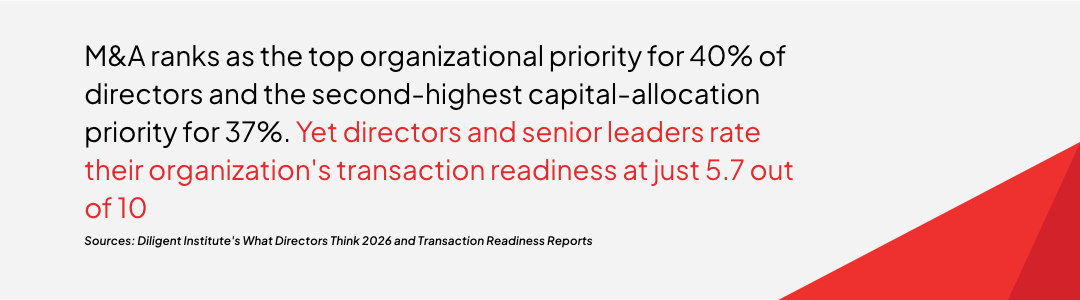
Sources: What Directors Think 2026 and the Transaction Readiness Report
Skipp: AI is changing due diligence in two distinct ways. First, it's transforming how diligence itself is conducted, helping teams analyze information more efficiently and identify issues that might otherwise take much longer to uncover. But the more significant shift is that AI has become a diligence topic in its own right. Buyers are now asking two AI questions: how they can use AI to support the diligence process, and whether the target organization has appropriate governance around its own use of AI. That means understanding which AI tools are being used, what data is being fed into them, and what controls exist around confidentiality, intellectual property, bias, model outputs and regulatory compliance. Increasingly, AI governance sits at the intersection of product, employment, data, intellectual property and regulatory diligence. AI governance has moved from a niche technology question to a cross-functional diligence issue that can influence risk, valuation and post-transaction integration.
Brady: The most important thing to understand is that AI changes the workflow, but it doesn't change accountability. The responsibility for the outcome doesn't disappear simply because part of the process has been automated. Legal and deal teams remain accountable for the decisions they make and the conclusions they reach. AI can support that work, but it doesn't replace human responsibility or judgment.
In practical terms, AI can significantly accelerate due diligence. It can classify documents, identify gaps in records, compare contracts, extract change-of-control provisions and flag inconsistencies across large volumes of information. Tasks that might previously have required teams of people working for weeks can often be completed far more efficiently. But efficiency shouldn't be confused with judgment. An AI model may identify an unusual clause or highlight a potential issue, but it cannot determine its significance in the context of a particular transaction. That's still the role of experienced legal and deal professionals. That's why governance matters. Organizations need clear controls around how AI is used, how outputs are reviewed and how decisions are made. AI lets diligence professionals spend less time finding information and more time applying the expertise and judgment that only people can provide.
Brady: My advice is simple: be curious, stay connected and be willing to try new things. Across almost every conversation I have with clients, the recurring challenge is how to leverage technology and new ways of working to stay ahead of an increasingly complex regulatory environment. The organizations making the most progress are the ones that stay open to learning, actively engage with their peers and aren't afraid to experiment, regardless of budget or technology.
They attend industry events, share experiences, exchange ideas and look for practical lessons they can apply in their own organizations. Just as importantly, they don't tackle these challenges in silos. The most successful organizations bring together legal, governance, compliance, technology and operational teams, drawing on expertise from across the business to solve problems collectively. The pace of change means no one has all the answers. That's why continuous learning and collaboration matter so much. Be willing to test new approaches, learn from what works and adapt when things don't go quite as planned. The organizations that embrace that mindset will be far better positioned for whatever comes next.
Brady and Skipp's advice is part of the 2027 resilience guide: Six regulatory shifts redefining governance, risk, audit and compliance. Download it for the full transaction readiness checklist, plus five more deep-dive regulatory, risk and resilience conversations for 2027.
Download the full guide and checklist →
"Cybersecurity, data governance and AI governance now sit alongside ownership and financials as transactional fundamentals." — Tracey Brady, Vice President, Business and Product Strategy, Diligent
Inside the GC Risk Index: Managing AI, cyber and regulatory risk

In this episode of the Corporate Director Podcast, Sachin Kohli and Demian Ahn of Wilson Sonsini examine the risk environment facing organizations and the implications for boards, general counsel, chief legal officers, and executive teams. The latest GC Risk Index found that respondents rated their organizations’ current risk level at 6.6 out of 10, with approximately 60% falling into the high-risk range. The discussion explores why risk is expected to remain elevated through 2027, even as the primary drivers continue to change.