
In this article

It's Monday morning and the week is already moving faster than the work.
A risk assessment is still waiting on inputs. The audit team is chasing evidence due last Monday. Control exceptions still need review, and Thursday's board update still needs its findings turned into action.
This is the work that fills the week: following up, testing controls, reviewing deviations, preparing reports. Too much time coordinating, not enough time acting on what it reveals. There's a better version of that week. The work stays the same; the way you do it can change.
Risk and audit professionals face growing audit universes, multiplying regulations, and boards expecting faster, more strategic insight without a bigger team to deliver it. The traditional response — squeezing the same team through a larger workload — has a ceiling most teams have already hit.
Diligent's agentic AI capabilities for risk and audit is the answer: one interface where risk and audit teams hand off structured work without handing over control. The judgment calls, reviews and sign-offs still belong to your team; the setup, chasing and documentation don't have to.
Diligent's agentic AI is built inside the Diligent One Platform, which means risk and audit teams already share one risk register and one control library. A control exception can update risk posture automatically, and a reassessed risk can shift audit priorities, instead of each team working from its own disconnected system.
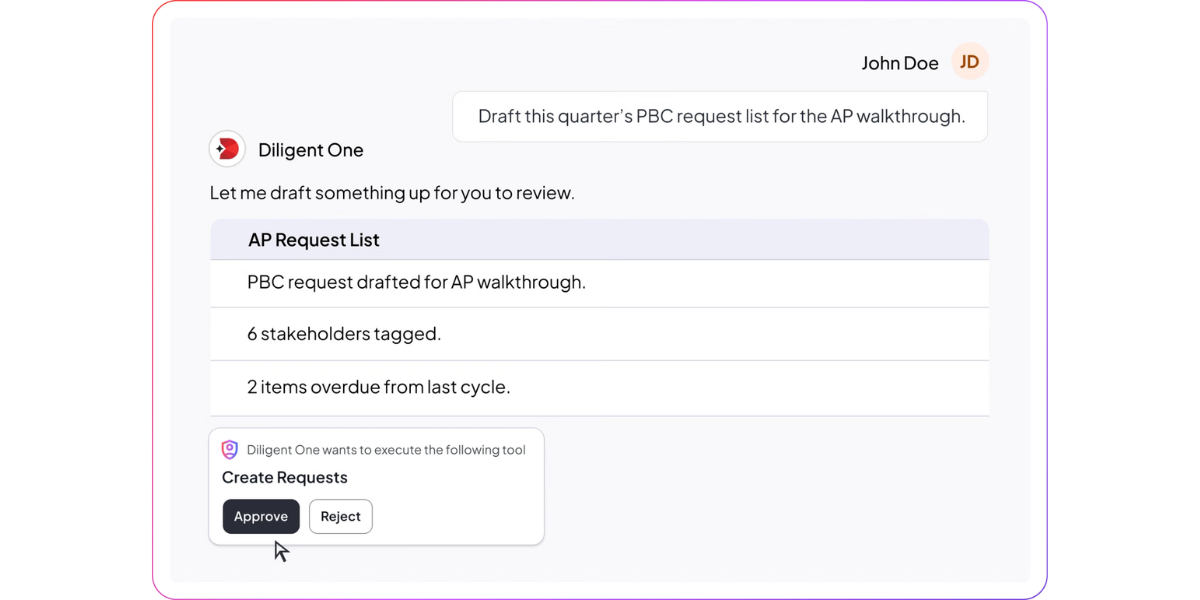
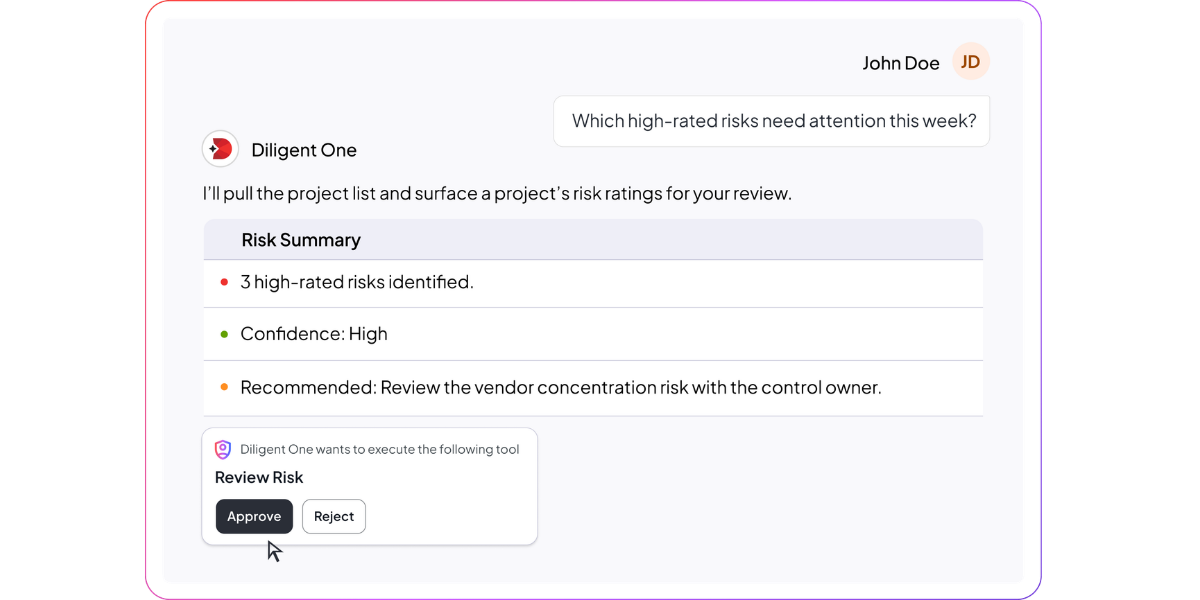
Now, with dedicated risk and audit agents also ready and at your disposal, you just describe what you need in plain language (e.g "Draft this quarter's PDC request list"), and the relevant specialist agent takes on the work, brings it back for review, and waits for your input before the agent executes any action.

You don't log into a separate AI tool or copy sensitive risk data into a chatbot with no audit trail. It runs inside the Diligent platform under Zero Data Retention contracts, with permission controls, connecting you to agents trained specifically to execute risk and audit workflows.
Risk Officers don't need another dashboard telling them the register is out of date. They need the work behind the register to move, so the picture leaders see is current enough to act on.
The real frustration isn't a lack of visibility. It's that keeping the register current and mapping controls to risks takes more manual effort than most teams can sustain. The risk picture changes. The register doesn't. By the time the board sees it, it's already stale.
Diligent’s risk agent handles that work: building and updating risk assessments as scope, ownership or the risk environment changes, and mapping controls to risks automatically.
When a regulation lands or a control owner changes, it flags what needs attention and proposes updates for review. The risk professional confirms every change, but deciding what a risk means stays human. What changes is how quickly teams move from administration to analysis, with more capacity left for the decisions that follow.
➜ Learn more about agentic AI use cases for risk professionals
➜ Schedule a free demo of risk agent
CAEs are asked to cover more ground with flat headcount and faster turnaround. The areas that most need scrutiny often don't get it, because the capacity isn't there — and much of the team's time still goes to setup and documentation rather than the strategic insight boards actually want.
Agentic AI in internal audit is where many teams are finding headroom. An audit manager describes an engagement in plain language within the chat interface, and audit agent creates a structured project with objectives, risk-control mapping and PBC requests ready to go.
Teams start from a foundation instead of a blank file, and prior-year work becomes this year's starting point rather than a closed folder.

Auditors can prompt it to chase missing evidence and check whether documentation is sufficient for testing; documentation gets validated and indexed, and workpaper drafts generate while testing is underway. It also supports execution — applying evidence to control testing, assessing effectiveness, and flagging exceptions — and can structure findings and propose remediation when issues arise.
The auditor makes every call. The audit agent removes the coordination overhead that used to sit between those calls, leaving more capacity for the judgment and advisory work boards actually want.
➜ Discover what else agentic AI can do for audit professionals
➜ Schedule a free demo of audit agent
Turning completed work into something the board can use is where momentum usually stalls.
Diligent's AI reporting capability help move both risk and audit teams from live risk and controls data to board-ready outputs, without ever having to rebuild the story from scratch: start from approved templates, draft your prompt in plain language, refine through chat, and produce outputs ready for sign-off.

Executive summaries, committee presentations, remediation tracking, all generated from completed engagement data. 'Board-ready' stops meaning 'last-minute'.
Every recommendation these agents make is reviewable.
Every action traces back to an underlying data object, so the reasoning is visible and auditable. Consequential actions require explicit human approval before they execute. The risk agent won't modify your risk appetite, and the audit agent won't publish a report without sign-off.
That's not a limitation. It's how governance should work. Diligent's approach runs across four tiers, from passive monitoring to permanently prohibited actions, with a human review checkpoint at every point in between.
In regulated environments, traceability and accountability aren't optional — that checkpoint is what makes the difference.

The risk agent, audit agent and AI board reporting are the first specialist agents in Diligent's agentic capability suite. And more are coming.
The number of agents doesn't matter though; what they give back does. Less time updating registers, chasing evidence and rebuilding reports, and more time understanding risk, challenging assumptions and helping leadership decide.
Risk and audit professionals are still responsible for judgment, oversight and accountability. What shrinks is the administrative burden between them and that work — more space for the expertise only they bring.
See it for yourself. See what a different working week looks like.
From AI talk to real impact: How today’s leaders do more without adding headcount
Unlock the potential of AI in governance, risk, and compliance with our comprehensive guide. Learn how to streamline workflows, enhance reporting efficiency, and build a robust AI action plan while maintaining control and accountability. Download now to elevate your organization's AI oversight and drive measurable impact.