
This article originally appeared in our November 5th edition of the Diligent Minute Newsletter. For more insights like these, delivered straight to your inbox, subscribe here: https://www.diligent.com/newsletter-signup
Corporate governance has always been a way of answering a deceptively simple question: How does a group of people — such as a country or company — decide to do things? The governance structures we rely on today — boards, committees, scheduled meetings, formal written reports and oversight — have served organizations for generations. But the conditions around them are changing much faster than the structures designed to manage them.
Artificial intelligence is the great accelerator of this tension. It's already influencing the way organizations do business, how they analyze information, serve customers, manage employees and make decisions. It's also entering boardrooms, sometimes through approved systems, but more often through consumer-facing AI tools over which the organization has no visibility or control. We also learned that while 82% of U.S. public-company directors said they use AI, only 6% have clear boardroom-specific policies for how it should be used in governance work.
The question is no longer whether AI belongs in governance. The question is whether board governance in its current form is capable of shaping what AI becomes.
That is the purpose of The Future of Corporate Governance in the AI Era, a project we're developing with the New York Stock Exchange. We are not setting out to produce a checklist for one technology or a forecast that will quickly become obsolete. We want to listen across markets, roles and perspectives to understand what is changing in the work of governing, what should endure, and what leaders will need in order to make sound decisions in the context of a world defined by AI.
Our first listening post in Munich made clear that this is not simply a technology conversation. It is a conversation about responsibility. When AI influences a decision, who owns the outcome? How should directors leverage AI tools in ways that promote — rather than erode — trust? How should organizations balance experimentation with data privacy, security and the ability to defend their choices? These are questions about power and judgment, not just software.
They also invite us to reconsider what effective oversight looks like. A board does not need to become a room full of technical specialists. It does need the confidence to ask better questions: What is being used, by whom, and with access to which data? Who is accountable for each use? How can having a "human in the loop" to defend decisions scale to match the pace of AI development? And what value is the organization seeking in return for the risks it accepts?
At its best, governance creates the conditions in which people can innovate responsibly: clear purpose, informed challenge, appropriate safeguards and accountability when things go wrong. It helps organizations move with confidence not because every uncertainty has disappeared, but because leaders know what they are deciding and who may be affected.
The AI era gives us an opportunity to revisit the purpose of corporate governance itself. In a world where decisions, capabilities and risks travel faster than a quarterly meeting cycle, the task is to protect the foundational governance principles that can still guide boards. Answers will not come from any one company or expert. They will emerge through open, serious conversation among the people entrusted with governing organizations and the communities those organizations serve. The listening posts are designed to make space for that exchange, compare what boards are experiencing, surface tensions that do not have easy answers, and learn across different governance traditions.
While the aim of the project is to produce a published blueprint report, the deeper ambition is a shared understanding of what responsible oversight means as AI changes institutions and the people within them.
Stay tuned to this newsletter for updates as the work progresses.
Munich was the beginning of that conversation.

Board AI use rises: Director Confidence Index June 2026

A new survey reveals a significant rise in generative AI adoption among U.S. public company directors, with 82% using the technology for board work in the past six months. However, most lack formal guidelines or oversight, raising concerns about legal and operational risks as AI's influence expands in corporate governance.
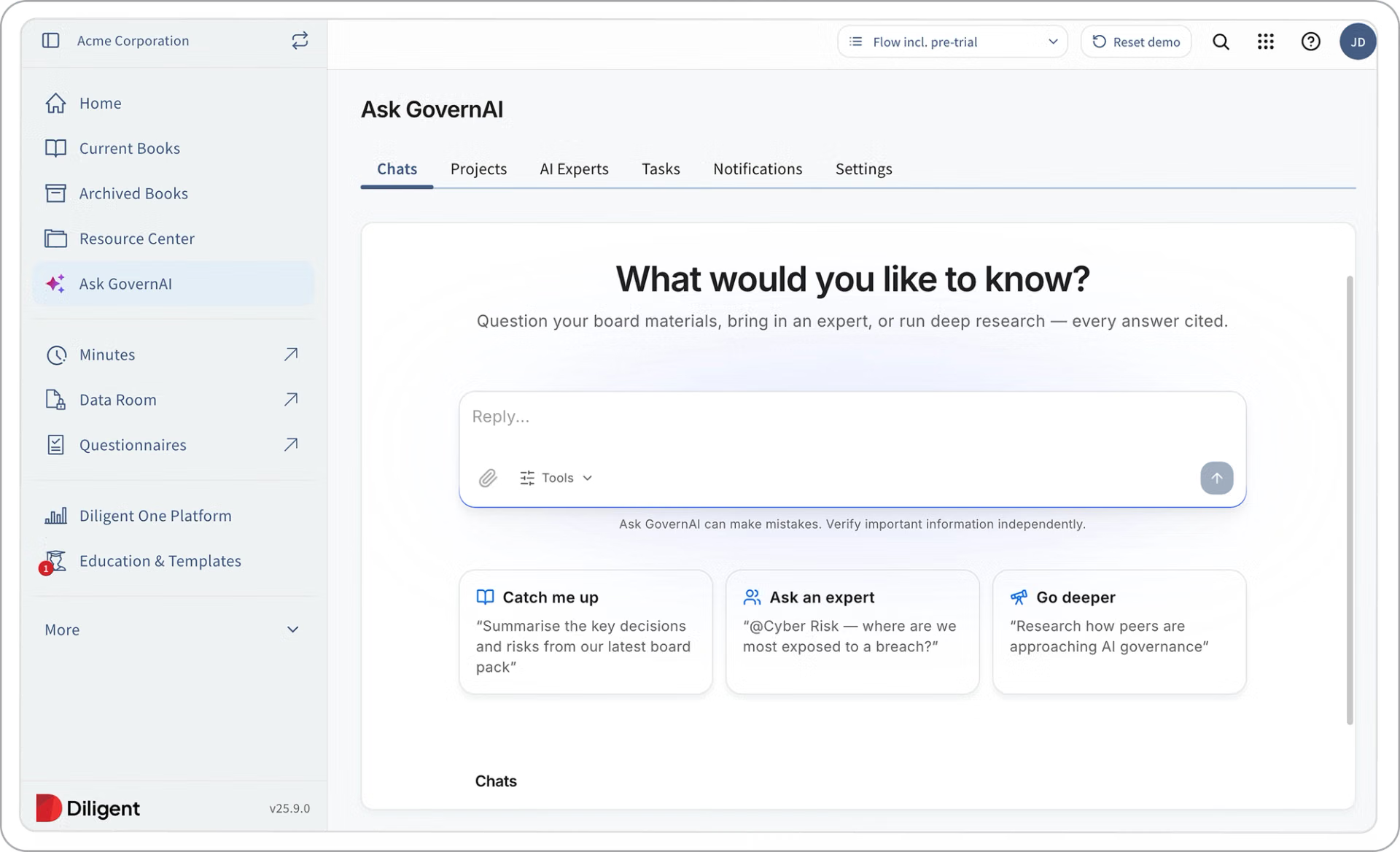
GovernAI: Secure AI for boards, directors and governance teams

Recent research shows directors are already turning to AI for board work, often without formal governance in place. This blog introduces the next generation of GovernAI, helping directors get secure, cited answers, expert perspective and boardroom context from their own materials, all within Diligent Boards.