
In this article

Every growth stage startup reaches a governance inflection point. Investor expectations outpace internal processes, and gaps that were invisible at Series A become friction in diligence, recruiting and enterprise sales conversations at Series B and beyond.
According to The Transaction Readiness Report by Diligent Institute and its research partners (2025), companies rate their confidence in transaction readiness at just 5.7 out of 10, and limited resources rank as the top transaction challenge for 56% of organizations.
Getting governance right early isn’t about adding overhead. It’s about building the infrastructure that keeps decisions moving, stakeholders informed and your company credible at every stage of growth.
Here’s what this playbook walks you through:
Growth stage startup governance refers to the formal structures, processes and documentation that growing companies ($10M–$150M in revenue) put in place to satisfy investor expectations, customer diligence requirements and regulatory obligations. It covers everything from board committees and meeting workflows to compliance infrastructure and stakeholder reporting.
For scaling companies, governance serves three business-critical functions. It demonstrates operational maturity to institutional investors during funding rounds. It unlocks enterprise contracts by meeting customer security and compliance requirements. And it protects founders from personal liability as the organization grows more complex.
The challenge isn’t that founders don’t care about governance. It’s that lean teams lack dedicated governance personnel, face competing priorities between growth and oversight, and struggle to identify which obligations actually apply to their business at this stage.
The shift from a founder-led advisory dynamic to a formal board with outside investors is the defining governance transition at this stage. Getting composition and decision rights right sets the foundation for everything that follows.
Aim for a board that balances founders, key investors and at least one independent director agreed by both sides. The goal isn’t more seats. It’s a functional group that can make hard calls, hold management accountable and still move at operating speed.
“The board fundamentally has to trust management. There are lots of ways the board trusts but verifies. Trust starts with communication. Communication is successful when it’s proactive, when it anticipates and addresses board members’ concerns, and speaks to their experience from other boards and their operational experience.”
— Inna Barmash, Chief Legal Officer & Corporate Secretary at Amplify
Choosing an independent director: Most private companies recruit operating executives, active or retired leaders, rather than career directors. Treat this hire like an executive role: define the gap you need filled (enterprise go-to-market, security, finance or regulated operations) and build an interview loop that tests for judgment, not résumé polish.
Committee formation: Establish compensation and nominating governance committee charters early. Add an audit-focused committee once your financial reporting, external auditor relationship or customer demands require more formal oversight.
According to What Directors Think 2026 by Diligent Institute and Corporate Board Member, 58% of directors want less presentations and more time for strategic planning, reinforcing why formal committee structures matter for keeping board time focused on decisions rather than catch-up.
Resolving seat-allocation tensions: Founders should recognize that investor influence often increases over time, but governance design gives you more tools than board math alone. Protective provisions, committee composition and clear supermajority decision categories can preserve founder influence without turning every decision into a power struggle.
With board structure formalized, the next priority is establishing the cadence and workflows that keep governance running smoothly between company milestones.
Meeting cadence: Hold formal board meetings on a predictable schedule and use lightweight written KPI updates between meetings to reduce surprise management. Reserve a dedicated strategy off-site for long-range planning, separate from operational review.
Agenda structure: Keep meetings focused on decisions and oversight, not slide-by-slide presentations. Structure your agenda around decisions required, key tradeoffs and time-boxed working sessions. Always include a closed session without management. As board meeting best practices evolve, the shift is toward using the board pack as the presentation and treating meeting time as scarce decision bandwidth.
“Tell the board what they need to know, not what you know.”
— David Platt, Chief Strategic Development Officer at Moody’s
Board-pack workflow: Use a consistent process: gather inputs early, reconcile metric definitions and narratives, obtain CEO and chair sign-off, then archive the final version in your board portal with clear version control. Distribute materials well in advance and set a firm cutoff policy for late changes.
In practice, many teams freeze KPI definitions and draft narratives by the end of the prior week, circulate a near-final pack early in the meeting week and enforce a clear cutoff for changes unless the CEO or chair approves an exception.
Explore how growth-stage companies prepare for funding rounds and exits.

Growth-stage companies typically face overlapping compliance demands from customers, regulators and investors. Treat this work as transaction readiness: build reusable proof points now so diligence is faster later.
If you have EU customers, GDPR requires clarity on a few basics: what personal data you collect, why you collect it, where it lives, who has access and how you respond if something goes wrong. The fastest path to compliance readiness is building a simple data map and documenting your incident response steps.
GDPR explicitly requires maintaining records of processing activities, which becomes the backbone for consistent customer answers and faster diligence.
For CCPA, companies crossing the applicable revenue threshold must implement consumer rights infrastructure. If you’re approaching that threshold or expect to cross it during your next growth push, assign a clear privacy owner now, stand up a simple intake-and-response workflow for consumer requests and make sure your data inventory can support timely responses.
Treat SOC 2 as a transaction readiness project that protects revenue, not just a compliance exercise. The full journey from initiation to a SOC 2 Type II report typically spans 6 to 12 months, since Type II requires demonstrating the operating effectiveness of controls over a sustained observation period of at least three months.
Work backward from enterprise sales requirements and your next major diligence event: pick a control framework owner, run a readiness assessment and start collecting evidence continuously so the audit doesn’t become a last-minute fire drill.
If a late-stage prospect asks for a Type II report before signature and you’re not there yet, a documented readiness plan with clear control owners and a current evidence log can keep the deal alive while you complete the formal reporting window.
Maintain a disciplined cadence for independent 409A valuations and refresh them after material events like financings or major business changes. Many companies also pause option grants around major transactions until the updated valuation is in place to reduce tax and compliance risk.
Investors and enterprise buyers respond well to a short, documented plan with owners, milestones and evidence artifacts. Even a lean program becomes credible when it’s consistent and easy to show. Follow this sequencing:
The Transaction Readiness Report found that only 4% of organizations have fully integrated GRC and financial systems, with 60% reporting systems that are either completely siloed or only partially integrated. That gap widens for private companies, which are nearly three times more likely to have completely siloed systems compared to public company counterparts. Make compliance reviews routine instead of annual, and tie check-ins to board reporting cycles so evidence collection stays consistent.
Governance only works when it connects to execution. The following operating patterns make that connection explicit.
Even if you don’t fully integrate systems this year, close the practical gap by defining “board-ready” KPIs once, linking each KPI to an owner and source system and maintaining a repeatable evidence trail (policies, controls, approvals and key contracts) that can be pulled into your virtual data room and board portal without rework.
The metrics you report and how you present them directly shape investor confidence. Make reporting easier to trust by making it easier to compare period over period.
Core metrics growth investors track: Most growth-stage board decks include a consistent set of metrics with definitions that don’t change each quarter:
Board-pack structure: Build a concise deck with an executive summary (cash position and decisions required), finance and KPI dashboard, a small number of operational deep dives, governance and risk updates and an appendix with full financial statements. Label each slide “for decision,” “for discussion,” or “for information” to keep the meeting focused.
According to What Directors Think 2026, 84% of directors have changed their approach to scenario planning, and 53% say they don’t often receive real-time data between meetings. Growth-stage companies that lock KPI definitions, use a repeatable template and maintain a running decisions log give their boards a transparency advantage that many larger organizations still struggle to achieve.
“Every conversation with the board is an opportunity to educate the board about your business. They’re not in your business every day, and they travel in other circles and often sit on other boards. The risks are generally different within the same industry, and certainly across industries. It’s about having that platform for discussion and educating each other.”
— Barmash
If an IPO is on your horizon, governance preparation takes longer than most founders expect. If it’s not, use this as a later-stage roadmap to revisit when you approach late-stage financing, start hiring public-company leaders or begin fielding public-market questions from investors.
The practical approach is to start earlier than feels necessary and build maturity in phases:
NYSE and NASDAQ require majority-independent boards, with all audit committee members meeting strict independence criteria. Additionally, both exchanges require at least three standing committees: audit, compensation and nominating/governance. Building these structures gradually, rather than scrambling in the months before filing, gives your team time to work through the operational realities of public-company governance.
The bottlenecks described throughout this playbook are common: time-intensive board-pack assembly, manual compliance tracking and inconsistent metric formatting across reporting cycles. These are exactly where AI-enabled workflows help growing teams do more with fewer resources.
Here’s how Diligent supports growth-stage governance and transaction readiness:
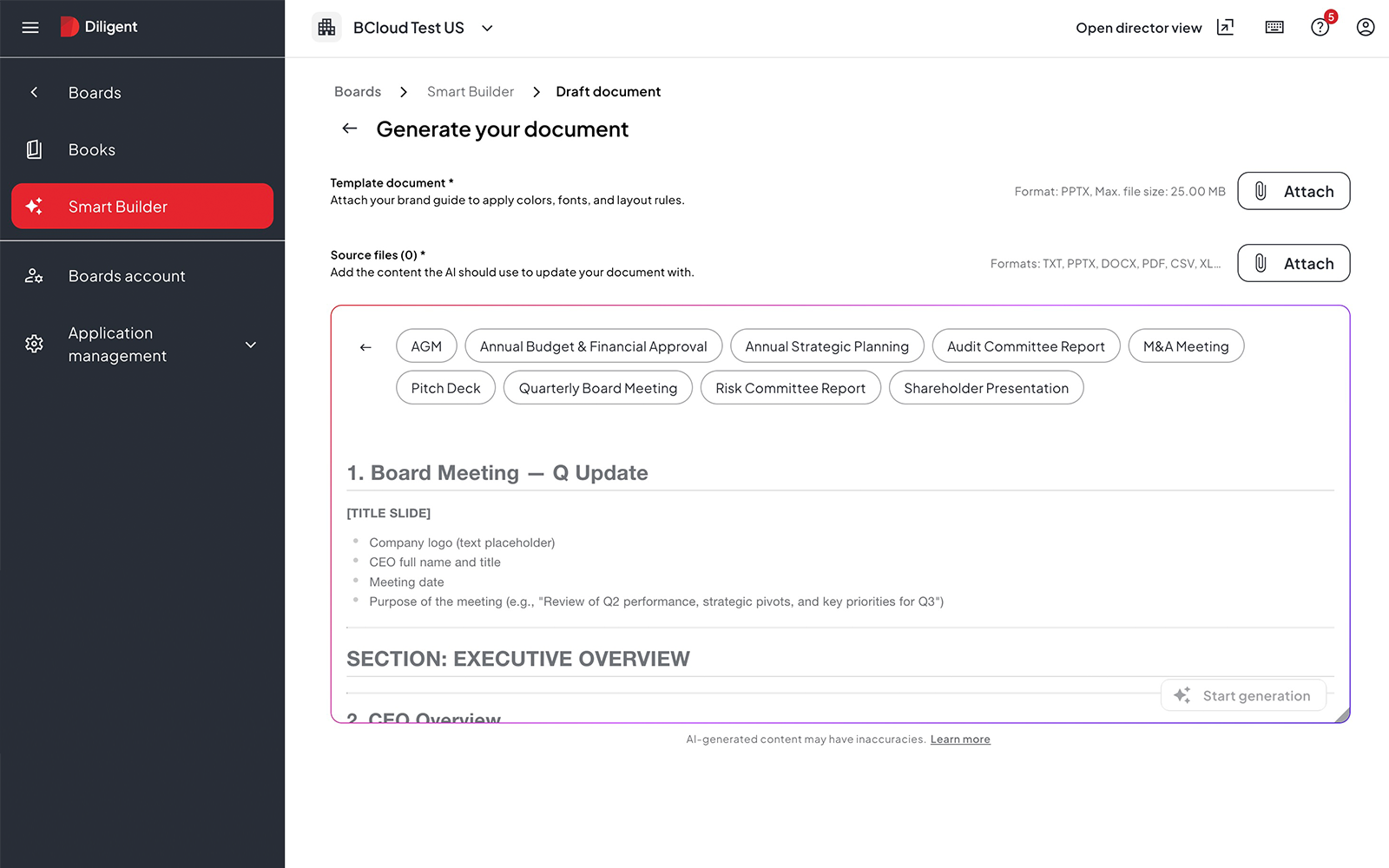
The goal is straightforward: Keep your board materials, risk signals and diligence artifacts continuously ready so important conversations stay focused on growth, not gaps in process.
Governance at the growth stage comes down to building once and reusing often. The structures, workflows and evidence artifacts in this playbook compound over time: each funding round, enterprise deal and board cycle gets faster because the foundation is already there.
See how Diligent helps growth-stage companies build governance that scales. Schedule a demo.
Most growth-stage companies hold formal board meetings quarterly, though companies in active fundraising or transaction cycles often meet monthly. Pair formal meetings with lightweight written KPI updates between sessions so directors stay informed without consuming excessive management bandwidth. The cadence should keep decisions moving and avoid “big bang” updates that overwhelm board members with months of accumulated information.
Form an audit-focused committee before external expectations force your hand. Typical triggers include increasing financial reporting complexity, bringing on an external auditor or enterprise customers requesting stronger oversight during vendor diligence. The committee should oversee financial reporting quality, auditor engagement and risk management compliance. Waiting until the IPO preparation phase to establish this committee creates compressed timelines and steeper learning curves.
The end-to-end SOC 2 Type II process typically takes 6 to 12 months, including preparation, a 3- to 12-month observation period and the formal audit itself. Startups with existing security practices and compliance automation tools can compress the preparation phase, but the observation period remains fixed. Work backward from your next enterprise sales deadline to set a realistic start date.
Growth investors typically expect ARR movements (new, expansion, renewal, churn), net revenue retention, burn multiple, gross margin, CAC payback period and LTV:CAC with cohort retention context. Present each with clear trend lines and variance explanations tied to the operating plan. Consistency matters more than volume: lock definitions once and keep them stable across reporting periods.
Governance design gives founders more tools than board seats alone. Protective provisions, committee composition requirements and supermajority decision categories for reserved matters (major financings, material M&A, key leadership changes) can preserve meaningful founder influence while satisfying institutional investors’ oversight expectations. The key is negotiating these structures during early funding rounds rather than after investor board governance expectations have already been set.
Build investor-ready governance for your growing company today. Schedule a demo to see how Diligent helps scaling organizations get governance right from the start.