
In this article

Invoice fraud detection has become one of the most critical capabilities for audit, risk and finance leaders running high-volume accounts payable environments. Fake invoices from fictitious vendors, duplicate payments hiding across multiple ERPs and overbilling that slips past manual reviews put constant pressure on chief audit executives, controllers and payment integrity leads. Invoice fraud detection is the use of analytics, process controls and AI to identify fake, altered or duplicate invoices before payment.
The scale of the risk is well established. The AFP survey found 79% of organizations were victims of attempted or actual payments fraud in 2024. Most organizations still rely on manual checks and sample-based reviews that catch only a fraction of suspicious activity, even as transaction volumes grow.
This guide is a practical resource for audit, risk and finance leaders moving past those limitations to full-population, analytics-driven detection and continuous monitoring.
This guide covers:
Invoice fraud is any scheme in which fake, altered or misdirected invoices cause unauthorized or duplicate payments. Core mechanisms include fake suppliers submitting fabricated invoices for goods never delivered, cloned invoices with altered totals or bank details, overbilling through inflated unit prices or quantities and resubmitted invoices designed to trigger duplicate payments.
Invoice fraud detection covers the processes and tools used to identify suspicious or fraudulent invoices before payment: process checks (three-way matching, approval workflows, vendor verification), analytics over full AP populations rather than samples and AI-driven anomaly detection with continuous monitoring. The focus is the invoice-to-payment lifecycle within AP and procure-to-pay (P2P), not broader payment fraud categories such as card or wire fraud.
Five common schemes account for most AP fraud and leakage. Each works differently, and each leaves a different detection signal.
Entirely fabricated invoices from fictitious vendors, or legitimate invoice templates with altered totals, bank details or line items. These schemes often rely on spoofed email domains, forged letterheads or shell companies with P.O. box addresses and legitimate-appearing tax IDs.
Business email compromise (BEC) attacks involve fraudsters impersonating known suppliers and requesting changes to remittance instructions. The scams work because the vendor name is real, the invoice format is familiar and the request arrives within a legitimate transaction window. AI tools are making fake invoices harder to spot visually as fabricated documentation becomes more convincing.
The same invoice submitted twice, identical or with minor variations such as a changed invoice number or date. Duplicates are one of the most common and financially measurable invoice fraud patterns because detection requires comparing every invoice against every other across the full payment history, a population-level comparison manual processes cannot perform.
Inflated unit prices or quantities, collusion between vendors and internal approvers and recurring round-number invoices that signal manual manipulation rather than legitimate billing. When the purchase order itself was created at the inflated price, three-way matching succeeds because the invoice matches the corrupted PO.
Invoices submitted without purchase orders, from unapproved vendors or for goods and services not received. Without a purchase order as an anchor, the three-way match control that protects PO-backed invoices does not exist. These schemes often exploit gaps in decentralized procurement processes.
Duplicate invoicing is one of the most common and financially measurable fraud and leakage patterns in AP. High transaction volumes drive duplicate payments because manual checks cannot catch them at scale, and IIA GTAG-13 identifies duplicate testing as a core analytical technique for fraud detection.
Detection requires matching across invoice number, amount, date, vendor and bank account on the full population, including fuzzy matching for near-duplicates that sample-based reviews cannot perform. UnitingCare deployed full-population analytics across 460+ locations and identified $1.1 million in duplicate payments invisible to site-level reviews. Test the full payment history rather than isolated business units or limited review windows.
Manual review fails for four interconnected reasons. Combined, they make manual-only AP fraud control impossible at scale.
AP teams cannot reliably review every invoice across multiple entities, agencies or business units. Manual review introduces fatigue, inconsistency and blind spots, especially in organizations processing thousands of invoices per week. High-volume environments require detection methods that do not depend on human attention to each transaction.
Multiple ERPs and inconsistent vendor master data leave fraud hiding in the gaps between systems, with duplicates in one business unit never compared against invoices in another. The Transaction Readiness Report by Diligent Institute and partners found only 4% of organizations have fully integrated GRC and financial systems, which helps explain why suspicious invoices slip across ERP boundaries.
Traditional audit and fraud testing reviews only a fraction of invoices. Sampling provides assurance about the sample, not about the invoices that were never tested. The ACFE Report to the Nations shows organizations using proactive data analytics experience fraud losses roughly 50% lower than those that do not, yet proactive analytics remains one of the least implemented anti-fraud controls.
Most invoice fraud is discovered after payment, often months later, and reactive investigation recovers only a fraction of losses. Organizations need proactive, analytics-driven surveillance that catches fraud before the pay run, not forensic reviews after the money is gone.
Learn how full-population testing helps audit and finance teams uncover fraud, duplicates and control gaps that sampling misses.

Detection sits in three reinforcing layers: process controls, data-driven analytics and AI plus automation.
Two- and three-way matching, approval thresholds, standardized vendor onboarding, segregation of duties and bank-detail change verification form the foundation. These preventive controls are necessary but insufficient on their own, especially when insiders override them.
Analytics profiles invoices and vendors, flags duplicates and anomalies and cross-checks invoice data against vendor master records, POs, goods receipts and payment history. Techniques such as Benford’s Law analysis, fuzzy duplicate matching, vendor clustering and threshold-avoidance detection deliver the detection layer process controls cannot.
AP automation tools handle invoice capture, coding and workflow routing. AI and analytics operate on the structured data those systems produce, providing fraud and anomaly detection, pattern recognition and continuous risk insight. AP automation processes invoices; analytics analyzes them for fraud. The two layers are complementary, not competing.
Diligent ACL Analytics is purpose-built for the analytics-led detection layer audit, risk and AP teams need on top of their AP and ERP systems.
"ACL has a 40-year history as the premier audit analytics tool." — Tom Keaton, Vice President, Business and Product Strategy at Diligent
ACL Analytics connects directly to AP and ERP data and runs cost containment analytics for duplicate invoices and payments, non-PO invoices and out-of-policy vendors, split invoices tested against approval thresholds, low-value and round-dollar patterns and dormant or sudden-activity vendors. Every invoice is analyzed, not a sample.
Pre-payment analytics shifts the detection point from post-payment investigation to pre-payment prevention. By running tests before disbursements, teams catch duplicates, unexpected vendors, unusual amounts or date patterns and high-risk invoices before money leaves the organization.
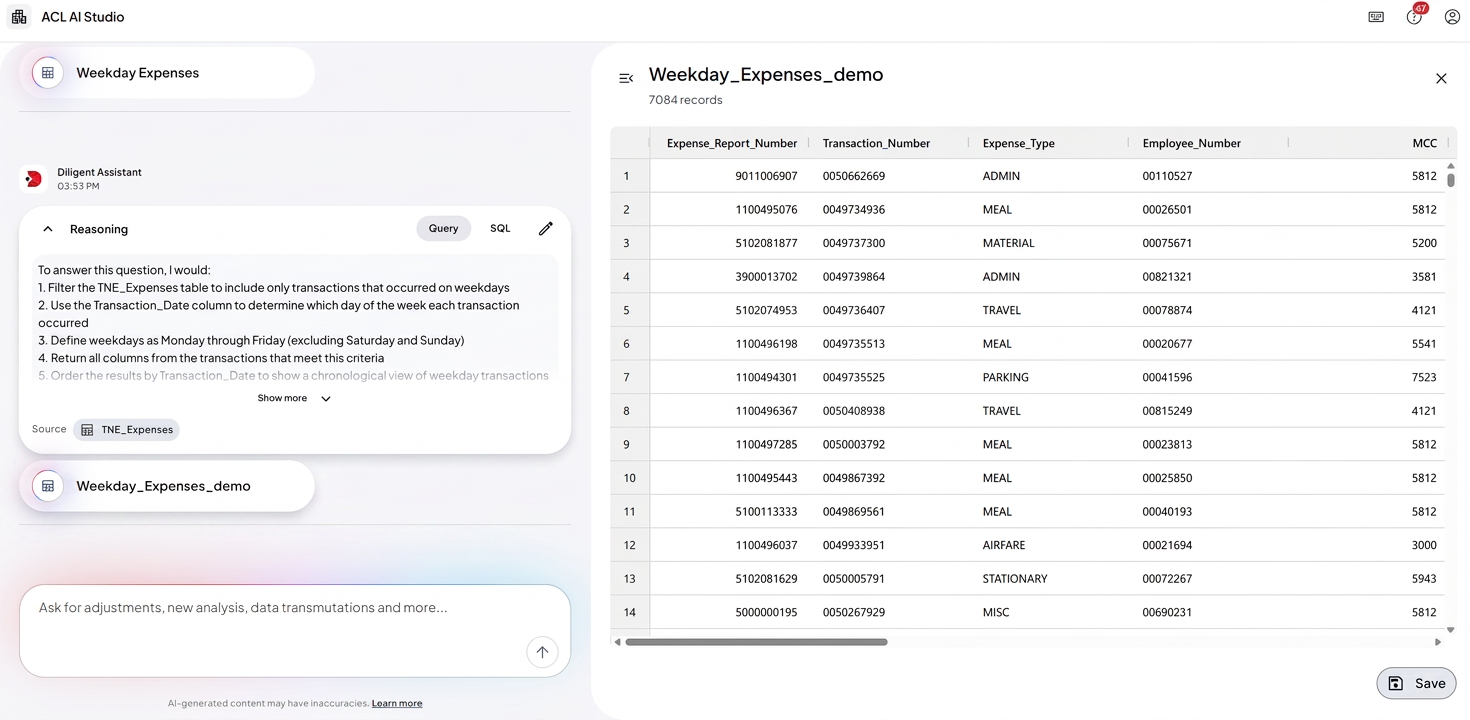
Natural-language prompts (for example, “show potential duplicate invoices over $10,000 this quarter”) generate auditable analytics logic without scripting. Guided analytics covers AP fraud use cases such as duplicate payment risk, suspicious vendor clusters and unusual approval patterns, designed for non-technical auditors, risk analysts and AP leaders without a data science team.
"ACL Analytics today is much easier to use and makes analytics available to everybody, not just coders." — Jason Venner, Diligent (former ACL user)
Oversight matters when AI runs in audit workflows. The IIA and ISACA guidance both call for AI used in audits to be transparent, documented and traceable to inputs. ACL AI Studio generates analytics logic with audit-ready results that can be reviewed and validated, with actions logged and exportable for traceability.
Diligent Robotics lets teams schedule AP fraud detection analytics on any cadence, whether daily, weekly or before each pay run. Exceptions route into Results dashboards and workflows for review, remediation and audit-ready evidence. The shift is from periodic one-off testing to continuous, automated invoice fraud surveillance.
See how UnitingCare identified $1.1M in duplicate payments using ACL Analytics and continuous monitoring.

Three cases show what full-population analytics finds when connected to live AP and ERP data: external duplicates, internal kickback and continuous controls monitoring at scale.
UnitingCare used ACL Analytics with continuous monitoring across more than 460 locations. The analytics identified approximately $1.1 million in duplicate payments in one year, turning invisible leakage into measurable financial recovery. The organization moved from periodic, sample-based checks to continuous surveillance across its full AP population.
Continuous surveillance changes how quickly teams detect issues and how often they can act on them. Scheduling recurring analytics is the practical step that turns a recovery into a repeatable program.
An enterprise telecommunications company moved from spreadsheet-based audit work to Diligent Internal Audit combined with ACL Analytics, cutting some audit timelines by about one-third and enabling more data-driven testing across financial and operational processes, including AP and invoice-related controls. The shift is from periodic, sample-based audit cycles to continuous, analytics-led testing embedded in day-to-day operations.
The case shows how integrating audit management with full-population analytics changes both the speed and depth of coverage. AP teams gain analytics-led visibility into invoice and vendor activity, and audit teams free up the time previously spent on manual evidence gathering for higher-judgment work.
Siemens Financial Services deployed ACL Analytics to automate internal controls monitoring. The program achieved 119% ROI and $429,000 in net financial benefits over three years, with 756 hours saved annually, 70-80% time savings in IT controls monitoring, 90% faster ICFR testing and a 50% reduction in exceptions.
"ACL Analytics enabled our core competencies to flourish and added value in a new way that was both effective and efficient." — Jason A. Gross, Vice President of Controls Management, Siemens Financial Services
Hours saved get reinvested in higher-judgment work, and exception volumes drop because fewer issues escape detection in the first place.
Public-sector and higher education organizations face the same fraud risks as private enterprises but operate under tighter oversight and leaner audit and finance teams.
Federal agencies face improper payments and fraud risk in high-risk programs covering benefits, grants and vendor payments, with oversight pressures from payment integrity requirements, A-123 internal control assessments and OIG audit scrutiny.
GAO reporting estimates widespread improper payments across government programs. The Payment Integrity Information Act (PIIA) requires every program to be assessed for improper payment risk, and OMB Circular A-123 links payment integrity assessments to agency-wide internal control assessments. The DoD OIG review made the standard explicit: Until agencies compile complete universes of payment transactions, they are unlikely to comply with PIIA.
Full-population analytics meets these requirements with testing across agencies and programs, audit logs for payment integrity reviews and pre-built analytics for duplicate payments, suspicious vendors and anomalous payment patterns.
State and local governments face fraud, waste and abuse risks across grants, payroll, procurement and benefits, often with lean teams covering broad portfolios. Sample-based audit cannot reach the population-level coverage fraud detection requires.
The Oregon Secretary of State Audits Division has used ACL Analytics to analyze hundreds of millions of claims and identify complex merchant fraud schemes that traditional methods missed.
Analytics platforms scan invoices and payments across all programs, detect suspicious vendors, duplicates and anomalies without new headcount or data science skills and schedule automated monitoring across high-risk programs.
Universities face a uniquely complex compliance environment: federal grants, Single Audit requirements, Title IV student aid controls and P-card oversight each carry their own fraud risk profile, and the funding sources overlap through the same AP systems.
Risks include research grant misuse, P-card and travel and expense (T&E) abuse, vendor fraud around restricted funds and student tuition irregularities. Procurement card fraud is often detected through audits or data analysis rather than in real time. Analytics over grant-, aid- and tuition-related invoices produces evidence for sponsors, regulators and governing boards.
Four practices separate organizations that catch invoice fraud early from those that recover from it later. None require large teams, but all require integrating analytics into routine AP operations.
Standardized vendor onboarding with verification steps and restricted vendor master file write access is the most effective process control against fake vendor and BEC-driven fraud. Independently confirming bank-detail changes through an out-of-band callback to a known contact number, rather than a number provided in the change request, closes the most exploited gap.
Three-way matching is necessary but not sufficient. Layer exception-based analytics at population level on top of AP workflow controls to catch what matching rules miss: near-duplicates, split invoices, round-dollar patterns and dormant vendor reactivation.
Move from periodic testing to continuous monitoring of key metrics: duplicate payment rate, new vendors with high invoice volumes early in their lifecycle, out-of-tolerance invoices, invoices just below approval thresholds and vendor master changes coinciding with large payments.
No-code analytics and reusable, scheduled tests let AP managers, audit generalists and risk analysts run invoice fraud detection without depending on a data science team. When analytics is accessible to the teams closest to the data, it becomes a continuous capability embedded in daily operations rather than a quarterly project.
Most organizations begin with one high-value use case and expand as the program matures.
Step 1: Identify top invoice fraud and leakage risks. Start with duplicates, fake vendors, overbilling and high-risk programs or entities.
Step 2: Connect AP and ERP data to ACL Analytics, beginning with the highest-risk entities, agencies or business units. Most organizations start with one ERP instance and expand.
Step 3: Deploy AP cost containment analytics on full-population data. Validate exceptions with AP teams to calibrate thresholds and confirm findings.
Step 4: Layer Robotics and ACL AI Studio to move from one-off testing to continuous monitoring. Schedule automated tests on a weekly cadence and use ACL AI Studio for ad hoc investigation of flagged patterns.
Teams new to AP analytics can start with a 30-day free trial of ACL Analytics focused on duplicate invoice detection. Teams ready to scale can book a fraud analytics discovery session that maps Robotics and ACL AI Studio opportunities across AP, vendor, payroll and T&E data.
Invoice fraud detection is the use of analytics, process controls and AI to identify fake, altered or duplicate invoices before payment is authorized. It covers the full invoice-to-payment lifecycle and includes both preventive controls such as matching and approval workflows and detective analytics such as full-population testing and continuous monitoring.
The most common types are duplicate invoices, fake or altered invoices from fictitious vendors, vendor impersonation through business email compromise, overbilling and kickback schemes and non-PO invoices for goods or services not received. Duplicate invoices are the most frequent and financially measurable pattern because they can be detected reliably through full-population analytics.
Combine process controls (three-way matching, segregation of duties, vendor verification) with full-population analytics that test every invoice against the complete payment history. Pre-payment analytics catch duplicates and anomalies before disbursement, which is fundamentally different from forensic recovery efforts that try to claw back funds after payment.
AI-powered analytics such as ACL AI Studio uses natural-language prompts and machine learning to identify anomalies, suspicious patterns and potential fraud across AP data. It extends what rules-based analytics can catch by surfacing patterns that predefined tests may not anticipate, while producing auditable, explainable results rather than black-box outputs.
Full-population invoice and payment analytics provides the evidence and audit trails that federal agencies need for payment integrity reviews and A-123 internal control assessments. ACL Analytics documents testing methodology, exceptions identified and remediation actions in formats that support OIG audit and reporting requirements.
Stop paying fake and duplicate invoices. Start a free 30-day trial of ACL Analytics to test 100% of your AP data for invoice fraud, or book a discovery session with an ACL specialist to map the highest-value detection use cases across your invoice and payment data.
Start a free 30-day trial of ACL Analytics or book a discovery session to map the highest-impact use cases.