
We asked Tom Keaton, Vice President of Business and Product Strategy, and Phil Lim, Director of Product Management at Diligent, to break down what's changing in AI governance and what leaders need to know.
Turn this into an audit-ready checklist. This interview is part of the 2027 resilience guide: Six regulatory shifts redefining governance, risk, audit and compliance, alongside a practical readiness checklist for spotting hidden AI concentration risk and testing supplier exit-ability before you need it. Download your copy of the 2027 resilience guide here.
Keaton: AI governance remains a top board concern because the technology is evolving faster than most organizations can adapt to it. The technology itself is changing rapidly, new use cases are emerging constantly, and regulatory expectations continue to develop across jurisdictions. As a result, boards can't afford to look at AI through the lens of any single regulation.
What's more, AI is increasingly embedded in the systems, products and decision-making processes that organizations rely on every day. That means any failure in governance, whether it's shadow AI, unmanaged AI use or unintended consequences from AI-driven decisions, can create risks across multiple areas at once. Cybersecurity, intellectual property, compliance, reputation and stakeholder trust can all be affected. Because AI touches so many parts of the business, it requires continuous oversight from the board and executive leadership alike.
Lim: AI is likely to have a profound impact on how organizations operate and how people work for many years to come. Whenever a technology creates that much transformation, it also introduces significant uncertainty and risk. The challenge is that many organizations are still learning where those risks lie. Some are well understood, while others are only beginning to emerge as AI adoption accelerates. That's why boards and leadership teams need to take a more proactive approach to understanding, assessing and governing AI risk, rather than assuming traditional risk frameworks will be enough.
Lim: What I'm hearing from audit teams is that AI is already delivering significant efficiency gains across the organization. The challenge is ensuring that greater speed doesn't come at the expense of accuracy. As AI-generated content becomes more common, there's a real risk that errors, assumptions or hallucinations get carried forward and accepted as fact.
Internal audit is uniquely positioned to address that risk. Audit teams bring an evidence-based, skeptical mindset and a focus on validating what is true, not just what appears credible. As organizations rely more heavily on AI-generated outputs, internal audit can help ensure decisions remain anchored to reliable evidence and that errors don't become embedded and amplified over time. In many ways, audit's role is to provide that essential reality check as AI adoption scales.
Keaton: I think one of the most important principles is that internal audit should not own AI governance. Its value comes from its independence. Audit's role is to assess whether governance frameworks are operating effectively, challenge assumptions, identify control gaps and provide assurance that risks are being managed appropriately.
At the same time, internal audit shouldn't be seen as an obstacle to innovation. The best audit functions help organizations adopt new technologies with greater confidence by providing objective oversight and constructive challenge. Strong governance and independent assurance don't slow progress down. They create the conditions for organizations to move faster, knowing that the right guardrails are in place. In that sense, internal audit plays a critical role in helping organizations pursue AI opportunities while maintaining a disciplined, risk-based approach.
Keaton: The first step is gaining visibility into how AI is actually being used across the organization. You can't govern what you can't see. That means building and maintaining a clear inventory of AI use cases, understanding what data those systems rely on, who owns them and what controls are in place.
Once that foundation exists, organizations can focus on their highest-impact use cases and connect them to the governance processes they already use for risk and compliance. Linking policies, approvals, testing, monitoring and access controls back to those use cases creates an AI governance program that stays transparent, consistent and scalable as adoption grows.
Lim: My advice is simple: don't build AI governance in a way that prevents the business from innovating. The most effective programs create guardrails around AI use rather than placing barriers in its path. I've seen organizations implement thoughtful governance frameworks that assess risk, apply proportionate controls and help teams adopt AI responsibly. I've also seen programs become so restrictive that people look for ways around them, creating even greater risk. If governance becomes a wall, employees will find ways to work outside it. If it acts as a set of brakes, it helps the organization move quickly while staying in control. The organizations making the most progress build AI governance that makes responsible use easy rather than something people have to work around.
Lim: Technology plays an important role in turning AI governance from a policy exercise into an operational process. One of the biggest challenges organizations face is maintaining visibility over the growing number of AI tools, models and use cases being deployed across the business. A platform such as Diligent can serve as a central system of record, helping teams inventory AI use cases, assess risk, document controls and track governance activities in a consistent way.
Beyond governance itself, technology can also strengthen assurance. As organizations rely more heavily on AI-generated information, audit and risk teams need efficient ways to verify that outputs are accurate, supported by evidence and reflective of reality. AI-enabled audit and assurance tools can help teams test, validate and investigate information more effectively, allowing them to focus their attention on the areas of greatest risk.
Keaton: Boards, legal, risk, audit and IT teams all need different views of AI risk, but they need to be working from the same underlying information. Boards need clear reporting on the organization's most material AI risks and activities. Legal and risk teams need visibility into evolving regulatory obligations across jurisdictions, they also need to ensure the organization has an up to date and enforceable AI governance policy. Audit teams need assurance that governance processes and controls are functioning effectively.
The value of a platform such as Diligent is its ability to connect those perspectives within a single framework. Rather than managing risks, controls, regulatory requirements and reporting activities in separate systems, organizations can create traceability between them. That makes it easier to understand how AI risks are being managed, how controls align to regulatory expectations and where potential gaps may exist. Ultimately, effective technology supports more than compliance. It provides transparency, improves cross-functional coordination and gives boards and leadership teams greater confidence that AI risks are being identified, monitored and governed in a consistent and defensible manner.
Source: Diligent Institute, GC Risk Index Q4 2026
Lim: My advice is to be intentional about how you adopt AI. The technology can deliver enormous gains in efficiency and productivity, but those benefits don't come automatically. Organizations need to be thoughtful about where AI is being used, how outputs are being validated and whether it is genuinely improving decision-making and outcomes. Leaders should encourage adoption, but they should also create a culture of critical thinking. Using AI in a way that produces better, more reliable outcomes matters more than simply using more of it. The organizations that get the most value from AI will be the ones that balance speed and efficiency with strong judgment, oversight and accountability.
Keaton: My advice would be to build your governance program around principles and risk, not around the latest regulation. Regulations will continue to evolve, differ across jurisdictions and adapt as the technology changes. If your program is designed solely to comply with today's requirements, you'll find yourself rebuilding it every time the regulatory landscape shifts.
Instead, focus on creating a governance framework that is durable and flexible, to revisit and iterate as AI innovation and use continues to evolve. Establish clear ownership, risk-based controls, ongoing oversight and transparent reporting. The organizations that lead in AI governance won't necessarily have the longest policies or the most restrictive guardrails. They'll be the ones that can demonstrate responsible AI use in practice, adapt to new requirements as they emerge and enable innovation while maintaining trust and accountability.
That's step one of the AI governance readiness checklist in the 2027 resilience guide: Six regulatory shifts redefining governance, risk, audit and compliance. Download it here for the checklist, along with Keaton and Lim's advice plus five more regulatory, risk and resilience deep dives for 2027.
"Internal audit should not own AI governance. Its value comes from its independence. Strong governance and independent assurance don't slow progress down; they create the conditions for organizations to move faster, knowing the right guardrails are in place." — Tom Keaton, Vice President of Business and Product Strategy, Diligent
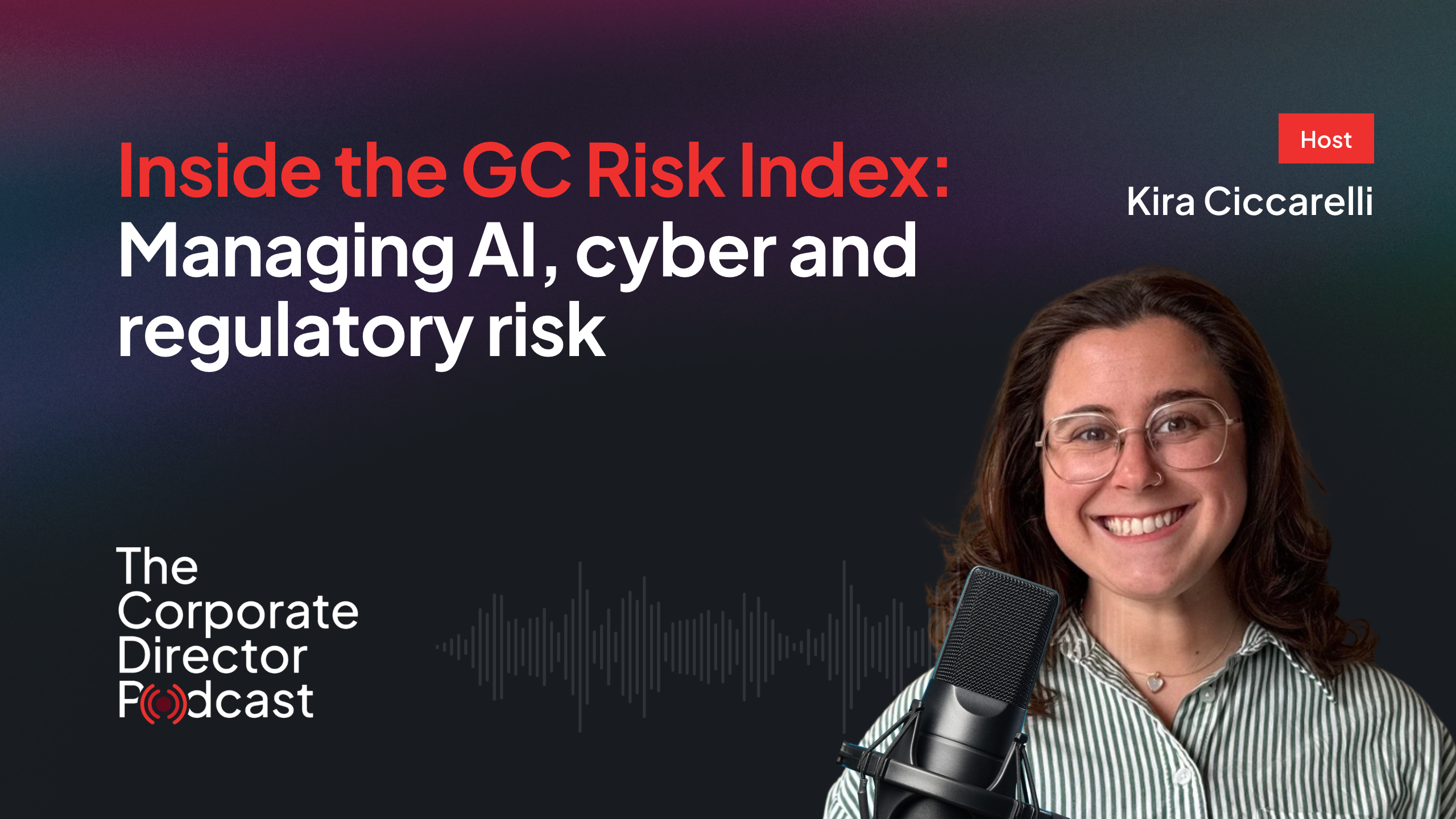
Inside the GC Risk Index: Managing AI, cyber and regulatory risk

In this episode of the Corporate Director Podcast, Sachin Kohli and Demian Ahn of Wilson Sonsini examine the risk environment facing organizations and the implications for boards, general counsel, chief legal officers, and executive teams. The latest GC Risk Index found that respondents rated their organizations’ current risk level at 6.6 out of 10, with approximately 60% falling into the high-risk range. The discussion explores why risk is expected to remain elevated through 2027, even as the primary drivers continue to change.