

In this article

Good corporate governance is the system of practices, controls and accountability that lets an organization pursue its goals ethically, comply with regulation and balance the interests of its shareholders and wider stakeholders. Governance is the process by which corporations establish their rules and policies and implement and monitor them. Yet, it's good corporate governance specifically that's become the watchword in the business landscape. Groups and individuals holding positions of power must have a sense of accountability and a means of carrying out checks and balances if they want to govern successfully.
Good governance typically leads corporations to achieve their goals ethically and comply with regulatory expectations and best practices. In successfully fulfilling their mission and plans through corporate governance, corporations will enhance their prosperity and find favor in the eyes of their shareholders.
For this reason, good governance underpins successful businesses today, where expectations around ESG (environmental, social and governance) issues like sustainability and diversity are ever-growing. Focusing on such matters encourages a mature governance framework, helping organizations make the right decisions at the right time.

This article will help you take the essential first steps on your organization's journey to good governance by explaining:
UNESCAP (the UN's Economic and Social Commission for Asia and the Pacific) summarizes good governance as "participatory, consensus oriented, accountable, transparent, responsive, effective and efficient, equitable and inclusive and follows the rule of law."
As a result, good governance:
PwC believes that "Good corporate governance contributes to sustainable economic development by enhancing the performance of companies, increasing access to external capital and improving confidence in the market, which leads to stability." In other words, it's about taking responsibility for an organization's ESG and related principles, like corporate social responsibility and governance, for a set time, ultimately leaving the organization in better shape than it was when you were at the helm.
"We need to challenge not good governance as a rule, but the standards that have been ossified over time." — Marc Hodak, Partner, Farient Advisors.
Learn essential good governance tactics and boost board performance.

The bar for what counts as good governance keeps rising with the risk environment. In What Directors Think 2026 by Diligent Institute and Corporate Board Member, 84% of directors said they had changed their approach to scenario planning in the last five years in response to heightened risk — a shift that shows how much more actively today's boards are expected to anticipate and govern uncertainty, not just react to it.
In a corporate context, good governance sets the tone and environment for all individuals or stakeholders to have a voice. A commitment to good corporate governance means:
To shareholders, good corporate governance is a reflection of their best interests. Comprehensive governance practices promote transparency, accountability and ethical decision-making, all of which build confidence that the board is acting for the good of shareholders.
Thorough oversight and regular evaluations underscore the board's commitment to its fiduciary duties, as do mechanisms that mitigate conflicts of interest. Together, these practices create a good corporate governance approach that shareholders trust to safeguard their investments.
Good corporate governance benefits stakeholders at all levels of the organization by:
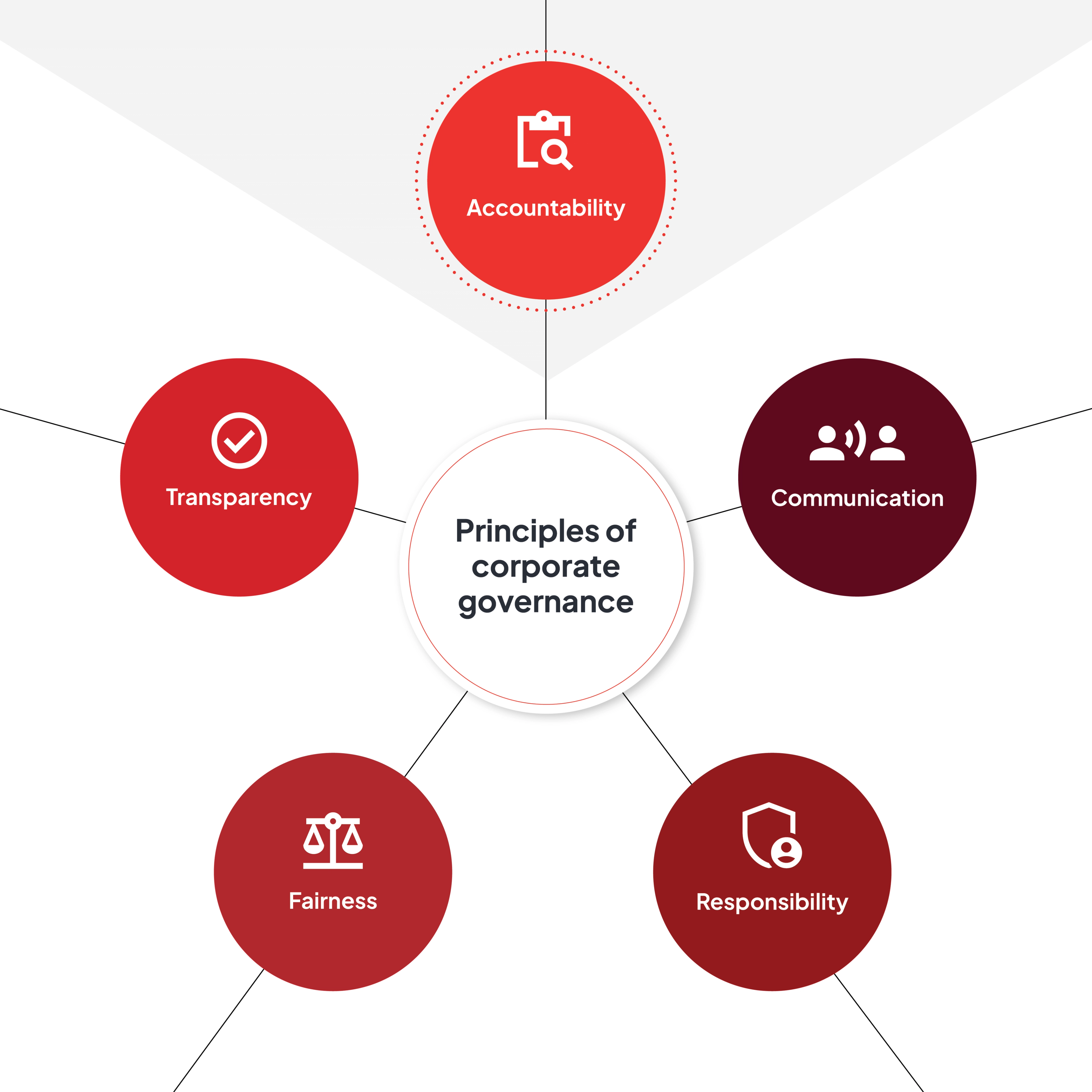
The principles of corporate governance are the foundational guidelines that ensure a company is well-directed and controlled. There are five core principles: accountability, fairness, transparency, responsibility and communication. Below, we take a closer look at each and how they support good governance.
Accountability is a crucial characteristic of good governance, just as it is in many other areas of business and societal life. Boards of directors are accountable to groups and individuals affected by their decisions, including their shareholders, stakeholders, vendors, employees and the general public.
Transparency and the rule of law go hand-in-hand with accountability in corporate governance. Transparency is one of the core values of good governance, and it both drives and evidences accountability.
Good corporate governance requires that records and processes are transparent and available to shareholders and stakeholders. Financial records should not be inflated or exaggerated. You should present reporting to shareholders and stakeholders in ways that enable them to understand and interpret the findings.
Transparency means stakeholders should be informed of key corporate contacts and told who can answer questions and explain reports, if necessary. Corporations should provide enough information in their reports to give readers a complete view of the issues.
Good governance's "participatory" nature requires that boards and organizations become more equitable and diverse. Moreover, these diverse board members and employees cannot be silent partners; they need an active voice in corporate decision-making. The board may play a key role in driving diversity, but equally, diversity within the board itself drives better thinking. But beware of tokenism; the importance of transparency in good governance cannot be overstated. Strong, well-composed boards both include and value the views of people with various skills, talents, abilities, experiences and perspectives.
Boards should expect all of their members to participate in board meetings, and a commitment to good corporate governance practices demands that board chairs facilitate meetings in ways that draw out the perspectives of all board directors.
One of the essential principles of corporate governance is the board of directors' responsibility. They must provide consistent and proactive oversight, ensuring everything from strategy to risk management, financial reporting and legal compliance runs smoothly. However, the board can't fulfill its duties at any cost.
Instead, the board must act in good faith, with due diligence and care. A board's fiduciary duty to act in the company's and stakeholders' best interests is fundamental because it prioritizes the greater good above all.
The boardroom is an appropriate forum for hosting robust discussions and debates. In fact, it's expected. Some of the most heated debates result in the best decisions, as representatives from many different walks of life come together with varying perspectives.
Good corporate governance means securing agreement from these discussions. Consensus-oriented decision-making has to consider this diverse group's different needs and perspectives to deliver a broad consensus that will serve the best interests of communities and companies.
Corporate governance principles are interconnected; while it all starts with the five core principles, many other characteristics underpin good governance. These include:
All too often, crises and controversies can overtake the corporate world's focus. A timely response to the unexpected is crucial, with corporations that practice good governance usually able to prioritize swift and honest communication with shareholders and stakeholders.
As planners and overseers, board directors are responsible for conducting their duties effectively and efficiently. Many corporations also consider the environmental impact as they perform their duties and responsibilities. For example, using the drive for good governance as an impetus for digital transformation, an organization may transition from manual paper processes to more environmentally friendly software solutions, such as the integrated suite of board leadership and collaboration tools.
Each board director has an equal seat at the board table. Each director can and should use their voice to share their experiences, opinions and philosophies to enhance and broaden discussions. No one should feel left out or that their views have less meaning than others.
This same ethos should permeate the entire organization, with a culture of diversity and inclusion underpinning all of your operations. Diversity, equity and inclusion (DEI) are core elements of good governance.
The rule of law means boards should be fair and impartial in their collaborations and decision-making. Certain circumstances may require boards to seek outside counsel, guidance or expertise from external, third-party experts. Good corporate governance requires boards to act ethically, honestly and with the utmost integrity, whether making decisions themselves or working with third parties.
One of the primary responsibilities of board directors is strategic planning, which includes the organization's mission, vision and values statements. Strategic planning leads boards to understand where the corporation is going and how it will get there. Good corporate governance requires a robust planning process, incorporating action plans, budgets, operating plans, analysis, reporting and much more. The strategic plan holds board members accountable for their decisions and for monitoring their goals. Strategic planning also includes risk management and protecting the company's reputation, and as such, is an opportunity for organizations to put into practice many of the good governance principles they espouse.
Corporate governance principles can also be more formal and well-documented. The G20/OECD Principles of Corporate Governance are the most widely accepted global governance standard. The OECD first developed them, and the G20 later endorsed them as a tool for governments, regulators and companies to create sound governance frameworks.
There are six guiding principles for this standard:
What does good governance look like? There are numerous examples of best practices regarding corporate governance principles.

Some things you may also look for:
Today’s corporate secretaries are strategic governance leaders. Learn the exact strategies and tools secretaries can use to boost board effectiveness.

Understanding strong governance principles is important, but what do they look like in practice? Here are two companies actively building good corporate governance frameworks:
Canadian Light Source (CLS) runs Canada's only synchrotron, a national research facility at the University of Saskatchewan in Saskatoon that supports researchers from across Canada and around the world. Its board and committees ran on paper binders and email attachments — and with directors spread across the country, version control and meeting preparation were slow and error-prone.
Because effective oversight depended on getting accurate material to directors wherever they were, CLS needed a single secure system of record that could do the following:
Together, these features gave CLS the transparency and accountability that good governance depends on, without adding friction for its directors.
Optimizely is a global digital experience platform company whose software helps organizations manage content, run experiments and personalize customer experiences. As the business scaled, its board approval processes for equity grants, resolutions and other sensitive sign-offs relied on manual follow-ups and scattered documents that were hard to track and audit.
Because so much of its board activity centered on approvals, Optimizely set out to make board operations faster and audit-ready by doing the following:
The result was a faster and cleaner board process that was easier to defend under scrutiny. Governance controls strengthened the business rather than slowed it down.
While there is no silver bullet for good governance, technology solutions are a solid foundation for thriving governance practices. Today's governance platforms collect and analyze a great deal of information about your business activities, which can help optimize your processes.
The average organization generates a lot of data. Every day, users create 2.5 million quintillion bytes of data, much of which companies collect and store.
This data includes information on products, goals, customer sentiment and almost every other business activity. The proper data management and visualization tools can transform these facts into useful information to monitor the ESG criteria that inform good corporate governance.
Diligent organizes data into powerful dashboards that filter and present essential information from various sources. News, your own data, and stakeholder surveys all combine in a single suite of tools to create a powerful feedback loop that monitors every decision your company makes.
For every action, there's a reaction. Each decision you make plays out over the long run. Irresponsible activities that eventually hurt shareholders and stakeholders usually start as a small ripple that turns into a tidal wave.
If your company decides to reduce costs by cutting quality, the grumbling of customers will eventually impact your bottom line — and those customers will find another place to go.
News and public opinion are terrific and underutilized sources of information. Many organizations fail to realize customer and stakeholder perceptions until it's too late.
All this information helps you understand your risk and where you stand within your industry. Are you a leader in the field, or is there room for improvement?
Your data helps you create gaps, and SWOT analysis reports. These are the basis from which to generate risk and other corporate strategies.
With a complete understanding of your business environment, including how you meet ESG criteria for risks and opportunities, you can create a good corporate governance strategy to mitigate risk.
Data-driven decision-making is not just a trend; it's a necessity. Companies with a more mature data strategy often see a 2.5 times improvement in all company outcomes. Establish policies and guide your organization using the four principles of data governance.
Planning and data are only helpful with the drive to deploy them correctly. It's up to you to act with the right data-based strategies.
Present and own your decisions. Act on the insights you gain responsibly. Avoid the pitfalls of bad data governance.
Good corporate governance is multi-faceted but ultimately achievable. Yet, there is no one-size-fits-all approach to management. How quickly and effectively you achieve good corporate governance best practices depends on your organization's maturity. The more advanced your organization is at foreseeing risk, the better your board will become at making the right decisions at critical times.
Both robust technology and governance maturity are essential pieces of that puzzle. Download the governance maturity checklist from Diligent to learn the most important steps you can take to propel your progress toward good corporate governance.
The core principles of corporate governance include accountability, transparency, fairness and responsibility. These guide how companies are directed and controlled. Strong corporate governance ensures that decision-making is ethical, oversight is effective, and the rights of shareholders and stakeholders are protected.
Corporate governance is essential for building trust, stability and long-term success. It helps prevent fraud and mismanagement, improves access to capital, enhances reputation and aligns a company's strategy with stakeholders' interests. Good governance also supports regulatory compliance and effective risk management.
The G20/OECD Principles provide a global benchmark for best practices. In practice, they guide companies and regulators to:
Companies often apply these principles through board policies, audit and risk committees, ethics codes and stakeholder engagement strategies.
Corporate governance refers to the framework of rules, processes and structures that guide a company's direction and oversight. On the other hand, management involves the day-to-day operations and decision-making by executives and staff. Governance sets the overall direction, while management executes it.
Famous corporate scandals like Enron and Theranos are prime examples:
Both highlight the dangers of weak governance: unchecked power, lack of accountability and a failure to protect stakeholders.
Corporate governance is the "G" in ESG, and it underpins the success of environmental and social initiatives.
Strong governance ensures that ESG goals are stated and embedded in strategy, measured and reported transparently. This includes board-level oversight of climate risk, ethical supply chains, diversity policies and more. Without good governance, ESG efforts can fall short or become mere box-checking.